I picked up two magazines today which both contain articles I've written on Preeta Samarasan. And both also have a plenty more great book related stuff to read.
Preeta is cover girl of MPH's Quill magazine (free to cardholders, RM8 to others, at branches of MPH) with a gorgeous portrait photo taken by top New York-based photographer Miriam Berkley who talks about her work and about what makes a great author photo inside.
The piece on Preeta here is an e-mail interview in which I ask her about the starting point of her novel, how far the family in the novel is based on her own (perish the thought!), how doing an MFA helped her and whether writing from outside the country gives her more freedom to write honestly. Do go pick up a copy to find out the answers! Preeta herself writes a very interesting piece - No More Dirty Laundry : In Defence of Fiction.
In other pieces I enjoyed, Chet writes about her "torrid affair with digital books" (!) ; Lydia gives poor, mistreated books a voice; Amir Muhammad (who seems to have the scary ability of getting everywhere these days!) reviews Adibah Amin's Glimpses; Daphne Lee writes about one of my favourite Scottish folk heroes Tam Lin; Yang May Ooi talks about her encounters with British food and Saradha Narayanan talks about hanging up her stethoscope to become an author.
The other magazine is Off the Edge and my piece about Preeta here is a review of Evening is the Whole Day. I am so happy that Jason Tan gave me the space I needed.
There are the usual thought-provoking articles about politics and the arts, and the more literary things include another episode in the life of Kam's Datuk, and the second extract from Kee Thuan Chye's The Swordfish and Then the Concubine, as well as reviews of two recent publications from The Edge Publications, Shape of a Pocket by Jacqueline Anne Surin, and Tipping Points : Viewpoints on the Reasons for and Impact of the March 8 Election Earthquake. Benjamin McKay reviews Shanon Shah's play Air Con.
Tengku Razaleigh Hamzah is the cover boy here, and the subject of a very lengthy interview with Jason. I wonder if he will still be able to mount a challenge for the presidency of UMNO and really hope so.
* (The piece is not online at the moment - but may be later.)
Monday, March 15, 2021

Saturday, December 20, 2014
Review KL Noir Yellow

Local publisher Fixi’s popular KL Noir series is completed this month with the release of this fourth and final volume. In Yellow, we are promised stories that are “sick and twisted”, and a journey through “the dark underbelly of Kuala Lumpur”. And this is pretty much what we get.
The nature of the genre means that we know that things are always going to end badly, but we are grateful to writers who take the trouble to create convincing characters and believable scenarios along the way. The best stories in the collection also show us the city we think we know in a new light, and reflect the cultural zeitgeist.
When seemingly ordinary folk turn to violent crime in fiction, it takes skill on the part of the writer to make the transformation convincing. Two stories in particular manage this challenge very well.
Selvi in Subashini Navaratanam’s Girl Power feels rage and frustration at the lot of women in traditional Tamil society, and fights against social restriction. She comes to increasingly identify with the dark goddess Kali after accidentally glimpsing a statue during a temple visit as a child. This is an intelligent and heartfelt piece with a strong narrative voice and the journey into obsession is entirely credible.
In Sharmilla Ganesan’s French Fries For Aunty Kamalan, a devout Hindu discovers from a website that her favourite French fries from a fast-food restaurant chain are actually fried in beef-fat to make them more delicious. This is of course completely against the tenets of her faith. We really feel for Kamalan as she is torn between desire for the forbidden food, haunted by the jingles and the TV ads, and her self-disgust. The story also nicely parallels the spate of scare stories about products on the market containing “porcine” DNA.
Several of the stories play with the idea of the duality of man, with good and evil co-existing within an individual. Zufar Ismail’s cop on the trail of a serial killer in Breaking Point makes a terrifying discovery about himself, and the voice of the wearied cop is particularly convincing. Catalina Rebuyan’s The Kill Wishis an almost metaphysical tale of a hired assassin who comes across a victim who is so completely good that he must rethink his mission.
Appearances, as we learn, are deceptive. An old man suffering from dementia in a care home must be harmless, right? But when in Chin Ai May’s Never Forget A Face, a retired cop thinks he recognises an old adversary among the other inmates, his instinct for self-preservation takes over. And the contrast between innocence and evil is nowhere stronger than in Trap by Choong Jay Vee, a chilling tale of a cosplayer attending an anime convention at KLCC dressed as Lolita.
As we might expect in a collection of this nature, there’s plenty of blood and gore. The opening of Sek Han Foo’s The Disgraced is stomach-churningly violent, while Happy Family by Claudia Skyler Foong ends up with almost as many corpses as a Shakespearian tragedy.
But there are more understated pieces too, the most powerful of which is Paul Gnanaselvam’s The Ride. A poor boy from one of the roughest neighbourhoods feels a need to keep up appearances in front of his wealthier classmates, and is overjoyed when one offers him a daily lift in his chauffeured car. There’s real horror in the implied ending, which is surely drawn from newspaper accounts of unexplained deaths in the lift shafts of the notorious San Peng flats.
Sukhbir Cheema’s story The Lost Pilgrim also uses setting very well and gets across the difficulty of creating any sense of connection in the city.
The one piece of reportage in the book is an account by Martin Vengadesan of the rise of the legendary gang leader Botak Chin in the 1970s. Nicknamed “the Robin Hood of Sentul”, Chin was both charismatic and wily, and his sharing of the spoils with the wider community ensured his survival for a long time. It’s a shame that the piece feels a lot flatter than the fictional efforts that surround it.
However, while there is much good writing in the book, there are still plenty of rough edges. There are the problems with the nuts and bolts of short story construction that seem to dog most local collections; stories start too slowly and not far enough in, scene transitions are not smooth in places, and back story often seems dropped in whereas clues should have been planted much earlier.
Sometimes the flaws co-exist with the strengths. Timothy Nakayama’s Ambrosia takes us into the sharply realised world of the celebrity chef, but the darker elements in the story just don’t convince. Similarly, inContrail, Leroy Luar creates an atmospheric setting for his story of urban exploration set in the old budget terminal, but the encounter with the protagonist’s ex-girlfriend and the back story about their relationship is clumsily drawn.
Overall, though, this is a very enjoyable collection, and the sheer inventiveness of the writers ensure that the tales never feel derivative or predictable.
Monday, June 16, 2014
So where have you gone, bibliobibuli?
I apologise for not having kept up this blog. I know quite a number of you were disappointed.
A number of things happened. I was going through a bit of a rough patch and hit a bump in the road as far as reading is concerned. I simply couldn't read for a while. I came back to reading via short fiction and have been enjoying many writers I've discovered Robert Olen Butler, Ron Rash, T.C. Boyle, Cynthia Ozick. I also got pulled back to reading by Tan Twan Eng's gorgeous The Garden of Evening Mists, which I read slowly, a chapter a day, really savouring it. Now I'm reading more than ever and thoroughly enjoying myself again.
I think that one of the pleasures and problems with being a blogger about books is that you keep getting manuscripts and books passed to you. I ended up feeling guilty about those I wasn't enjoying and they ate into my reading time.
Perhaps there is such a thing as "blogger burnout". Several things came together. I found it hard to summon up as much enthusiasm and time and energy as I had formerly - especially as I was so busy with my classes. I realised that the blog which had started off as being something I kept for me to think through certain issues was being kept more for other people than for me. I got a bit upset when Facebook came along and everyone started commenting there rather than on the blog, even if I asked them not to. The party had clearly moved elsewhere, something that I've now come to accept.
I also watched with horrified fascination as the comments on this blog got taken up with personal agendas and ding-dongs. I never wanted to censor the comments on the blog, but I should have reigned some of the excesses.
I felt too that there were always too many thing to blog and not enough time to put them up.
The worst thing that happened though was most of the pictures suddenly disappearing from the blog after I started using Google+ and accidentally pulled the plug on them. (I thought "What are these pictures doing here when I haven't posted them?") So I have to slowly replace them or get rid of the gaps where the pictures used to be.
Then too, I felt the blog had become a bit of a mish-mash with all sorts of content about book,s writing, publishing, live events, reviews, mixed up.
So my solution - yes I'm on Facebook and Twitter. I have also started using Scoop.it - and am "curating" (silly word!) literary-related content across a number of boards which you can follow if you are interested in literary news.
I will keep this blog here because the archives are important and keep it for reviews and opinion pieces rather than every day news.
Monday, April 29, 2013
The Carpet Bombing of Readings from Readings 2
 It's quite distressing that our our second book has been hit heavily by negative remarks and 1-star reviews on Amazon.
As you might know, the book Readings from Readings 2: New Writing from Malaysia, Singapore and Beyond edited by myself and Bernice Chauly was published in November last year and launched (with the help of the very supportive Tan Twan Eng no less!) at the Georgetown Literary Festival in Penang. The book is a collection of writing by Malaysian writers and expat writers living in Malaysia and grew out of the monthly literary event I organise.
My friend, publisher Amir Muhammad, helped me to get it onto Amazon.com via his account. It was a great feeling being able to make Malaysian writing visible on an international platform. I didn’t expect to sell hundreds of copies – really this was a symbolic act, as the main market for the book is obviously the local one and it is doing well in the bookshops here.
The first negative reviews hit in the space of just a day or two over New Year, and there were more a few weeks later. The lies have been many and varied: the book was poorly edited and proofread (you have only to hold it in your hands and flick through the pages to see how wrong that is); that it fell apart; that the line spacing was wrong; that every other word was an obscenity (there's not even one swear word); that I was some kind of a Muslim fundamentalist; that I was not sympathetic about the Boston bombing, (hello, this book came out last year!); that I was some kind of bleeding-hearts liberal pursing an agenda (yeah I have an agenda all right - to do something for Malaysian writers). And so on and so on, the creativity of my particular troll never letting up.
Incidentally, only 6 books have been sold on Amazon so far and the e-book isn't out yet, so of course these "reviewers" have not even seen a copy of the book.
Initially, I had no idea where the reviews were coming from and why they were being posted. I was very shaken by the attack – and worse, felt that somehow I had let my writers down. I contacted Amazon’s Customer Service department and they took a look at the page but responded that the reviews did not contravene the Terms of Service so they could do nothing.
A few days ago I added a couple of quotes from local newspapers and perhaps it was this that has triggered the latest spate of comments.
I tried to track down some of the Amazon “reviewers”. Most of them are the usual “gun-for-hire”, posting 5 star ratings while saying nothing much about the book. In most cases there was so little information in their profiles that they were untraceable, but in 3 cases I managed to find out who they were via Google.
The first reviewer I tracked went by the nick Funmom91 (alias Victoria Heckstall). She turned out to be a single mother in the US who makes most of her money from writing for-pay blog posts and reviews (as well as a little prostitution on the side judging from the police reports I unearthed!). We had a brief conversation on Twitter and minutes after, she took her "review" down.

Another “review” was posted by a Sri Lankan who goes by the nick Dilmaxa and who was solicited via Fiverr.com. When I threatened him with legal action he admitted that he had accepted payment for a 1-star review and took it down (screenshot of his "confession" below).

From: Brandi
To: sharonbakar@yahoo.com
Sent: Friday, March 8, 2013 10:04 AM
Subject: RE: Your review on Amazon
Let me Start off by Saying I am sorry. Yes I was paid for this review. It was not my own words. I was paid to simply cut and paste this review. I didn't like it one bit but since I didn't clarify I wouldn't post negative reviews (which has now been changed) I had no choice but to follow it. I have since deleted the review. I will deal with the consequences on my end, that's my fault.
I am a writer myself, I do know how much time and effort goes into it. I am sorry I treated another writer like this, specially when it wasn't honest. I had placed that gig on my job in hopes to help people promote their own products. That was the first time I ever received a request of that nature.
I understand the damage has been done and their it not much that I can do to change your feeling about me, just know that I am actually an honest person, I am a freelance writer and I will not EVER take a job of that nature again. I have edited my job and put in bold letters that I will not place negative reviews again.
If there is anything I can do to make it up to you, please let me know. Thank you for hearing me out and I am sorry if I ruined your day over someone acting petty and be following in line.
-Brandi
In a further email conversation with her, she told me that she didn’t know who had commissioned the review as she gets the review work from a middle man. I am not sure if this is true.
I am angry at Amazon which does not seem to be supporting the authors and publishers who use its services. The use of fake reviews is so widespread that the whole system is rotten. I knew about fake 5-star reviews, but I had no idea that 1-star reviews could also be bought.
Note that one point that both Brandi and Dilmaxa make - they were given the text of the reviews! There is one single voice behind all the viciousness. One person paying dozens of people. Spending a great deal of money (even if the fee is just US$5 a pop) in order to distress and defame. I am sure this is a personal vendetta – against me, and perhaps also against one particular writer in the book who has been singled out for abuse. (It looks as if the troll knows him personally.) This individual might have had his/her work was rejected when I made my selection for the book. He/she also knows how to purchase reviews quickly and easily without incriminating himself/herself. It could be that they acquired this familiarity by buying "shills" (5-star reviews) from sites like Fiverr.com.And it's likely that their behavior elsewhere has been erratic and abusive.
How much hatred must that individual have inside them? And to be this obsessive - aren't they mentally ill?
I have written a second report for Amazon, and am waiting for their reply. I am weighing my options as far as legal action is concerned. (I have access to the lawyer downstairs who has plenty of advice to give!)
But what disturbs me most about this attack is that it is possible at all.
It's just too easy for folks who want to make a little money online to set themselves up as sock-puppets with multiple Amazon accounts and bogus identities.
Almost nothing has been written online about this phenomena referred to as "carpet-bombing" in this Forbes article, and more than anything I would like to think that by making my experience public I am in a small way encouraging this huge company (that clearly aims to take over every aspect of our reading life) to become more accountable and to change its policy re fake reviews.
Update 25/5/13 :
The last rash of 1-star reviews have been taken down by Amazon.com. Am very grateful for that. Will still be pushing for more of the reviews to be removed.
Update 17/8/13:
Interesting footnote. I noticed the other day that there was a rash of 1-star reviews on the first book on GoodReads. All of them were posted on the same day (March 13), within minutes of each other, under different names, but they were written in the same style as the Amazon reviews. The location for all the reviews was given as exactly the same area of Auckland, which may finally have pinpointed our troll! I know exactly who it is now, but having the proof in my hand so I can take legal action is a tiny bit trickier - though I'm working on it.
More 1-star reviews were added to Amazon.com and later got cleaned off. Amazon seem to now be taking notice. Maybe the Forbes review article and the comments had an effect?
Update 11/11/14:
Many more fake accounts opened on GoodReads, which makes it oh too easy to post multiple 1-star reviews. How many hours did this poor idiot waste opening them and making them look credible? (They get cleaned off, then he wastes a few more hours putting more up. I'm sure this will keep going on.)
I know who who my bully is (because he doesn't even bother to cover his tracks anymore, now sending hate-mail directly to my inbox). The writing and publishing community and journalists in Malaysia know who it is. I have his address and I have a lawyer in Auckland who is happy to move ahead with the case.
Because the person you are hurting most is yourself, John Ling ... Please get yourself some psychiatric help before all that hatred implodes.
*Picture credit : (top) Penang Global Tourism
Sunday, February 24, 2013
The Last Runaway

My review of The Last Runaway by Tracy Chevalier appeared in The Star today. This is the original version which reads a bit better!
Tracy Chevalier, best known for The Girl with a Pearl Earring which became an international best-seller and a Hollywood film, sets the seventh of her historical novels in her native America. The Last Runaway, set in the 1850’s, takes a look at the country, pre-Civil War. It deals with the legacy of slavery, and in particular what came to be known as The Underground Railway, an escape route set up to help slaves make their way to Canada. The “railway” comprised of safe houses or “depots” where runaways could find shelter and food. Although, as Chevalier notes on her website, the numbers of slaves escaping this way was not great, the very fact that the “railway” existed at all must have threatened slave owners and appeared to undermine the whole economy.
Tracy Chevalier, best known for The Girl with a Pearl Earring which became an international best-seller and a Hollywood film, sets the seventh of her historical novels in her native America. The Last Runaway, set in the 1850’s, takes a look at the country, pre-Civil War. It deals with the legacy of slavery, and in particular what came to be known as The Underground Railway, an escape route set up to help slaves make their way to Canada. The “railway” comprised of safe houses or “depots” where runaways could find shelter and food. Although, as Chevalier notes on her website, the numbers of slaves escaping this way was not great, the very fact that the “railway” existed at all must have threatened slave owners and appeared to undermine the whole economy.
After a broken
engagement, Quaker Honor Bright decides to follow her sister who is leaving for
America and a new life. Grace is
betrothed to Adam Cox, who left Britain earlier to set up shop in a village in
Ohio. The voyage across the Atlantic is
so horrendous that Hope realizes that she would not be able to ever face it
again to return to England.
Sadly, Grace does not
make it to Ohio, but contracts yellow fever on the journey and dies. Honor is thus thrown onto the kindness of
strangers. When she reaches Wellington
in Ohio, she is taken in by the plain spoken milliner, Belle Mills, who becomes
her only real friend. Honor wins her respect because of her skill with a
needle, and Belle soon puts her to work helping to decorate hats and make bonnets.
Adam Cox comes to
collect her a few days later. He is
living with his recently widowed sister-in-law, the dour Abigail, and the
living arrangements prove to be awkward. Honor realises that the only option
open to her is to marry, and she accepts the proposal of Jack Haymaker, whose
family own a thriving farm nearby.
Honor must learn to
adapt to her new environment. Everything
is different in her adopted country from the landscape with its large open
fields and forbidding woods, and the weather with its extremes of summer heat
and winter cold, to the monotonous corn-based diet. But
the most difficult adjustment she must make is to fit in with the small-minded local
community and the family into which she has married. Things
only get worse as she becomes aware of the plight of runaway slaves passing
through Ohio (which is a free state) on their way to Canada and their
freedom.
Hope realises that
Belle is involved in the “railway” early on in the novel, but she finds herself
personally involved when a fugitive slave appears in the yard one day. Soon she is hiding food and directing slaves
to the next town where they can find safety.
Even though Quakers are
against slavery on principle, since they believe every human being carries the
same light within them, her husband and his family forbid her from helping any
more runaway slaves. The passage of the Fugitive Law means that there are dire penalties
for harbouring them, something the Haymakers know only too well.
Honour is left in no
doubt that her if she obeys her conscience she is imperiling those she lives
amongst. Furthermore, she risks being
ostracized from the Quaker community and losing all rights to her own child if
she persists. Compounding the moral dilemma is the fact that Quakers are not
supposed to tell lies, but Honor realises that sometimes lies, or at least
evasions, are sometimes needed to prevent greater injustice. These
dilemmas are at the heart of the story, and Honor realises that there just are
no easy answers.
Complicating matters
more are Honor’s feelings towards Donavan, Belle’s brother who is a bounty hunter
looking for slaves. The sexual tension
is palpable, and their scenes together are some of the most compelling in the
book. It’s a pity that Jack Haymaker is
so colourless in comparison.
In Honor Bright,
Chevalier creates a heroine who grows and evolves to take charge of her own
destiny. Ironically, she is as much a
runaway in a metaphorical sense as the slaves that she helps.
The book is very
thoroughly researched yet the historical background never weighs down the
narrative. Indeed, The Last Runaway is a page-turning piece of fiction, and its great
strength is in the very real sense of period and place that Chevalier creates,
particularly in the domestic details. Particularly enjoyable are her descriptions of
the traditional art of quilt making which serves as a motif throughout the
book.
Tuesday, April 17, 2012
Twan Eng at Kinokuniya
I’m thrilled to bits when author Tan Twan Eng asks me to moderate his meet-the author session at Kinokuniya on April 8th. The bookstore is in any case Tan’s home away from home when he is back in KL. I joke with him about which is greater, the amount earned in royalties from his novels or the amount he has spent here over the years. He laughs and agrees it’s probably the latter, and knowing his voracious reading habit, I can well believe him.
Penang-born Tan’s first novel The Gift of Rain has been a success in every meaning of the word – critically acclaimed, it was also longlisted for the Man Booker which is one of the world’s most important literary prizes, and it has also been a very popular novel with readers on both sides of the Atlantic. (A barometer of this is reader ratings on Amazon where it has never fallen below 4.5.) The popularity of the book in the US though, took Tan completely by surprise, he says.
It took Tan three years to write his second novel The Garden of Evening Mists which is set in Malaya during the communist insurgency. It tells the story of lawyer Yun Ling Teoh, who though scarred by her wartime experiences in a Japanese camp, nonetheless decides to fulfill her promise to her dead sister to build a Japanese garden. She becomes the apprentice of a man who was once gardener to the Emperor of Japan, and who has built his garden in Cameron Highlands.
There’s actually a phenomenon known as “second novel syndrome” where writers get terrific performance anxiety about writing a follow-up to a successful novel. Was this the case with Tan?
He agrees: “When you write a first novel you give everything that you have, basically you dry the well, and there’s nothing left for the second novel. Every book, I’m starting to suspect, will get harder and harder to write and it’s not something I’m looking forward to.”
The great American Don DeLillo once said a first novel comes to the writer as a gift and he doesn't necessarily know how he wrote it: it's the second novel that teaches him how to write. Tan feels (and I’d completely agree) that his writing is much more controlled in this second novel, the plot more carefully shaped, and while the descriptions of place are still gorgeous (especially those of the garden) they draw attention to themselves far less .
Tan confesses that he has become more interested in gardening in recent years and the idea for the novel came from when he actually met someone who had been gardener of the Emperor of Japan at a social gathering in Johannesburg. Although they couldn’t really communicate because of the language barrier, the very job title provided the spark of inspiration, and Tan says “I had various elements floating around already and this tied them all together”.
Tan confesses that he has become more interested in gardening in recent years. Because he wanted to work with a Japanese garden this meant that the setting for the novel would have to be one of Malaya’s hill resorts, and only Cameron highlands was sufficiently developed at the time the book is set. He was also fascinated, he says by the myth of Jim Thompson, the Thai silk baron who went missing in Cameron highlands in 1967. (Indeed Thompson makes a cameo appearance in the book.)
Some of the scenes in the novel are so vividly realized, it is like stepping back into the Malaya of that era. Tan described how he researched the novel – drawing on contemporary accounts and on old photographs. He said that one of the toughest jobs in writing a novel is to decide how much research should go in to the novel, and he found that he had to cut out a lot of his material for fear of boring his reader.
I wondered how hard it was for Tan to write from the perspective of a woman. He says that it is difficult because women in the 40s and 50s because they were subject to greater restrictions did not have as much liberty to move around as the men. Tan also said that he found himself looking at women – how they sat, and trying to puzzle out the contents of their handbags!
I pointed out to Tan that in both books he is very generous with plot. There was so much incident packed into The Gift of Rain that I wasn’t sure how to classify the novel when I first read it – literary fiction or thriller? I asked him how important he feels storytelling is to him. He feels that there is a swingback in literary fiction with writers giving storytelling more importance, because “People getting tired of too much self-indulgence from a writer.” “You might have a lot of things to say but you really have to capture the reader’s attention and without story it’s difficult to get the reader turning the pages.”
For me the part of the book I found the most moving was the stunning love story of the historian, Tatsuji, who had been a kamikaze pilot. This part of the novel grew from the Tan’s short story Somewhere Above the Clouds (published in the Asian Literary Review in 2007).
I point out that while Tan never follows his characters into the bedroom but he has some ingenious ways to suggest the quality of their love making. Sex scenes can be notoriously difficult to write and there is of course the annual Bad Sex Award which must scare writers. “If you don’t do it well, it becomes laughable … like the act itself. “ Tan agrees. “I always skip the sex scenes in books. So when I’m writing I have no interest in describing it as well unless it’s really relevant – and most of the time it’s not. You’re more interested in showing the effect.”
There was very active participation from the audience at Kinokuniya – many of whom are fascinated to find out how an author works.
Tan worked previously as a lawyer in KL, and we wanted to know what there is about the job that still influences him. He says that one fall out is that he places great importance on clarity(as all lawyers must). If writing is not clear, the author is really cheating the reader.
His work ethic shows the influence of his former career. He treats writing as a job, makes sure he dresses neatly in a shirt before he begins because, he believes if you’re sloppy, then your thinking becomes sloppy. And he works more or less 9-5. He confesses though that the internet is a bit distraction and says he often has to switch off his wi-fi.
But perhaps the best bit of advice for all of us who would one day like to be sitting signing out own books in Kinokuniya – is to just get the work done!
Thursday, March 01, 2012
Writing a Novel in 24 Hours
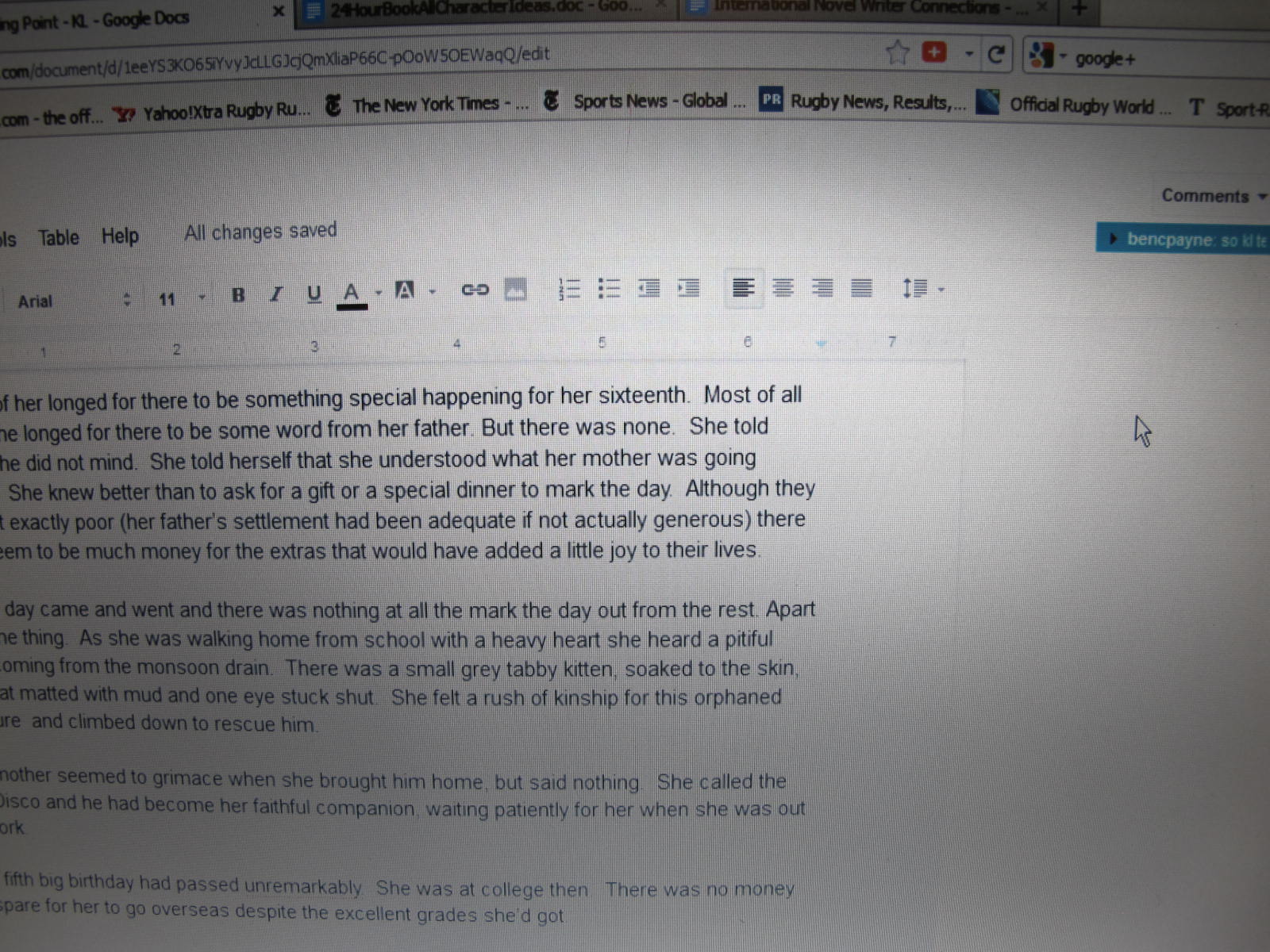
Writing a whole novel in 24 hours seems like an impossible task, let alone when there are 29 co-authors in 4 different parts of the world! But this is exactly what we did on Leap Year Day, February 29th, thanks to Grey Yeoh of the British Council who brought together a whole bunch of us, including Gina Yap, Zedeck Siew, Saras Manickam, Daphne Lee and myself, to interact with writers in three other cities across the globe. This is the result :




LEAP
A novel by 29 writers from 4 cities written in 24 hours around the world.
February 29th, 2012. In Kuala Lumpur, it's Sara's birthday, a day she dreads, even though it only comes around once every four years. In Delhi, Tanya makes a dash for the airport and the carefree lifestyle that she has always dreamed of. In London, Dave wakes up from a bad dream to find his life in fragments that he must piece together before the day is out. In Vancouver, Win's day goes from bad to worse, as she struggles to face up to her past.
On the leap day of 29th of February, Spread the Word brought together four teams of writers from across the globe to write a collaborative novel. Spanning Delhi, Kuala Lumpur, London and Vancouver, four characters connect, disconnect, and follow their own journeys of discovery. There was a whole lot of hilarity and hard work, and much coffee and chocolate was consumed. We would love you to enjoy the fruits of the writers' labours.Download the book as a pdf. The all-singing, all-dancing e-book can be downloaded here .To read the ePub file on your Mac or PC, you'll need Adobe's Digital Editions application, available to download free from http://www.adobe.com/products/digitaleditions/




LEAP
A novel by 29 writers from 4 cities written in 24 hours around the world.
February 29th, 2012. In Kuala Lumpur, it's Sara's birthday, a day she dreads, even though it only comes around once every four years. In Delhi, Tanya makes a dash for the airport and the carefree lifestyle that she has always dreamed of. In London, Dave wakes up from a bad dream to find his life in fragments that he must piece together before the day is out. In Vancouver, Win's day goes from bad to worse, as she struggles to face up to her past.
On the leap day of 29th of February, Spread the Word brought together four teams of writers from across the globe to write a collaborative novel. Spanning Delhi, Kuala Lumpur, London and Vancouver, four characters connect, disconnect, and follow their own journeys of discovery. There was a whole lot of hilarity and hard work, and much coffee and chocolate was consumed. We would love you to enjoy the fruits of the writers' labours.Download the book as a pdf. The all-singing, all-dancing e-book can be downloaded here .To read the ePub file on your Mac or PC, you'll need Adobe's Digital Editions application, available to download free from http://www.adobe.com/products/digitaleditions/
Subscribe to:
Posts (Atom)