Showing posts with label reading and writing in prison. Show all posts
Showing posts with label reading and writing in prison. Show all posts
Thursday, July 22, 2010
Sentenced to Reading
Can being sentenced to a reading course actually turn the lives of an offender around, perhaps even save his life?
Experiments in the US seem to indicate that this may indeed by the case, writes Anne Barker in The Guardian, and looks at a rehabilitation programme called Changing Lives Through Literature (CLTL) which runs across the US and has achieved some spectacular results with thousands of offenders, and at a very low cost.
Now a new programme called Stories Connect is running in UK prisons, though it has not yet been used as an alternative to sentencing, and the University of Exeter is also using it with people in the community with drug and alchohol programmes.
The testimonials of students on both programmes are pretty inspiring, and should reaffirm for us all just how powerful and important reading is, and why it needs to be part of all our lives.

Tuesday, December 18, 2007
The Poets of Guantánamo
The great thing about poetry is the way it gives a voice to the voiceless and disenfranchised, expresses the deepest of hurts, and helps to heal them.
A collection of poems written by the prisoners of Guantánamo prisoners' poems was launched in the UK a few days ago, the Guardian reports. (The US launch was in August.)
Poems From Guantánamo: The Detainees Speak brings together poems written by 17 of the detainees, collected American law professor Professor Marc Falkoff,who has represented them.
The poems were written with no expectation of an audience beyond the other inmates - some of them carved with pebbles on styrofoam cups, to be passed around and read, and then confiscated when the plates were collected.
Many of the featured poets were writing for the first time, although according to an article on SFGate.com Shaikh Abdurraheem Muslim Dost was already a respected religious scholar, poet, journalist and author of 19 published books before his arrest about a month after the Sept. 11 attacks. He recreated his "cup poems" from memory after his release in 2005.
His brother and former fellow Guantanamo inmate Badruzamman Badr said in an interview :
You can listen to some of the poems on the University of Iowa website and find links to more reviews and discussion about the treatment of detainees.
Of course, if you care about the issue of detainment without trial in general terms, the Amnesty International website provides useful information. Because who knows, it could be coming to a country near you!
(Picture at right from the New York Times.)
A collection of poems written by the prisoners of Guantánamo prisoners' poems was launched in the UK a few days ago, the Guardian reports. (The US launch was in August.)
Poems From Guantánamo: The Detainees Speak brings together poems written by 17 of the detainees, collected American law professor Professor Marc Falkoff,who has represented them.
The poems were written with no expectation of an audience beyond the other inmates - some of them carved with pebbles on styrofoam cups, to be passed around and read, and then confiscated when the plates were collected.
Many of the featured poets were writing for the first time, although according to an article on SFGate.com Shaikh Abdurraheem Muslim Dost was already a respected religious scholar, poet, journalist and author of 19 published books before his arrest about a month after the Sept. 11 attacks. He recreated his "cup poems" from memory after his release in 2005.
His brother and former fellow Guantanamo inmate Badruzamman Badr said in an interview :
Poetry was our support and psychological uplift. Many people have lost their minds there. I know 40 or 50 prisoners who are mad. But we took refuge in our minds.Dost is himself amazingly positive about his time in Guantánamo:
The positives have outweighed the negatives ... I was not unhappy for being detained because I learned a lot. I wrote from the core of my heart in Guantanamo Bay. In the outside world I could not have written such things.So how good is the book? Megan O' Rourke writing for Slate.com says the book is distinctive for a number of reasons:
First, because it is a collection of writers, it drives home the plurality of experience and attitudes of those incarcerated, pushing back against the tendency to view them as interchangeable "enemy combatants." Second, because many of the authors are still being held in Guantanamo, it serves as testimony in an ongoing debate over the rights of foreign citizens who have been labeled dangers to the United States. Third, poetry proves to be an ideal way for these authors to convey the frustrations of imprisonment. The supple restrictions of the form lend intensity to their despair (or fury) at being imprisoned without habeas corpus on a remote island. ... What makes it interesting is not so much the literary virtues of the poems—some are quite artful, while others are less accomplished—as the way the poems restore individuality to those who have been dehumanized and vilified in the eyes of the public.And US former poet laureate, Robert Pinsky assesses the collection at The World.org pointing out that it's greatest quality is its urgency.
You can listen to some of the poems on the University of Iowa website and find links to more reviews and discussion about the treatment of detainees.
Of course, if you care about the issue of detainment without trial in general terms, the Amnesty International website provides useful information. Because who knows, it could be coming to a country near you!
(Picture at right from the New York Times.)
Friday, August 24, 2007
Poetry Behind Bars
 Being much interested in the therapeutic uses of writing, I felt inspired by this piece by Louise Tickell in today's Guardian about a project to bring performance poetry to prisoners.
HMP Grendon in Buckinghamshire for men with convictions for serious crimes has been designated the UK's first "fully therapeutic prison", and the Grendon Live Literature programme is run by Alan Buckley (pictured above with one of the prisoners) and Steve Larkin, two Oxford-based performance poets. Ten weeks of writing workshops culminate in a final performance.
The programme has been found to develop the inmates literacy and presentation skills, but what about the quality of the material produced? In Poet's Letter magazine Buckley writes:
An obvious question is: are the poems people write any good? Or is writing them just good therapy for the inmates? The answer is that the standard of writing and performing is incredibly high for a group of people (both inmates and students) who – on the whole – have never done anything like this before. Although the inmates in particular often write about traumatic past experiences, the reality for them is that they are in therapy groups every day, so they tend to be very clear about seeing the poetic task as different. Also, the series of seven workshops ends with a slam (“The Slam in the Slammer” – could it be called anything else?), open to visitors from outside as well as inmates, so there is a healthy pressure to write and work up pieces that are able to engage an audience, whether this is through humour, exploring the common ground of human existence, or challenging people’s assumptions.
As a trained psychotherapist myself, with fifteen years’ experience of working in mental health and drug and alcohol settings, a prison TC is a familiar environment. What is incredibly refreshing for me is to have the chance to engage with people in a a way that is so clearly focussed on creative expression and moving forward, rather than exploring historical hurt.
Sunday, August 05, 2007
Inspired Incarceration
 Oscar Wilde did it. So did Brendan Behan, Cervantes, Thomas Malory, John Bunyan and Voltaire.
And, of course, Jeffrey Archer.
(And in South-East Asia we could also add Pak Pram.)
In the Times Peter Wayne, newly released from prison salutes great writers who drew strength from their incarceration which they used to fuel their writing.
Wayne is himself has:
20-odd years’ worth of scintillating journals that I have hung on to come hell or high water in 30-something prisons ...and now plans:
... to anatomise incarceration in a way that will enlighten and entertain future generations. It is my hope that, in future, readers will be able to read my work and say: “That was how it really was.”
 I hope it works out for him and that he doesn't need to ... erm ... go back and collect more material!
Incidentally, I am very interested in initiatives like the Writers in Prison Network in the UK. Wonder what the possibility of setting something up like this here would be?
Thursday, November 16, 2006
Writing Retreat - For Free
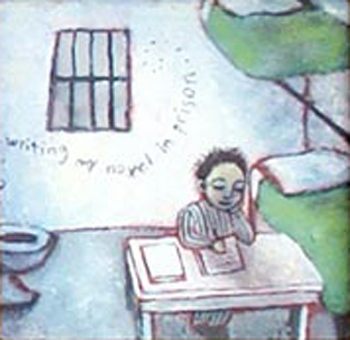 Imagine having plenty of time and space to write without any of the distractions of everyday life, and food and lodging found. Not only that, but when you fancy a little distraction you can take advantage of the fact that you are surrounded by excellent story tellers whose tales you can take as material for your own writing. Too good to be true? Not a bit of it.
Don't all apply at once.
(Pic by Pauline Lim nicked from here.)
Saturday, August 06, 2005
Books in Custody
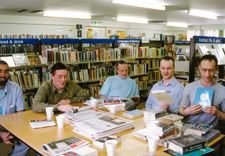
The competition of find Britain's best reading group was recently won by a inmates of a prison. The Penguin/Orange Prize was awarded to the "book loving fools" of High Down Prison reading group, Surrey.
Loved the reaction from the one-male member of our group Fiction&Friends when I forwarded an article about the finalists:
Why is it that women love to meet and talk books but men not?
Postscript:
Read about Nick Hornby's prison visit.

Loved the reaction from the one-male member of our group Fiction&Friends when I forwarded an article about the finalists:
"Am laughing out loud at the fact that the only all-male book club consists of a bunch of convicts. So that's how you get men to read. Take them out of the general population and lock them up!"
Why is it that women love to meet and talk books but men not?
Postscript:
Read about Nick Hornby's prison visit.
Subscribe to:
Posts (Atom)