Showing posts with label african authors. Show all posts

Wednesday, September 09, 2009

Uwem Akpan - Writer Priest

... my writing, I’d say too, is an extension of the pulpit … it reaches folks who don’t care for organised religion in a different way
Nigerian author and Jesuit priest Uwem Akpan is interviewed by Grace Talusan for the Ubud edition of Quill magazine, and the piece is up on Eric's blog. Akpan's short story collection Say You’re One of Them won the 2009 Commonwealth Writers’ Prize for Best First Book (Africa). His stories of children caught in dire situations are set in Rwanda, Nigeria, Benin and Ethiopia.

He is one of the authors appearing at this year's Ubud Writers and Readers Festival.

Friday, June 27, 2008

Those Genteel Dogsbodies of Despotism

Dangerous things, novelists.

Nobel winner JM Coetzee revealed last week that his colleagues and associates at the University of Cape Town were also also his secret censors during the last days of apartheid.

Boyd Tonkin in today's Independent writes :
These teachers and writers might greet their quarry in the university corridors of Cape Town or (in one case) invite him for over for a barbecue: "I was rubbing shoulders daily with people who were secretly deciding whether or not I was going to be published in South Africa."
The irony is clear :
... these shrouded arbiters thought that they were on the author's side. Over and over, they reported that Coetzee's gnomic fiction would only appeal to a minority of "sophisticated", "discriminating" and (above all) "intellectual" readers. So the novels could safely be allowed to circulate – and would pass way over the heads of the vulnerable masses. "These people," Coetzee concluded, "regarded themselves as part of the literary community, and as unsung heroes of a kind." In their refined eyes, they "took on a dirty job in order to safeguard South African literature against the Philistines". Far better that they, with their ideals, should censor than some boorish bureaucrat.

In outlook and action, these stalwart anti-Communists reminded me of no one so much as the arts-loving Stalinist snitches of the old East Germany – as screened so memorably in The Lives of Others. At any cheese-and-wine do, c.1980, these genteel dogsbodies of despotism might have got along famously. As a parable of the self-delusions that permit good – or at least righteous – people to serve malign causes, Coetzee's analysis had all the lapidary power of his stories. For his censors (whom he imagined poring over his suspect prose, Mozart on the stereo, an Irish setter on the rug), the end more than justified the means. And the end was the preservation of a system that would have kept Mandela in jail until the day he died.

Friday, June 06, 2008

Hearts of Darkness

Two works of non-fiction I've read this week were both in a sense journeys into the heart of darkness.

I picked up a copy of William Styron's Darkness Visible: A Memoir of Madness at the Big Bookshop sale. It's a very slim volume, just 84 pages long, which started life as a lecture given at a symposium sponsored by the Department of Psychiatry at the Johns Hopkins University School of Medicine. It was later developed into a piece for Vanity Fair before being published as a book.

Styron was hit by serious depression at the age of 60, and describes most evocatively his own struggle with the life-threatening illness from first symptoms, through his treatment, his brush with suicide, hospitalisation to eventual cure. Along the way he includes the stories of friends and others so afflicted - many of them also writers.

It's the honesty of the book that makes it so compelling. It was one of the first "insider" accounts of depression, and captures extremely well just what it feels like. (You have to have been there to know.) I agree with him that the word "depression" is totally inadequate, sounding more like a mild case of the blues rather than something that fills your soul with dread and despair.

The second book involved a physical journey into the part of the world that Conrad described in his novel Heart of Darkness - the Congo. Tim Butcher, a journalist for The Daily Telegraph decides to recreate H.M. Stanley's famous expedition in the 1870's. (Stanley had been also sponsored by the same newspaper!) He was also curious to see the country that his mother had visited in the 1950's as a tourist. He was told that by just about everyone he contacted that the journey was impossible, but against the odds he manages to enlist the help of aid workers (including a pygmy human rights activist and the Malaysian commander of a vessel working for the UN) and others. Each stage of the journey is uncertain, and he's constantly in danger of his life and in great discomfort. But he does manage in the end to find the transport he needs (motorcycles, dugouts, a UN barge) and the journey continues. It's impossible not to salute his courage.

Blood River : A Journey into Africa's Broken Heart is a fascinating account, not just because it takes us into a part of the world we wouldn't normally venture into and lets us share the journey (from our comfy armchairs!), but also for the historical perspectives which are woven into the narrative.

In the space of half a century, Congo has gone completely backwards - it is not "a developing country", or an "underdeveloped country", so much as an "un-developing country", going backwards so fast that almost nothing remains of the infrastructure left under Belgian rule due to the greed and incompetence of its leaders. It's a terrifying portrait of how quickly things can unravel. You also come to realise that putting things right isn't a matter of throwing financial aid at the problems, but in establishing the rule of law.

It's impossible not to really pity the ordinary people of this failed country, but that there is such potential for economic growth (minerals, fertile land) turns this missed opportunity into a tragedy.

As you would expect, there's plenty of coverage of the book on The Telegraph website, including photos and extracts.

The book was chosen as one of the reads for the Richard and Judy bookclub and of course made the shortlist for this year's Samuel Johnson Prize.

Many thanks to Kavita of Pansing for passing me this copy.

Friday, March 28, 2008

Breakfast Book Sale, Tea Time Reading

Reading is sexy, promises Daphne Lee, and invites you all to a book sale at Dram Projects in Section 17 tomorrow morning. (Click poster for details). Proceeds go to the Malaysian-UK exchange Project.
We'll start setting up at 9 and be ready to sell books by 10!
she says.

Quite apart from from feeding your reading habit, you can feed your hungry appetite with a lovely big breakkie at Food Foundry next door.
Baked Beans, Sautéed Mushrooms, Toast, Bacon and Sausages with Scrambled or Fried Eggs choice of coffee or tea RM18.90

French Toast with apple fillings 9.90

Pancakes with honey and jam 10.90

Scrambled eggs with salmon on toast 13.90
Also on tomorrow, a reading by Nigerian author Anthony Isoh from his self-published novel Black Banana at Silverfish from 5.30pm to 7.00pm .

Monday, February 25, 2008

Achebe's Book Hits 50

Celebrations are planned in cities across the US to celebrate the 50th anniversary of one of the twentieth centuries greatest novels, Chinua Achebe's Things Fall Apart.

Scott Timberg in the Los Angeles Times pays tribute, and looks at how it has influenced other African authors.

Chris Abani, a nigerian author based in Los Angeles calls the book :
... inescapable. ... You're either working against it or within it; you're rejecting it or you're accepting it. But the conversation has to include it.
Kwame Anthony Appiah, a Princeton University professor of philosophy points out that :
The book establishes a series of conventions on how things are to be written about . . . that had never been represented before. ... No one had taken the stately cadences of traditional African speech into English.
And Half a Yellow Sun author Chimamanda Adichie says the novel led to:
... a glorious shock of discovery. It taught me that my world was worthy of literature, that books could also have people like me in them.
I count myself very lucky to have had the opportunity to teach the novel to a class of very enthusiastic Form Five students in Nigeria who made my experience of reading Achebe even more special.

Wednesday, June 13, 2007

Achebe Honoured

I'm very happy to see Nigerian author Chinua Acebe honoured with this year's Man Booker International Prize worth £60,000 .

Says John Ezard in the Guardian:
In choosing to give the award to a man who is regularly described as the father of modern African literature, the judges have signalled that this new global Booker has achieved the status of an authentic world award in only its second contest.

By honouring Achebe they have redressed what is seen in Africa - and beyond - as the acute injustice that he has never received the Nobel prize, allegedly because he has spent his life struggling to break the grip of western stereotypes of Africa. One of his most famous essays is an onslaught against Joseph Conrad's masterpiece Heart of Darkness, a novel about a European's descent into savagery in Africa.
The Guardian website also has a guide to Achebe's life and work and you can read an extract from Things Fall Apart (which is one of my favourite novels) here.

Acebe himself says in the Times:
It was 50 years ago this year that I began writing my first novel, Things Fall Apart. It is wonderful to hear that my peers have looked at the body of work I have put together in the last 50 years and judged it deserving of this important recognition. I am grateful.
It has, of course, been an amazing week for Nigerian authors (and not just Nigerian - Igbo!) with Chimamanda Ngozi Adichie winning the Orange Prize a few days earlier. In an interview with Stephen Moss in the Guardian she talks about the need to get right away from stereotyped views of Africa:

We have a long history of Africa being seen in ways that are not very complimentary, and in America ... being seen as an African writer comes with baggage that we don't necessarily care for. Americans think African writers will write about the exotic, about wildlife, poverty, maybe Aids. They come to Africa and African books with certain expectations. I was told by a professor at Johns Hopkins University that he didn't believe my first book ... because it was too familiar to him. In other words, I was writing about middle-class Africans who had cars and who weren't starving to death, and therefore to him it wasn't authentically African. ... People forget that Africa is a place in which class exists," she says. "It's as if Africans are not allowed to have class, that somehow authenticity is synonymous with poverty and demands your pity and your sympathy. Africa is seen as the place where the westerner goes to sort out his morality issues. We see it in films and in lots of books about Africa, and it's very troubling to me.

You may remember that Doreen Baigana said something very similar some time back.

Thank goodness for all those authors, Achebe in the forefront, who have managed to break the mould.

Thursday, May 31, 2007

Once Were Child Soldiers

I have never been so afraid to go anywhere in my life as I was that first day. As we walked into the arms of the forest, tears began to form in my eyes, but I struggled to hide them and gripped my gun for comfort. We exhaled quietly, afraid that our own breathing could cause our deaths. The lieutenant led the line that I was in. He raised his fist in the air, and we stopped moving. Then he slowly brought it down, and we sat on one heel, our eyes surveying the forest. We began to move swiftly among the bushes until we came to the edge of a swamp, where we formed an ambush, aiming our guns into the bog. We lay flat on our stomachs and waited. I was lying next to my friend Josiah. At 11, he was even younger than I was. Musa, a friend my age, 13, was also nearby. I looked around to see if I could catch their eyes, but they were concentrating on the invisible target in the swamp. The tops of my eyes began to ache, and the pain slowly rose up to my head. My ears became warm, and tears were running down my cheeks, even though I wasn’t crying. The veins on my arms stood out, and I could feel them pulsating as if they had begun to breathe of their own accord. We waited in the quiet, as hunters do. The silence tormented me.
Ishmael Beah describes his first battle in harrowing detail in his memoir A Long Way Gone: his closest friends are shot dead, and he kills a man for the first time, a point from which there is no turning back.

I told you that I picked up the book as a bit of an impulse buy in Times the other day because I felt it would give me another perspective on the issue of child soldiers that I could put alongside Beasts of no Nation by Uzodinma Iweala which I was (still am!) in the process of reviewing. That Beah's story parallels Iweala's should come as no surprise as this is the story of hundreds of thousands of children in Africa.

But this is without a doubt the most moving book I've read in some time, much more so than Iweala's fictional version perhaps because of the hybrid language Iweala uses, perhaps because of the deliberate lack of specific detail. (Where are we? What war is this?)

I won't write more about the book here (wait for the review lah) but you can read a condensed version of the memoir archived on the New York Times website and also listen to an interview with Beah here.

Would I recommend it? Most definitely. The story, though harrowing, is beautifully written and I couldn't put it down. Few books move me to tears. This did.

Beah is a pretty incredible young man and if there is one book that deserves to be widely read this year because it will chance hearts and minds, this is it.

Now then, what are you reading?

Tuesday, May 22, 2007

Teacher's Pet

You have a class of creative writing students, some of them loaded with natural talent turn in beautifully written work, another struggles with his basic grammar but clearly has something to say.

Who deserves the teachers help the most?

And who succeeds in the end?

Ayse Papatya Bucak assistant professor of English at Florida Atlantic University talks about the student he hardly knew, Ishmael Beah (left), whose heartbreaking memoir A Long Way Gone is in all the bookstores now and very well worth reading.

He writes more about teaching Beah on his blog:
But what the memoir made me think about was naturally the workshop in which I knew Ishmael. The writing he was doing then (fiction, drama and poetry) was all grounded in his real experiences (though not the worst of them) and fortunately I had a class that recognized that in workshopping this kind of autobiographical material it was important to be sensitive. At the time, his writing was still full of ESL mistakes and honestly a little rough. But while we talked some about those things, the focus was always on the material--what we thought he could do with the material. And I'm glad of that because we had no idea really the extent of the horror of Ishmael's past. There was no way for us to know that by the time he was fifteen he was a trained military killer and that by the time he was eighteen he was addressing the UN about child soldiers. This was a good reminder to me that while I think I know my students, I really know very little of what their lives are like outside of the classroom, and that I shouldn't assume that I do. I don't think anything would have stopped Ishmael from writing his story, but I'm glad to say that our class was a voice of encouragement, expressing that we wanted to hear more.
Many thanks Jen for forwarding the link.

Wednesday, May 02, 2007

Karma Chameleon

The Independent Foreign Fiction award this year has been won by Angolan José Eduardo Agualusa for The Book of Chameleons. The £10,000 prize money will be shared by the author and Daniel Hahn who translated the novel from the Portuguese.

According to Boyd Tonkin in the Independent:
The novel mixes comedy, tragedy and touches of fantasy as it explores the recent history of the former Portuguese colony, whose independence in 1975 was followed by more than 20 years of bloody civil war.

Its hero, an albino African called Felix Ventura, works as a "genealogist" who fabricates a "better past" for ambitious clients haunted by previous traumas. He shares his adventures, memories and dreams with the novel's narrator: a gecko who observes the action from the walls of Felix's house.
One of this year's judges, David Constantine, describes the novel as:
... a beautiful fiction. It has grace, agility, wit, a lovely inventiveness.

Monday, April 09, 2007

Beasts and Bollocks

So what are you reading this week?

I didn't get a whole lot of reading during the litfest, with so many events to attend and people to talk to. And over the past week I've been a bit of a nibbler, dipping into several different books.

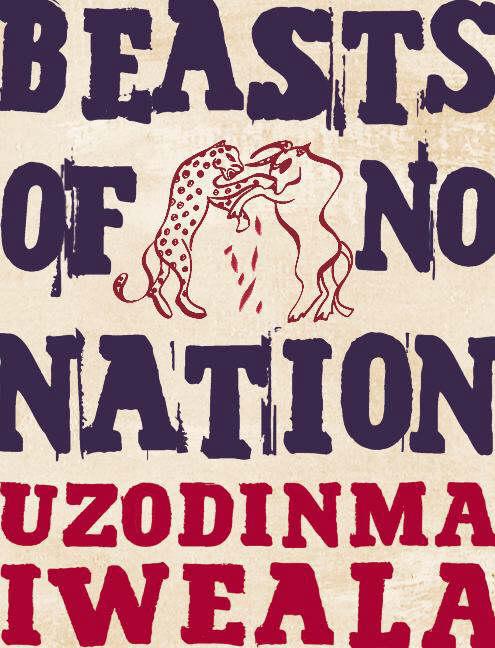
One book I did finish was Uzodinma Iweala's Beasts of no Nation. It was high on my must-read list anyway, especially as it is written by a Nigerian author (albeit one who is also an American author) and Nigeria's a part of the world I know and care about. And then Ms. D declared it her favourite book of last year, and I respect her opinion. And then it won the John Rhys Llewellyn Award.

I can't recommend this little book (142 pages) too highly. It's the story of a child swept up into the chaos of Nigeria's Civil War, abducted by a rag-tag group of rebels and forced to become a child soldier. Agu narrates his own story in broken English: the voice is very well done, capturing the essence of Nigerian pidgin without ever slowing the writing down.

The book addresses a very basic human question - how can an individual be drawn in to committing inhuman acts? Poignant flashbacks of family and school days show us Agu's life before the war. But his descent into hell is rapid and fueled by starvation, drugs and the sure knowledge that if he does not kill, he will himself be killed. Soon he is slaughtering innocent victims along with the rest, and even deriving pleasure from it. Despite the setting , the book could actually have been set anywhere in the world where children are recruited to fight.

I could write a whole lot more about the book but will save that for a review I'm writing for Off The Edge.

I must also add that I love this particular paperback edition from HarperPerennial for its handfeel, cover design, the flexibility of the spine, the weight of the pages, the size of print ... and all the add-ons at the end including an essay by the author talking about how the book came to be written. This is how I would like all paperbacks to be.

I've been dipping into a couple of books that I acquired at the last Big Bookshop warehouse sale, among them Bollocks to Alton Towers is a sort of alternative travel guide to places in UK. Most books of this sort direct you to the famous tourist spots (like the amusement park, Alton Towers, in the title), this quirky little book recommends day trips to all kinds of obscure places which also guarantee a dose of fun. Here's a pub built like a pack of cards in Devon, the David Beckham trail in North London, a village on Salisbury Plain abandoned during the war when the army wanted to test weapons, the Cumberland pencil museum ... and much much more. The pieces by Robin Halstead, Jason Hazely, Alex Morris and Joel Morris are amusing and informative and I'd love to follow up some of these unusual day-trips next time I go back to dear old Blighty. (I'm getting homesick!!)

Actually I've several more books I want to talk about but I'm afraid I'll be sucked into the black hole of this blog for the rest of the morning when my typing fingers are demanded for elsewhere things.

So I kick the ball to you, and promise to post about other reads later.

Friday, April 06, 2007

And Tash Aw's Second Book Is ...

... X-24, an anthology of short fiction which he has co-edited with Nii Ayikwei Parkes. The collection is published by Lubin and Kleyner, a new imprint of Flipped Eye (which some of you may remember is the publisher of two of the performance poets who have visited Malaysia in the past months - Jacob Sam-La Rose and Roger Robinson).

Writers included in the book Sefi Atta, Naomi Alderman, Daniel Alarcon, Peter Hobbs and Moorish Girl herself Laila Lalani.

I don't know if local bookshops are bringing this in, but I'm tau-pauing it from Amazon.com because a book-addict needs a hit as fast as possible.

Tuesday, December 12, 2006

Tale of Child Soldiers Wins Llewellyn Rhys Award

The John Llewellyn Rhys award for debut writers was won by Uzodinma Iweala's for his Beasts of No Nation, described by Michelle Pauli in the Guardian as:
a brutal but surprisingly poetic novel about an African child soldier ... an intensely moving story, as well as a horrifying one, all the more so for tackling an issue of our time ...
The issue of course being child soldiers and as the Pauli points, Save the Children estimates that around 300,000 children around the world are currently fighting in wars.

Nigerian born Iweala is just 23. He grew up in the US and studied at Harvard where his novel grew out of the thesis he was writing. His mum Ngozi Okonjo-Iweala is Nigeria's finance minister (and hailed as "a great reformer").

You can read with him about his writing and about his views on Africa in this very interesting interview from the Morning News.

And as this article from the Herald Tribune points out, there is a whole new generation of Nigerian writers taking the literary world by storm. Some names to watch out for Sefi Atta, Helen Oyeyemi, Chris Abani, Segun Afolabi, and Chimamanda Ngozi Adichie.

All of which makes me very happy. Not least because a part of my heart still lives in Nigeria.

Related Posts:

Shakespeare the African (15/3/05)
Read and Become Wise (11/5/05)

Saturday, August 19, 2006

Writers - What Did You Do In The War?

What happens when writers find themselves caught up in the horrors of war?

Richard Lea in the Guardian checks in with authors on both sides of the current conflict in South Lebanon, including Lebanese novelists Elias Khoury and Hassan Daoud, Israeli author Orly Castel-Bloom and writer of surreal short-fiction Etgar Keret, and Palestinian author Adania Shibli.

Unsurprising verdict: war isn't very good for writing. My favourite comment comes from Castel-Bloom:
I used to write books they called post-modern, but now it is pure realism.
Meanwhile, Nobel prize winner Gunter Grass's shock revelation that he once served in Adolf Hitler's Waffen SS force has ignited a firestorm of criticism, writes Tony Paterson in the Independent,with some quarters demanding that he return the award. Grass claims that writing his new autobiography Peeling the Onion (supposed to be published next month, but I believe it has already been launched) finally gave him the opportunity to face up to his Nazi past.

Also well worth reading on the case is this post on the Done with Mirrors blog (via Tailrank).

The Nigerian Biafran war provides the background to Chimamanda Ngozi Adichie's new novel, which is dedicated to the grandparents Adichi never knew. Adichi's highly praised first novel Purple Hibiscus was shortlisted for the Orange Prize in 2004 and won the Commonwealth Writers First Book Prize. The novelist is profiled by Christina Patterson in the Independent. Although writing of war at second-hand, Adichie clearly gets things right. Patterson describes Half A Yellow Sun as:
... a magnificent novel, packed with memorable characters and their different worlds. Adichie's own childhood took place entirely within the bounds of a university campus, but she captures village life, and the cocktail-drinking coteries of the super-rich, as if they too were part of the fabric of her daily life. She also captures the horrors of war: the constant upheaval, the hunger and the brutalising fear that causes ordinary people ... to take part in acts of casual brutality.
In case we need reminding.

Wednesday, August 03, 2005

On Not Conforming to a Stereotype

Sometimes I wish my life had been more tragic ...
... writes Nigerian writer Doreen Baingana in this article from yesterday's Guardian.
This is because my audience expects me, as an African writer, to regale them with tales of hunger, war and catastrophe. ... felt as if I had been invited under false pretences. I should have been born in a poverty-stricken village, brutally circumcised with a blunt, unsanitised knife with other five-year-old girls, then, a few years later, kidnapped by child soldiers, becoming a sex slave of a rebel commander before escaping dramatically and trekking through the dry bush for miles and months until I was rescued by foreign aid workers, "rehabilitated" and adopted by a gracious American family. I would end up triumphant and grateful in the US and living to tell my story; which is, of course, a story worth telling.
Writers from the "developing world" are too often expected to support myopic western views of what their part of the world and their literature is supposed to be like: Africa is impoverished; Asia is "exotic"; all Latin-Americans write magical realism.

Baigana says that African writers should counterbalance the view of the continent given in media portrayals:
As an African writer, I pluck what I know and throw it into a pot with what I don't and what I conjure out of nothing and dreams. I shake in all sorts of spices, grains, water, salt and lies, African or not, and try to create a new stew with new flavours every time. I ask my audience to demand this much of me and other African writers. To expect so much more than yesterday's leftovers: the newspapers' diarrhoeic stream of problems and problematic stories. Let's imagine together all the possible and impossible ways individuals try to make sense of themselves and their worlds, African or otherwise.
I'm glad that she also questions that tired old label "postcolonial", so beloved of literature departments and used to describe literatures from all those parts of the globe that were once coloured pink.
Even here in cosmopolitan London last July, at events for the Caine Prize for African Writing, students and others posed questions within the same framework, using the word "postcolonial" like it was going out of style. I wish. Is there any other way we can view and talk about the multiplicities of the African experience? We need to, desperately.