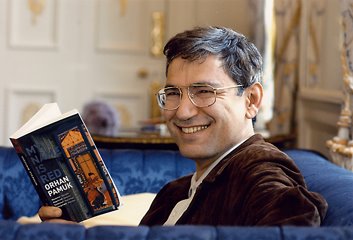
Showing posts with label orhan pamuk. Show all posts

Monday, May 30, 2011

The Naïve and Sentimental Novelist

My review which was in the Reads Monthly section of The Sunday Star yesterday :


What actually happens when we read a literary novel? And what is in the mind of an author when he writes one? These are the central questions addressed by Orhan Pamuk in The Naïve and Sentimental Novelist. And since the Turkish writer is both an avid reader and the Nobel Prize winning author of several internationally acclaimed novels (including Snow, My Name is Red, and The White Castle), he is extremely well-qualified to do so.

The title of the book is taken from the famous essay by Friedrich Schiller . Pamuk’s “naïve” novelists, he says, are unaware of the techniques they are using, and they write spontaneously as if carrying out a natural act, as opposed to “sentimental” or reflective novelists “who are concerned with artificiality of the text and its failure to attain reality”. I have to say though that I did not find the distinction a particularly useful scaffold for Pamuk’s arguments, particularly as the author himself admits that all great novelists ultimately have to be a blend of both. At times, his discussion seems rather abstract and academic, perhaps not surprisingly, as these six linked essays were initially delivered in the form of lectures at Harvard University in 2009.
On Naive and Sentimental Poetry

But it is when he writes more anecdotally and personally that he is at his best. Anyone who has fallen passionately in love with reading will recognize themselves in Pamuk’s descriptions of his younger self, encountering the great works of fiction for the first time, discovering in them important truths about life, and acquiring from them “a breathtaking sense of freedom and self-confidence”. Pamuk draws on the classics for his examples, including Tolstoy’s Anna Karenina and War and Peace, James Joyce’s Ulysses, Proust’s In Search of Lost Time, and Defoe’s Robinson Crusoe.

Pamuk captures the special magic of the literary form. He describes how the words on the page become invisible as we look through them onto an entire landscape with the ability “to oscillate between the long view and fleeting moments, general thoughts and specific events, at a speed no other literary genre can offer.” We can simultaneously see, he says “the broader picture, the whole landscape, the thoughts of the individual, and the nuances of the character’s mood.”

More than once he refers to the “intense and tiring effort” required to read a literary novel, and he lists a whole lot of different things that the reader actually has to do simultaneously to connect with the text. We observe the scene and follow the narrative, and transform the words on the page into images. Our memory labours intensively to hold all the threads of the story and what we know of the characters. We appreciate the style, make judgments about the moral choices the characters make, and congratulate ourselves for being able to read “a difficult” novel.

As we read, we are constantly wondering, he says, how much of the novel tells of real experience and how much is an act of imagination, and also how much of the author’s own life is invested in the fiction. Indeed, he devotes a whole essay to the topic, but concludes, not surprisingly, that “the novel is not completely imaginary nor completely factual.”

But even as we are deriving pleasure from the surface details of the novel, we are searching at a deeper level for “motive, idea, purpose”, in fact what he calls “a secret centre”. Reading literary fiction, he says, is the act of determining the real centre of the novel, “whose source remains ambiguous but which nevertheless illuminates the whole.” It is the slow uncovering of this centre that gives the reader full satisfaction.

Popular genre fiction, he says, typically lacks this centre, and is read largely for comfort. But he does single out some genre writers (including Patricia Highsmith, John Le Carre, Stanislaw Lem and Philip K. Dick) as authors whose work can be read at a deeper level.

Pamuk is perhaps at his most controversial when he talks about the creation of character in the novel. He suggests that over the past 150 years our curiosity about characters has taken up much more space in the novel than it has in life, and that “It has sometimes become too self-indulgent, almost vulgar”. He believes that “People do not actually have as much character as we find portrayed in novels” , and reckons that human character is not nearly as important in shaping our live as it is made out to be in the novels and literary criticism of the west. This certainly is food for serious thought.

He goes on to attack the idea of the character-driven plot, where the author seems to expect that “… the hero like a prompter on stage will whisper to the novelist the entire course of the novel.” This approach, taught extensively on creative writing courses, “merely goes to show that many novelists begin to write their novels without being sure of their story, and that is the only way they are able to write.” He says that in his own writing his protagonist’s character will be formed, as a real person’s is, by situations and events.

Much of what is written about literature in academic circles is made inaccessible to the ordinary book-lover and writer by the jargon of literary theory. This book can be enjoyed by both the enthusiastic reader and by writers, and should serve to spark deeper discussion of the craft of the novel - whether or not one chooses to agree on all points with Pamuk.

And of course, perhaps more importantly for fans of Pamuk’s work, The Naïve and Sentimental Novelist gives an intriguing insight into the preoccupations and approach to writing of one of the world’s most important authors.

Tuesday, September 25, 2007

On Translating Pamuk

Maureen Freely, US journalist, novelist and translator, shares her thoughts on translation into English from Turkish and in particular the challenges of translating Orhan Pamuk in the latest online edition of Literature Matters.

In her talk at The British Council's 30th Cambridge Seminar on Contemporary Literature she says:
Translation, I’m often told, is a mechanical exercise. There is the text, which like fate, is already written; the translator’s job is simply to replicate it in another language. All this is true, but there is more to a text than its surface. When I sit down to translate a novel by Orhan Pamuk, I know it will not be enough to find the correct words. I need to be sure they are also the right words – the words that will conjure up the imaginary world in which it is set. So I myself need to believe in that cloistered world, to believe myself inside it. Only then can I hope to find the words that will make it visible in English.

This is not as easy as it sounds, for there is a very great distance between Turkish and English. There is no verb ‘to be’ in Turkish, and no verb ‘to have’. There is only one word for ‘he’, ‘she’, and ‘it’. Turkish is an agglutinative language: a root noun in a routine sentence will often have a string of six, seven, or even eight suffixes connected to it. It has many more tenses than English does. It can dart between the active and the passive voice with grace and ease. It loves clauses beginning with verbal nouns (the doing of, the having been done unto of, the having being seen to have something done to someone else…..) In an elegant sentence, there will often be a cascade of such clauses dividing the subject from the verb, and that verb appears so close to the end of the sentence that it often serves as a punch line, reversing the expected meaning of all that has come before it. To be overly clear is to be crude. To write well is not the say the obvious, but to suggest what lies beyond it. So Turkish is not just another language: it is another way of looking at the world.
And she explains the personal reasons that made her want to undertake this often seemingly impossible task.

There is much more good stuff on the British Council's Literary translation website.

Saturday, May 05, 2007

Silenced Voices

Remembering today writers and journalists who have faced persecution and even execution for following the truth I thought I'd write about one of the writers I met at last year's Ubud Readers and Writers Festival - Turkish Author and Journalist Asli Erdogan.

Asli's courage and intelligence greatly impressed me. Formerly a quantum physicist with CERN, she gave up the search for elusive particles to become a writer producing two novels The Shell Man in 1994, and The City in Crimson Cloak (about Rio de Janeiro where she did her PhD) as well as a collection of interlinked short stories Miraculous Mandarin in 1996. Her short story Wooden Birds received first prize in a competition opened by Deutsche Welle Radio in 1997.

Nobel prize winner Orhan Pamuk calls her:
... an exceptionally sensitive and perceptive writer who gives us perfect literary texts.
Asli's passionate interest in human rights led her to journalism.

Turkey has the worst record for persecution of writers in the world, she says. The infamous Article 301 making it a crime to insult "turkishness" has hit the headlines as prominent writers have been charged with it for drawing attention to the genocide against the Armenians and the plight of the Kurds. The case that attracted the most international attention was that of Orhan Pamuk who stated in an interview with a Swiss magazine, that "Thirty thousand Kurds and a million Armenians were killed in these lands and nobody but me dares to talk about it."

But Asli says that the the publicity surrounding Article 301 has drawn attention from even more serious human rights abuses in Turkey. She wrote articles about hunger strikes (in one 110 people died!), rape and deaths from torture in Turkish prisons.

She knew that she risked being jailed for speaking out. She lost her job after two and a half years and has been constantly harassed by the police. The month before the Ubud festival she said, there was a police car parked in front of her apartment all the time. "I felt I was going crazy," she said, but managed to joke about the drug dealers living in the street being in awe of her.

I found online a tribute Asli wrote for another persecuted Turkish writer, Hrant Dink, who was one of the most prominent voices of Turkey's shrinking Armenian community. He was convicted in 2005 under Article 301 for writing about the Armenian genocide, and received threats from nationalists who viewed him as a traitor. He had hoped to emigrate, but was gunned down by a 17 year old nationalist outside his offices on January 19, 2007.

Asli here describes the scene at his funeral as one hundred thousand mourners marched together:
It was a long, silent walk. Thousands and thousands of people were slowly walking, side-by-side, under an unexpected winter sun, a luminous sky, reminiscent of spring. A compact, homogeneous crowd was filling the avenues, the streets, the squares. There were blood-red carnations. Black signs spelling out the same message in three different languages: "We are all Hrant, we are all Armenians."Hrant's face emerges above arms, above heads, an intact face, bearing no signs of aging, with his gentle, comforting smile... Thousands of people, in mourning, heartbroken, intently turned to that face with a sense of loss even deeper than if he had been one of them. Newspapers, headlines, people clapping their hands, the white dove, so alive, in front of Agos people recognizing each other and humbly greeting, heads bowed in gravity, weighed down by the assassination. It was a winter sun that we did not seem to deserve. (But who had the right to deprive anyone of that sun, be it for a single minute?) "They say it is five miles away, do you think we can walk that far?" a voice says. Another one replies: "We will make it!" We walk on, leaving a deep invisible mark behind us.
Asli, today our thoughts are with you and other Turkish journalists (and other journalists around the world) who are are brave enough to speak out. Regardless of the personal danger.

Sunday, December 17, 2006

Snow Drift

Abandoned Snow three-quarters of the way through and then hop skipped to the end to find out what happened to the characters. (Now I understand why it took Starmag reviewer Anu Nathan six months to read it!) No point labouring through something you're not enjoying, hey? I now somewhat reluctantly add it to the venerable list of dumpees whilst trying not to feel too inferior to all those friends who wax lyrical about it.

I only read reviews when I'm done with a book, and very much enjoyed the reviews of Snow on newspaper websites. (Complete Review has a whole list of them.) Despite my own struggle with the book, I have to agree with these words by Laurel Maurey in the San Francisco Chronicle:
Pamuk is a good antidote to the easy answers that so much modern literature offers; if you're a fan of Dostoyevsky, Fowles, Hesse, George Saunders or any other author with the guts to muck with your mind, read Pamuk. ... "Snow" will make you feel the arguments surrounding fundamentalism as a situation of murky grays, where the only thing black is the night, and the only thing white is the snow.
Margaret Atwood's review in the New York Times intrigues when she talks about the Male Labyrinth Novel ... something I'd never considered before:
The twists of fate, the plots that double back on themselves, the trickiness, the mysteries that recede as they're approached, the bleak cities, the night prowling, the sense of identity loss, the protagonist in exile -- these are vintage Pamuk, but they're also part of the modern literary landscape. A case could be made for a genre called the Male Labyrinth Novel, which would trace its ancestry through De Quincey and Dostoyevsky and Conrad, and would include Kafka, Borges, García Márquez, DeLillo and Auster, with the Hammett-and-Chandler noir thriller thrown in for good measure. It's mostly men who write such novels and feature as their rootless heroes, and there's probably a simple reason for this: send a woman out alone on a rambling nocturnal quest and she's likely to end up a lot deader a lot sooner than a man would.
Or maybe women have more pressure on them just to get on with things because too much depends on them?

Will try some of Pamuk's other novels later on. Promise.

Now it's back to Auster. I'm supposed to be reviewing The Brooklyn Follies and better get on with it!

Thursday, December 14, 2006

Snowed Under by Snow

I am halfway through Orhan Pamuk's Snow. Please tell me that it gets better!

I am having to force myself through every page. I have to keep stopping to work out what proportion of the book I've read and how much there is still to go. My eyes skip over whole chunks and then I have to go back and read again.

It isn't so much the plot that's getting to me. I'm fascinated to read about Turkey, and about the clash of extremism and secularism. I like the way different characters are allowed to give their viewpoints.

I like the slightly surreal setting - the impoverished, provincial city of Kar and the relentless snow which has cut it off from the rest of the world. The issues interest me - and I really want to know why the "headscarf girls" are committing suicide. I like the fact that the main character is overcoming his writer's block and getting inspired. And there are some nicely farcical moments (the description of the political theatre is funny).

But the writing is just so terribly terribly DULL.

It feels like a C19th novel. (I feel there are echoes of Dostoevsky.) Just look at the length and complexity of the sentences! This in itself wouldn't be a problem but the dialogue is turgid, and not a single character seems alive. Ka (the poet), is such a wimp, I really don't care what happens to him. Much of this may be due to the translation, of course. In this novel of ideas, Pamuk's prose wears heavy snowboots.

Can I force myself on to the end? I'll try for the next couple of days ...

Sunday, October 29, 2006

The Ideal Reader

At the risk of being an Orhan Pamuk bore, thought I'd post my link to yet another article written by the author recently. I think it is extremely relevant because it addresses the question of "Who do you write for?" which is one which writers here must also ask themselves.

Pamuk's article In Defence of the Ideal Reader appeared in the Age a few days ago, and is well worth reading in full. Here's just a snip of it:
Writers write for their ideal reader, for their loved ones, for themselves or for no one. All this is true. But it is also true that today's literary writers also write for those who read them. So the needling questions and suspicion about these writers' true intentions reflect a disquiet about the cultural order that has come into being.

The people who find it most disturbing are the representatives of non-Western nations and their cultural institutions. Crisis-ridden non-Western states that are anxious about national identity - and reluctant to face up to the black marks in their histories - are suspicious of novelists who view history and nationalism from a non-national perspective.

In their view, novelists who do not write for national audiences are exoticising that country for "foreign consumption" and inventing problems that have no basis in reality.

There is a parallel suspicion in the West, where many readers believe that local literatures should remain pure and true to their national roots: Their secret fear is that a writer who addresses an international readership and draws from traditions outside his own culture will lose his authenticity.
Related Posts

Who Do You Write For? (11/4/06)

Saturday, October 28, 2006

Orhan's Medicine

Nobel prize-winning novelist, Orhan Pamuk celebrates 30 years of spinning fictions. In the Guardian he writes about what fiction, and writing, mean to him. He likens them to a dose of medicine that he must take every day in order to be happy:

Let me explain what I feel on a day when I've not written well, if I'm not lost in a book. First, the world changes before my eyes: it becomes unbearable, abominable; those who know me can see it happening to me, too, for I myself come to resemble the world I see around me. For example, my daughter can tell that I have not written well that day from the abject hopelessness on my face in the evening. I would like to be able to hide this from her, but I cannot. During these dark moments, I feel as if there is no line between life and death. I don't want to speak to anyone, and anyone seeing me in this state has no desire to speak to me either. A milder version of this despair descends on me every afternoon, in fact, between one and three, but I have learned how to treat it by reading and writing: if I act promptly, I can save myself from a full retreat to my corpse.

If I've had to go a long stretch without my paper-and-ink cure, be it due to travel, an unpaid gas bill, military service (as was once the case), political affairs (as has been the case more recently) or any number of other obstacles, I can feel my misery setting inside me like cement. My body has difficulty moving through space, my joints get stiff, my head turns to stone, my perspiration even seems to have another smell. This misery can only grow, for life is full of punishments that distance a person from literature. ...

Related Posts:


It's Pamuk! (12/10/05)
Pamuk and the Novel (29/10/05)

Friday, October 13, 2006

It's Pamuk!

Congratulations to Orhan Pamuk who has won the 2006 Nobel Prize for Literature. It's a choice I doubt anyone can be unhappy with: Pamuk has both the literary and political credentials.

His highly acclaimed books include Istanbul: Memories and the City part memoir , part tribute to the city, and novels Snow, My Name is Red, The New Life, The Black Book, The White Castle.

In January this year, a Turkish court dropped charges against Pamuk who had been accused of “blatantly belittling Turkishness” over an interview that he gave to a Swiss newspaper in February 2005. The statement that caused the stir:
Thirty thousand Kurds and one million Armenians were killed in Turkey. Almost no one dares to speak out on this but me.
He was referring to the killings by Ottoman Empire forces of thousands of Armenians in 1915-17, and called them "genocide", a charge that the Turkish authorities deny. Pamuk faced up to three years in jail. Now that's courage.

Opinion on Pamuk's win in Turkey is apparently very divided, the Herald Tribune reports. It also quotes EU Enlargement Commissioner Olli Rehn, who has been pressing Turkey to scrap the law that took Pamuk to trial. He recalls a conversation he had with Pamuk in Istanbul last year.
I asked him what best I could wish him. He replied: 'That I can write books again and free my mind from all this harassment. I'm a novelist.'
Rehn continues:
Today's Nobel Prize is good news for world literature, but also good news for artistic freedom and for freedom of expression in particular. It is good news for all those who want to speak, search, learn the truth, pursue dialogue, exchange thoughts and knowledge, not just in Turkey, but everywhere else in Europe and in the world.
For much more on Pamuk, visit his website.