A young boy is taken by a relative to the house of a wealthy, somewhat eccentric man with long hair to work as a houseboy. His new master is a good man with a lovely speaking voice and a large library. He is concerned about the boy's education and gives him books to read. The boy does his best to please his new master and win his heart with his culinary prowess. The man has friends who comes to the house to discuss politics against a background of political unrest (leading to civil war) while the boy listens. There is one special woman in the man's life whom the boy falls in love with too.
Has anyone else noted the close similarity of the opening chapter of Chimamanda Ngozi Adichie's Half a Yellow Sun (my current read) and Romesh Gunasekera's Reef? Nothing more than coincidence, I'm sure, but it's making me feel quite weird ...
This, anyway, is my next read, a long-overdue want-to-read from my burgeoning to-be-read-shelf. I am as usual running behind with the reviews here of things read, but hope to post more as soon as I have a backlog of articles out of the way.
But what are you guys reading? I'm sure we'd all love to know.
Showing posts with label romesh gunasekera. Show all posts
Showing posts with label romesh gunasekera. Show all posts
Thursday, April 24, 2008

Wednesday, October 18, 2006
Sri Lanka's First Literary Festival
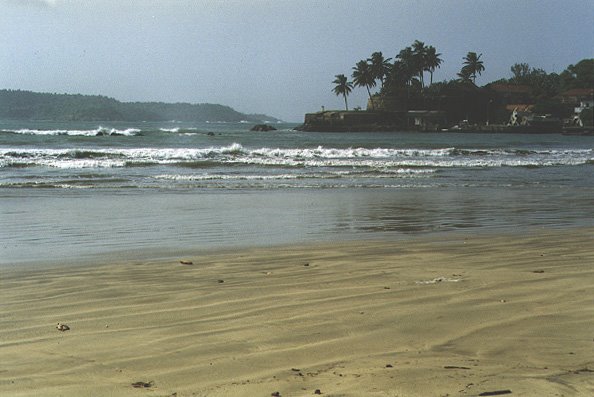 Sri Lanka's first international literary festival is to be held in the historic southern seaside town of Galle, 11-14th January 2007. The exciting line up includes:
William Dalrymple, world renowned ex BBC correspondent & author Sir Mark Tully, Arthur C Clarke, distinguished biographer Victoria Glendinning, Sri Lankan authors Yasmine Gooneratne & Romesh Gunusekera, Christopher Kremmer, Suketu Mehta, Madhur Jaffrey, Nury Vittachi, Deepika Shetty, Elmo Jayawardena and a list of Sri Lankan authors who have won Michael Ondaatje’s Gratiaen Prize over the past years.The festival will also honour one of Sri Lanka's most renown authors Nihal de Silva who was killed this year in a landmine explosion. (I hadn't heard of him before, but anyone who writes and loves birdwatching is close to my heart - right, Glenda?)
Organiser Libby Southwell sent me a press release which I'm happy to pass on, and will let you know more news when I have it.
I'd love to go to this. (Imagine meeting Arthur C. Clarke!) But I just looked at the airfare on MAS. I'd have to write an awful lot of articles to cover that.
Sunday, September 17, 2006
Perfectly Bowled
 My article about Romesh Gunasekera in Starmag today. It's a blend of interview and review. But it definitely suffers from the word limit which is unavoidable with so little space for reviews, but extremely frustrating when the book is as complex and multi-layered as The Match, and you are bursting to say so much more about characters and themes and the writing. Difficult too just to cut out chunks of a conversation with a fascinating writer and reduce them to soundbites.
“Identity is never a one dimensional thing,” says author Romesh Gunasekera, neatly sidestepping my question about whether he sees himself as a British or a Sri Lankan writer. His novels and short stories are set in both places and he clearly relishes the ability to move between worlds without being pigeonholed himself.What I'd have added if the word-limit was unlimited and my editor had put up with self-indulgent meanderings:
His first novel Reef, a lyrical story about memory and imagination, put Gunasekera firmly on the international literary map. The novel was nominated for the 1994 Booker prize, and whilst he says it was wonderful to be shortlisted, he claims that it was “kind of ideal not to have won it because the one or two first time writers who did win it with the first book tended not to have written after that.”
At under 200 pages, Reef is an unusually short novel in an age where fiction writers seem obliged to turn out complex and lengthy tomes. Says Gunasekera with characteristic humility “I didn’t think I had the right to demand someone read a long novel by a writer they didn’t know.”
It is impossible of course to write about Sri Lanka without reference to the atrocities which have been part of its recent troubled history. I ask him whether he felt he had a duty as a writer to make sense of the violence.
“I’m not writing to an agenda, but writing stories that interest me,” he says. “But I also have to write to understand the world I live in and the fact that the world is getting more violent.”
In his earlier works that violence tends to occur outside of the frame of the story, but with its effect and reverberations being felt by the characters in the foreground. It’s his third novel Heaven’s Edge, set in a dystopian fictional country, which deals with the subject more directly. It “explores the whole idea of violence, how it comes into our lives and how man has to come to terms with it.”
Gunasekera says he always has ideas for the next novel are germinating even as he writes current one. “I already know the books I intend to write if I live long enough”, he says. But he finds it hard to talk about the process that he goes through when writing fiction because it’s been different for each book.
“One thing I’ve learned is I don’t know how to do it. I do know roughly how long it’ll take me which is longer than I think. I have a rough idea of how much of my life will go into it. Otherwise when you start any book you are always a novice.
“If you write the kind of books I tend to write which don’t conform to a genre, you start with nothing and you have to invent the way to do it each time. People always talk about giving birth to novels, and I think that there is a similarity. Afterwards you tend to forget what’s involved, how difficult, frustrating and painful it is.”
It’s vitally important for him that the book feels alive for his readers and totally engages them. The key to making this happen is a great deal of revision.
“Unless you are making a Jackson Pollock which is fine in terms of self-expression, creating different worlds does involve rewriting. I’d happily continue rewriting for many more years except that some time it must come to an end.”
Gunasekera’s first book Monkfish Moon established his credentials as a writer of short fiction at a time when it was relatively rare for writers to bring out a collection as a first book, and although he says that he would love to bring out another, it not be commercially viable.
Indeed, the short story has been declared so seriously endangered in Britain that a campaign to save it from extinction has been instigated. But Gunasekera sees the tide beginning to turn with the awarding of an annual short story prize, and with the growth of e-zines and the increasing popularity of the short-short story. He firmly believes the short story is still the best form for the beginning writer to tackle.
I tell him that I read that he’d once warned that fiction can be dangerous because it “opens up things that probably shouldn’t be opened up” and ask him what he meant by that. It’s a theme he warms to.
“Literature should be subversive. When you read a book, you become the story. You can imagine it exactly how you like and no-one can tell you you’re right or wrong. External authority has no place - and this is why in a repressive regime fiction is banned and fiction writers are persecuted.”
And probably the most powerful argument for our need to read good books!
Romesh (in my blog we're on first name terms!) writes about a character who lives between countries and between cultures, and who adopts a home for himself and puts down roots.
I can identify with the sense of dislocation that Sunny experiences, since I'm someone who has moved from one part of the globe to another (UK to here, and a couple of years in Africa in between.) You don't quite belong, either in the place you came from originally - although it represents your roots, and you don't quite belong in your adopted country. You constantly struggle to define who you are.
I know many Malaysians who feel like this. Their roots are in India, China, Indonesia, Pakistan. Their work or student days have taken them overseas, often to Western countries. Some of them emigrate to other countries for a spell or for good, looking for better lives for themselves.
These children of a wider world some unkindly call "bananas" (yellow outside, white inside) when they come home. But skin colour has nothing to do with the colour of the inner self. (If they are bananas, I'm a cheese-sandwich.)
We also absorb cultures through the books we read, the films we watch, the places we travel in our heads. And we decide to deliberately adopt cultures ... and one way of doing this is our choice of sports teams (which neatly brings us back to one of the main themes of the book!)
As Romesh said to me in the earlier interview: "I don't understand what people mean by culture." The more you think about it, the more slippery the concept gets, and the more meaningless terms like "nationality" and "patriotism" become.
I like this slipperiness. I like moving between cultures. But sometimes it can feel lonely too. (What say you?) Romesh captures this feeling so well in the book.
Romesh refuses to call himself a British or a Sri Lankan writer. The first time I interviewed him I was a bit miffed that he was being so unpindownable. After reading The Match, I fully understand.
What else? One thing that struck me reading the book is that Sunny is just so bloody ... ordinary! Heck, my life is more interesting than Sunny's (and that's not saying a lot)! There are times when I want to shake him up and shout in his ear to get a grip on his life, especially when his marriage begins to go down the tubes and he starts to slide into alchoholism. But how well I understand the sense of not being able to communicate what you want to say to someone you love because words are inadedequate. Sunny is so real! A cross-cultural everyman.
Romesh doesn't budge an inch from his viewpoint throught the novel, which gives the novel an intimacy ... and a great honesty. And the writing is of course, beautiful, with the kind of polish that can only come from painstaking revision.
Could wax on and on. But most of you have gone to sleep by now, so I'll stop here.
Would I recommend The Match? Definitely for those who love literary fiction, are fascinated by excellent craftsmanship. Definitely not for those requiring a thrill-a-minute, pacy read!
Saturday, September 09, 2006
Romesh the Wizard!
 Don't miss this account on Zafar's blog of Romesh Gunasekera's reading at the Asian Civilizations Museum’s auditorium last month, it's so beautifully written.
I'm always stumped for how to describe writers physical appearance and it seems presumptuous (for me) even to try, but I think Zafar captures Romesh beautifully:
He has a Harry Potter like intelligent bespectacled face, but his unruly mop of salt and pepper makes him look like a monkish boy wizard who has grown a tad older in his troubled fantasyland ...Well, Romesh does weave magic too!
I loved what Romesh said about belonging :
When I was very very young, reading all sorts of books that I used to come across, I was never where I was reading, I was where I was fantasizing.All readers will surely identify with that!
Tuesday, September 05, 2006
Meeting My Match
Wouldn't it be nice if after finishing a good novel you could somehow hook up with the author and ask all those questions that are burning inside you?
Well, I have the bookholic's dream job. I just finished The Match last night and later this morning will be chatting to author Romesh Gunasekara about it in a phone interview for Starmag. The last time I spoke to him, the book was yet to be launched.
So if you'll excuse me for a while - I have to skip off and prepare my list of questions.
You might in the meantime like to check out Alefiya Akbarally's beautiful pictures of Romesh at Lord's cricket ground here and here.
Related Posts:
Have Pen, Will Subvert 27/11/05
B-Reef Reading 28/11/05
Romesh Revising 25/3/06
String Hoppers 16/5/06
Tuesday, May 16, 2006
String Hoppers
Sharanya's posted up eating a $5 plate of string hoppers, I think of my father by Leah Lakshmi Piepzna-Samarasinha over on our poetry blog : it's all about the power of food to define who we are and to bring back memories.
$5 for a plate of string hoppers? I used to pay - wait for it - £7 (almost RM50!) for a single utthapam when I was back in London, and it was nowhere near as good as the ones I enjoyed at a tatty hole-in-the-wall place in Cheras for less than RM2 ... but somehow still worth it.
My funniest food moment came one day at Heathrow when I was on my way back to visit my family in England. I got stopped by a beturbaned Sikh customs officer who wanted to search my luggage.
Out came all these little plastic bags containing dried leaves and powders and some stinky resinous stuff which he held at arms length suspiciously.
They're my spices, I pleaded. I need to cook my Malaysian food ...
It was such a funny piece of brown/white/asian/British role reversal!
The picture below is Romesh Gunaskera's drawing String Hoppers which I purloined from the South Asia Diaspora Literature and Arts Archive from which I stole pictures of his drafts some time back.
 I'm feeling hungry now!
Saturday, March 25, 2006
Romesh Revising
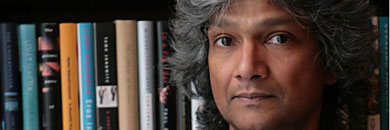 Romesh Gunasekera's long awaited new novel The Match hits the bookstores this month. The novel, set between Sri Lanka, Manila and London reflects the moves that Gunasekera has made in his own life, and draws on the dislocation he felt growing up in an expatriate environment. But he denies that the novel is autobiographical, and tells Judith Palmer in the Independent that he sets out to use a personal geography, rather than a personal history.
He talks too about his attitude to revising his work, honing and revising until the very last minute - tinkering with the text even after the proof copies have been issued. (Much to the delight of his publisher, I'm sure!)
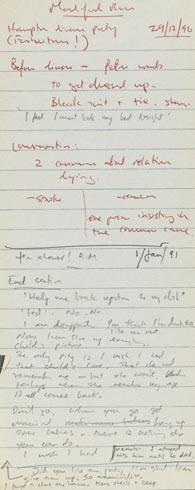 Some time back when I was researching Gunasekera for the article I wrote for the Star I came across the South Asia Diaspora Literature and Arts Archive which has generously put up some of his drafts online so that we can get an idea of how the text has been written and revised. Among the treasures here: handwritten notes for Monkfish Moon and revisions made to pages from Reef.
Note to self: leave wide margins on all draft copies in future for scribbling changes!
Note to self and everyone else: great writers revise, revise, revise and revise and then maybe revise some more. Mediocre writers (including one or two who've passed manuscripts my way) say "Do I really have to?"
Monday, February 20, 2006
A Home for Bookworms
 Continuing the bibliobibuli guide to local bookshops:
I write so often about Silverfish because Raman is the superhero of the book-centric world: the universe knows no peer! Truly.
The shop was in Sri Hartamas in 1999, moved to more upmarket Bangsar a few months later, and occupies the first floor of a shop-lot on Jalan Telawi Tiga, just a roti canai's twirl from Devi's Corner.
Raman moved into publishing in 2000. Revitalised the Malaysian short story in English, long neglected, with his New Writing series. Gave the wannabe-published something to live for. (Which reminds me, the deadline for the next anthology is end March and even those of you who read this blog from the otherside of Pluto can send in stories.) Published books by other local writers. Is perhaps the best person to send a manuscript too if you need a second opinion, though he won't mince words if he thinks it's rubbish. (I do respect his opinions even if I don't always agree with them.) Runs an editing service.
Hosts events for writers - some very famous names have turned up to read and socialise and eat crisps including Bharati Mukherjee, Shashi Tharoor, Tash Aw and Romesh Gunasekera.
Raman also started up the KL International Literary Festival, something that was badly needed in this corner of the globe. (The next festival is glinting in Mr. Raman's eye even as I type this. I seriously better run and hide.) Now he has started up a literary mag. Is there no end?
As a bookshop, it must be admitted, Silverfish is a little run-down, extremely eccentric. (Like it's owner?)
It might be my bad luck but the shoe-mender from the street below always seems to be changing his clothes on the stairs. (He uses the switch-box as his personal locker.) I've stopped apologising for invading his privacy.
Raman's recently partioned off the back room, and now has a space for readings, classes, meetings. He's custodian of a large private library of antiquarian books about this part of the world, and you can sit and read them as long as you like.
The best thing about the shop is that it operates as a meeting place for all kinds of interesting people.Peter Carey and VS Naipaul have browsed the shelves. You might bump into an ambassador or a BBC correspondent or a famous poet or a publishing rep or just another booklover or fictionating scribbler like yourself. Hang out here. Make yourself a cup of tea. Relax.
A woman recently wrote to Raman all the way from Australia to express her concern about the name of the shop. Did Mr. Raman know that Silverfish ate books?
(The one and only silverfish that turned up in Mr. Raman's office one day was treated with the great reverence that befits a mascot.)
Tuesday, January 31, 2006
Dreamer Idiot Tackles Postcolonialism
 One of the most exciting things about this blog is that very often when I post something up, readers drop by to debate a point or add a comment and suddenly there's a dialogue going on from which I learn so much.
The other day I was totally gobsmacked to receive a long and very eloquent e-mail from dreamer idiot who picked up a dismissive comment I made about post-colonialism ( after reading Raman's piece on the term). With his permission I post it up part of his e-mail (but totally forgive those with no interest in literary studies if they choose to tune out at this point - this is the academic stuff after all and not everyone's cup of tea) :
This ... brings me to both Raman’s and your discomfort with the term ‘post-colonial’, which certainly has its many detractors, and as my limited knowledge both as reader and former student of literature would enable me to say, a contested term in literary studies. Yes, the term doesn’t sit well with many readers, but as Mr. Raman pointed out, it has been a helpful, but still problematic term for academics to employ when looking at the writings of writers from post-colonial nations. In the words of Philip Roth (as quoted in your post), I’m probably one of the people that needs be shot. (So, here’s my response to some of Mr.Raman’s partly misunderstood but still legitimate grievances.
You probably know all of these already, but I am just putting everything in as part of my response) The study of post-colonial literature may be traced to the pioneering work of the late Edward Said and the group of Australian literary critics, Bill Ashcroft, Graham Huggan, Helen Tiffin on Australian, African, Caribbean literature (probably Pacific as well) led to the formation of a post-colonial literature as a field of academic study. (There is also Anne Brewster whose PhD research about twenty years ago centred on Malaysian and S’pore literature in English.)
‘Post-colonial’ as a term becomes misleading because of the debates surrounding what constitute the ‘post-colonial’, hence it is probably best, to avoid the confusion and frustration of readers, to say that ‘post-colonial’ is a theory of literature (and culture). By and large, ‘post-colonial’, as the term suggests, examines and explores the social (cultural), historical, economical and political conditions of colonialism that shape the nature of the fictions and poetry that are produced. Although European colonialism may have ended for about a good forty years, the lingering effects of colonialism and the varying responses and reactions to them (again, social, political etc) may be felt and experienced till today. As ‘post-colonial’ is a theoretical framework, it has been used in a variety of ways. Yes, Irish writers like James Joyce and Seamus Heaney are sometimes examined under the term ‘post-colonial’, because their Irish identity stands out markedly and emerges out of a sense of being historically subjected under the English, and in Heaney’s case, the politics of the British and the IRA. Not surprisingly, J.M.Coetzee is also considered a post-colonial (and also post-modern) writer who struggles to make sense and redress or apologise, if you will, for the trauma of colonialism in South Africa.
Mr.Raman’s issue on why ‘post-colonial’ has not been employed for American and Canadian literature is a another good case in point of the problematics of the term. Firstly, there have been critics who have applied ‘post-colonial’ to American literature, but it has been mainly restricted to African-American literature, but the scholarship has not been very productively developed, because African-American literature is unique in its own position of displacement and identity politics (these writers are still American not Africans). Moreover, American literature (and history) has its roots in an Anglo-European tradition, hence it is not exactly ‘colonial’ in that it does not constitute a foreign political and economical (or cultural) imposition or influence. American literature, also, has developed its own voice/s through its writers and poets like Hawthorne, Melville, Whitman and Emily Dickinson, blazing a path and establishing a tradition of its own.
In contrast, Australian literature presents a slightly different situation, mainly because of the complication of its convict history. ‘Post-colonial’ has been used by some literary critics to characterise, describe even white Australian writers (it’s true).Mr. Raman is right on the point that many writers, not just ‘white’ writers, but even writers like Romesh Gunasekera reject such labelling which, though a term of convenience for academic study, can be rather constrictive and limited. With regard to N.K..Narayan, Mr. Raman is mistaken, because he is considered a post-colonial writer. The only reason he does not appear on the list Mr.Raman mentioned is that he is not as widely read or rather taught in literature courses, since most are often only introductory courses to a whole range of post-colonial literatures; and then, those courses are dependent on the speciality of the lecturer. Unless one works specifically on Indian or what is sometimes called South-Asian literature in English, one probably might not read him.
It therefore appears that post-colonial writers belong to a specific ‘species’ of writers, as many have noticed. They are often writers , whom you may prefer to call ‘World writers’ and their works, ‘World literature;, but they have been called ‘post-colonial’, simply because their writing draws upon their ambiguous or double position as writers who are somewhat ‘exiled’ or disconnected from the land of their birth or family’s origin, and being so, feel simultaneously at home and not at home in the ‘First’ World country that they are residing in and from which they write their fictions. ... Another problem with the ‘post-colonial’ is that there appears to be a degree of literary exoticism and orientalism involved, (something Mr. Raman took issue with), which is also probably why Thor Kar Hong picked a bone with what he deems a rather ‘forced’ use and depiction of cultural and temporal setting in Tash Aw’s novel. The term ‘post-colonial’ then turns more contentious, as the politics of reading comes into the picture. Among the criticisms that get levelled is that ultimately the imperial ‘West’ still holds the epistemic ‘power’ in defining and designating what it deems ‘good’ literature. ...
By the way, am I a postcolonial hangover?
Monday, November 28, 2005
Author Pate
 Margaret Atwood once said something along the lines of - "Wanting to meet an author because you like his book is like wanting to meet a duck because you like pate." Strange analogy!
Thanks Reezal for the photo.
B-Reef Reading

There's a special magic about hearing an author read his own words and it was a real treat to listen to Romesh Gunasekera read from Reef both at Silverfish and at the British Council reception Friday night.
It's a book of "memory and imagination ... how you work out who you are and why you're there ..." (Romesh's words) and the characters have taken up residence in my head.
The story is a long flashback, narrated by a Sri Lankan restauranteur living in London after a late night encounter with a compatriot at a petrol station. Triton recalls his life as a houseboy in the employ of Mr. Salgado, an aristocratic dilettante, and how he gradually takes over the running of the household. Triton observes and puzzles over Salgado's relationship with the unconventional Nili, and does his best to lubricate the friendship with wonderous offerings of food (the love cake with extra eggs and freshest butter, the beautiful parrot fish, and of course the Christmas turkey).

It's a novel of great charm and beauty.
Another book of Romesh's that I've greatly enjoyed is Monkfish Moon, his collection of short fiction set between Britain and Sri Lanka. My favourite story is Batik, about a Sri Lankan couple living in London in an apartment they have carefully and lovingly renovated together. But now the news of atrocities committed at home threatens to tear their relationship apart. As in Reef, there's a sense of safety lost, a paradise despoiled.
Truth is held in the smallest of details - the gory dissection of the chicken for dinner, the bruise coloured door, the shards of a shattered cup.
A tiny gem but totally satisfying.
Postscript:
Leon wrote about the Friday night reception at British Council director's place. Since we don't have photos, we have blog memories, Leon.
Sunday, November 27, 2005
Have Pen - Will Subvert
 My article in Starmag today:
Romesh Gunasekera doesn’t believe in pigeon-holing, nor does he write to an agenda.
IDENTITY is never a one dimensional thing,” says author Romesh Gunasekera, neatly sidestepping my question about whether he sees himself as a British or a Sri Lankan writer. His novels and short stories are set in both places and he clearly relishes the ability to move between worlds without being pigeonholed himself.
(British Council Malaysia brought the writer to Malaysia recently; he gave a reading from a selection of his works at the Silverfish bookshop in Kuala Lumpur.)
His second novel, Reef, a lyrical story about memory and imagination, put Gunasekera firmly on the international literary map. The novel was nominated for the 1994 Booker prize, and while he says it was wonderful that it was shortlisted, he claims that it was “kind of ideal not to have won because the one or two first time writers who did win with the first book tended not to have written after that.”
At fewer than 200 pages, Reef is an unusually short novel in an age where fiction writers seem obliged to turn out complex and lengthy tomes. Says Gunasekera with characteristic humility, “I didn’t think I had the right to demand someone read a long novel by a writer they didn’t know.”
It is impossible of course to write about Sri Lanka without reference to the atrocities that have been part of its recent troubled history. I ask him whether he felt he had a duty as a writer to make sense of the violence.
“I’m not writing to an agenda, but writing stories that interest me,” he says. “But I also have to write to understand the world I live in and the fact that the world is getting more violent.”
In his earlier works, that violence tends to occur outside of the frame of the story, but its effect and reverberations are felt by the characters in the foreground. It’s his third novel, Heaven’s Edge, set in a dystopian fictional country, which deals with the subject more directly. It “explores the whole idea of violence, how it comes into our lives and how man has to come to terms with it”.
Gunasekera says ideas for the next novel are germinating even as he writes the current one. “I already know the books I intend to write if I live long enough,” he says. But he finds it hard to talk about the process that he goes through when writing fiction because it’s been different for each book.
“One thing I’ve learned is I don’t know how to do it. I do know roughly how long it’ll take me, which is longer than I think. I have a rough idea of how much of my life will go into it. Otherwise, when you start any book you are always a novice.
“If you write the kind of books I tend to write, which don’t conform to a genre, you start with nothing and you have to invent the way to do it each time. People always talk about giving birth to novels, and I think that there is a similarity. Afterwards you tend to forget what’s involved, how difficult, frustrating and painful it is.”
It’s vitally important for him that the book feels alive to his readers and totally engages them. The key to making this happen is a great deal of revision.
“Unless you are making a Jackson Pollock (the American abstract artist famous for his ‘drip and splash style’), which is fine in terms of self-expression, creating different worlds does involve rewriting. I’d happily continue rewriting for many more years except that some time it must come to an end.”
Gunasekera’s first book, Monkfish Moon, established his credentials as a writer of short fiction at a time when it was relatively rare for writers to bring out a collection as a first book, and although he says that he would love to bring out another, it not be commercially viable.
Indeed, the short story has been declared so seriously endangered in Britain that a campaign to save it from extinction has been instigated. But Gunasekera sees the tide beginning to turn with the awarding of an annual short story prize, and with the growth of e-zines (online magazines) and the increasing popularity of the short-short story. He firmly believes the short story is still the best form for the novice writer to tackle.
I tell him that I read that he’d once warned that fiction can be dangerous because it “opens up things that probably shouldn’t be opened up” and ask him what he meant by that. It’s a theme he warms to.
“Literature should be subversive. When you read a book, you become the story. You can imagine it exactly how you like and no one can tell you you’re right or wrong. External authority has no place – and this is why in a repressive regime fiction is banned and fiction writers are persecuted.”
And that is probably the most powerful argument for our need to read good books!
Thursday, November 24, 2005
Romesh Reads
Book lovers and scribbler-wanna-be's - don't forget that Romesh Gunasekera will be reading tonight at Silverfish 7-8pm. And if you haven't discoverd his books yet - maybe the nice Mr. Raman will have a copy or two left.
I interviewed Romesh yesterday for a feature which should appear this Sunday in Starmag. So today is mad writing day to get my notes in some kind of order.
See you tonight?
I interviewed Romesh yesterday for a feature which should appear this Sunday in Starmag. So today is mad writing day to get my notes in some kind of order.
See you tonight?
Thursday, October 20, 2005
Reading Romesh

Novelist Romesh Gunesekera is going to be in KL next month, his visit sponsored by The British Council. He's participating in the Worlds in Discourse conference organised by Universiti Kebangsaan Malaya (UKM) from 21-23 November.
Mark down 24th November in your diaries because that's when he's going to be reading from a selection of his works at Silverfish on at 7 p.m. .
Romesh was born in 1954 in Sri Lanka and moved to England in 1971. His first novel, Reef (1994), won a Yorkshire Post Book Award (Best First Work) and was shortlisted for both the Booker Prize for Fiction and the Guardian Fiction Prize. You can read more about him and his works here.
I had had Reef sitting on my 'to be read' shelf for a very long time. (More bookguilt!) I picked it up the other day and am really enjoying it. (And it's short - only 190 pages in an age where litfic always seems to be bloated!)
I managed to pick up copies of his Monkfish Moon and The Sandglass at Silverfish. Raman has brought in copies from India so they are a bit cheaper. Guess who's busy doing her homework right now?
Subscribe to:
Posts (Atom)