Showing posts with label writers desks. Show all posts

Sunday, August 03, 2008

Author Mural

A fascination for authors workspaces spills over into art, Eric Konigsburg reports in the New York Times.

Elana Climent's mural At Home With Their Books features six chronologically ordered panels, each depicting authors with a New York connection was painted for New York University's Languages and Literature building.

You can enjoy a slide show of panels featuring Edith Wharton, Washington Irvine, Zora Neale Hurston and Frank O'Hara, each featuring authentic details.

Monday, June 16, 2008

Desk Space

Following the sale of Dicken's desk the other day, Jane Sullivan in The Age meditates on our continuing fascination with the writer's desk. (How would you explain this vicarious interest?)

She mentions the ongoing series in The Writer's Room in The Guardian (not online - and I really hope there an eventual book) in which author's writing spaces are photographed :
Andrew O'Hagan is clearly proud of his desk's Dickensian connection: it used to belong to a Victorian lawyer's office in Doughty Street in London, next door to Dickens' place. O'Hagan has a "crazily tidy" room and he confesses to obsessive-compulsive tendencies: "Every day I write up the two or three biggest priorities on the blackboard, and, even if the tasks aren't completed, I wipe the board clean when I knock off."

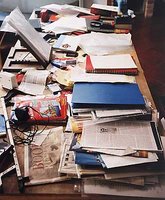
Other writers are much messier. Clutter is the norm. Very few writers go in for state-of-the-art technology or cutting-edge design: most workspaces look like modest makeshift converted bedrooms or student rooms. They are crammed with books, family pictures, children's creations or mementoes of past triumphs that David Lodge describes as "ego salve". The authors often avoid PCs, bashing out their books on typewriters or getting down first drafts in longhand. There are quite a few huge, horrible chairs for bad backs. Some like a room with a view: others prefer a blank wall.

Colm Toibin thinks of his room as a cave: "I have left instructions that I would like to be buried here when I die or a bit before, the cave bricked up." His chair is one of the most uncomfortable ever made: "After a day's work, it causes pain in parts of the body you did not know existed. It keeps me awake."


Some writers don't have a designated workspace, or even a desk. A. L. Kennedy lies down on a monster black leather chair with her laptop in her lap, in a room the colour of blood.
The literary relic with the most resonance for her, she says is Henry Lawson's pen.

Monday, June 09, 2008

Great Desk-pectations

Charles Dickens' mahogany writing desk and walnut chair, handed down through the family, sold for just over $850,000 at auction at Christie's last week. The proceeds go to the Great Ormond Street children's hospital in London.

The buyer, Tom Higgins, made his millions as CEO of a psychic readings business, but plans to use the desk where Dickens penned Great Expectations, to write letters.

Saturday, June 16, 2007

Adichie's Desks

I wrote at the dining table when I could not use my father's desk because he was working or because a sibling was on the phone. The table, light green and long, was the family dumping ground -- of newspapers, university circulars, wedding invitations, bananas or groundnuts bought on the way home -- and the tiny ants that lived underneath it appeared after breakfast to crowd around bits of sugar or bread. I always cleared a space for myself at one end, opposite the grand old wood-paneled air conditioner, used so rarely that a puff of dust always burst out before cool air followed. It was noisy and, during birthdays when the parlor was filled with friends and food, graduations, baby showers for my sisters, the celebratory party when my mother was appointed registrar, there was always a loud vacuum-like sound of the air conditioner in the background.
Chimamanda Ngozi Adichie reminisces about the writing desks where she learned to write in this wonderfully atmospheric piece from The Washington Post.

(Photo taken from Adichie's website.)

Sunday, February 11, 2007

Whose Desk?

Whose writing room? Find out and view even more famous authors' scribbling spaces on the Guardian website. Must say, though, that this is the one I like best. (And the author is one of my favourite people!)

And if you have an interesting space for your literary endeavours, send me a pic or a link and I'll feature it.

Saturday, July 08, 2006

Writer's Desks

Just acquired a copy of Writer's Desks by Jill Krementz - bought second-via Abebooks because it's now out of print. This particular copy formerly resided in the Indiana-Marion County Library and cost me just US$5.

It's a book of photographs of famous writers at their work, and I thought I'd scan in some pages for you with quotations from the text so that you can have a vicarious peep into their writing lives. Then I thought, why not turn it into a quiz? Can you identify who's who in these wonderfully candid shots?

I'll put the answers in the comments section (a neat little trick of Lydia's!)

I just discovered a prayer for writers. ... It was written by Samuel Johnson on April 3, 1753, the day he began work on the second volume of the first dictionary of the English language. He was praying for himself. ... Anyway, this is the prayer: "O God, who hast hitherto supported me, enable me to proceed in this labour, and in the whole task of my present state; that when I shall render up, at the last day, an account of the talent committed to me, I may receive pardon ...."
The only thing I can say is that it takes place - or the best of it takes place in a sort of a vacuum. On the worst of mornings. On the least likely of mornings. When you expect nothing to happen. When the page is blank. When the mind is blank. Even in a state of depression of melancholia. And then, only with good luck ...


I don't take time off or make myself work; I have no work routine. I am compulsive about writing. I need to do it the way I need sleep and exercise and food and sex; I can go without it for a while, but then I need it.

I don't take notes; I don't outline; I don't do anything like that. I just flail away at the goddammed thing ... I'm a salami writer. I try to write good salami, but salami is salami. You can't sell it as caviar.

I surround myself with objects that carry with them a personal history - old books, bowls and boxes, splintering chairs and benches from imperial China. I imagine the people who once turned the pages or rubbed their palms on the surfaces.

Yes, I also love pre-loved books!

Thursday, April 27, 2006

Bright Spark

This is a story I should have blogged before ... but other things got in the way.

Let's start here with this picture of a writing desk much messier than mine (which pleases me no end!) But would that the work that came from mine were anywhere near as good!

It's actually Muriel Spark's desk at her home in the Tuscan village of Citivella, snapped by friend and Scottish journalist Alan Taylor in 2003. For those interested in such details, (and for goodness sake, I am!), she wrote in copperplate handwriting in her favourite spiral-bound notebooks, on just one side of the page and (terrifying this) generally got it right with the first draft!

Born in Edinburgh, Scotland, Spark began her literary career in the 1950s as a poet and biographer but began writing fiction comparitively late in life.

She was 39 and a struggling single mother, and recovering from a breakdown when she won a short-story competition on the theme of Christmas in the Observer in 1951. The piece was The Seraph and the Zambezi, based on her time in Southern Rhodesia (now Zimbabwe) where she had lived with her ex-husband, and was chosen out of nearly 7,000 entries. (The Observer has republished the story.)

She became a Roman Catholic a decision she described as corresponding to what she had always known and believed, and which greatly influenced her life and art. Graham Greene, another Catholic convert provided her with both moral and financial support.

In all, she wrote 23 novels, as well as short fiction and poetry, but is best known for The Prime of Miss Jean Brodie (1961), which took her just six weeks to complete! It's a disturbing story of a charismatic school teacher who exerts an almost godlike influence over a group of chosen students (whom she refers to as "the creme de la creme"). The novel was based in part on Spark's own school experiences where she too came under the spell of a Brodiesque teacher.

The film adaptation of the novel was so good (and yes, it's on that list) that Spark said "A lot of my other books are overlooked due to Maggie Smith. Lots of people think that she wrote it."

Spark passed away, aged 88 on April 13th. Obituaries and tributes flooded the literary pages of Britain's newspapers: author/critic David Lodge calls her:
... a truly original writer, one of those rare figures who change the possibilities of an art form for other practitioners.
while Jenny Turner in The Independent praises her unique narrative voice:
In it's waspishness, its spirit, it's curiously posh-scottish camp, it was one of the great creations of postwar British writing.
Time perhaps to reread her work?

Friday, April 07, 2006

My Writing Space

Starlight wrote the other day about writers and their writing desks and included my description of my writing space.

It fits into the bay window of the bedroom, and has a view out over Rubber Research Institute. (I need daylight!) Here's a photo:

Clutter includes:
  • beach stones and shells and semi-precious stones (for the right energies)
  • wooden hand which I bought from the Tate Gallery
  • my lucky gypsy clothes peg bought from a traveller in London
  • a mug of Chinese tea
  • printouts of stuff I'm supposed to be working on for reading at Borders (oh ye gods, what shall I read?)
  • my cheapo homemade notebooks for guiltless scribbles of nonsense
  • a beautiful much too expensive notebook bound with pea-green cloth bought from Bookbinders on a day when I needed cheering up (it worked)
  • gel pens of all different colours (a whole rainbow)
Notice the absence of a computer - this is the land of paper and pen.

Monday, June 13, 2005

The Loneliness of the Long Distance Writer

If you're in London, you can catch this tribute to the writer's art on Hampstead Heath.

The scultor, Giancarlo Neri calls the design a "monument to the loneliness of writing". It stands 30 feet high.

Hampstead Heath was chosen because of its literary traditions. Writers such as DH Lawrence lived nearby and poets Shelley and Keats strolled together there.

Neri says that the work has been well received by writers:
They all identify with the condition of being prisoners of their desks, of the confinement that it requires to actually write about the outside world. ... The idea was to reverse that sense of captivity and put the writer on public display.
Nice of someone to think about the writer's lonely toil!