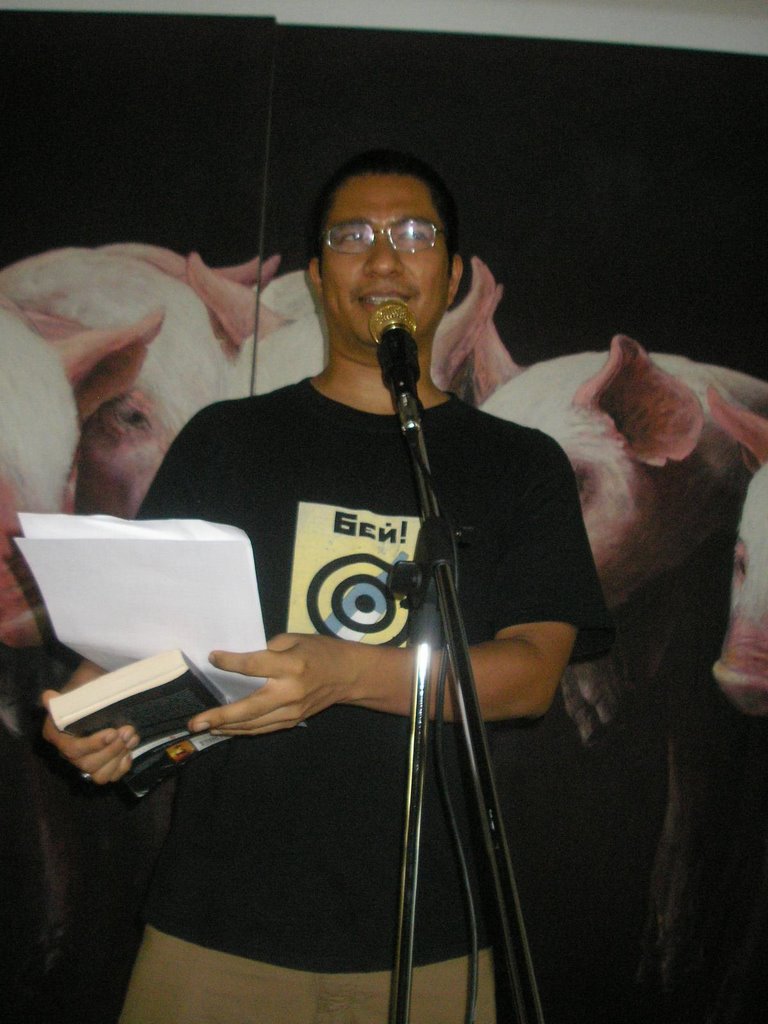
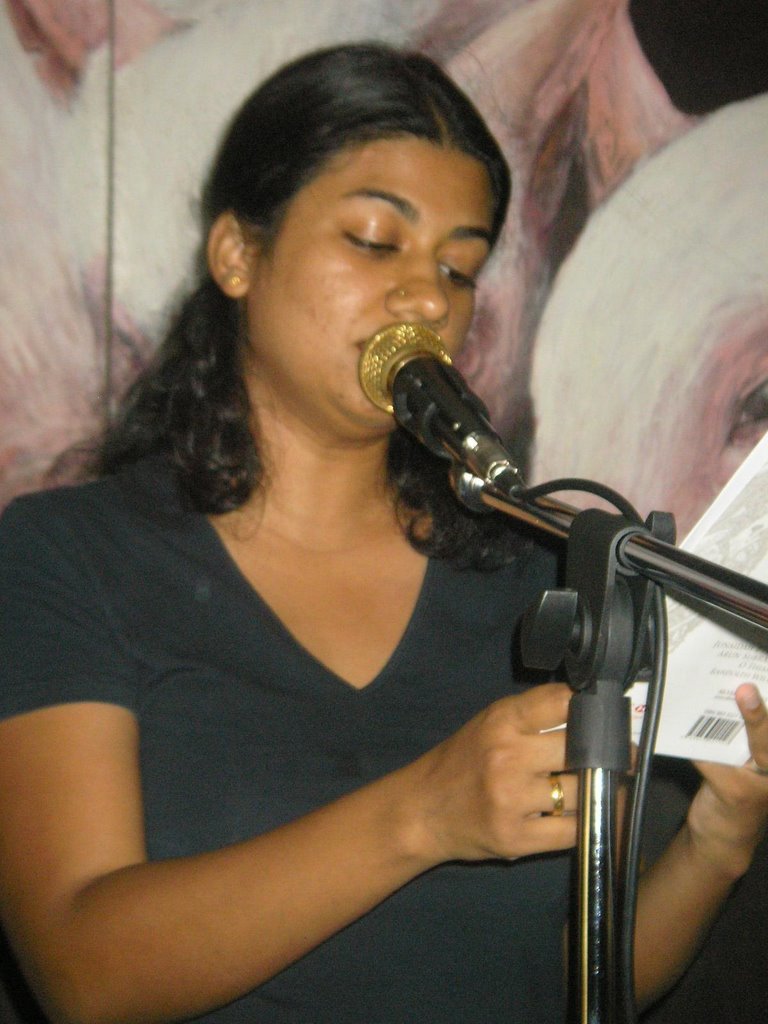
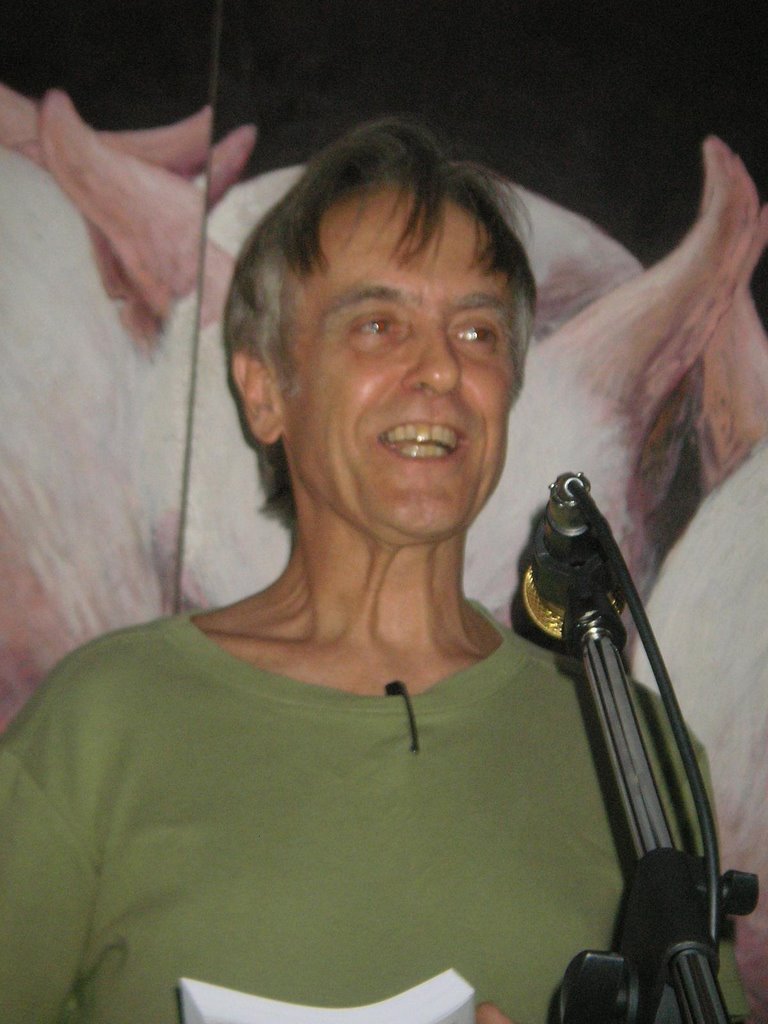
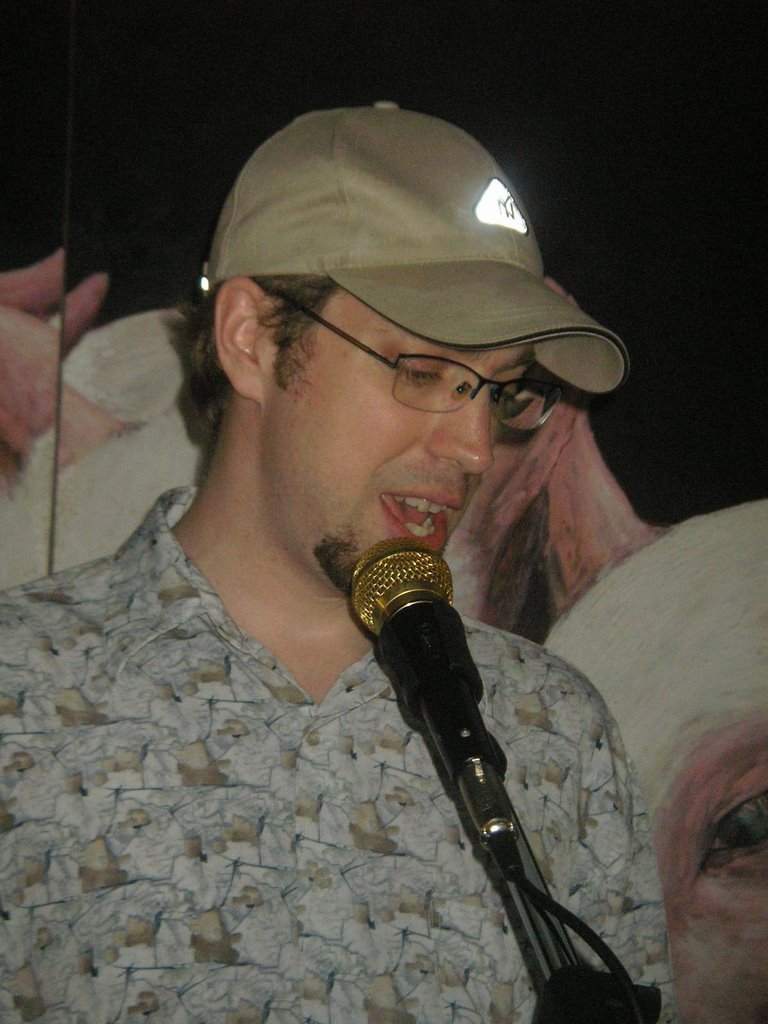
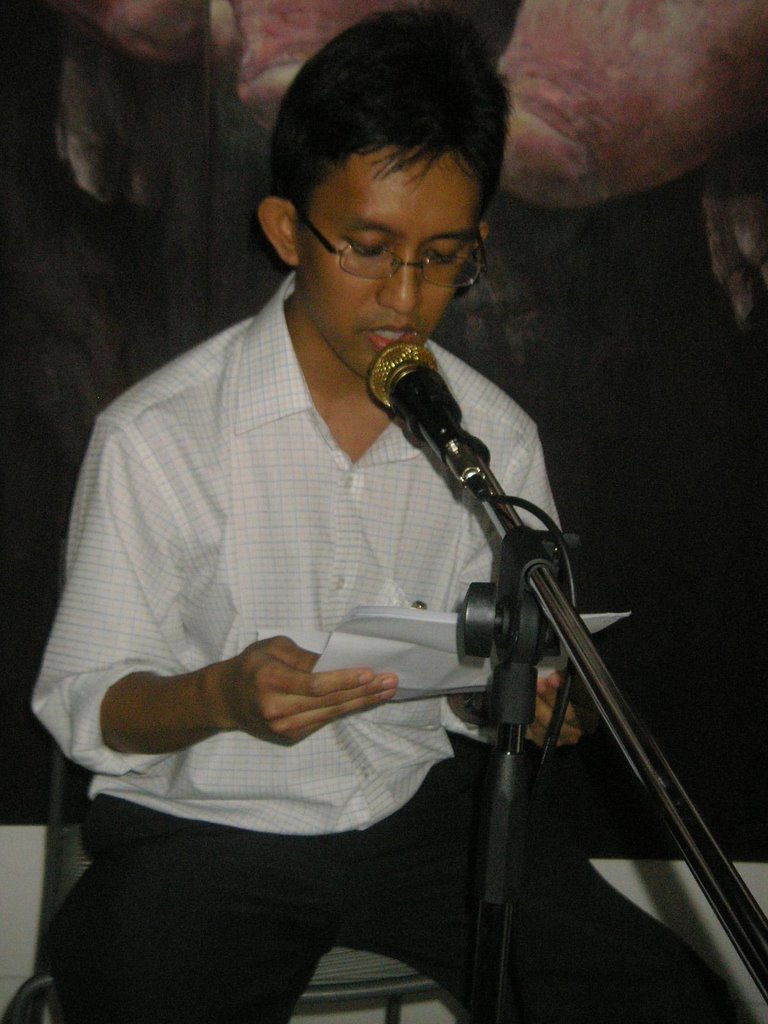
Yesterday's Readings at Seksan's went wonderfully well. My biggest thanks go Reza who took the time and trouble to go shopping for a portable sound system for me, and came up with the perfect solution. For the first time, we were amplified. And what a difference it made! No longer did we have to strain to hear. No longer did we have to much the words of the quietest writers.
It has to be said though that Seksan's doggy (recovering from distemper) decided that he had things of his own to say - though addressed to his friend over the back wall rather than to us. Fortunately, when
Amir Muhammad stepped up to the microphone, he settled down to listen too.
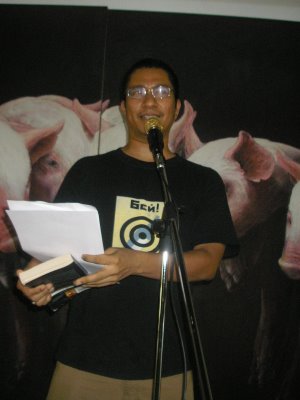
Amir is of course a famous indie film-maker whose work has won international critical acclaim, although at home all he's won
is controversy for
The Last Communist. His next
banned film is
Apa Khabar Orang Kampong and is due to premier at the 57th Berlin Film Festival next month. Amir is
also has a column in the
New Straits Times on Thursdays. (You may not be speaking to the newspaper anymore, as indeed I am not, but Amir's column is a must-read.)
Amir read us some of the pieces that his editor thought unsuitable and very funny they were too. There was a spoof review of
M - The Opera; a news item about folks who move into a house but find themselves under seige by the former occupant who constantly criticises what they are doing to the property; and also a piece entitled (topically enough!)
Should I Sue for Defamation? Apparently, Amir keeps receiving letters from readers who are unclear on the concept of satire, and take his columns at face value. Duh!
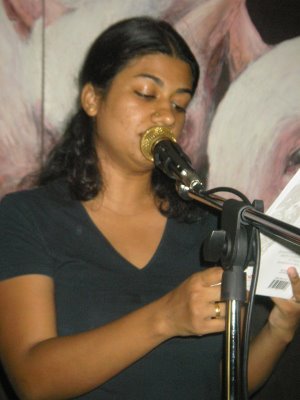
I'm still practising saying
Thaatchaayini Kanantu's full name! I met Thaatch at
the launch party for
Silverfish New Writing 6, and very much enjoyed the extract from her novel in progress. She had agreed to read
In God's Belly later in the year, but when Hsiung Han See called at the last minute to say he wouldn't be able to come, I roped her in for this month ... and she sportingly agreed. Very many thanks, Thaatch!
I like what she wrote
on her blog about writing:
I have 7-tonnes of memories resting in a million buckets and I have no idea how they got there, why they are there and what potential use they have.
Well we know now that sitting in those memory buckets is plenty of raw material for more evocative stories ...
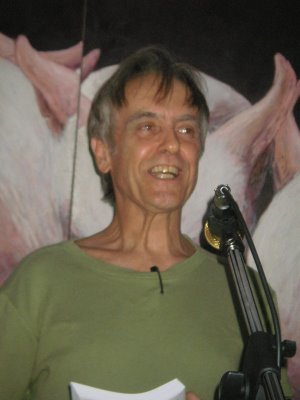
Another writer from SNW6 - Peter Hassan Brown. I've known Peter for years, but as half of the singing duet
Passion with his wife Markiza. Peter read from his short story
Dysfunction, introducing it by saying he had been afraid of a negative reaction to his portayal of the family in the story (the girl
lepaks* at the LRT station, her brother is a drug-addict who steals from the mother to finance his habit), but I think it's a very well-observed piece that really comes alive for me. I loved too his poem
Fritters - about the food and about frittering one's life away in the most enjoyable way.
Peter is now working on a novel.
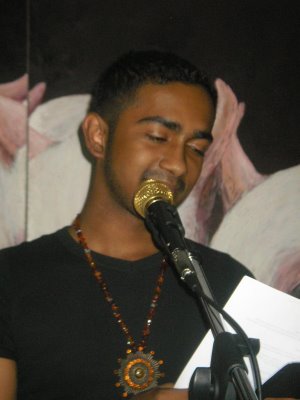
Yes, I know I shouldn't keep banging on about this guy being just 17. What does age have to do with anything? Least of all with the ability to write really well. kG's poems are honest, sexual, often deeply painful and beautifully crafted. He also read an extract from a "long short story".
Okay then, 17 going on 28.
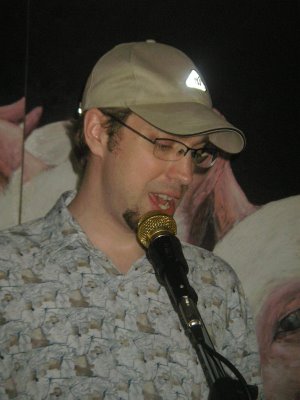
It was great to finally meet Jordan MacVay, after months of reading each other's blogs and exchanging e-mails. Although he confessed to
"sweating like a whore in church" with nervousness, he read really well, the piece beautifully chosen.
Jordan has been working with Rizal, an Achenese tsunami survivor, to tell his story. This extract was amusing in places - especially with the - almost surreal - incongruity of Rizal and his friend floating in the sea and encountering six naked girls floating on a tree. And also deeply moving. (Read Jordan's account of the afternoon
here.)

Burhanuddin Baki has a place on the
MA in Creative Writing at the University of East Anglia for later in the year. And having heard him read his fiction - am not at all surprised that he was selected. What did surprise me was how funny his work is - I'd imagined he would write in a very literary, very serious way from his very learned comments on my blog and from his business card (he has first class degress in Maths and Philosophy! Scary!). The reference to
"the giant millipede" (am sorry, won't explain the context for the more impressionable minds reading this blog) was unexpected - and hilarious! Well, Burhan, just hurry up and give us the whole novel!
What else? It was a very hot afternoon, and I think we were all melting. We had a larger than usual crowd there (around 30), and because of the sound system, they tended to spread out a bit more into all the arty nooks and crannies. The wine this month was rubbish because I bought
el cheapo plonko myself (RM15 a bottle - doubles as drain cleaner) - the La Bodega sponsorship has to be renewed and I'm onto that ...
Thanks to all who read and all who came. (I'm sorry I did not have more time to chat.) Thanks to Seksan once again for the beautiful and inspiring space. Thanks again to Reza for his help. Thanks to Nic for letting himself be bullied into washing glasses and opening wine bottles ... and for keeping me calm ('cos as he noticed I have this tendency to panic and see in my mind's eye everything that could possibly go wrong ... but doesn't).
UpdateJust as well
I escorted Lainie, and Danny off the premises!
kG's thoughts.
Glossary
*lepak = to hang out, but has a very negative connotation, especially in the Malaysian pressL
 Vietnamese-Australian author Nam Le has won the international Dylan Thomas Prize for young writers for his first collection of short stories. The award, worth £60,000 recognises the best young writer in the English-speaking world and ensures that the inspirational nature of Welsh poet Dylan Thomas' writing will live on.
 Here's Nam Le's website for The Boat, where you can read an extract and reviews, as well as more about the author.