Showing posts with label post-colonial theory. Show all posts

Wednesday, February 06, 2008

Burgess Revisited

One wonders why the literary world should tire of such a luminous figure. Is the neglect because Burgess left behind too many books? Or that his particular brand of ugliness is not worth dwelling upon? We're willing to forgive Evelyn Waugh for his racism and sexism, in part because Waugh's talent was more readily apparent. Burgess, by contrast, was a man who made up dialects to fuel his narratives, merged Levi-Strauss's structuralist theory with Joycean experimentalism with M/F, and made no secret of his love of popular fiction. Perhaps such idiosyncrasy in books and in writing are far worse than an author's personal peccadilloes. But these reasons are not sufficient enough to discount a writer who toiled over writing that was original and unusual and different, and who deserves due reconsideration.
Edward Champion's post about the need to reconsider the work of Anthony Burgess on the Guardian blog is a sharp dig in the ribs for me because I have had scribblings waiting in my notebook about this very issue since Rob Spence's lecture at Universiti Malaya last month. Datuk Shan who was also there infallibly reminds me every time we meet that I promised to blog this! And I still owe thanks to Professor Lim Chee Seng who made the whole thing possible.

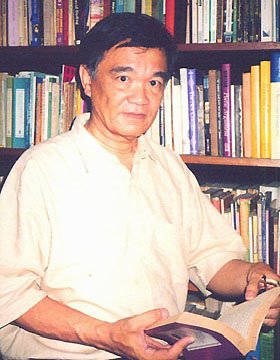
Rob (right) is the kind of academic I appreciate - fascinating, accessible, and very well-researched, and what follows is an extremely potted and pale version of his talk, sketched only in broadest outline and lacking all those examples and details that brought it to life that day at UM.

He talked about the neglect of Burgess in Britain, which is something I hadn't really realised (having been much more concerned about the neglect of Burgess in Malaysia!) noting that the author hasn't been awarded the kind of attention that British authors of a similar stature (e.g. example Graham Greene and Kingsley Amis) have received. And he never received a knighthood or award of the state in Britain, while the critics generally ignored him or were dismissive. Rob notes that there was always a body of opinion which was anti-Burgess.

Until his death, that is. Rob notes the instant revival of interest in Burgess when he passed away in 1993, with the obituary columns unanimous in their praise for him. Apparently the English papers rolled out their major writers including Malcolm Bradbury, A.S. Byatt.

Elsewhere it was a very different story. In Europe he was seen as an intellectual and he was honoured by the French, Italian and Monaco governments. (His most highly regarded work in Europe is Napoleon Symphony: A Novel in Four Movements.) In the US he was a distinguished visiting professor, someone able to stand shoulder to shoulder with the giants of American literature.

What were the reasons for this neglect in Britain?

First of all, he was perceived as an outsider. He had only lived 16 years in the UK after he left the army, mainly because of British tax laws. He also deliberately excluded himself from literary circles which was probably a contributory factor to the pejorative tone with which his works were met in the press.

Then there is the question of the size of his output. Burgess' sheer productivity (he wrote over 30 novels alone!), seemed to annoy many people, and as Rob says, this suggests differences in literary culture. There is the feeling that if you produce that much stuff it can't be all that good.

Rob describes Burgess as very much a "writer for hire" (churning out not only fiction but also film scripts, reviews, criticism, translation, even at one point a company brochure) but says that he feels that Burgess' fictional output was of a consistently high quality. The author had a strict routine of writing 2, 000 words a day and seldom needed to revise his work.

There is apparently still much unpublished material and we can expect some posthumous novels, as well as a revival of interest in Burgess' musical compositions which are also felt to be very important. So, it seems, we have much more to look forward to.

Let me just leave you with the only bit of video footage of Burgess talking I could find on Youtube. He's discussing pop music and modern culture, and this interview from the '60's seems quaintly outdated now, although what he's actually saying holds every bit as true today.

Monday, December 03, 2007

Happy Birthday, Mr. Korzeniowski!

I hope you can find enough space on your cake for all 150 candles, Mr. Korzeniowski. Or would you rather that we called you by your later name, Joseph Conrad, which you adopted when you became a naturalised Brit in 1886?

You're undoubtedly an inspiration to every would-be writer here who struggles with eccentricities of English grammar and vocabulary. You didn't even begin to learn the language until you were in your twenties ... and yet became one of the greatest writers of the C20th, critically praised for your style and precision.

I had to read Heart of Darkness as a set text three decades ago, but this story of a journey up the Congo and into the nature of evil affects me profoundly even now. But I never did think that Francis Ford Coppola's film, Apocalypse Now, which was based on it (albeit with a setting shifted to Vietnam) even remotely matched up.

Of course, in this part of the world we have particular reasons for celebrating your birthday: a large proportion of your work was set in:
... the Eastern Seas from which I have carried away into my writing life the greatest number of suggestions.
This excellent New Straits Times article about your connection with the region points out that:
Although Conrad only spent about eight of his 20 years of sailing in the “Malay World", his experiences inspired him to start writing and formed the setting for novels such as Lord Jim, Victory and The Shadow-Line.

The people he met can be seen in his work. For example, the real-life Captain William Lingard in Sarawak was the model for Captain Tom Lingard, the central character in a trilogy — Almayer’s Folly, An Outcast of the Islands and The Rescue. Conrad also referred to “an English Rajah” in Kuching, Sir James Brooke, in Almayer’s Folly.

The novelist was aware that the Malays — whether of Bugis, Sulu or Javanese origin — were all “Mohammedans” (the term used for Muslims at that time), says Dr Agnes Yeow, head of the Department of English at Universiti Malaya.

She points out that his tales are “punctuated with hajis, pilgrims both returned and en route, invocations to Allah, as well as references to pilgrimage, the Holy Shrine and the Quran".

The Chinese are also found in most of his tales from this region, ranging from waiters, cooks, tellers, labourers, rickshaw-pullers and boatmen at one end of the spectrum, to a small group of Chinese who made their fortunes and became upwardly mobile, notes the academic whose PhD thesis was Envisioning the Malay World: A Study of Conrad’s Eastern Tales.

And Conrad also includes the Straits Chinese whose ancestors had settled in the Malay World for more than a century. They were Chinese by descent, had intermarried and interacted with the Malays, and were politically allied to the British.
The article also suggests that your work helped to sow the seeds of independence in this part of the world, by being critical of colonialism in your work. (It's a point of view, by the way that Ng Tze Shiung on the NST letter page objects to a few days later ... )

What's the truth? I think that we should reread your work and decide for ourselves!

So, a very happy birthday. And thanks.

*I am very sad that I missed the travelling exhibition Joseph Conrad: Twixt Land and Sea held in November at Times bookstore at the Pavilion Kuala Lumpur, Bukit Bintang. I just didn't know about it! (Times - why don't you have a mailing list, and why don't you slip the word out to bloggers????)

Monday, May 28, 2007

Malaysian Gothic?

One of the nice things about having this blog is that I have interesting people from across the world getting in touch to ask questions or share experiences.

Gina Wisker of Anglia Polytechnic University in Cambridge wrote to say that she's looking for Malaysian women writers, especially those who use post-colonial gothic in their work.

Now this had me stumped. I know what post-colonial means. I know what gothic means.

But post-colonial gothic?

Gina patiently filled in the gap in my ignorance. She reckons that the term was first coined by David Punter, and :.
.. it suggests that colonial and imperial spaces are haunted by silenced and returned ghosts of a hidden past. ... I also use it to look at how postcolonial writers use images of vampires, ghosts, zombies, werewolves etc etc, witches, myths, spider women and so on writing against the impacts of colonialism and imperialism through looking at power and so on which relate to ethnicity, cultural difference, gender. Usually the writers are using myths and images and writing about their own lives and hidden histories - examples would definitely be Beth Yahp's Crocodile Fury on which I've written a couple of times, and Tash Aw's The Harmony Silk Factory but also much of Catherine Lim's work ...
So the short question is does anyone know of Malaysian women writers who supernatural elements in their work?

Monday, April 16, 2007

Pascakolonialisma in Pink

The latest issue of Quill is yours for free if you flash your MPH card, and a mere RM8 if not.

It's crammed with so much good stuff I don't know where to begin.

I loved Eric Forbes' article on the short story, chock full of excellent reading recommendations which I would love to see the bookstore promoting! He also gives sterling advice about how to submit your manuscript.

It's a Long way to the Floor author David Byck explains about how he got started. Tan Twan Eng talks about the writing of The Gift of Rain, and FireWife author Tinling Choong (who will be visiting Malaysia in July) is interviewed at length.

Dina Zaman and Tunku Halim debate about whether you would take a look at the book a person reads before you decide to get married to them. Pragmatists both. (I think books are windows to the soul ... should have thought twice when I found only war stories on my beloved's bookshelves!)

The Ambassador for Mexico, H.E. Alfredo Perez-Bravo reveals his love for Octavio Paz, Marques, Vargos Llosa and Carlos Fuentes (good for him!) and talks about Umberto Eco's The Name of the Rose as the ultimate airport novel (CSI Medieval Italy!).

There's a long interview with Farish Noor, and Dr. Faridah Manaf writes a very interesting piece about gender, race and nationalism in post-colonial Malaysia. Am most impressed that the Malay word for post-colonial is pascakolonial, which I will now slip into conversation with the gardener.

Yours truly writes about why Writers Need Friends which I dedicate to my scribbling running mates. (Saras, Mercy, Soo Choon, Leah - you're famous now!). My pics of the Night of the Living Text event are in there too.

But as I told you, my article on book banning ironically got censored out.

That doesn't surprise when the PM himself graces the cover, holding the book of tributes for his wife Datin Paduka Seri Endon who died of cancer in October 2005. The book A Bouquet of Jasmines. (Yes, "jasmines" with an "s"! - a big fat grammar blooper in the title!) was launched at a grand gala evening where everyone who is anyone wore pink and drank pink drinks (think Barbie!).

(Sorry, sorry ... I don't know where such cynicism comes from.)

Friday, February 09, 2007

Did Burgess Get it Right?

Rob Spence asked a very good question in the comments a couple of days back. Referring to The Malayan Trilogy by Anthony Burgess, he asks:
What does the average Malaysian make of Burgess's portrayal of the place?
meaning of course, Malaysia.

Rob is a UK academic, and Burgess his area of special interest, so the question is a particuarly pertinent one (and you never know, might end up in a research paper!).

All I can say is that the local readers I know (including the members for my book club) have very much enjoyed it, and were not offended by its portrayal of the different racial groups. There are those in academia apparently (or so Faridah informs me) who consider the book a nasty bit of orientalism especially as it propagates "the myth of the lazy native", and have had a nice bit of post-colonial revenge on the text. (I want to follow this up.)

But I'd like to throw the question open to those of you who have read it.

BTW I've just finished writing an article for Kakiseni about the book and the banning thereof and it will be up as soon as the site is revamped.

And if we can get the status of the book sorted out, I suggest that we have a KL readathon of the book and a public debate later in the year. Who's up for it??

Tuesday, February 06, 2007

A Blog of Influence

Don't believe this ... Amir just left a comment to say I was listed as one of the 50 most influential blogs in Malaysia on Sabahan.com. And there I am at number 36!!!! This time he uses Technorati to tally the list.

It's very exciting, especially as the focus here is on things literary. Especially as I sometimes bore the pants off you by writing about Patrick White and post-colonial literature!

I have nowhere near the number of hits per day of many of those higher on the list (I read in the NST that Paul Tan gets 20,000 hits a day) but it is so good - and humbling - to have been linked by so many people.

By the way, I switched to the new Blogger last night and am so happy with it. Those of you who said there's not much difference, probably have a lot fewer posts to juggle. Tags are going to make it so much easier to find things again. Readers looking for information via Google are going to be able to find all my posts on a particular topic easily rather than just one of two. I've already added a whole lot of tags - playing with my new toy!

Must be very careful to spell names right in my tags though. Upset poor Pang a bit by getting his name wrong ... Very very very sorry.

I ought to put up some advertising and make some dosh ... but I've always held off, thinking it didn't look aesthetically pleasing ...

Friday, February 02, 2007

A Women's History of Malaysia

Farish Noor is calling for papers and articles for a publication to be entitled A Women's History of Malaysia from the Post-Colonial Era to the Present which Farish will be editing with Rachel Leow. The reasoning behind the project?:
Malaysian history, like the official history of many postcolonial societies, is narrow in focus, overwhelmingly political, and dominated by the unstated assumptions of those who write that history. More often than not, these mainstream narratives have ignored large areas of the past that are either not perceived to contribute to national history or run counter to the cultural, linguistic, class and gender leanings of the historians themselves. Official Malaysian history is no exception. The history of women in Malaysia, in particular, has hitherto received desperately little attention by historians and contemporary scholars.
The book is slated for release by Silverfish, later in the year.

More information available on The Other Malaysia website.

Tuesday, January 16, 2007

A Malaysian Literature?

Former DAP MP Sim Kwang Yang writes about all that ails local literature in his column An Examined Life in Malaysiakini (subscription needed to read the whole piece).

He talks about the divided nature of the Malaysian literary community:
The obvious problem is with the very existence of anything that we can recognise as Malaysian literature. Obviously, there is a body of Malay literature, especially that promoted by the Dewan Pustaka dan Bahasa. All the Chinese newspapers give plenty of space for aspiring writers to develop their talents. I am sure the Indian community also have some literary activity. But do we have a Malaysian literature - for all Malaysians?
He points to a lack of a readership for the local product, rather than a lack of local talent, as being at the heart of the problem. He also mentions Chinese novelists who have gone on to find more fertile ground in Taiwan (and I would so love to know more about them).

Can we blame the political climate for the lack of literature? No, he says:
Something is wanting in our national soul. ... It is all too easy to point to the politics of race and the ensuing repressive climate that stifles the freedom needed for artistic creativity. There is some thing in that. Ours is a much politicised society. When Eric Hobsbawm’s “official nationalism” has invaded and permeated all the public space of the individual at all social and cultural levels, the creative impulse that must spring forth from the nadir of individuality must die a slow death.

On the other hand though, contradictions and adversities are the raw materials of which great novels and poems are made. The ridiculous contradictions of racial unease were given a humorous treatment by Anthony Burgess in his Malayan Trilogy, even if he was also not impervious to racial stereotyping. From the perspective of Edward Said’s post-colonial critique, Burgess was also guilty of telling his story from the colonizer’s point of view. But at least, you can credit Burgess for giving a more human face to the Malayan ‘natives’ than Conrad or Maugham had ever done.

Beside, literature seeks to uncover the truth. Or at least literary endeavour tries to unravel the enigmatic nature of truth. Sometimes, artists must address themselves to the power-that-be. Often, the voices that tell that important story are more powerful than the power that tries to silence them.
He gives the example of writers in the Soviet Union during the communist era - the regime was oppressive, but great literature flourished underground. We have nothing like that level of oppression, and produce much less.

I think that what he says next really hits the mark:
At the end of the day, I think our failure in producing any Malaysian literary classics can be attributed to our failure at building one nation out of a culturally and linguistically diverse population.

It would be very hard for any aspiring writer to escape from the walls of his ethnic prison. The object of his concern is largely limited to his life-experience within his ethnic enclave. His theme, narrative, and the tonality of his treatment are almost bound to be ethnic biased.

Even if the writer wants to step out of his ethnic circle, and venture into the Malaysian form of life that crosses ethnic boundaries, he would be deterred by a whole host of racial and religious sensitivities. There is little room for experimentation. Even when no mistake has been committed, the poor writer may have to confront an angry mob at his front gate demanding his head as punishment for his perceived or imagined insults against certain race or religion.

Of course, there is the problem of language.

I also know of Chinese writers who are trying to write in Bahasa Malaysia. BM is a beautiful language in the right hand, but it has been deadened by politico-bureaucratic usage. The national language is so politicised that people of non-Malay descent will harbour great resistance in using this language for purposes other than official communication .... In any case, literary works that are not produced in BM will be sidelined, because that is the social reality in Malaysia.
The solution?:
Given the splintered nature of our Malaysian linguistic universe, perhaps English is the only suitable medium for the birth of a great Malaysian literature.
And he suggests Malaysiakini hold a writing contest, not at all a bad idea.

But I would say that perhaps one of the most pressing needs is for dialogue. There are, as Sim says, different writing communities who do not know what other writers are doing, and surely the time has come to address that?

(Many thanks to Terri for pointing out this article to me!)

Wednesday, December 27, 2006

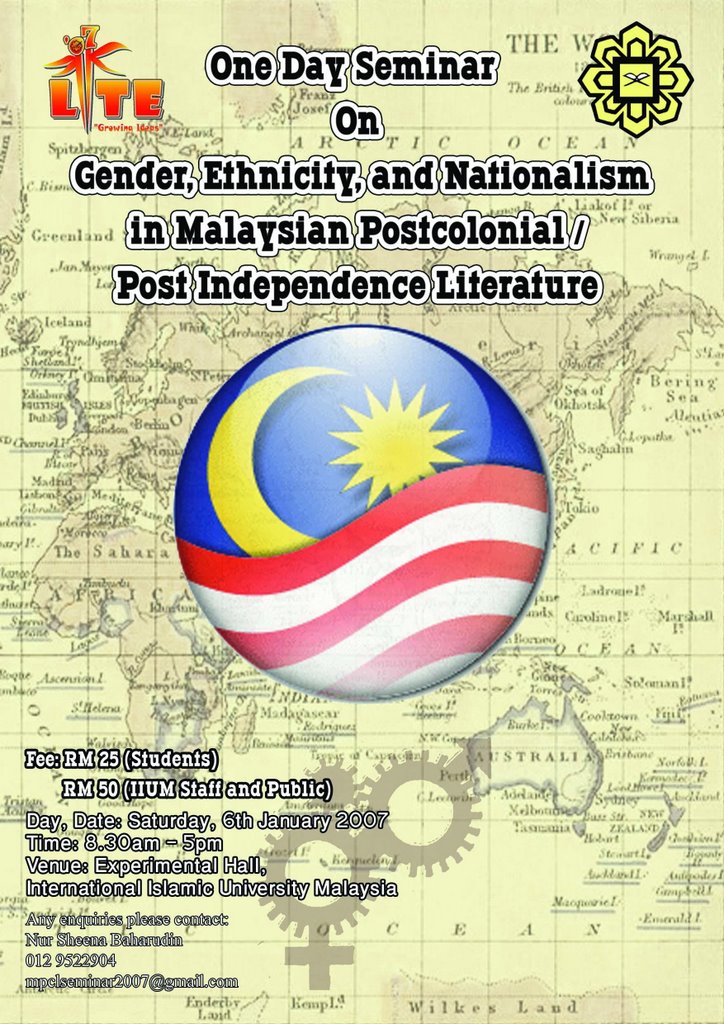
Seminar - Post Colonial Malaysian Literature

Poet and academic Faridah Manaf sent me details of a literature seminar to be held Saturday 6th January at the International Islamic University. Speakers include playwright Kee Thuan Chye and poet Wong Phui Nam.

Contact details are on the poster (click and click), and on Faridah's blog.

Maybe I'll see you there?

Friday, October 27, 2006

Farish at Silverfish

There's a launch with a difference tomorrow evening at Silverfish when writer/intellectual Farish Noor will be launching a new website:
... set up by a number of Malaysian scholar-activists and volunteers with the simple aim of providing other sources of information for those who are interested in unearthing aspects of Malaysian history, politics and culture that have thus far been sidelined, marginalised or erased in the official historiography of the post-colonial state.
Admission is free. But do RSVP Usha/Phek Chin, tel: 03-228 448 37, before Friday 27th Oct 2006 due to limited space.

Sunday, August 20, 2006

English as Colonial Leftover

In today's New Straits Times a piece on post-colonial Malaysian poet Wong Phui Nam, which sadly does not seem to be on the newspaper's website. (Frustration!) There's a wonderful line in Wilson Henry's article about Wong choosing his words in the interview as carefully:
... as if he were picking jewels from a Nepalese trader.
Poetry is catching, it seems!

Wong was born in Kuala Lumpur in 1935, a fifth generation Straits Chinese. His struggle with his identity and ethnicity lie at the core of his work. He graduated in Economics from the University of Singapore and went into banking a post in a bank, writing poetry in his spare time.

He says:
I write in English and how many read in English or are even interested in English poetry? We have lost three generations of Malaysians who studied in the national medium.

After May 13, the question, the question of what language I was forced to write in was forcefully brought home to me. I no longer wanted to write, at least in a language I was told was a colonial leftover. The National Language Policy and other policies on national unity, culture and economics made me reassess what I was doing. I began to question the validity of the language I was writing in.
His self-imposed exile from writing lasted 15 years until Edwin Thumboo in Singapore invited him to contribute some of his work to a collection. His work appeared in numerous journals, and is taught on university literature courses. His poems have also been collected in An Acre of the Day's Glass, and he has recently completed a verse-drama Anike, to be performed next year.


Related Post

Write in English? Don't be so Disloyal! (22/8/05)

Tuesday, January 31, 2006

Dreamer Idiot Tackles Postcolonialism

One of the most exciting things about this blog is that very often when I post something up, readers drop by to debate a point or add a comment and suddenly there's a dialogue going on from which I learn so much.

The other day I was totally gobsmacked to receive a long and very eloquent e-mail from dreamer idiot who picked up a dismissive comment I made about post-colonialism ( after reading Raman's piece on the term). With his permission I post it up part of his e-mail (but totally forgive those with no interest in literary studies if they choose to tune out at this point - this is the academic stuff after all and not everyone's cup of tea) :
This ... brings me to both Raman’s and your discomfort with the term ‘post-colonial’, which certainly has its many detractors, and as my limited knowledge both as reader and former student of literature would enable me to say, a contested term in literary studies. Yes, the term doesn’t sit well with many readers, but as Mr. Raman pointed out, it has been a helpful, but still problematic term for academics to employ when looking at the writings of writers from post-colonial nations. In the words of Philip Roth (as quoted in your post), I’m probably one of the people that needs be shot. (So, here’s my response to some of Mr.Raman’s partly misunderstood but still legitimate grievances.

You probably know all of these already, but I am just putting everything in as part of my response)
The study of post-colonial literature may be traced to the pioneering work of the late Edward Said and the group of Australian literary critics, Bill Ashcroft, Graham Huggan, Helen Tiffin on Australian, African, Caribbean literature (probably Pacific as well) led to the formation of a post-colonial literature as a field of academic study. (There is also Anne Brewster whose PhD research about twenty years ago centred on Malaysian and S’pore literature in English.)


‘Post-colonial’ as a term becomes misleading because of the debates surrounding what constitute the ‘post-colonial’, hence it is probably best, to avoid the confusion and frustration of readers, to say that ‘post-colonial’ is a theory of literature (and culture). By and large, ‘post-colonial’, as the term suggests, examines and explores the social (cultural), historical, economical and political conditions of colonialism that shape the nature of the fictions and poetry that are produced. Although European colonialism may have ended for about a good forty years, the lingering effects of colonialism and the varying responses and reactions to them (again, social, political etc) may be felt and experienced till today. As ‘post-colonial’ is a theoretical framework, it has been used in a variety of ways. Yes, Irish writers like James Joyce and Seamus Heaney are sometimes examined under the term ‘post-colonial’, because their Irish identity stands out markedly and emerges out of a sense of being historically subjected under the English, and in Heaney’s case, the politics of the British and the IRA. Not surprisingly, J.M.Coetzee is also considered a post-colonial (and also post-modern) writer who struggles to make sense and redress or apologise, if you will, for the trauma of colonialism in South Africa.

Mr.Raman’s issue on why ‘post-colonial’ has not been employed for American and Canadian literature is a another good case in point of the problematics of the term.
Firstly, there have been critics who have applied ‘post-colonial’ to American literature, but it has been mainly restricted to African-American literature, but the scholarship has not been very productively developed, because African-American literature is unique in its own position of displacement and identity politics (these writers are still American not Africans). Moreover, American literature (and history) has its roots in an Anglo-European tradition, hence it is not exactly ‘colonial’ in that it does not constitute a foreign political and economical (or cultural) imposition or influence. American literature, also, has developed its own voice/s through its writers and poets like Hawthorne, Melville, Whitman and Emily Dickinson, blazing a path and establishing a tradition of its own.

In contrast, Australian literature presents a slightly different situation, mainly because of the complication of its convict history. ‘Post-colonial’ has been used by some literary critics to characterise, describe even white Australian writers (it’s true).
Mr. Raman is right on the point that many writers, not just ‘white’ writers, but even writers like Romesh Gunasekera reject such labelling which, though a term of convenience for academic study, can be rather constrictive and limited. With regard to N.K..Narayan, Mr. Raman is mistaken, because he is considered a post-colonial writer. The only reason he does not appear on the list Mr.Raman mentioned is that he is not as widely read or rather taught in literature courses, since most are often only introductory courses to a whole range of post-colonial literatures; and then, those courses are dependent on the speciality of the lecturer. Unless one works specifically on Indian or what is sometimes called South-Asian literature in English, one probably might not read him.

It therefore appears that post-colonial writers belong to a specific ‘species’ of writers, as many have noticed. They are often writers , whom you may prefer to call ‘World writers’ and their works, ‘World literature;, but they have been called ‘post-colonial’, simply because their writing draws upon their ambiguous or double position as writers who are somewhat ‘exiled’ or disconnected from the land of their birth or family’s origin, and being so, feel simultaneously at home and not at home in the ‘First’ World country that they are residing in and from which they write their fictions.
... Another problem with the ‘post-colonial’ is that there appears to be a degree of literary exoticism and orientalism involved, (something Mr. Raman took issue with), which is also probably why Thor Kar Hong picked a bone with what he deems a rather ‘forced’ use and depiction of cultural and temporal setting in Tash Aw’s novel. The term ‘post-colonial’ then turns more contentious, as the politics of reading comes into the picture. Among the criticisms that get levelled is that ultimately the imperial ‘West’ still holds the epistemic ‘power’ in defining and designating what it deems ‘good’ literature. ...
dreamer idiot - am most touched to think that you've taken the time and trouble to fill in the (clearly considerable!) gaps in my knowledge of the subject.


By the way, am I a postcolonial hangover?

Sunday, January 22, 2006

Coming to Terms

The Silverfish litmag both online and in its printed form (pickupable from the the shop) is growing ever more substantial and interesting, and the website is now much less clunky. Not bad for a publication that's effectively a one-man show, (though one of my reviews is in there, and a good short story by Robert Raymer).

Raman has also slipped in a couple of eloquent sound-off pieces. He takes issue with the term "creative writing" and talks about how creative writing courses are invariably rip-offs creating unreal expectations for those who just want easy fixes, while the charlatans who teach such course just run away with the money, I suppose.

The article by Sam Sacks that Raman refers to is well worth a read. It highlights the dangers of formulaic teaching of creative writing "rules", resulting in a homogeneity of style which can undoubtedly be seen in much recent American writing. (Golden's Memoir's of a Geisha is wonderfully formulaic, for example, and he was a product of such a course.)

The UEA course on the other hand has continued to turn out distinctive writers, Rattawat Lapcharoensap, Tash Aw, Diana Evans, Tracy Chevalier, Andrew Miller, and Toby Litt. My favourite new writer of last year, Marina Lewycka did the creative writing MA at Sheffield Hallam University. (Not Union Jack-waving here but.)

As Tash said on that occasion at Silverfish :
No-one's ever going to teach you how to write. The (UEA) course makes you look at your own work and develop critical skills very quickly.
And that really is the heart of the matter. Rule bound formulaic teaching vs. providing the opportunity for writers to discover what works for them, and what doesn't, in a relatively unstressful environment.

There are courses and there are courses, then. Teachers worth their salt need to constantly reevalaute their methodology and ask themself the toughest of questions - what kind of writers are we producing? The UEA course is clearly doing something right: the Iowa Writers workshop perhaps not.

I could argue much further but won't. Raman's piece is well worth a read, and you might also like to look at some of my previous posts about creative writing courses.

Raman's other rant is against the term post-colonial literature. And here, I agree with him entirely. I guess it's just that those who spend time in the academic pursuit of Literature (with a big L) need lots of funny expressions that make the rest us mere readers feel like ignorant yoiks.

Monday, August 22, 2005

Write In English? Don't be so Disloyal!

Does the fact that writers choose to write in English show a basic disloyalty to the national language? And is this anyway a tired old debate with little relevance?

I'm sitting on the sidelines and letting others kick up dust, since I'm a Mat Salleh and a post-colonial hangover anyway. (And besides, how many more problems does the local writing scene need? I mean really, why add guilt to the heaps of practical problems writers face getting their words out there?)

All of this of course springs from responses on my entry the other day about Nisah Harun's article about recognition for local writers. I'm really glad that Rem ("The Naked Climatologist!" - how sexy is that?) and Clarissa Lee dropped by to add eloquent and thoughtful responses. Please do go and read.

I dug up a couple more interesting takes on the same issue - both from the archives of Kakiseni. The first is from a 2001 interview with local playwright Kee Thuan Chye:
Kakiseni: What problems do you have as a writer of fictive or creative work? Is there mental and intellectual space to thrive as a creative writer within the Malaysian 'space'?

Kee: I'd say the biggest problem would be you're not encouraged in this country if you write in English. Now, it's better. There's more acceptance. (But) I have sometimes felt I was not doing the right thing still continuing to write in English - in what was considered the colonialist language.

I began writing during the time when there was (a sense of) 'nationalistic fervour', and I felt that I was not patriotic enough. You felt guilty that you were not writing in the national language. As a child who grew up in English, with Malay being taught as a language, people of my generation didn't take it (Bahasa) seriously enough. (However) it would've been foolhardy to try to write in Malay. I would never have cut it if I had written in Malay.

National literature was considered to be Malay literature. Other literatures were considered sectional, or 'other' literature. As a person who writes in English, I felt very marginalised - not accepted, not recognised. And even till this day, writing in English is still not fully recognised. That should not be the case. The person writing it is still Malaysian. The concerns are still Malaysian concerns. The ethos could be very Malaysian too.

The second is an article by Zedeck Siew about his impressions of the KL Litfest last year where Identity was one of the main themes:
Zedeck concludes (good for him!) by saying:
To National Laureate Professor Muhammad Haji Salleh: I'm going to try for a part in your truly Malaysian Canon. And I'm going to write in English.

The trouble with the debate about which language to write in is that you can continue arguing yourself round in circles while nothing much changes. And what really is the dilemma? We need excellent writing in both English and Malay. And all writers, no matter what language they choose, should be cheering each other on.

Wednesday, August 03, 2005

On Not Conforming to a Stereotype

Sometimes I wish my life had been more tragic ...
... writes Nigerian writer Doreen Baingana in this article from yesterday's Guardian.
This is because my audience expects me, as an African writer, to regale them with tales of hunger, war and catastrophe. ... felt as if I had been invited under false pretences. I should have been born in a poverty-stricken village, brutally circumcised with a blunt, unsanitised knife with other five-year-old girls, then, a few years later, kidnapped by child soldiers, becoming a sex slave of a rebel commander before escaping dramatically and trekking through the dry bush for miles and months until I was rescued by foreign aid workers, "rehabilitated" and adopted by a gracious American family. I would end up triumphant and grateful in the US and living to tell my story; which is, of course, a story worth telling.
Writers from the "developing world" are too often expected to support myopic western views of what their part of the world and their literature is supposed to be like: Africa is impoverished; Asia is "exotic"; all Latin-Americans write magical realism.

Baigana says that African writers should counterbalance the view of the continent given in media portrayals:
As an African writer, I pluck what I know and throw it into a pot with what I don't and what I conjure out of nothing and dreams. I shake in all sorts of spices, grains, water, salt and lies, African or not, and try to create a new stew with new flavours every time. I ask my audience to demand this much of me and other African writers. To expect so much more than yesterday's leftovers: the newspapers' diarrhoeic stream of problems and problematic stories. Let's imagine together all the possible and impossible ways individuals try to make sense of themselves and their worlds, African or otherwise.
I'm glad that she also questions that tired old label "postcolonial", so beloved of literature departments and used to describe literatures from all those parts of the globe that were once coloured pink.
Even here in cosmopolitan London last July, at events for the Caine Prize for African Writing, students and others posed questions within the same framework, using the word "postcolonial" like it was going out of style. I wish. Is there any other way we can view and talk about the multiplicities of the African experience? We need to, desperately.