Showing posts with label malaysian poets. Show all posts

Monday, March 29, 2010

Eddin's Bloodlines

News of a very interesting event at CHAI House :
MIGRATION SEASON at CHAI April - June 2010.

MIGRATION SEASON at CHAI begins with poet and journalist Eddin Khoo's exploration of his family album.

~BLOOD LINES: Poetry, Memory and the family album~

"What began it all was the bright bone of a dream I could hardly hold onto..."

(Michael Ondaatje)

What is the nature of a family memory? How is that nature evoked in the encounter with a photograph? What do family histories conceal and how are family myths constructed? How is literature crafted from an unravelling of these?

For a decade, the writer has been collating photographs that piece together the family memory for a series of prose and prose poem remembrances.

In BLOOD LINES: Poetry, Memory and the Family Album he shares examples of photographs from his family album, explains the methods of use, reads excerpts from his assemblage of prose and prose poems and discusses the curious nature of memory and autobiography.

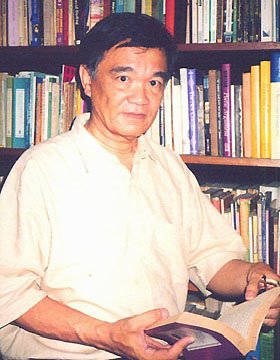
Eddin Khoo is a poet, writer, translator and journalist. Founder-Director of the cultural organisation Pusaka, he most recently collaborated with the late, critically acclaimed artist Ibrahim Hussein to complete the artist's autobiography, entitled IB: A Life ~ The Autobiography of Ibrahim Hussein.

Entry: Donation to CHAI Min RM10

Free Entry to CHAI- Wallahs*

* To find out more about how to become a CHAI-Wallah please e-mail us at chai@instantcafetheatre.com
Date : Thursday, 01 April 2010
Time: 20:30 - 22:30
Location: Instant CAFE's HOUSE of ART and IDEAS [CHAI]
Street: No. 6, Jalan 6/3, Off Jalan Templer, Section 6
Town/City: Petaling Jaya, Malaysia

Sad I won't be able to be there myself as I'm teaching ...

Tuesday, February 02, 2010

Our Event, the Capricorn!

So ... it turns out that our event, Readings, is a Capricorn (since it was born 8th January 2005) which makes it (according to audience member, Dave Tee, "ambitious, strong willed and never prepared to say die"!)

Forgive a short detour to nostalgia.

We began of course at Darling Muse gallery, and later in 2005 moved to Seksan's and have had a home here ever since. Bernice was the mummy of Readings, and I took over as adoptive mum when her mum became terminally ill, and then she fully handed over the event to me and started a new one, Ceritaku!, at No Black Tie.

Over the years we've given more than 160 writers space to read their work and given them a meeting place where friendships have been forged and collaborations born.

And as straits-mongrel (who also gave me permission to use his beautiful pictures) points out beautifully in his post Reading in Colours,  this event has brought together a huge diversity of folks in the kind of Muhibbah spirit that this 1 Malaysia thing is supposed to be about. Frankly, that's never been on the conscious agenda, but has definitely been one of the best things that has naturally emerged from the event.

And now we've launched a book project which hopefully will put event and writers on the map.

So a party to celebrate this was in order, and party we did.


We welcomed back some of our earliest readers and introduced some new ones.

I've been trying to get hold of The Loud girl aka Elaine Foster ever since I first heard her read at one of The British Council's Wayang Kata events.  She could also be crowned slam queen of KL, and is organising spoken word events now in collaboration with Word Forward in Singapore.  I especially loved the first piece she read, which she had written in collaboration with George Wielgus and Tsiung Han See about the coming revolution and what it would not be like!


Jo Kukathas, actor, playwright, director, and driving force behind Instant Cafe Theatre had been one of the participants in the British Council's creative writing workshops earlier this month.  I loved the pieces she brought to share with the group, and she read from one of them - she isn't prepared yet to say whether it is fiction or autobiography ("It's a something.") which tells the story of larger than life family members.  I really am looking forward to more.


Some three years back, O Thiam Chin told the sad story about how hard it was for him to self-publish his first collection of short fiction and get the copies sold.  How far he's come since then, with a very well-received second book, Never Been Better, published by MPH. (And the bookshop sent along copies for sale.)

And then it was time for cake! We actually had three cakes.  Two of them were red velvet cakes with butter-cream icing ordered from That Last Slice, and they tasted every bit as good as they looked. (Thanks, Aishah,  for driving over from Shah Alam to deliver!)

The third was an absolutely delicious chocolate cake which Saras had had a friend bake for us, and very much appreciated. 


We blew out candles and made a wish - for the next 5 - no, 50 years of Readings to be as successful.


After the break, Bernice Chauly read from the book she is finishing Growing Up with Ghosts which she describes as:
... a literary autobiography, a memoir of sorts in five voices ... about her Chinese and Punjabi family and diasporas which span hundreds of years.
It will also form part of her MA in English Literature and Creative Writing at University Malaya.  Bernice has also been chosen as one of four writers worldwide to participate in Winternachten's (International Writers' Festival of The Hague) tour of the Dutch Caribbean and Suriname in April on the theme A Sense of Belonging.

What I've heard of the new work so far (in the workshops and here in Readings) shows that Bernice is working with fascinating material, and as she says, writing of this kind has been very much neglected in Malaysia. I think it also takes a lot of courage to put your own story out there in the public arena.

Do read this interview Bernice did with The Nutgraph last year, in which she shares some of her personal history with us.


Kam Raslan is the writer who has read more frequently at Readings than any other and  we have followed his Datuk Hamid from his first tentative fumblings with a Swiss milkmaid,  appearing in his own column in Off The Edge, and finally getting a whole book - which the Malaysian public took to their hearts - dedicated to his adventures.  Now it seems that there is a sequel in the pipeline, and the extract that Kam read was as endearing and as funny as ever.  It had the Datuk in a department store attempting to choose a perfume for The Wife's birthday, when a whiff of a fragrance called Betrayal sets off a train of Proustian memory ...


I  had to put Rahmat Harun last, because he is just such an impossible act to follow.  And of course the famous  Keranamu Malaysia had to be the centrepiece of his performance ....  This guy is a force of nature!


Thanks very much to Seksan for the wonderful space (though I was a bit sad that for the first time there was no art on the walls), to all who read and all who supported, to Aishah and Saras for cakes, and to all those who helped set up and clear away.  Nothing happens without you all.

Friday, October 16, 2009

Malaysian Writing in English is Dead!

Malaysian poet Wong Phui Nam declared Malaysian writing in English dead yesterday at a press conference to publicise the Singapore Writer's Festival, held at MPH Midvalley (about which more later) :
We should be looking at young writers - their absence shows that the tradition of writing in English is dead. ... Why are writers in English dying out in this country? In 10-20 years time Malaysian writers in English will be an adjunct to Singaporean writing.
He also talked about how other writers in English had "run away" from Malaysia, and how the greatest of them was Shirley Lim.

I respect Phui Nam very much (An Acre of the Day's Glass is the Malaysian poetry collection that has most excited me, and I wish that they made more writers in his mould!) but I don't agree with him on the above. I don't just think it is a case of me being unrealistically optimistic - perhaps it is more a question of perspective.

In organising Readings@Seksan, I am constantly coming into contact with Malaysian writers (new and not so new, young and not so young) whose work excites me, and who work confidently and well in English. Writers in English are not even an endangered species, I'd say. (What do you think?)

And as for the overseas writers having "run away" ... well, anyhow, I have already blogged all I have to say on the topic here.

Something else that Phui Nam said that was very interesting :
I am not writing in English. I am writing in EMS : Educated Malaysian English. We speak the language in a different way, a subdialect of the English language.
Malaysian English of the acrolectal variety (linguistic term for standard educated form of a language) is a distinct variety of English and should be every bit as acceptable internationally as any other (UK, American, Australian, Indian etc). I wrote about the issue in this interview for The Star.

Postscript :

Daphne Lee also blogged (very powerfully) about this, and concludes :
Wong spoke about how Malaysian writing (in English) is stillborn, a result of our education system. Having identified this problem, I should think Wong has his own theories about how the deadening effect of our schooling can be countered and/or reversed. Does he and others like him have a part to play in helping aspiring authors produce writing that has a chance to grow in effectiveness and beauty? Perhaps Wong just does not think it is his battle to fight.
BTW there is an interesting comment on the blog about how Readings@Seksan could be perceived as "cliquey". I responded at length and would value your (honest) comments too.

(Someone else did yell at me not so long ago "What does Readings achieve? Nothing at all.")

Postscript 2:

Zedeck Siew at Klue magazine writes about Phui Mam's speech :
Doom and gloom, then. But we're sorry if these dire pronouncements sound bitter to us. Yes, official support for English-language writing is practically non-existent. That said, things seem to be on the mend, actually.

Writers are soldiering on. Brian Gomez's excellent pulp -- but supremely relevant - novel Devil's Place was published last year. This year, Kow Shih-Li's Ripples and Other Stories was shortlisted for the Frank O'Connor Award - the most lucrative prize for short fiction. Further back was Kam Raslan's Confessions of an Old Boy.

How about the anthologies: Silverfish Books' regular efforts, or the queer collection Body 2 Body? And non-fiction, such as the excellent (and bilingual) New Malaysian Essays series? Literary readings happen with acceptable regularity: Readings and CeritAku; or Say Goodnight, Twitterverse. Amir Muhammad (of Matahati Books) has hosted organised the KL Alternative Bookfest twice, to much success.

There is a second problem with Phui Nam's complaint. KLue itself is an English-language publication - but even we don't prize the lingua Brittanica's purity that much.

The Malay-language book business is booming, from mainstream romance to the fringe. Its literature is in rather ruddy shape: new small (but significant) ventures like Oxygen Press are springing up all over the place. Sang Freud Press's works deploy an urban form of Malay that doesn't shy from displaying its obvious syncretism.

The language of this region has always been a Creole, mixing Bahasa Melayu, English, the Chinese dialects and Indian languages. Phui Nam appeared aware of this when he said that "we speak [English] in a different way." He, of all people, should know - since his full name is Mohammed Razali Wong Phui Nam, and his latest plays Malay/Cambodian takes on Antigone and Medea. No need to be so precious lah.

Tuesday, March 03, 2009

Mystery, Magic, Durians, Clouds and Zambia

This Saturday's Readings@Seksan turned out to be a female affair though not by design. Although a couple of folks I'd hoped to have event couldn't make it (Marina Mahathir had her own book launch at Megamall but will be with us next time; and Avanti Kumar was whisked off somewhere else by his publishers to promote his book.)

As always we managed to have one little disaster this Saturday (the usual anything that can go wrong manages to) , the microphone packed up but thankfully everyone read extra loudly and the audience huddled in close to listen.


Lawyer-by-day Jade-Yi Lo had the unenviable task of reading first. Jade attended my creative writing class and is a new writer absolutely hungry to write and very hard working. The story she'd shared with us on the last night of the class, The Girl with Red Ruby Shoes, was such so magical, I invited her to read in front of the crowd at Seksan's. She'd reworked the story, and even though I knew the ending, it still kicked me in the stomach.

Adeline Loh read the first hilarious chapter of her book Peeing in the Bush about what drove her to leap into the unknown, the reactions of nearest and dearest, and the search for a travelling companion ...


Lee Eeleen's story Scenes From The Shopping Complex appears in the Urban Odysseys collection. It is a beautifully observed piece about the nightmare of a weekend family trip to the shopping mall and the politics of family life. Much of it is written like a film script, and I particualrly love the delicious counterpoint between the supermarket soundtrack of James Dobson's Focus on the Family (which yes, for some reason really does get played ad nauseam in supermarkets here) and the reality of shopping with kids. Great comedy.

I was so grateful when Bernice agreed (the night before!) to come and read for us. And she had new material - autobiographical pieces for the new autobiography she is writing, Growing Up With Ghosts, as part of her M.A. course in creative writing at Universiti Malaya. I loved the portrait of the whole family feasting on durian - you could smell and taste the fruit. Yum!


Shih-Li Kow read her shortest story Let the Bird Sing from her new collection Ripples. A small bird sits on the windowsill of a dying man and the two are locked into one final adversarial battle. It's one of the more surreal pieces in the book - an excellent piece of micro-fiction.

Sheena Baharudin is a poet, spoken word artist, and lecturer at the International Islamic University. (It was nice to see that she had brought along some of her students!) She has performed her work alongside leading poets at various venues around the city. I am impressed by how she has grown as a poet, and how much more assured her voice has becom both live and on the page. Just take a look at the poems she read - Monologue 1.01.001 and and Cloudy Conversations.

Thanks to all who came (including quite a number of new people who I hope will find their way again), to all who read, to Shahril Nizam for the blog poster, to Seksan for his inspiring space, to the guys from MPH in Bangsar Village for bringing over books to sell, to Eugene and friends who cleared up, and to Reza in advance for fixing the microphone ...

See you all later in the month. I've fixed readings for March 28th (provided Seksan will have us) and have a great line-up already worked out. More about it later.

Sorry I'm late posting this - my photos weren't so good so I was waiting for someone to come up with some better ones and Tan May Lee came to my rescue! (The first three nice pics are hers, the last three not so nice pics are mine.)

Tuesday, February 24, 2009

Alina's Beloved


Alina Rastam launches a new collection of poetry Saturday 21st March at 6.30 p.m. at Central Market. (For full details click the poster up to size.) Here's my review of her previous collection, in case you missed it.

The launch is open to all but please do let Alina know if you are coming so she can estimate refreshments.

Tuesday, December 09, 2008

Rahmat the Rebel

It is not only the artists who should change the country and the world that they live in. It is everybody’s responsibility. The first step is to open up imagination.
Controversial poet (and artist and rebel!) Rahman Harun responds to Bissme's searching questions in the Sun and along the way talks about (among much else) the ISA, the environment, the state of the country, and how he marched to Putrajaya with others to hand the PM a pillow.

You can watch Rahmat performing his most famous poem, Keranamu Malaysia, a liturgy of Malaysian slogans on YouTube, here.

Sunday, August 24, 2008

Nic for Tea

Young poet Nic Wong has been doing a writer's residency at Rimbun Dahan, working on pieces about Malaysian flora and fauna, as part of his first poetry collection. (I will demand a percentage of any profits from the sale thereof, having been Nic's personal library service!)

Tomorrow afternoon (Monday 25 August) at 4p.m. he will be reading his work at a tea and poetry event held in the underground gallery, and you are all invited. More about both Nic, Rimbun Dahan and the event here.

Saturday, August 09, 2008

Thumboo Talk and Reading

Professor Quayum has just sent me information of a couple of events taking place at the International Islamic University to which all of you are invited (and please pass the information on).

The first is a public lecture by Dell Visiting Professor, Edwin Thumboo (who is sometimes described as Singapore's unofficial poet laureate!) :
Tilting Paradigms: Creativity in Englishes

Abstract: The decision to write poems, plays, short stories and novels is a personal one. If we are bi- or tri- lingual by the time we decide, it is our main – or strongest – language that chooses us. Few have the ability to create in two languages, let alone three; it is difficult enough in one. For the ex-colonial, it is either the language of one’s race or the language of former colonisers. If we chose English, as many have, we face a number of challenges. What English and why? What shapes the substance of our experience behind our writing, and to what extent? And how is that substance influenced by the history and the politics of national recovery and nation formation? Issues such as those arising from the fact that English is the leading international language, the influence of literary traditions and content of other languages, and the relationship between the various national literatures, will be noted as well as discussed in terms of their creative and critical implications. The language in this case is English and the focus is on poetry.

DATE: 12 AUGUST 2009
TIME: 10 AM – 12 NOON
VENUE: HS SEMINAR ROOM, IIU

Professor Edwin Thumboo is a distinguished poet and academic who has been teaching at the National University of Singapore (NUS) for over forty years. His publications include six volumes of poetry, two collections of nursery rhymes, over twenty academic books, and articles in leading literary journals around the world. He has received several literary awards including the Singapore National Award for poetry (1978, 1980 and 1994), the Southeast Asia Write Award (1979), the Singapore Cultural Medallion (1980), the ASEAN Cultural and Communication Award in Literature (1987), and the Raja Rao Award (2002). Currently an Emeritus Professor, Professor Thumboo was the Head of the Department of English Language and Literature, NUS, for sixteen years (1977-1993) and Dean of the Faculty of Arts and Social Sciences for eleven years (1980-1991).
The second is a poetry reading. (Click on the poster to read the details.)

Friday, July 27, 2007

Diving Deeper

In today's Star Two, my review of Alina Rastam's first collection of poetry Diver & Other Poems. My first review of any poetry book in fact so a little bit of a scary venture and I hope I hit the right note. I did very much enjoy the collection and there are several poems that I've gone back to reread several times ... will probably extemporise a bit more on the Puisi-Poesy blog which I have been shamefully neglecting for the last few weeks. (Sorry, Dreamer Idiot!)

Alina is one of the readers tomorrow at Seksan's and we have an altogether great lineup, although sadly Martin Axe isn't going to be able to make it.

Sunday, August 20, 2006

English as Colonial Leftover

In today's New Straits Times a piece on post-colonial Malaysian poet Wong Phui Nam, which sadly does not seem to be on the newspaper's website. (Frustration!) There's a wonderful line in Wilson Henry's article about Wong choosing his words in the interview as carefully:
... as if he were picking jewels from a Nepalese trader.
Poetry is catching, it seems!

Wong was born in Kuala Lumpur in 1935, a fifth generation Straits Chinese. His struggle with his identity and ethnicity lie at the core of his work. He graduated in Economics from the University of Singapore and went into banking a post in a bank, writing poetry in his spare time.

He says:
I write in English and how many read in English or are even interested in English poetry? We have lost three generations of Malaysians who studied in the national medium.

After May 13, the question, the question of what language I was forced to write in was forcefully brought home to me. I no longer wanted to write, at least in a language I was told was a colonial leftover. The National Language Policy and other policies on national unity, culture and economics made me reassess what I was doing. I began to question the validity of the language I was writing in.
His self-imposed exile from writing lasted 15 years until Edwin Thumboo in Singapore invited him to contribute some of his work to a collection. His work appeared in numerous journals, and is taught on university literature courses. His poems have also been collected in An Acre of the Day's Glass, and he has recently completed a verse-drama Anike, to be performed next year.


Related Post

Write in English? Don't be so Disloyal! (22/8/05)