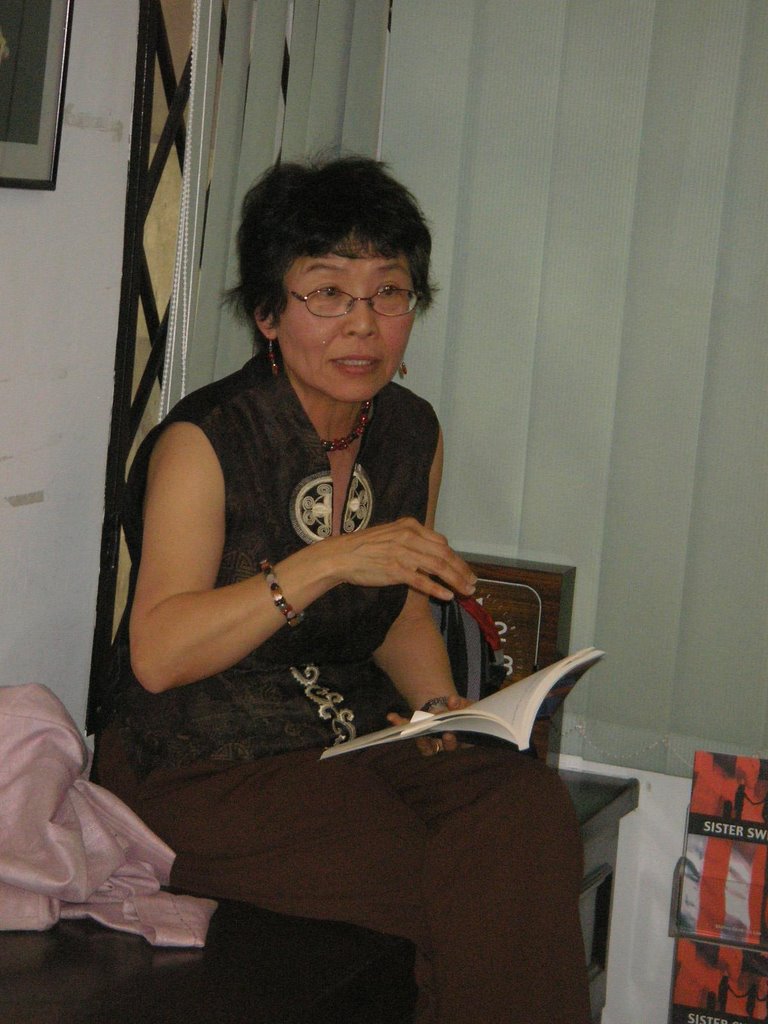
Showing posts with label malaysian english. Show all posts

Friday, October 16, 2009

Malaysian Writing in English is Dead!

Malaysian poet Wong Phui Nam declared Malaysian writing in English dead yesterday at a press conference to publicise the Singapore Writer's Festival, held at MPH Midvalley (about which more later) :
We should be looking at young writers - their absence shows that the tradition of writing in English is dead. ... Why are writers in English dying out in this country? In 10-20 years time Malaysian writers in English will be an adjunct to Singaporean writing.
He also talked about how other writers in English had "run away" from Malaysia, and how the greatest of them was Shirley Lim.

I respect Phui Nam very much (An Acre of the Day's Glass is the Malaysian poetry collection that has most excited me, and I wish that they made more writers in his mould!) but I don't agree with him on the above. I don't just think it is a case of me being unrealistically optimistic - perhaps it is more a question of perspective.

In organising Readings@Seksan, I am constantly coming into contact with Malaysian writers (new and not so new, young and not so young) whose work excites me, and who work confidently and well in English. Writers in English are not even an endangered species, I'd say. (What do you think?)

And as for the overseas writers having "run away" ... well, anyhow, I have already blogged all I have to say on the topic here.

Something else that Phui Nam said that was very interesting :
I am not writing in English. I am writing in EMS : Educated Malaysian English. We speak the language in a different way, a subdialect of the English language.
Malaysian English of the acrolectal variety (linguistic term for standard educated form of a language) is a distinct variety of English and should be every bit as acceptable internationally as any other (UK, American, Australian, Indian etc). I wrote about the issue in this interview for The Star.

Postscript :

Daphne Lee also blogged (very powerfully) about this, and concludes :
Wong spoke about how Malaysian writing (in English) is stillborn, a result of our education system. Having identified this problem, I should think Wong has his own theories about how the deadening effect of our schooling can be countered and/or reversed. Does he and others like him have a part to play in helping aspiring authors produce writing that has a chance to grow in effectiveness and beauty? Perhaps Wong just does not think it is his battle to fight.
BTW there is an interesting comment on the blog about how Readings@Seksan could be perceived as "cliquey". I responded at length and would value your (honest) comments too.

(Someone else did yell at me not so long ago "What does Readings achieve? Nothing at all.")

Postscript 2:

Zedeck Siew at Klue magazine writes about Phui Mam's speech :
Doom and gloom, then. But we're sorry if these dire pronouncements sound bitter to us. Yes, official support for English-language writing is practically non-existent. That said, things seem to be on the mend, actually.

Writers are soldiering on. Brian Gomez's excellent pulp -- but supremely relevant - novel Devil's Place was published last year. This year, Kow Shih-Li's Ripples and Other Stories was shortlisted for the Frank O'Connor Award - the most lucrative prize for short fiction. Further back was Kam Raslan's Confessions of an Old Boy.

How about the anthologies: Silverfish Books' regular efforts, or the queer collection Body 2 Body? And non-fiction, such as the excellent (and bilingual) New Malaysian Essays series? Literary readings happen with acceptable regularity: Readings and CeritAku; or Say Goodnight, Twitterverse. Amir Muhammad (of Matahati Books) has hosted organised the KL Alternative Bookfest twice, to much success.

There is a second problem with Phui Nam's complaint. KLue itself is an English-language publication - but even we don't prize the lingua Brittanica's purity that much.

The Malay-language book business is booming, from mainstream romance to the fringe. Its literature is in rather ruddy shape: new small (but significant) ventures like Oxygen Press are springing up all over the place. Sang Freud Press's works deploy an urban form of Malay that doesn't shy from displaying its obvious syncretism.

The language of this region has always been a Creole, mixing Bahasa Melayu, English, the Chinese dialects and Indian languages. Phui Nam appeared aware of this when he said that "we speak [English] in a different way." He, of all people, should know - since his full name is Mohammed Razali Wong Phui Nam, and his latest plays Malay/Cambodian takes on Antigone and Medea. No need to be so precious lah.

Friday, February 20, 2009

Don't Keep Me in Suspenders

Lydia Teh's latest book Do You wear Suspenders : The Wordy Tales of Eh Poh Nim is now out and it has my blurb on the back (I seem to be making a profession of this!) :
Learners of English cannot be said to have a mastery of the language until they are able to use colloquial expressions with ease and familiarity and have a wide vocabulary. Acquiring this, of course, takes time. Lydia Teh’s very clever Eh Po Nym columns on the Mind Our English pages of The Star not only help learners build up their stock of language, but do it in a fun way and with a decidedly local flavour through the accounts of the adventures and misadventures of the eponymous hero.
Eponymous /Eh Poh Nym ... geddit?

If you want a taster, Lydia has archived some of her columns here.

And the always enterprising lady actually created this fun bookformercial to promote it:


And on her blog, Lydia has a competition with some tasty prizes - go see.

An aside. Lydia and I were debating this word "suspenders". In Malaysian English guys sometimes use the term to mean "underpants".

"That's wrong," said Lydia "it refers to the things that men keep their trousers up with."

"Nope," said I "It's the thingies that keep up ladies' stockings when they want to look sexy."

She was arguing for the American definition of the word (which seems to be the most widespread in Malaysia), and I was arguing for the British English definition.

I actually find it quite a hoot when Malaysians say they follow British English, because although the spelling system might follow the later, the accepted vocabulary is a mix of both - influenced strongly by the media. (There's a great academic study in there for someone ...)

But this diversity gives Malaysian English it's character ... something that the book celebrates very well indeed.

Saturday, September 06, 2008

Squandered English?

Saras was insistent that I blog this. Placed the photocopies in my hand since I had missed the originals. (Yes, I've been telling her to get a blog of her own and I think she's finally listening.)

I'm sure most of you will have read it and been horrified by the advertorial which appeared in the New Straits Times (Lim Kit Siang was kind enough to put it on his blog). Quite apart from it having more capital letters than any other piece of writing I've ever seen in my life (I'm sure there's a parody to be made out of this), the standard of English is completely, totally inexorable. What hurts most is that this tribute to a royal personage was put out by a university.

Syed Nazri in the NST asked the questions that need to be asked about the state of English in the country.

It's a decline I've witnessed over the time I have been here (25 years). One of the assets the country had - the English language - has been stupidly squandered.

Of course the move to Bahasa Malaysia* means that everyone speaks the National language so much better. Or do they?

In my writing classes I often have participants who have very interesting things to say, but are clearly struggling in English. (Note that these are above average intelligence, educated adults holding down good jobs.) Some can barely write a grammatical sentence.

"Why not write in Malay instead?" I say. "I've taught you the skills, and you can transfer them to writing in your own language. You might even find a bigger market for your work."

"No"
they reply. "My English is so much better than my Malay."

Now that really scares me. Without even one fluent language, aren't even your thought processes screwed?

And is it really so difficult to teach students to be fluent in two languages?

(Sorry for the lack of posts over the last few days. My internet connection is very very slow and frustrating again at the moment. Pages keep hanging on me, can't go anywhere, can't read my email much of the time. When will we have some better alternatives to Screamyx and the rest?)

*The national language (B.M.) became the medium of instruction nearly 30 years ago.

Saturday, June 14, 2008

Sisterhood!

I've sat on this review of Shirley Lim's Sister Swing for an awful long time, but because Shirley is back and launching her next book Princess Shawl at Silverfish today, it seemed an appropriate time to actually put my notes together. I've also noticed that I get an awful lot of hits from folks - students? - looking for information about the novel so I get very guilty when I spot those visitors on my site meter! Here 'tis then :

Some years ago Shirley Lim wrote a story called Mr. Tan’s Girls which won the Asiaweek short story contest and found its way into several anthologies, including The Merlion and the Hibiscus which is where I first came across it.

In Sister Swing, she picks up the same cast of characters and replays the short story in the first chapter. But this time the father, Ah Kong, meets his end in a rather more shocking manner - he dies after seeing his two elder daughters examining their private parts in a mirror! (It's a terrible secret the elder sisters share and I was surprised Lim didn't make much more of this later in the novel).

The novel is the story of three sisters, Yen, Swee Yin and Paik, and the narration moves between them with Lim inventing a separate voice for each of them.

Swee Yin, nicknamed Sister Swing, is really the character at the centre of the story. She sees the family name wing as “an occult name … conjuring feathers and flight" and the metaphor is a fitting one because she does indeed test her wings and is the first to fly the nest.

The sisters are left a tidy sum of money in their father's will and Swee decides to take up a course in New York State, where she is incredibly lonely. She's also the first sister to discover love, and has an affair with her lecturer, Professor Lopez.

The complex relationship between the sisters and their various rivalries is very well drawn. Yen, whom Swee refers to as "my oldest sister who grew up to become younger than me" grows up a little lazy, more laid back than Swee Yin, and very much dependent on her younger sister.

Lim spoke at a reading at Silverfish some time ago about the problems that writing the voice of this characters in such a way that it retained something of the quality of Malaysian English, yet was intelligible by American readers.

I was interested to see how Lim rises to the challenge she sets herself, particularly as other Malaysian and Singaporean writers will find this an issue that they also need to resolve.

In Yen's case, though, I must confess the voice does not entirely convince. It is somewhat uneven – some complex constructions are perfectly grammatical, yet in other places phrases in broken English are scattered in and seem a little jarring.

The third sister, Peik, is their father’s favourite child, the one who tries hardest to please. After the father dies she feels left out when Yen becomes Swee's closest confidant, and finds consolation in religion, turning to an evangelical church and changes her name to Pearl. Lim convinces rather more with this voice, particularly with the way her speech is peppered with biblical expressions. (One can't help feeling very sorry when she tells Swee later in the novel that her husband “did not want to make me big with child”.)

I must say that I like the colour and humour of the Malaysian chapters better than those set in an America which is quite cold and distancing.

Yen decides that she also would like to study in the States and the sisters take up courses in Long Beach, California where Swee becomes quickly involved with Sandy, ex-military and studying welding part time, while Yen becomes involved with a biker called Wayne. I really felt frustrated that the girls take up with such obvious losers! Sandy turns out to belong to a white supremacist group, although Swee is very slow to pick up on this.

Central to the novel is the theme of Asian identity, which Lim handles very well. Everyone in America seems to have an idea about what Asians are, or what Asians should be, and seem to want to put everyone together in the same box.

Swee finds herself lumped together with all other Asians, regardless of nationality, and subject to all kinds of preconceptions. Her first lover, Lopez, himself only too aware of racism, urges Swee to "find her community".

Mrs. Butler, her lecturer for Race in America, teaches her about slavery and the history of the blacks, but shows her resentment against the upstart Asian immigrants who “aren’t willing to wait their turn”, and in a clever kind of reverse racism, Swee is not given the A for an assignment she so clearly deserves. “I know you fresh immigrants” says Mrs. Butler “you’re pushy”.

Swee is criticised by a driving instructor who says Asians are too timid and cause accidents by going too slowly. And the sisters are called “gook girls” and “sluts” by the child-wife of Keith, Sandy’s welding teacher (but actually the leader of the white supremacist group). Pinny, a Hong Kong student Swee remembers from her first college, adapts to fulfil racial stereotypes perfectly, and plays the part of a Vietnamese “mamma-san” in a bar for Vietnamese veterans .

Swee is forced to lead an uneasy double-life. As she grows more aware of how Asians are perceived in America, and begins to write articles to give a voice to the wider Asian community, with whom she finds herself identifying increasingly. At the same time, she finds herself increasingly pressurised by Sandy to reinvent herself as "Sue" and dye her hair brown, so as to appears almost white.

In her naivety she cannot see Sandy for what he is, or the danger he poses, and this ignorance has tragic consequences.

Paik also ends up in California, running a mission with her husband Robert and his father Pastor Fung to minister to a congregation of mainly Latinos and Asians. She decides that she wants to spend her portion of the inheritance installing a huge cross atop the makeshift church which uses the premises of a disused furniture warehouse - but like Swee she is impossibly naive and good intentions backfire. Both girls really are unequipped to really cope with life in America, and the novel is really a journey for them to find themselves.

While the plot, in the wrong hands, could have been fodder for melodrama, Lim's writing shows just the right of amount of restraint.

If anything I would have liked the novel to be have been longer and to have explored Paik's story rather more. And the tying up of ends in the last couple of chapters seems rather too neat.

It's almost as if the novel it could have developed into something really good but got reigned back abruptly before it could quite get there ... and one wonders why. Sister Swing comes close being the kind of novel that might have found commercial success in an international market, which is no less than Ms. Lim deserves.

Sunday, July 15, 2007

Things Fall Apart ... Perhaps

Was intrigued by this article which appeared a few days ago in Utusan (yes, another one, am actually fascinated by the literary articles in this newspaper which venture into territory the English language newspapers don't seem to touch.)

The writer (who strangely remains anonymous) is talking about a state called Anomie, a lack of regard for the generally accepted social or moral standards, or as Wikipedia kindly defines it for us:
...a reaction against or a retreat from the regulatory social controls of society
Actually the link to the Wiki page is relevant since the writer of the Utusan article seems to have drawn from it very heavily! (Play this game - google names from the article and then look for the English version on the Wiki page - how many can you find? How many sentences are direct translations?) If nothing else I call it lazy journalism.

That doesn't worry me so much as how flawed the argumentation is. The writer doesn't seem to grasp at all what anomie is or how it applies to either film or literature! (Of course, it's such an intellectual word to fling around!) So, Malay novels are getting written in "bahasa rojak" (fruit salad language - a whole mixture of lingos in other words.) And we're supposed to accept this as an example of anomie???

This mixing of languages, known in linguistics as code-switching is a natural feature of the way Malaysians speak, constantly shifting between languages and levels of discourse ... and why shouldn't this be a feature of the films and literature of the country? I am happy to see some of the young writers and filmmakers here exploiting this freedom.*

There's a paucity of other examples in the article from the Malaysian scene. Nothing much about literature, though this of course is the promise of the title. And the writer includes just one indirect reference to film ... Sharifa Amani's shaved head in Yasmin Ahmad's new film Muallaf. In what sense is this an example of anomie? Please do enlighten me! Social values going to the dogs because one actress decided to go "botak" for the sake of art?

Well, I'm not convinced.

All authors and filmmakers worth their salt have a duty to reflect and criticise society. Literature and films should be dangerous and uncomfortable. (Or what are they for?) And writers must above all be true to themselves.

Writers like Camus, Dostoevsky, Sartre, Lermontov wrote from a deep sense of dislocation in their time, still seem streets ahead of many of their contemporaries, and produced some of the world's greatest literature.

And Camus won a Nobel ... the prize you covet so much on behalf of Malay writers. Perhaps there is a lesson to be learned here? This from his acceptance speech:
Each generation doubtless feels called upon to reform the world. Mine knows that it will not reform it, but its task is perhaps even greater. It consists in preventing the world from destroying itself. Heir to a corrupt history, in which are mingled fallen revolutions, technology gone mad, dead gods, and worn-out ideologies, where mediocre powers can destroy all yet no longer know how to convince, where intelligence has debased itself to become the servant of hatred and oppression, this generation starting from its own negations has had to re-establish, both within and without, a little of that which constitutes the dignity of life and death.
I actually suspect that there is plenty of anger and alienation for local writers and filmmakers to draw on if they are brave enough. (For it takes great courage to write boldly and honestly.)

With this I end my little rant, dear Editor of the lit page of Utusan. I am so glad that you have the space to raise important issues ... but I do hope for some more carefully fleshed out arguments!

Postscript:

I realised after writing this that the term "bahasa rojak" actually is used to address very real concerns that the Malay language is becoming debased, especially by the incorporation of English words which are then "Malayised" with suffixes and prefixes and local spelling. I must say that I very much dislike this too, not least because it also debases the English language! An upcoming conference at Dewan Bahasa dan Pustaka addresses the issue.

However, while I am all for a purity of the language in publications and on the airwaves, writers of fiction, playwrights and filmmakers must choose the version of the language they feel best serves their purposes, particularly when they represent Malaysian voices . This could be "bahasa rojak" or a plurality of languages. I hope that this issue is brought up too.

Thursday, June 21, 2007

Sexy Grammar!

My interview from today's Star with Ronald Carter who co-wrote the Cambridge Grammar of English: A Comprehensive Guide with Michael McCarthy.

There's nothing sexy about grammar books, right? Wrong, totally wrong! This grammar describes the spoken language along the written for the first time ever and comes up with some real surprises about how the language is used.

Malaysian English an inferior variety? No, it's just as valid as British English says Carter ... and for that matter every other linguist and lexicographer (dictionary compiler) that I've ever spoken to. Read the article to see why, if you're not convinced.

I do want to talk about Malaysian English at length some time, but it's such a big topic and I have so many thoughts about it ...

Tuesday, February 27, 2007

Celebrating Voices

The second of Saturday's literary events was of course, "Readings" at Seksan's. And for me the event was all about ... what is an authentic Malaysian voice?

Yang-May Ooi read first, and poor thing had to compete a little against the rain. Thank goodness we're amplified now.

She decided to use her slot for an experiment. She had brought along a passage from the novel she is currently working on, Tianming Traviata, and she read the same piece written in two slightly different voices. The first very standard English, the second in identifiably Malaysian English. I enjoyed both versions, though the second sounded more natural to me and all but Eric Forbes seemed to agree when we took a vote afterwards.

I told Yang-May later that Shirley Lim had talked about having the same problem when she wrote Sister Swing, and it really is a big deal for local writers. (I do so badly want to write at length on this but haven't yet got round to it.)

Talking about capturing voice, Datuk Shan does a great job of getting Indian voices down to the page and playing with them for comic effect as in the story about Mrs. Sarjit Singh getting teased for her terrible mispronunciations.

Zhang Su Li read us several appetite-whetting short pieces from her travel book A Backpack and a Bit of Luck. I loved the first piece she read about the time she worked in an opticians in Britain and gave a lecture to an old man about the correct way to put on glasses - only to realise that he only had one hand having lost the other in the war. This being Britain, a cup of tea while he told his story put things right. Su Li managed a very creditable northern accent!

Patricia Low is a very talented young lady. My first encounter with her work was with The Oral Stage's Rojak, last year. Two of my favourite pieces were penned by her and she was one of the directors. I sadly missed TOS second production, 59 Minutes, so it was nice that Pat read us a monologue from it - a wonderfully funny satire about the building of a durian tower in a shopping mall. But as I say, Malaysia constantly satirises itself! The scary thing about the piece was that it all seemed just too possible!

I loved the natural way that the voice in the story moved between English and Malay ... this is the reality of voice in the local context, the constant dipping between languages. For convenience. For emphasis. For humour.

Haris Zalkapli (and now I have his name spelt right!) writes columns on pop culture and politics and the interface between. I knew nothing about him before the reading since I had enlisted Raja Ahmad's help in finding good Malay writers, and I am very happy to have "discovered" Haris. He's clearly a writer who has found his niche - his pieces are entertaining and the arguments nicely developed. He read two columns The Stones and the Great Firewall, about The Rolling Stones tour of China and A Lesson in Coolness about Condoleza Rice and other politicians employing pop culture as a campaigning tool.

This was the second time that Eileen Lui has read at "Readings". Her stories have appeared in Silverfish collections, including the book I edited, Collateral Damage. She read a moving piece about a friendship ... which should have been more than a friendship ... about the best friends who became "better friends", but never quite made the transition to becoming lovers.

Thank goodness not everyone is like this couple, or Eileen would be out of a day-job!

Was very happy to see poet Wong Phui Nam in the audience and I think he was very pleased to see so many people interested in writing. I have invited him to read next time!

Many thanks (and you know the litany by now!) all who read and all who turned up to support them. To Seksan for the space. To La Bodega for the lovely wines. To Reza for help with the sound. To all who helped get set up and to Zedeck for washing glasses. Sorry I was so bossy.

I've decided not to hold "Readings" next month as the KL Litfest is on at the end of March and it's better that everyone supports that. But watch this space for April announcements.

Saturday, March 25, 2006

Shirley Shines

A sizeable crowd of booklovers and old friends packed into Raman's back room yesterday to hear Shirley Lim (pictured left, perching on top of a cupboard!) read from her latest novel Sister Swing and talk about the challenges she faced in writing it.

Lim explained that the novel about the three sisters had grown out of a short story (the now much anthologised Mr Tang's Girls) she had written very much earlier in her writing career. (It won the Asiaweek short story prize.) This time though, the girls kill their father in a completely different (and pretty inventive!) way and carry the burden of guilt throughout the novel. Swing is in fact the nickname given to the middle sister, Swee Wing, who is at times moody and contradictory.

Since Sister Swing is a coming-of-age novel and an important part of growing up is becoming sexual, Lim says that she had to find ways of writing about it without being either too graphic or evasive. I thought she'd struck just the right note in the extract she read from the first chapter ... about the girls examining their private parts in the mirror!

The novel also explores racism in the US (Lim's adopted country) which she sees as not just a question of white vs. other, but also other vs. other (for example, the riots in LA pitched Koreans against blacks). Lim describes herself as an "equal opportunity offender", drawing attention to different permutations of prejudice in the novel, which features also a white supremisicist boyfriend.

Lim described how she tried to overcome the problem of giving the three sisters distinctive voices. She has Swee speaking Manglish in the novel which she says is hardly ever represented on the printed page.

(I interject at this point to say that the linguist in me takes issue with the use of the term Manglish to talk about Malaysian English, and it is an issue that I want to return to in another post - especially with reference to how it affects the choices made by Malaysian writers.)

Lim points out that writers from other language backgrounds have taken pride in using dialect forms. (She gives the examples of Derek Walcott and Jamaica Kincaid who both use West Indian patois to great effect in their writing.) She says that she asked herself why she had been afraid of writing in Malaysian English up to that point. (Although when she did include a passage written in Malaysian English in Joss and Gold, a reviewer wrote "this book could have been better edited"!)

She said she asked herself while writing the book:
If I don't try to write in Malaysian English now, then when? And if I don't do it, then who will?
Is it a little churlish to point out that Kee Thuan Chye has used it to great effect in his plays and in the extract from his novel in progress (which progresses no further sadly) published in New Writing 10?

She struggled with Swee's voice, rewriting many times. Worried that the Malaysian English might alientate American readers and then worried that when she used Standard English she lost the voice, she eventually struck a compromise between the two. (The Silverfish audience yesterday felt it to be rather too watered down.)

Malaysian writers really do have a struggle to position their writing. Just who are they writing for? (Writers in Britain and the US I think cannot even conceive of this struggle, for obvious reasons.) Lim says that she was intitially targeting the Asian American audience, but as she wroe the book it became more and more Malaysian.

The book is published in Singapore by Marshall-Cavendish and in fact there are problems of distribution in the US. How do local publishers break into the overseas market? (This is a problem that bedevils Raman too.) As Lim says, there is "unadulterated prejudice" against non-American, non-British publishers.

In all, it was a lively event and raised some very pertinent issues for local writers. I was happy to get my copy of Sister Swing signed, and meet up with a ton of friends.

(For another take on the event check out Yvonne's blog - and she has lots more pictures.)

Friday, April 15, 2005

Varieties and Variations

The dictionary-loving part of me romped out this morning to do a presentation for Oxford University Press for the launch of the new Advanced Learner's Dictionary. Did my product endorsement bit up on stage, stressing all the unique selling points of the 7th edition.


I have no problem wearing the hat of dictionary advocacy - and the OALD is an excellent product, forced by an increasingly competitive market to continually reinvent and improve itself. (Bet you didn't know, incidentally, that all profits from the dictionary are ploughed into training scholarships for English language teachers.)

I learned when I was doing my agony-aunty-for-the-English-language bit for the Mind Our English page for The Star that most folks had problems with grammar points that could be both quickly and easily solved by reference to a good dictionary. The fact that they were willing to write e-mails to us and wait days if not weeks for a reply, frankly baffled me. "Buy a good learners' dictionary," I wrote at the end of almost every reply. Teach a man to fish ...

Am especially happy to see that so much vocabulary in the new OALD has been taken from other Englishes besides the big two ... and particularly that some Malaysianisms have made it into the dictionary. English is a world language and Malaysian English speakers own it as much as anyone. Malaysian English vocabulary differs somewhat from standard British English. Different is not wrong. And when such variations are acknowledged by the world's most scholarly publisher of dictionaries, it can only boost the confidence of local users. (I would actually like to see Oxford go even further and produce a fully localised English dictionary, but I guess the economics will always preclude that.)

When Chief Editor of the OALD, Sally Wehmeier, came to Malaysia last year she talked about how Oxford has lexicographers around the world working to chart developments in local varieties of English. I mentioned "handphone" to her as a local usage that should go into the dictionary because it is so widely used in Asia - and isn't it much nicer sounding than than "mobile" (beloved of Brits and antipodeans) and more descriptive than "cellphone" of American usage?

The word "bungalow" in British English means a single-storey house, but in this part of the world the word refers to "a large house, sometimes on more than one level", according to the dictionary. I'm really happy to see this. Shortly after I came to live here, I found myself expending vast quatities of red ink marking "double-storey bungalow" wrong wrong wrong in an end-of-year exam ... only to find that everyone in the English department sided with the kids and not with the supposed-expert Brit. My attempt to swim against the tide didn't last long. I'm quite proud of the fact now that I live in a double-storey bungalow house ... especially now that the word has Oxford's endorsement!