Showing posts with label kee thuan chye. Show all posts

Monday, June 22, 2009

Offensive Words

Should a racist word be dropped from a Malay dictionary?

Malaysia's High Court has dismissed an appeal from an Indian Muslim association to have the derogatory term keling dropped from its pages. In The Star S.S. Yoga looks at the colourful history of racist slurs in Malaysia and around the world.

Writers Kee Thuan Chye, Dina Zaman and Amir Muhammad are asked for their opinions and agree that the word should not be omitted from the dictionary but should definitely be flagged as offensive.

I agree too. We may not love all the words that are in a dictionary but to pretend that they don't exist is in a sense dishonest. It is important though that dictionary users know whether such words are acceptable or not.

The example of the word nigger in English dictionaries is a good one. My Oxford Concise Dictionary (the one I keep on my desk) has a special usage note which tells me that the word has :
... strong offensive connotations and is today one of the most racially offensive words in the language ...
Wouldn't something like this work for the Kamus Dewan?

Monday, March 09, 2009

Chye's 10 Questions

I think writing plays is very fulfilling in the sense that you are able to create fiction from the reality you see around. And you can also get away with a lot more things than you can in journalism because it’s not so direct, and also when you write a play, you’re creating a work of art. ... And that transcends a lot of things. When you see the actual product being staged and it comes alive, that’s an indescribable feeling.
Playwright, author, journalist Kee Thuan Chye answers 10 questions for The Edge Financial Daily.

Saturday, December 06, 2008

Censorship in Malaysia

If you missed veteran journalist and playwright Kee Thuan Chye, dramatist and actress Jo Kukathas, Malaysia Today editor Raja Petra Kamarudin talking to Riz Khan on Al-Jazeera about press freedom and censorship of the arts - well, here it is again thanks to the miracle of YouTube!


Monday, December 01, 2008

Everything from Malay Ghosts and Dissenter's Balls to Toy Pianos

Our Saturday Readings@Seksan was a fabulous mixture of political discussion, Malay ghosts, poetry with toy musical instruments, and some fantasy writing which raised real world issues.

Happy I was to hand the MC-ing of this event over to Animah Kosai so I could just relax and enjoy the event. (Anyone else want to have a go another time? I like being lazy!)

Danny Lim started the ball rolling by reading about a couple of local spooks from his Malaysian Book of Ghosts. We learned about the elf-like Bunian of Malay mythology, and it was fascinating to hear about the journalist (formerly with Time magazine) who actually interviewed one for Men's Review back in 1999! We also heard about Hantu Kum Kum :
A roving female ghost carrying a tombstone like a baby, who goes around asking for milk, and attacks young virgins to restore her youth and beauty.
Incidentally, the Malay version of Danny's book, Kitab Pengetahuan Hantu Malaysia, is due to be launched this Friday 8.30 pm onwards at Bau Bau Cafe at The Annexe, Central Market with a whole variety of exciting folks reading ... including me! (I am the star attraction, come and laugh at the Mat Salleh mangling Malay!)

The focus of this particular Saturday after noon was very much on Kee Thuan Chye's March 8th : The Day Malaysia Woke Up which is a collection of contributions in response to the seismic shift in the political landscape of Malaysia following the last elections. Animah read her essay What Do the Children Think?, a very effective and yes, charming piece, blending the personal and political piece to talk about how Malaysians of different are divided from each other and how hard it is for a child to see that.

Kee Thuan Chye who put the book together read extracts which included interviews with former law minister Zaid Ibrahim (The Reforms Will Come), and the extracts from the interview with Raja Petra Kamarudin delightfully titled How Big Are Your Balls? in which he talks about his arrest under the ISA (the first time round, that is) and gives his take on the political landscape.


If there was any danger that we might take ourselves all too seriously with all that politics, all that dissipated when The Happy Unicorn Collective (a group comprising Dianne Dayanna, Priya K., Nurul, Patricia Low, Tan Koon, Fairuz S. and Adam Kharul and formed for Project Connect earlier in the year) took the floor after the break.

The group blended Priya K's eccentric poetry with an unusual mix of musical instuments which included rucksack percussion, kiddy xylophone and toy piano, stylophone, and children's trumpet! The most hilarious poem was one about seagulls being evil and stealing chips when the group went to UK. (The biggest culture shock just has to be one involving the wildlife!)

It was really great to have Glenda Larke (above) with us. As I probably told you before, I knew Glenda as an environmentalist long before I even knew she wrote - let alone was a prominent fantasy writer. She started by saying that it is ironic that fantasy is a genre much looked down on, when many very famous literary authors (among them Doris Lessing, Margaret Atwood, Gunther Grass, Marquez) have written in the genre ... except that of course good fantasy fiction tends to get a different name slapped on it. (This is something we've talked about before on this blog.)

Glenda read to us from her new, as yet untitled novel, which is to be the first part of a new trilogy, set in a world where water is a scarce and precious commodity (as she predicts it will be for all of us soon). The extract was an engaging piece about two brothers in this arid landscape.

When the book is published we must invite her back! In the meantime, you can find Glenda's excellent blog Tropic Temper here. (She has a nice write-up of this event.)

Brian Gomez was a no show (he got the time wrong) and I was sad about that because I am really enjoying his absolutely crazy novel Devil's Place. Never mind, we will invite him again and send him an alarm call.

But it was a great stroke of luck that Kam Raslan (above) happened to be along (he is now living in China, but back for a visit) and since he also had a piece in March 8th, it was the perfect opportunity to ask him to read his essay The End of Fear, about how the violence that the government warned about if the political order were threatened, failed to materialise, and how :
Fear is a legitimate emotion but it either leads to a desire to leave or extreme caution. It is not a good fertiliser for growing exciting things (although it is manure).
After the readings ended, some folks stayed back to chat with Chye and the other authors about the book and about their thoughts about keeping the spirit of March 8th alive, while we clearer up round them.

Thanks to all who read and all who came. Thanks to Seksan for the wonderful space. Thanks to Shahril Nizam again for making the poster. Thanks too to the setters-up (foremost among them, Chet) and valiant clearers away.

Next month I think Bernice is organising something for teen writers, so I will keep you posted.

Sunday, November 30, 2008

Chye and Jo and RPK On Riz Khan's Show

Learned (via Facebook, where else?) that you can catch Kee Thuan Chye on "Riz Khan Live" on Wed (Dec 3) at 10pm (1400 GMT) on Al Jazeera, Ch 513 (Astro). He will be talking about culture and politics and the ISA with Raja Petra Kamarudin and Jo Kukathas.

Unmissable, I'd say!

Friday, November 21, 2008

Literary Happenings!

Here are some of the other literary things you can find going on in the next few days in KL.

Tomorrow, Saturday 22nd November at 5.30pm at Silverfish Books (58-1 Jalan Telawi, Bangsar, KL) Kee Thuan Chye and friends Azmi Sharom, Animah Kosai, Helen Ang and Chacko Vadaketh will be reading excerpts from March 8th : The Day Malaysia Woke Up. There will be a discussion and Q&A after the reading and refreshments will be served. Free admission. (More information here.)

The Department of English Language and Literature (IIUM) will be hosting An Evening of Readings and Spoken Word on Tuesday 25th November from 8:00pm - 10:30pm in Ballroom 3, Crown Princess Hotel, City Square Centre, Jalan Tun Razak. This is an event held in conjunction with the international conference entitled ENGLISH and ASIA: First International Conference on Language and Linguistics 2008.

The evening will feature local poets and writers Dato' M. Shanmughalingam, Prof. Ghulam-Sarwar Yousof, Dr. Nor Faridah Abdul Manaf, the popular KL Slam's regulars and finalists, the active spoken word collective Poetry Underground and many more.

There will also be a performance by Ms Hardev Kaur, renowned Malaysian Hindi singer and local indie musicians ready to perform their original compositions. There may also be an open mic session.

The event is free for all Conference delegates. However, for non-delegates, there is a RM40 door fee inclusive of supper break by the end of the program.

Please reserve tickets now as places are limited. Contact Sheena 0129522094 nubian.crib@gmail.co to book your seats or if you have any enquiry! (The event also has a Facebook page.)

Please don't forget about Readings@Seksan on November 29th. I am just about to get the info out!

Thursday, November 13, 2008

Chye on Pop TV


Kee Thuan Chye is interviewed on The Fairly Current Show this week by Fahmi Fadzil about his latest book March 8: The Day Malaysia Woke Up.

The big questions how much have things actually changed since March 8th and are those winds of change still blowing?

Thursday, October 09, 2008

Thuan Chye Rides the Tsunami

Kee Thuan Chye is interviewed in the Sun by Bissme S about the political tsunami that swept the country on March 8th, the subject of his latest book (subtitled The Day Malaysia Woke Up)which features interviews with and essays with Malaysians from all walks of life and which he believes (and I think we would totally agree) that there has been an awakening to "the true meaning and practice of democracy".

I liked this :
Fear will inhibit you from doing a lot of things. If Raja Petra had been cowed by fear, he would not have spoken out and captured the imagination of so many people. He knew he would have to face the consequences and, sure enough, he is now being detained unfairly under the ISA. ... But he set an example that surpasses any example that any of our leaders has set. We all need to be more like Raja Petra.
and also his vision of :
A regard for all Malaysians as human beings, and therefore equal and inferior to none.
He also says (quite rightly) that :

He would also like to see literature written by Malaysians regarded as Malaysian literature, not segmented into national literature and communal literature, and wishes that the Printing Presses and Publications Act would be abolished.
*A round of applause.*

(Thanks too to Bissme for letting me know about this.)

Monday, September 08, 2008

When Malaysia Woke Up

Am extremely happy to hear that Kee Thuan Chye has a new book out (and he's a bit of a dark horse because I heard nothing about it pre-publication). He writes of course of the election result that shifted the ground beneath out feet.

The blurb reads :
March 8, 2008, Malaysians dealt a blow to the Barisan Nasional government that had held almost absolute power for 50 years by denying it the all-important two-thirds majority in Parliament and the control of five states. This book is about that historic day and the change that has come with it. It is also an expression of hope for a brighter future, with many Malaysians speaking their thoughts frankly and without fear. If you feel that March 8 was really something, this is the book to help you remember it for years to come.
The book was reviewed in Starmag on Sunday by R. Lim and apparently comprises personal accounts, essays and interviews ... including pieces by Kam Raslan and Animah Kosai.

Postscript:

More information from Chye :
ABOUT THE BOOK :
The day of the underdogs, the real Merdeka, a political tsunami, the perfect storm—by any name, March 8, 2008, will go down in history as a turning point in Malaysian politics. With their votes, Malaysians dealt a blow to the Barisan Nasional government that had held almost absolute power for 50 years. Denying it the all-important two-thirds majority in Parliament and the control of five states has certainly made the political scenario more vibrant.

Although surprised that there was such power in the vote they cast, Malaysians woke up to the true meaning and practice of democracy. They now face the present reasonably free from fear, free from the spectre of May 13.

This book is about that historic day and the change that came with it—an expression of hope for a brighter future, with many Malaysian voices speaking their thoughts frankly. There are also eyewitness accounts, interviews with key people, and articles never published before, written by fledgling and established writers.

Includes exclusive hard-hitting interviews with Raja Petra Kamarudin, Zaid Ibrahim, Lim Guan Eng, Dr Lim Teck Ghee and Dr S. Subramaniam.

HIGHLIGHTS

- How Big Are Your Balls? - an interview with Raja Petra Kamarudin
- The Racial Bias of Utusan Malaysia - a report by Yip Wai Fong, Centre of Independent Journalism
- One Hundred-Odd Days After March 8 - a comprehensive record of events
- Enough of the NEP - an interview with Dr Lim Teck Ghee
- Just Call Me Guan Eng an interview with Lim Guan Eng

Sunday, August 31, 2008

National Day Books

Malaysia is enjoying a long weekend for the 51st National Day, so Sunday's newspapers are, predictably, full of talk of nation building. It was a lovely surprise to see my friend and erstwhile writing group buddy Soo Choon on the pages of the Star, talking about her cross-cultural marriage.

In a very packed-with-good-stuff ReadsMonthly section the Starmag team journalists compile a list of their 51 best reads esp for Merdeka.

Daphne Lee interviews Bernice Chauly about her work (You can find the full interview on Daphne's blog.) :
Chauly’s poems are deeply personal. They may or may not be autobiographical in detail, but the stories they tell feel like they were shaped by real emotions and memories.

They are Chauly’s emotions, memories and stories, but they also speak to and for women the world over. They are familiar tales, but filtered through the voice of an individual, they defy the cliches of everyday experience and become significant, compelling and unique.
and Ahnaf reviews her collection of poetry The Book of Sins.

There's a write up by Rouwen Lin about the Read While Waiting flashmob event of last weekend.

Janet Tay review Nam Le's collection of short fiction The Boat (and there's a 25% off token!), and KayKay enjoys David Sedaris' When You Are englulfed by Flames.

Vernon Adrian Emaung crossed the causeway for Kee Thuan Chye's The Swordfish, Then the Concubine, which sounds as if it was beautifully staged :
Set in minimalist staging that featured a serambi or open platform for village gatherings, 15 Singaporean actors tackled a story that called for a cast of thousands across two generations – you couldn’t get more epic than that, right? Especially so when you have a gamelan orchestra providing for the peaks and troughs of human drama, the deafening clamour of war, and the crescendo of divine retribution. Music composer Joyce Teo and the Gamelan Asmarada group delivered proficiently on that aspect. The underlying political commentary linked current issues to these ancient myths quite commendably in the writing. Similarly, it was truly fascinating to watch the production draw stylistically from bangsawan (Malay opera), dikir barat, and silat to facilitate and vibrantly colour the storytelling.
It was quite an honour to have a Malaysian play kick off a Singaporean Theatre Festival. How sad I am I missed it. But I do hope it is staged here soon.

Saturday, August 23, 2008

Pulp Friction and Four Letter Words

Amir Muhammad's weekly Pulp Friction column in the Malay Mail is something I look forward to for its intelligent reviews of local books, both newly released as well as older titles, all of which have much to say about the country.

You can read all his pieces archived on his blog. The most recent talks about Kee Thuan Chye's We Could **** You Mr. Birch :
... a subversive play in both form and content.
I had always wondered about the **** of the title, but Amir solves the mystery :
The original title was We Could Kill You Mr. Birch. But the licensing authorities of 1994 thought the word ‘kill’ was too rude. So the playwright Kee Thuan Chye changed it to four asterisks. The authorities approved, not realising of course that the title now seemed much ruder.
I'm so looking forward to hearing Uthaya Sankar SB at Readings@Seksan next Saturday, and has recently released a collection of short stories, Rudra Avatara, written in Bahasa Melayu Malaysia (the distinction is vital!), and Amir says of the book :
If Uthaya were merely a spokesman for his race, this would not make him an interesting writer. What counts for more: His supple and surprising uses of plot and perspective, his sense of irony and the absurd, his occasionally breathtaking endings. ... Although he has won the requisite sastera (literary) awards, Uthaya has an almost potboiler sense of pace and momentum; not surprising when you consider John Grisham is one of his favourite writers.
The best place to source for books by local authors is of course Silverfish.

Amir currently awaits the banning of his latest film, Malaysian Gods.

Wednesday, July 16, 2008

Singapore Swordfish

Kee Thuan Chye's play critically acclaimed new play The Swordfish, Then the Concubine :
A bitingly comic satire that blends ancient myth with contemporary politics. A highly theatrical production of an exciting epic.
is being staged in Singapore from Wednesday, August 6 to Sunday, August 10, 2008 at The Drama Centre, 100 Victoria Street, National Library Building Level 3.

The play is directed by Ivan Heng and accompanied by live orchestration by Gamelan Asmaradana.

Here are links to my previous posts about the play and the Facebook page for the event is here.

Sunday, March 02, 2008

Remembering Lloyd

Kee Thuan Chye refers to his friend Lloyd Fernando in today's Starmag as :
... truly a scholar and a gentleman ... a man of grace and polish ... (who) loved literature and imparted his knowledge to his students with such passion that it made an indelible impact on their lives
He describes how Lloyd achieved his own education under difficult circumstances, migrating with his family from Sri Lanka when he was 12, and then during the war years having to work at a succession of menial jobs (including trishaw rider - can you imagine?) before he could continue his studies.

He completed his Senior Cambridge exam, and then worked as a teacher before he was able to enter university at the age of 29 and became an assistant lecturer at Universiti Malaya. He did a PhD with Leeds university and became a full professor in 1967. (Later of course he also became a lawyer and set up in practice.)

His contribution to Malaysian literature was enormous :
He was really the only person at the time visibly promoting new writing in English. He edited the landmark anthology 22 Malaysian Stories (1962) that gave recognition to fiction writers, the most outstanding of whom was Lee Kok Liang. Deservedly, that volume has seen numerous reprints and been adopted as a text in literature classes. It was even reissued more than 40 years later, in 2005.

Lloyd also brought attention to Malaysian playwrights. He edited New Drama One and New Drama Two (both published in 1972), which presented the works of Lee Joo For, Edward Dorall, Syed Alwi, and others. Without these two volumes, some of the plays of our pioneering playwrights might have now been lost.
Chye goes on to talk about how Lloyd:
... often spoke about his vision of a multicultural Malaysia transcending race and religion. That was something we had in common, together with our concern for racial integration and equality.

He dealt with these themes in his novels, Scorpion Orchid (1976) and Green Is the Colour (1993). Some have criticised his style as being too academic in its detachment, but the message shines through nonetheless.

I regard the novels as two of the most important works of Malaysian fiction in any language. They came from a writer who loved his country enough to advocate eschewing narrow tribal concerns in favour of humanism and harmony.

Lloyd once told me that one of the challenges he encountered in his writing was his constant attempt to find ways of expressing himself in English without sounding “English English”. He avoided stock epithets and turns of phrase. He strove for Malaysian inflection. Those who mistook him for a patrician professor of English – no doubt reinforced at one time by his pipe-smoking penchant – never saw the colloquial Malaysian side of Lloyd.
I think Shirley Lim's tribute to him is particularly apt :
If Malaysia had more like him, our history would have been very different, and as a people and a nation we would be in a much better position.
Professor Lim Chee Seng in the New Sunday Times calls Lloyd :
... the man who can be said to have shaped the Department of English at the country’s oldest university. He also calls him a literary activist (a term I really love) and mentions his setting up of the Malaysian Association for Commonwealth literature and Language Studies (MACLALS) which is still active to this day.
He says of Scorpion Orchid and Green is the Colour :
These novels focused on the theme of nation in ways which stimulated thinking on the urgent questions of what it means to be a Malaysian and how significant it is to be thoughtful in approaching the issues of living together in a multicultural society, in which demagogues and propagandists can sometimes usurp and sometimes distort the public discourse about the profoundly important issue of building the nation in prosperity and harmony.
Prof Lim says that he intendeds to celebrate Lloyd's life and work with a
... festschrift* volume with the working title, Essays In Honour Of Lloyd Fernando, which will feature academic essays, poems, reminiscences and even photographic work to honour a deeply influential and much loved professor, novelist, friend, husband and father.
And I reckon the best way for the rest of us to commemorate Lloyd is to read his novels.

(Ignoramus me didn't know what this word meant and had to look it up.)

Wednesday, February 20, 2008

Bernice and Thuan Chye Tell Tell

Tell magazine is one of my favourites on the newsstand for its well written and intelligent content. I am sad that I missed a few issues in the beginning, but now it's a must buy.

The present issue has a couple of nice pieces on local authors. Bernice Chauly is interviewed by Michelle Gunaselan about her latest collection of poetry The Book of Sins.

Bernice talks about the significance of the title, the concept of sin (around which she structures the book), about being taught Cathecism by nuns in her mission school (an experience that does rather scar one for life!), about her parents introducing her to books (her mother made her read Ayn Rand at 12!) and about how it feels to get up and read poetry which is so personal in public.

Elsewhere, Mustapha Mahidin meets playwright Kee Thuan Chye and his family. I've always loved the names he chose for his children: Soraya Sunitra Kee Xian Yin is his daughter, and Jebat Arjuna Kee Jia Liang is his son. (I first came across them in the dedication to We Could **** You, Mr. Birch). MalayIndianChinese elements all in one!

The current also features a tribute to Benazir Bhutto and (very topically) a piece on hidden cameras in hotel rooms and how to detect 'em.

Monday, July 09, 2007

Adaptation

Was lucky enough to be invited to attend the workshop on adapting texts for the stage oranised by FIRSTWoRKS/Instant Cafe Theatre and was much brain-boggled by the company I found myself in ... the other participants included stars in the theatrical firmament Ann Lee, Kee Thuan Chye, Jo Kukathas, Anne James, Thor Kah Hoong as well as best-selling author (!) and screen writer Kam Raslan, Zedeck Siew of Kakiseni, Bernice Chauly of the myriad talents, and the group of budding playwrights being nurtured by FIRSTWoRKS: Animah Kosai, Ridzwan Othman, Rahel Joseph and Shanon Shah.

Laurence Strangio the writer/director of Alias Grace talked us through the process of adapting his play from Atwood's novel telling us that he only drew on Grace's first person narration, and then only a small proportion of that. Although the film rights have been bought he said, it would be a very difficult film to make a movie because one of the most delightful ambiguities of the book is whether the mysterious peddler Jeremiah is the same person as Dr. Jerome La Pont, who hypnotises her. In the novel and in the play it is possible, Laurence says, for both possibilities to live at the same time.

He says he read and reread the book, putting post-it notes on the sections he liked best and then typing them onto computer. He says he played "fast and loose" with the arc of the story, and says he knew the book well enough to reinvent it. The first draft was three and a half hours long when read through, and was, of course, substantially cut. Laurence also showed us transparencies of a particular scene so we could see how it had changed over time, and explained how the actor's portrayal of the role (in this case Caroline Lee) fed into the way the work was written.

We talked about reasons for adaptation, and then we discussed texts that we had brought along to the workshop to adapt.

On the second day we drew a poster presentation of the key touchstones of our texts and here're some photos. (I put the full set on Flickr.)

Kee Thuan Chye hard at work ...

Me, being creative on the floor! I chose Tinling Choong's FireWife since I'd just finished reading it and found it very visual. (Eight women, eight photographs, fire, water).

Bernice wrestles Elizabeth Gilbert's Eat Pray Love: One Woman's Search for Everything Across Italy, India and Indonesia down to the ground!

Kam show-and-telling his take on Conrad's Heart of Darkness.

Chye and Ridzwan inspect the posters. (I think they're looking at the naked lady covered in sushi picture on mine!)

The most exciting part of the workshop I think was when single images were taken and improvisations built around them creating a new set of striking images.

Now adapting a text to a play is something I would very much like to do and seems more manageable somehow than starting from scratch ...

Sunday, July 08, 2007

Celebrating Life with a Capital L

Also much enjoyed in Starmag today, Kee Thuan Chye's review of Adibah Amin's recently reissued collections of her 1970's New Straits Times Columns, As I Was Passing Vols. 1 and 2.

Chye puts his finger on just what's so important about these books. They show us just how much the psyche of the Malays has shifted over time (and notice too that this is a theme which emerged in my earlier post about Kam Raslan today). I think what Chye points out is very important, so excuse the long quote:
If there is someone Malaysians could look to as a role model, it would have to be Adibah Amin. As a writer, she is truly accomplished. And through her writing, she comes across as an open-minded, cosmopolitan, all-embracing person who sees the virtues and positives in people and things, and does not discriminate against what she is unsure of or is seemingly alien to her.

... From the two volumes, one can gather that she is solidly rooted in her own culture, and that being so, derives the confidence to explore and even enter into other cultures without fear of losing her identity. All those petty-minded chauvinists who constantly warn against cultural pollution would be wasting their diatribes on her.

The first three sections of Volume 1 immediately set the cultural milieu she lives in. Her love of her own Malay culture is clearly and lovingly expressed. She describes her fascination for ghazal, Quran reading, bangsawan, dondang sayang and so on.

On Malaysian humour, she writes:

“... our public today must be a lot more sensitive than that of past generations. The humorous Malay folktales, told orally by the village Penglipur Lara to generations of kampong people, contain some strong satire.

“They ridicule not only common kampong types but also traditionally revered people – kings, ministers, religious officials.”

In 2007, about 30-odd years since the above was written, you could say Malaysians have become even more sensitive. The number of taboo subjects has certainly increased. And there are sacred cows that cannot be criticised – even the slightest bit.

There is also reluctance by some quarters to open up and accept pluralism in our society. Remember the e-mail that went around last year telling Muslims not to greet non-Muslims on the occasion of their festivals? And yet, as early as three decades ago, Adibah was writing lines like these:

“Deepavali has for me all the mystique of tales from the Mahabharata and the Ramayana.... It is part of a rich, ancient culture that has through the ages infinitely enriched mine. It belongs to a people who have become my people and are part of my present and future as they were part of my past.”

I feel the warmth in my heart when I read these words and the humanism inherent in them. Adibah celebrates Hari Raya, which she writes about in the book, but she also celebrates Deepavali and Christmas and Chinese New Year.

Recalling her childhood experience of Christmas, she writes of following her Eurasian neighbours into their house and singing Christmas songs “until the cocks began to crow”.

“It was heaven. To this day my idea of Christmas is sitting up till dawn singing song after song and stopping only to munch tapioca crisps and sip home-made pineapple juice.”

These days, some people might consider that culturally haram.

She writes, too, of Yin, her close Chinese friend, and how “wonderful it is to walk into Yin’s house on Chinese New Year Day ... and be warmly welcomed by the whole family”. She feels very much at home sitting among Yin’s multi-racial visitors, munching peanuts and melon seeds and “love letters” and adding “my noise to the merry din”.

“Perhaps you too have a Yin of your own – someone of another race with whom race becomes irrelevant, someone whose very existence makes nonsense of all race-based arguments. If you do, you will understand why I feel as I feel about many things.

“... I smile to think how far I have travelled from those childhood days when I sat by a drain and exchanged insults with Chinese schoolboys....

“In those days the Chinese held for me the fascination of an alien people. Their ways, I gathered, were very different from those of my people and were therefore necessarily wrong....

“I wonder what eventually shook my own conviction of my people’s monopoly to rightness? Was it reading, or thinking, or mixing? Or perhaps it was all three.

“But I know what shook my notion of my people’s monopoly to goodness. It was getting close to people from another race, culminating in Yin.”

I’ve let Adibah’s own words do the talking extensively here because she and her writing are so relevant to the present, so essential in these times when we find ourselves confronted with issues and sentiments in the public sphere that threaten to rend the fabric that holds our multi-racial, multi-religious society together.

What Malaysia needs now is not another bridge, another towering building, Malaysia needs more people like Adibah Amin.

... You should get hold of both volumes and experience for yourself how Adibah celebrates Life, with a capital “L”, in its various shades and colours and totally without prejudice. That is undoubtedly a ray of sunshine in this cloudy climate of life-negating taboos.

Sunday, January 07, 2007

Symbiotic Academics

I am a bit sniffy the academic study of literature. Partly it's because it sometimes seems to me a parasitic pursuit, academics chomping on what writers have written and regurgitating a version of it (often in jargon which obscurifies) for their own professional advancement. But the relationship between academic and writer can, and should be symbiotic, offering a forum for the very necessary public debate of issues that affect the writing community as a whole, and lending the discussion an authoritative weight.

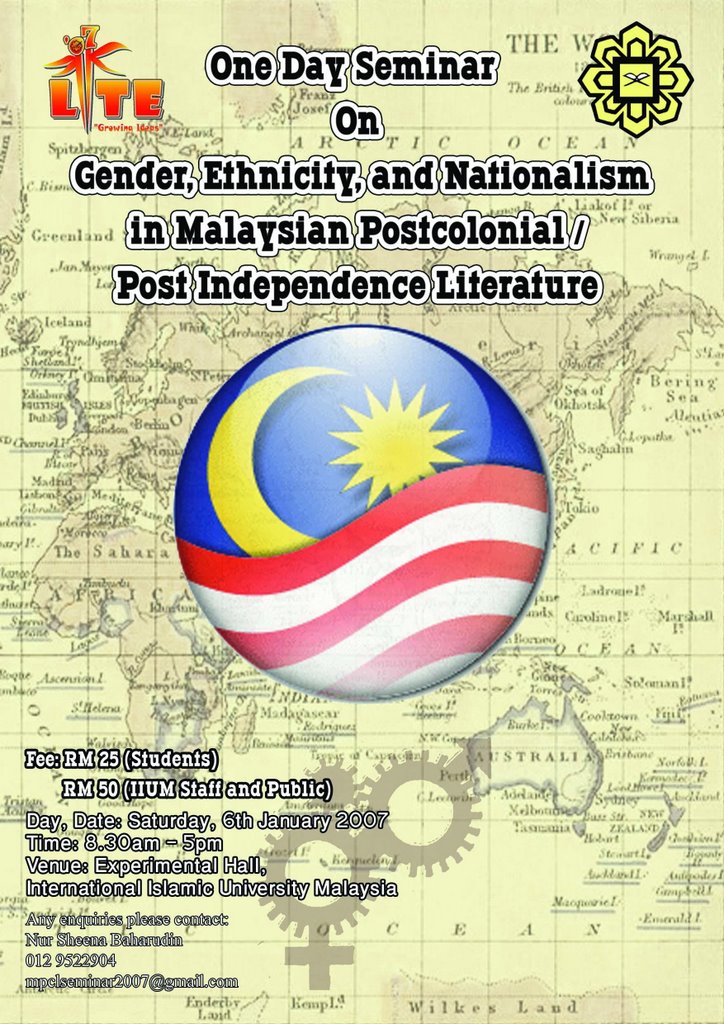
At yesterday's seminar at the International Islamic University there was a lot of very necessary talking going on and I apologise in advance for this is a very potted, gappy version which doesn't do justice to the depth of discussion and research. (I really do look forward to reading the papers in full.)

Academic and poet Wong Phui Nam gave a paper called Towards a National Literature, where he argued against the assumption (by some parties) that a national literature was literature written solely in the national language (Bahasa Melayu) and pointed out that no other nation in the world had found it necessary to legislate in this way. Literature can't be a created insignia of state, he said, because if you attempt to constrain it, you will be dealing with a dead object.

Historian Professor Khoo Kay Khim of Universiti Malaya gave a fascinating potted history of the country from the sultanates and Straits Settlements to nationhood, and I learned much along the way. Think you know it all? The transfer of power on 31st August 1957 was between which two parties? (And if the Brits are in the equation, you're wrong!)

Professor Dr Kamarrudin contrasted "orientalist" and "post-colonial" readings of Hikayat Hang Tuah.

Playwright Kee Thuan Chye talked about The Need to Adress Ethnic Relations in Malaysian Literature. It was his own frustration with the political landscape in Malaysia, of course, which provided the fuel for his plays.

He said that there is a real need to talk about what's happening in the country, but Malaysians shy away from controversty and are scared of offending sensitivies, so much doesn't get discussed. In particular, ethnic relations are far from sound and there is a need to improve respect among the races. He also made the point that in this country jingoism is often mistaken for patriotism, and the real patriots are in fact those those who do something for the country.

It was sad that Dr. Chong Fah Hing of UPM was unable to attend as I would have been very interested to have heard his paper about the state of Malaysian Chinese literature - something I know absolutely nothing about. Dr. Faridah told me that she had also lined up a speaker to talk about Malaysian Literature in Tamil - but that also fell through. Next time, perhaps?

The afternoon sessions focused rather more on gender issues.

Prof. Dr Ruzy Suliza Hashim (UKM) talked about memoirs and pointed out that while the genre is in a healthy state overseas, memoirs written by Malay women are few and far between. She referred to two memoirs, one by Khatijah Sidek, the first head of the women’s wing of UMNO to demand equal rights for its members, and the other by Shamsiar Fakeh, Former Head of Communist Party Malaysia's Women's Wing. (Dr. Ruzy said that this one was banned in Malaysia - must check this out).

But where were the voices of ordinary Malaysian women, she asked?

Dr. Noritah Omar (UPM) gave a paper entitled Framing gender and Ethnicity within the Construct of 'Bangsar Malaysia' and 'National Islamic Identity' in Malaysian Literature, and then the afternoon ended with Dr. Teh Chee Seng (UTAR) talking about the need for more women's writing in Malaysia as "there is not much to read".

I think that looking at women's writing is very necessary, particularly since in this part of the world their voices are heard less frequently than men's. Dr. Chee's paper raised some very interesting questions. But I don't agree with that academia can in any sense dictate what women should write about. (He said he wanted to see more fiction addressing "women and islam, victimisation of women, and female sexuality" as evidence that women were "evolving" in their writing.)

But if the academics want to read Malaysian women's writing, they really should be looking in the blogosphere where, for many women, anonymity allows a newfound freedom of expression.

And as for the question about why women don't write more about certain issues ... well, let's just say there's a lot of harrassment of (particularly Muslim) women who might be considered in some sense to have stepped out of line in what they write. (Enough said for the moment - might take this as my own research topic later on!) Women have to feel safe before they can write openly and honestly.

Animah came along and although it was her first academic literary event, enjoyed it ans asked good questions. It was also fun meeting Dr. Faridah's students whom I will be seeing again next week as I'm running a creative writing workshop for them!

Afterthought:

Yeah, okay. Let's add some academics to the fishtank. They can help to keep it clean.

Related Posts

On the literary stuff:

Dreamer Idiot Tackles Post-Colonialism (31/1/06)

On Kee Thuan Chye:

Kee Principles (17/9/05)
What You Already Know (13/9/06)
Origins and Originals (19/9/06)
Swordfish for Surrey (4/11/06)

On Wong Phui Nam

English as Colonial Leftover (20/8/06)

Wednesday, December 27, 2006

Seminar - Post Colonial Malaysian Literature

Poet and academic Faridah Manaf sent me details of a literature seminar to be held Saturday 6th January at the International Islamic University. Speakers include playwright Kee Thuan Chye and poet Wong Phui Nam.

Contact details are on the poster (click and click), and on Faridah's blog.

Maybe I'll see you there?

Monday, November 27, 2006

Sunday Supplement

There was a lot of interesting literary-related stuff in yesterday's Starmag.

First, the interview with outside-the- box-thinker, erstwhile student-activist, ISA Detainee, film-maker and writer Hishamuddin Rais.

I bumped into Isham at Raja Ahmad's open house the other day and asked him to read on Saturday ... but he must have forgotten. I do hope we can get him another time - the last time he read (a piece from his play about being interrogated) his words came across so powerfully.

He told me that he later took his play across the country, performing in small out of the way places for the people his words needed most to reach.

And then there was this very nice glimpse of Na'a Murad's (Jit's little brother) bookshelf. His favourites writers? Kurt Vonnegut, Umberto Eco, Salman Rushdie, Promoedya Ananta Toer, and science writers Stephen Jay Gould (I'm happy I've found another fan!) and Richard Dawkins. Who says there are no serious readers among us?

The last time in saw Na'a, he was playing one of the main characters in Animah's play.

There's a tasty little taster of Xeus' story Trashcan Child. (Now this seems to me a very good idea, The Sunday supplements in the UK and the US often have extracts from books. And what better way to promote local writing and get potential readers interested in books?)

And there was also an account by theatre director Kwong Loke of the staged reading of an extract from Kee Thuan Chye's play Swordfish and Then the Concubine at the Warehouse Theatre, Croydon. The play, you will remember, won a consolation prize at the International Playwriting Festival:
Kee writes from the heart; his works consistently emphasise fair play and equality. They question the state of being of both the individual and the society he lives in. It is not agit-prop, but, as with all valued writing, it expresses what he sees as flaws in contemporary life and offers them up for debate and self-examination. ...He is not afraid to raise issues of post-colonialism and history (We Could **** You, Mr Birch), state control and multicultural co-existence (1984 Here and Now), race, class and government (The Big Purge).
You always wonder how something written in this part of the world will go down elsewhere. I found this interesting:
The reading of the extracts was received with intense absorption; funnily, for a play that is so grounded in Asian tradition, it reflects Britain’s current mood towards its prime minister, Tony Blair, and his style of leadership – a break in trust and belief between the voters and the elected. The audience appreciated the universal relevance of Kee’s play, which well deserved its place in the shortlist ... The themes of injustice, intolerance, lack of foresight resulting in political failure brought an enthralled silence to the house. A long speech detailing impalement as a form of punishment was complemented by a stunning vision of a lonely girl washing her bare arms. It brought out all the vulnerability of the oppressed.
Well done, Chye, and what a pity you could not have been there yourself.

(Pics nicked from the Star. The pic of actress Se-Rock Park as the concubine, was originally from Warehouse Theatre).

Saturday, November 04, 2006

Swordfish for Surrey

Although, sadly, playwright Kee Thuan Chye was not chosen as one of the three winners at the International Playwriting Festival out of a shortlist of ten, he was one of two playwrights awarded a consolation prize and extracts from The Swordfish, and then the Concubine will be read out during the festival which will be held the weekend of on 18th and 19th November.

Those of you in the London area might like to go along and cheer can find more information here.

Chye sent me a rather nice PDF file with all descriptions of all the plays on it. I don't know how to post it here, but will forward it to anyone who'd like it.

This describes the extract which will be read (on Sunday 19th 7.30):
In a Singapura courtroom concubine Haslina is on trial accused of associating with a fundamentalist sect and the attempted murder of the royal consort, Tun Dara. As she pleads her innocence the judge must decide whether she is a victim of a conspiracy. Written in true epic style with a wonderful sweep invoking Brechtian parallels.
That's a great last line to put on the posters when the play comes here ... or would be if more people knew Brecht!

And talking about plays, playwright Ann Lee asked me to pass on word about the Women's International Playwriting Conference in Jakarta and Bali from 19 - 26 November, which she will be attending. Details here. The full fee is USD250 for all days, but there's a special rate for students and others who wish to for single day (includes plenary session, workshop and performance from morning to night) - which sounds a good deal! (And a good excuse for a break.)