Showing posts with label thor kah hoong. Show all posts

Thursday, August 09, 2007

Dzof the Viper?

Dzof Azmi's column in the Star at the weekend was a wonderful wind-up for people who love the physicality of published books. Words ... not books are what counts, he says, as he predicts the imminent demise of the paper manifestations and the growth of digital ones. Do go read.

(We've had this debate before, of course, and I can pretty much predict what your take on the issue is, just as you can most probably predict mine!)

Was much amused to read on Azmi's blog that Thor Kah Hoong had called up his mum and called Azmi ' a viper':
... for suggesting that the writing was on the electronic wall for physical books.
His response? :
I like that, I've never been compared to a muscle-engined sports car before.
Anyway, should Dzof's vision of the future come to pass, I would probably become Thor's best customer, and get stuck in a happy time-warp rediscovering past literary glories!

Monday, July 09, 2007

Adaptation

Was lucky enough to be invited to attend the workshop on adapting texts for the stage oranised by FIRSTWoRKS/Instant Cafe Theatre and was much brain-boggled by the company I found myself in ... the other participants included stars in the theatrical firmament Ann Lee, Kee Thuan Chye, Jo Kukathas, Anne James, Thor Kah Hoong as well as best-selling author (!) and screen writer Kam Raslan, Zedeck Siew of Kakiseni, Bernice Chauly of the myriad talents, and the group of budding playwrights being nurtured by FIRSTWoRKS: Animah Kosai, Ridzwan Othman, Rahel Joseph and Shanon Shah.

Laurence Strangio the writer/director of Alias Grace talked us through the process of adapting his play from Atwood's novel telling us that he only drew on Grace's first person narration, and then only a small proportion of that. Although the film rights have been bought he said, it would be a very difficult film to make a movie because one of the most delightful ambiguities of the book is whether the mysterious peddler Jeremiah is the same person as Dr. Jerome La Pont, who hypnotises her. In the novel and in the play it is possible, Laurence says, for both possibilities to live at the same time.

He says he read and reread the book, putting post-it notes on the sections he liked best and then typing them onto computer. He says he played "fast and loose" with the arc of the story, and says he knew the book well enough to reinvent it. The first draft was three and a half hours long when read through, and was, of course, substantially cut. Laurence also showed us transparencies of a particular scene so we could see how it had changed over time, and explained how the actor's portrayal of the role (in this case Caroline Lee) fed into the way the work was written.

We talked about reasons for adaptation, and then we discussed texts that we had brought along to the workshop to adapt.

On the second day we drew a poster presentation of the key touchstones of our texts and here're some photos. (I put the full set on Flickr.)

Kee Thuan Chye hard at work ...

Me, being creative on the floor! I chose Tinling Choong's FireWife since I'd just finished reading it and found it very visual. (Eight women, eight photographs, fire, water).

Bernice wrestles Elizabeth Gilbert's Eat Pray Love: One Woman's Search for Everything Across Italy, India and Indonesia down to the ground!

Kam show-and-telling his take on Conrad's Heart of Darkness.

Chye and Ridzwan inspect the posters. (I think they're looking at the naked lady covered in sushi picture on mine!)

The most exciting part of the workshop I think was when single images were taken and improvisations built around them creating a new set of striking images.

Now adapting a text to a play is something I would very much like to do and seems more manageable somehow than starting from scratch ...

Sunday, July 01, 2007

Raja Ahmad's Home for Art

Went along to the opening of Raja Ahmad Aminullah's gallery, RA Fine Arts, yesterday. It's in a bungalow house tucked away in Jalan Aman just behind City Square, on Jalan Tun Razak. Some literary types were there among the art lovers. Had a long chat with Thor Kah Hoong and Ted Mahsun. I bumped into one of my ex-MCKK students, Latt Shariman, whom I hadn't seen for more than twenty years ... and of course in my usual blur way didn't recognise him. Also met a couple of old school friends of Abu's and we chatted about how (even if a bit belatedly) we might finally get the Burgess plaque project off the ground.

Gave poet Rahmat Harun the frangipani treatment.

Raja Ahmad with the Prince Regent of PerakRaja Nazrin Shah and Tuanku Zara Salim who were the guests of honour, and behind them (in the orange shirt) speaker for parliament Tan Sri Ramli Ngah Talib

I was introduced to the prince and had a nice chat about my days in Kuala Kangsar.

I saw the great man of Malaysian literature A. Samad Said sitting alone and plucked up courage to say hello. No sooner had I sat down next to him than he said "Are you Sharon Bakar the blogger?" and called over his wife to meet me! Really, I was laughing!

The gallery has some excellent art and is open by appointment, call 03-21617431.

Tuesday, April 24, 2007

Books for the Boys

Since Glenda seemed quite intrigued by the comment I made yesterday about male readers choosing not to read female authors I thought I'd post up the article I wrote on the subject. This piece appeared in (the now sadly defunct) men's magazine Chrome in January 2006. Don't know how many of you read it at the time. Greenbottle and Amir Hafizi will find their own words still reverberating!
One rainy afternoon in Bangsar some years go, I was browsing in the shelves of my favourite second-hand bookshop when an elderly, dhoti-clad gentleman burst in from the street, brandishing a copy of Middlemarch at Skoob’s proprietor, Thor Kah Hong. Thor had apparently recommended the novel as the kind of improving read this gentleman said he was after. But now his customer was absolutely irate and demanding the book be changed.

“Why does she call herself George? I don’t read books by women writers.” He spat out the last two words as if they left a rancid taste in the mouth.

The answer is quite simple, of course. Mary Anne Evans became George Eliot to protect herself from prejudice in a predominantly patriarchal society, just as many other women authors have changed their names over the years to make sure that their work was judged solely on its merit.

The most famous woman writer in 19th century France, Aurore Dupin, published under the pseudonym George Sand. The Bronte Sisters, Charlotte, Anne and Emily published under the male pseudonyms of Currer, Ellis, and Acton Bell. Karen Blixen (of Out of Africa fame) chose to write under the male name Isak Dinesen. Lula Mae Smith wrote as Carson McCullers, and Janet Taylor Caldwell dropped her first name so as to be taken more seriously, writing also as Max Reiner.

Even in recent times, women writers have chosen to reduce their given names to initials so as to become sexually ambiguous; Booker winner A. S. Byatt and Scottish writer A.L. Kennedy among them. J.K. Rowling says she decided to write under her initials rather than her full name because she didn’t want the fact that she was a female to deter boys from reading her books.

But in these more enlightened times surely our Middlemarch wielding gentleman is an anachronistic exception, and writers like Rowling overly cautious? Sadly, it seems not.

Earlier this year, academics Annie Watkins and Lisa Jardine of Queen Mary College, London, carried out a piece of research to mark the tenth anniversary of the Orange Prize for fiction. They surveyed 100 academics, critics and writers – the people they felt were most likely to be well-read and have the most influential opinions about literature to find out their attitudes to the gender of authors.

They found that while women read writers of both sexes quite happily, most men did not. Four out of five men had most recently finished a book by a male, and most had trouble remembering the last novel by a female writer they had read.

Wanting to see if this held true in the Malaysian context, I carried out a small scale survey on my blog and found much the same results. Asked to say what they were currently reading, over 80% of the men said that they were engrossed in a book by a male author. However, unlike the sample interviewed in Britain, most said that they did read women writers and were able to recall the last book they’d read by one.

For most men, Watkins and Jardine concluded, great writing is male writing and they find it more difficult to like or admire a novel authored by a woman. This held true for one or two of my blog readers. “I don’t think women can write like Marquez, Nabokov or Gunther Grass,” wrote one blogger known as Greenbottle, “to me these guys write as though with penis instead of pen, full of masculine animal energy.” He felt that many women writers, on the other hand, tended to produce “saccharine, wimpy or effeminate writing”. Another blogger, Amir, felt that “prose written by a lot of female authors tends to be, how do you say it? Delicate? Detailed? Ditzy?”.

More worrying is that these prejudices also appear to extend to those who make recommendations about the best books to read and influence buying habits. Of 56 books suggested by male celebrities in the Observer’s summer reading list in 2003, only 6 were by women. A tally of Time magazine’s 100 All-time Novels chosen by critics Lev Grossman and Richard Lacayo and published earlier this year listed only 10 novels by women writers. (Closer to home, see how many articles about women writers you can find in the archives of the Silverfish litmag!) You can’t help but wonder whether women writers are playing on an even playing field.

Now, I’m certainly not one to press for political correctness at the expense of literary merit, and I fully recognise that male readers of fiction are in any case an endangered species (author Ian McEwan went as far as to say that when women stop reading, the novel will be dead).

But if your reading diet has hitherto consisted almost entirely of male writers, perhaps it’s time, at last, to give women a chance?

Monday, March 26, 2007

KL's Little Bookshops

Thanks Marisa for pointing the way to this article in the New Straits Times yesterday about KL's independent bookshops. It's nice to see the publicity for these little shops which are till able to hold their own despite competition from the big boys.

Not sure though Raman who caters for "the discerning reader" would care to be lumped together with the book rental places!

Above is a pic of Skoob proprietor Thor Kah Hoong. Time to make a vist if I could only get past these warehouse sales.

Monday, October 09, 2006

The Lure of the Independents

Johan Jaafar described every literary buff''s bookshop fantasy (well certainly mine!) in the New Straits Times on Saturday:
Back in 1988, I visited a small bookshop in New Delhi. I was browsing through a remarkable collection of Indian classics when a gentleman appeared. Since we were confined to a small space we had no choice but to acknowledge each other’s presence.

We talked about a book I was holding, the Bhagavad Gita — probably one of the best known war treatises in the history of mankind. I told him of my interest in the Mahabharata and how it went through a magnificent "local colouring" in my country.

Before he left he took out a book and gave it to me, The Golden Gate, which he signed. "My last copy, not in pristine condition I’m afraid, but since you can’t get it here, I’ll let you have it," he said.
It was of course Vikram Seth.

The Golden Gate is an incredible work (imagine this a whole novel written in sonnets!) I didn't know though that:
It was inspired in part by Aleksandr Pushkin’s Eugene Onegin. Legend has it that he found the copy at a second-hand bookstore in Stanford. That discovery changed his life forever. He chose to be a writer rather than an academic. See what a bookshop can do to a person?
This leads him to reminisce about other bookshop encounters both abroad:
... I was in Paris in 1997 when I came across the Shakespeare and Company bookshop (left) across the Seine from the Notre Dame Cathedral. It was not the original bookshop of the same name started by Sylvia Beach in 1919. That shop became famous for it was the meeting place for English- speaking expatriates and lovers of English books, not to mention the place where Ernest Hemingway, Ezra Pound and John F. Fitzgerald spent hours. In the world of Francophiles, Shakespeare and Company was the symbol of all things English. Beach died in 1962 but the name was retained by another bookshop.

It is cramped, cold, even stuffy, with books spilling into narrow corridors and whatever spaces available, but it was where the "real books" were. Unlike modern book stores that are well-lighted and better arranged, this place reminds you of penniless authors and unpretentious scholars lingering with only one purpose in mind — to immerse themselves in the world of books.

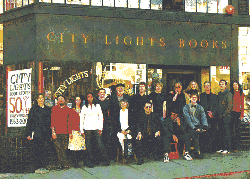
And then there is the City Lights of San Francisco. It was co-founded by poet Lawrence Ferlinghetti in 1953 and became the first in the United States to concentrate on paperbacks. The best thing about the bookshop is its unusual triangular structure.
... and nearer home:
I grew up in a village in Johor, 35km from the nearest town, Muar. There was no bookshop in the village. Whenever my father went to Muar I accompanied him. He would spend his time having teh tarik at his favourite mamak shop facing the Muar River. I was left to hang around at Kedai Buku Manap. What an experience it was. I was surrounded by books of all shapes and sizes. In my kampung, I read The Thirty Nine Steps and King Solomon’s Mines over and over again, for those were the only English books I had. At Kedai Buku Manap, there were few English books, none that I could afford anyway, but there were books published by Sinaran Brothers of Penang and Dewan Bahasa dan Pustaka. The best my father could do was to buy me a comic book.
He singles out those two little independent bookshops for praise:
I am more of the "Silverfish kind" – I am referring to the little bookshop in Bangsar the size of a convenience store, next to a famous eatery. Silverfish is unpretentious, it is a booklovers haven, and more importantly it offers the feel of familiarity that has eluded the bigger chains. ... Silverfish, which belongs to Raman Krishnan, is also a respectable publisher. Or I would prefer my friend’s little hideout — Thor Kah Hoong’s Skoob Books. Hideout, I say? It is hidden somewhere in the bowels of the tallest building in Old Petaling Jaya. Sadly, you will find a lobby with unoccupied shoplots, a hair salon and a snooker parlour before you come across this gem of a bookshop. Thor, the former journalist, is also an actor and playwright. His books are old and new, expensive and cheap, but like any small independent bookshop, it has the smell of genuineness.
I would so love to visit Shakespeare and Co. especially since reading Books, Baguettes and Bedbugs (which I've not told you about yet, have I?) and City Lights of course.

Independent bookshops are idiosyncratic and fun ... you never know what you'll find, who you'll bump into and just how grouchy or chatty the owner might be.

One of the delights of travelling is to seek them out independent bookshops in whichever country you find yourself. (There is such a phonomena as "bookshop tourism" you know!) Trouble is that the "personal touch" usually leads to more recommendations ... leads to more book buying ... leads to more penury!

Related Posts:

Skoob is Books Drawkcab (17/1/06)
A Home for Bookworms (20/2/06)

Saturday, June 03, 2006

The Spoils!


My loot from the Pay Less Warehouse sale yesterday. Went with Sham and we had such fun! I hadn't expected there to be so many desirable books - and for next to nothing.

There was such a carnival atmosphere. Everyone shovelling books into huge cardboard cartons with big smiles on their faces. Me piling book after book into Sham's box: "You must read this. And this. And this. And this." And then doing the same thing to all the other people standing around looking at the fiction. Never mind that we hadn't been formally introduced.

Met Raja Ahmad Aminullah, my poet/publisher friend. Thor Kar Hoong of Skoob Books was there with arms full. A very nice young man came up to ask me "Are you Sharon?" Turns out he's one of the silent readers of this blog and enjoys the book recommenations.

I found hardback copies of some of the books I have in tatty paperback and filled in gaps in my library with books by Philip Roth, Barabara Kingsolver, Alice Walker, Carol Shields, Ann Patchett and others. 16 lovely books for RM49!!

Friday, April 14, 2006

The Dina Zaman File

Dina Zaman suggested the idea of a blog interview the other day to tie in with her reading this afternoon at Borders. Since we'd arranged to meet yesterday morning to talk over a couple of her stories, it seemed like the right opportunity.

After all, if as Raman suggests, the local newspapers aren't featuring much book news, doesn't a self-styled litblogger have a duty to scoop an exclusive?

I've enjoyed Dina's writing for some time. The first stories I came across were published in a little volume called Night & Day (Rhino Press) and I felt rush of joy as I read them. Not only did the writing slip down easily, she was the first writer I'd come across who'd manged to get down to the page a Malaysia I recognised. (Heck, She even captured characters I had seen myself on the street!)

Dina told me that she had spent hours observing people while waiting for her bus after work (she was a PR executive for Central Market or wandering Petaling Street. The stories were there and waiting for her.

Dina says that she's always felt a sense of rootlessness, of being in the outside of things. Her father was a diplomat and the family had to continually move between postings so that she always felt like the new kid in town.

Born in 1969, she spent her early years in Tokyo and grew up speaking Japanese with "just a smattering of English, so that no-one knew what to do with me". One of her strongest memories from these early years was her mum making her a pair of wings because she fancied being a butterfly. The family later moved to the former Soviet Union where she attended an Indonesian school and has vivid memories of being bullied.

Because of the disruptions to her education, Dina moved back to live with her grandparents in rural Terrenganu and fell in love with kampong life. She was also homeschooled for a while - an experiment she describes as not being too successful, before the prestigious Sekolah Tungku Kurshiah and then Convent Bukit Nanas.

She discovered that writing was her vocation whilst on a degree course in Mass Communication at Western Michigan University. Forced to find a subsidiary subject, she chose creative writing initially because it seemed an easy option, but she found she had a flair for it, and Philippa, one of the pieces she wrote while there, found its way into Skoob Pacifica Anthology Volume 2 (1994) published by Thor Kah Hoong of Skoob Books.

A spell in PR followed, but Dina began to submit pieces to the New Straits Times, and before long she was offered her own column by editors Rose Ismail and Fatimah Abu Bakar. Christened Dina's Dalca (named after a kind of lentil curry which contains a whole mixture of ingredients), she soon had a large number of followers intrigued by the frankness of the writing, delighted by the humour. She also had pieces accepted by Men's Review where she describes editors Kam Raslan and Sheryl Stoddard as supportive "but tough".

She runs through the names which were most prominent in the writing scene in the early '90's, a time when the writing scene seemed so much more exciting, ("There were so few of us in the KL writing scene in those days, so we all knew each other and were working towards a common goal") but laments that of all those promising young voices only Bernice Chauly and Jit Murad are still writing.

Dina's blog The Gongkapas Times (written she says "to let off steam") carried on from where Dalca left off, and was one of the most popular destinations in the Malaysian blogosphere. There was a collective howl of sorrow when the blog suddenly got taken down by a hacker and months of entries were completely lost. (The good news though, is that it's back.)

She did an MA in Creative Writing in Lancaster, choosing it over SOAS because of London prices and a desire to be in the countryside and "live out farm girl fantasies". And there was the Lake District close at hand of course, with its writerly associations with Beatrice Potter and William Wordsworth.

She says that she didn't really feel stretched by the course where she felt she was repeating stuff she had done for her first degree. But homesicknesses was assuaged by writing about kampong life, and she finished the draft of a collection of short stories set in rural Malaysia. One of the stories, And She Became an Angel, was shortlisted for the Ian St. James Awards. (The collection The Road to Elvis and Other Stories will be published later this year.)

Her year in Britain also gave Dina the opportunity to travel around Britain and talk to fellow Muslims, and the idea for a new column about Islam was formed.

After a spell working for Marie Claire, she became editor of Rentakini, the magazine section of the controversial online newspaper, Malaysiakini. Her I Am Muslim column was born and Dina became a powerful female voice for moderate Islam in the country.

If Dina has become something of a public figure, she is at heart is a very private person who feels uneasy when her personal space is invaded. Her writing has attracted legions of fans, including some who don't respect her boundaries. "When you're very open and write about your life, people feel they know you."

She's also had her fair share of detractors over the years, she says, including those who ask "What is this Malay girl trying to prove?" and her early fiction has been criticised for being "too sexual, too angry". There's less anger, a great deal more humour in the new collection, but the stories are still bound to stir some controversy.

And once The Road to Elvis is Published? Dina's colourful stories about the larger than life characters in her extended family can keep me enthralled for hours, and I'd love to see her write a dynastic novel about her Terengganu roots ala Allende or Marquez.

Curiosity stirred? Well then, come over and hear her read some of her writing this afternoon at Borders! The fun begins at 3 p.m.

Sunday, April 02, 2006

Raman's Newspaper Rant

Raman has updated his website with some tasty news and an extremely interesting opinion piece about the local newspapers: don't they have a role to play in promoting reading?:
The two main papers publish more than a thousand pages each week (I wonder how many trees that is). One has two pages of book news, the other has no fixed schedule. Local book news? Forget it.
There is slightly more than that in the Star. Thor's column on Tuesdays which is sometimes spot on (especially when he talks about local writers), but at other times loses me and my eyes glaze over. (Sorry!) ... Perhaps an article on something literary gleaned from the Guardian which I've already read online (but if you are going to take literary articles from any newspaper in the world, please, make it this one). ... A page of short reviews on Thursdays - a pretty mixed bag . Yes, a little more in Starmag on Sunday, I enjoy the reviews and Daphne's articles about kids' books are excellent because written by someone with a passion. I don't read the NST 'cept on Sundays, but used to buy the Wednesday edition when there were literary pages.

Book pages don't attract readers? If you take books as your starting point, you can write about almost anything in the world anyway (I've visited sado-masochism, greasy spoon cafes, the Iraq War, issues of gender, millinery, cookery, and the female orgasm in the last few days!)

Blogging has taught me this: there is a readership for news and opinion pieces on books and authors ... providing that the writing is lively and takes the reader into account. Trying to be deep level literay (and the NST's pages tended to veer that way) will just make books seem lightyears away from the interests of most people. Drop the L word! But at the same time, don't underestimate your local readers. who are capable of a deeper level of intellectual engagement than the newspapers throw at them.

But yes, I agree with Raman's bottom line ... if a nation of readers is to be created, the newspapers must play a significant role.

I'm hungry for more than the local papers provide. I stick them on the recycle pile or use them as disposable plates for my cats after 5 minutes skimming ... and then spend hours online reading the book pages from overseas newspapers ... and reading blogs.

Was very interested in what Raman says about a local Chinese newspaper taking literature seriously and sponsoring an award :
A Malaysian Chinese daily (I have spoken to their CEO) has a biannual international literary competition and award for fiction, poetry and journalism which has been touted as the Chinese equivalent of "The Booker'. This project apparently attracts top writers from China, Taiwan, Hong Kong, Singapore, Thailand, Malaysia and all other countries in the world, and Malaysian writers in Chinese are most definitely world class. This same newspaper also has regular literary pages with discussions on a diverse range of topics by local and foreign writers. I was shown a page where the discussion was on the works of Borges and Bukowski. (Note to readers of English newspapers: no, they were not the villains in the last Star Wars movie.)
Amazing! I really didn't know. (Please tell me more if you did.)

Raman accuses a local newspaper of merajuking during the Literary Festival.

I actually don't know the truth of any of this, and I don't know how the publicity could should have been managed differently (I was coordinating the sessions and speakers so was mentally elsewhere during the lead-up) ... but it broke my heart that despite bringing something this enormous to KL and putting the country on the world literary map, despite months of hard work and stress ... there was next to no publicity for the whole venture and no write up in the press about it afterwards (just a mention in the education pages of the Star!).

Even those publications which pride themselves on having a finger on the pulse of the arts scene largely ignored us. Where else in the world would that happen? Though all the papers were happy to interview the writers we'd invited ... Hijuelos, Paul Bailey, without mentioning the Litfest ... or just in passing.

Maybe Raman stood on toes (he's pretty good at that!) ... maybe Raman didn't get the publicity machinery into place in time ... but the silence from the press hurt deeply.

Hurt me, anyway. Am I too sensitive?

Friday, February 17, 2006

Skoob is Books Drawkcab

Wonder how many of you actually know that we have a branch of the best secondhand bookshop in London?

(And yes, I have checked out the parent store, Skoob in Russell Square - how could I not?)

Skoob Malaysia has gone through a variety of incarnations. When I first came across it in the early 90's it was sharing half a shop-lot with a dobi shop. (That's a laundry - notice how I am now carefully translating terminology! Let's let shop-lot slip past and hope Walker doesn't notice!)

It later moved to slightly larger premises just up the road in Jalan Telawi 3. The first time I wandered in there, I had a surreal experience. Now bear in mind that this was well before the days of the big bookshops, when the best that could be found in Bangsar was a rack of Jackie Collins and Jeffrey Archer in Guardian pharmacy between the headache pills and the face creams. For some reason, I had a craving for a copy of Boswell's Life of Johnson.

I asked the woman behind the counter, expecting her to say something along the lines of "Huh?".

Cindy (for 'twas she) didn't skip a beat. Without looking at the shelves, without consulting any data base or list, she calmly asked "Would that be the 1923 Everyman edition in two volumns or the Heath&Co 1929 edition?" I nearly died of shock on the spot! We checked the shelves and both were there. An oasis in the dessert.

An oasis too of intelligent conversation as proprietor Thor (no relation to the thunder-god, unfortunately) playwright, actor, theatre-director, critic, lecturer, and his musician wife, Cindy, are book-loving kindred spirits.

I loved the shop for it's sheer plenty. Shelves were filled to capacity. There was a terrific range of novels, poetry, literary biographies, and of course the philosophy, religion and the occult in which the bookshop specialises. Books were stacked on the floor, filled even more boxes in the backroom, recent deliveries from the mother-ship in London.

Loved too the way that it drew eccentric characters to it. One rainy afternoon, I was browsing in the shelves of my favourite second-hand bookshop when an elderly, dhoti-clad gentleman burst in from the street, angrily brandishing a copy of Middlemarch at Thor who had apparently recommended the novel as the kind of improving read this gentleman said he was after. (He'd rejected a James Clavell novel the week before because the "language was not rich enough"!)

“Why does she call herself George?" he wailed "I don’t read books by women writers.”

I also laughed at Thor's story about customers coming in to buy antiquarian books by the yard to show the world how well read they were.

When rentals in Bangsar started to go through the roof, Thor moved a couple of miles closer to the city centre to a spacious property in Brickfields, behind the YMCA and next to a rather good Indian shop selling thosai. (Love Danny Lim's moody picture of Alvin Wong outside SKOOB in its Brickfields incarnation.).

More recently, it's moved again to Old Town, P.J. (Lot 122 & 123 Menara Mutiara Majestic, Jalan Othman to be precise), and takes a little more tracking down.

It's a book-lovers haven still (and a lot of books are much cheaper these days) and thanks to Cindy's artistic touch (flowers, lights, teak benches, cushions), the ambience is as squidgy as you could desire. Thor will even make you a cup of tea to sip while you browse. (Tell him Sharon said so.)

As I write this it strikes me that I badly need to make a pilgrimage to Skoob to fill some gaps in my collection, especially now that I have bookshelf space. (But for how long at this rate?? *sigh*).

Photo from The Sun

Wednesday, January 18, 2006

Thor's Silk Factory Grouch

Not everyone in the Malaysian litosphere is going gaga over Tash's Whitbread win. Just caught up (mucho belatedly) with Thor Kah Hoong's columns in the Star and he had a cumudgeonly go at The Harmony Silk Factory in last Tuesday's paper . His honesty though, is refreshing.

A FEW months ago, a few people discovered a perverse streak in this writer. They, believing in the opinionated voice that has filled this space for two years, thought I would be able, glibly, to summarise Tash Aw in a couple of sentences.

My reply: Nope, haven’t read it, haven’t thought of picking up a copy.

No immediate curiosity. I feel compelled to turn away when the fuss is heated. Particularly when the Malaysian connection whips up populist froth. Somehow, the occasions always feel tacky like a longest lemang applicant to the Malaysian Book of Records.

Sure, Aw grew up in Malaysia. But he was born in Taiwan. He lives in London. So who’s arbitrating for the claims of Taiwan and Britain?

I am reading Hsu-Ming Teo’s Australian Vogel (year 2000) winning novel Love and Vertigo (Allen & Unwin). Should we stake our claim on her as a Malaysian writer? She was born in Malaysia in 1970, but emigrated to Australia when she was seven. The narrative voice of the novel, Grace Tay, in Singapore for her mother’s funeral, asserts she is Australian. Does it matter?

Perversity has its limits. I did pick up Aw a couple of weeks ago, fortuitously just before the announcement of his winning a Whitbread.

Am I going to give my five sen worth?

No. I’m not going to sound like a sour grouch in the week of his success. My opinion doesn’t matter to him ? and really, good for him. The award will open more doors.

It’s just that I don’t know what the fuss is about because I’ve set aside the book. Another time ? maybe.

Well, okay, since it’s only worth five sen, my response was similar to the time I first read Amy Tan and her Joy Luck Club. I found myself being irritated and eventually skipping bits whenever Tan paused to explain the quaint exoticisms of Chinese culture and home to her primary readers, clueless ang moh.

Even if instruction in cultural oddities had been necessary, I believe it could have been weaved into the narrative more subtly. (Ref: Maxine Hong Kingston’s The Woman Warrior; National Book Critics Circle Award; for an adroit mixing of fact and fiction.)

Her explanations were clumsy and obvious, but excusable because it was her first effort. Her subsequent works have matured in this aspect. Culture has become an integral motive in her narrative, not an exotic gloss to attract tourists curious over chinoiserie.

That was Tan then. Aw’s instruction is even more clunky. In the second chapter, four pages are devoted to a paraphrase of Unwin’s 1954 study Rural Villages of Lowland Malaya.

What’s clunky? This is clunky: “I have paraphrased his words, of course, in order to avoid accusations of plagiarism, but the source is gratefully acknowledged.”

Excuse me. Is this a novel? Reads like one of my students’ essays. (Well, alright, a good student’s essay. Most of my college students would have problems spelling at least four words in that sentence.)

And then when the third chapter, titled The Kinta Valley, began in this fashion: “The Kinta Valley is a narrow strip of land which isn’t really a valley at all. Seventy-five miles long and twenty miles wide at its widest, it runs from Maxwell Hill ? etc,” my will to carry on reading started flagging.

I tried to detect some post-modernist irony beyond my antiquated radar. Maybe those passages were supposed to read like the primary school textbooks we had in the 1950s.

Then there are the details, the lack of. I couldn’t get a whiff of smells, a feel of lives fleshed fully.

Aawww, put my lukewarm snarl down to my senses blocked, clogged in the miasma of my year-end grouch.

Why am I persisting with Hsu-Ming Teo’s novel? I’ll let you know when I’m done with it.

Hadn't heard of Hsu-Ming Teo, but here's some information about her novel.

Tuesday, December 06, 2005

Contraband Reads

Ahah! The ever wise Thor Kah Hoong has the answer as to how to create a Malaysian reading public. In the Star today he writes:
The smuggling of books – therein lies an idea that will give a boost to the Government’s efforts to encourage reading. Instead of banning publications that are injurious to our moral and spiritual well-being, the Government should consider banning books it thinks we should read. Then Malaysians will be hounding booksellers like me for a contraband read, instead of, as in recent days, displaying prurient voyeurism, surfing the ’Net to look at a Chinese squat.
Damn. Now why didn't I think of that!

Wednesday, August 17, 2005

Of Thickie Pariahs and Books By The Yard

Victorian Beckham has never done it in her life.

Neither had Noel Gallagher ... until just recently.

Read a book, that is.

I think there are plenty of people out there who don't read books and who are none the worse for it
says Hester Lacy in today's Guardian:
... it's fine for anyone to confess that they really can't stick shopping; one can even seem quite smug about it. Not so if you aren't keen on books. Reading must be about the only pastime that is pretty much universally seen as "good" and virtuous - so to say openly that you don't like books puts you beyond the pale. For someone to say they don't care for reading labels them as some kind of thickie pariah, fair game for any insult. To decide any such thing on the basis of one single trait seems both sweeping and snobbish.
Meanwhile, concerned to show the world that he certainly isn't (despite popular opinion) a thickie pariah, George tells us what he's taking along as holiday reading . Convinced?

I remember Thor Kah Hong of Skoob Books telling me years ago about how he had customers come into his shop and order books by the yard to complement their home decor and fool vistors.

Update:

Apparently Gerry Adams (Sinn Fein leader) isn't much of a reader either. According to Rober McCrum in The Observer he confided to the New York Times not only that he had never finished Ulysses but didn't know anyone who had. McCrum asks for suggestions for a reading list to rescue Posh from the depths of her own ignorance.

Wednesday, July 06, 2005

Licence to Spin?

Thor Kah Hong's column in yesterday's Star interested me. It's about time someone wrote about Peter Ho Davies in the local papers! He's a superb short story writer for a start. He was acknowledged by Granta magazine as one of the best young British novelists in 2003. His work appeared in the 1995, 1996 and 2001 editions of Best American Short Stories and the 1998 O. Henry Awards. And he has a strong Malaysian connection - his mother is Malaysian-Chinese, and apparently Ho Davies also worked here.

I bought his collection of The Ugliest House in the World (which won PEN/Macmillan Silver Pen and the Mail on Sunday/John Llewellyn Rhys Prize) when it first hit the bookshops. There was the immediate rush of pleasure at discovering it contained a couple of stories set in Malaysia. And I enjoyed the whole collection very much indeed. In the beautifully surreal Buoyancy, a boy remembers his grandfather who drowned himself in the water jar in the back garden. And then there's the last story in the collection The Silver Screen, set in Brickfields during The Emergency.

This is what Thor had to say about it:

"The last story, The Silver Screen, (first published in Harvard Review and The Best American Short Stories 1996) was the one that gave me a few problems in the reading.

It raised all kinds of thoughts and questions about the imagination and creative licence. In the preceding page of “Acknowledgments”, Ho Davies credits Noel Barber’s The War of the Running Dogs as a particularly valuable source of historical information and notes: “Any inaccuracies are my responsibility, as, of course, are the occasional historical liberties I’ve taken.”

Log on to the website www.contemporarywriters.com set up by The British Council, and in the essay/comment on Peter Ho Davies, one is told that here is a writer who is “completely convincing” with “an exhilarating and vivid attention to detail”.

Therein lies my problem. In The Silver Screen he is not “convincing” because the “historical liberties” were more than “occasional”. I couldn’t have a smooth read because I kept stopping in irritation every time I came across inaccurate or risible details of a country, a neighbourhood, a time I lived through/in.

Starting with the first paragraph:

“From the end of the Second World War until the outbreak of the insurgency in 1948, the fourteenth Kuala Lumpur branch of the Malayan Communist party held its meetings at the Savoy Cinema on Brickfields Street.”

(I’d better establish my credentials. The first 23 years of my life were spent in Brickfields, 1950-1973. I have written, had published, and have performed on various stages several pieces entitled Brickfields Now and Then about growing up in Malaya in the 1950s.)

Brickfields Road instead of Street, the Lido cinema instead of the Savoy. Just names. I had no problem with that. And fiction can accommodate “the fourteenth KL branch of the Communist Party”.

My uneasiness first surfaced when I read that the “Savoy was an open-air cinema – four high walls with no roof and a huge canvas screen stretched out against the night sky.” Such alfresco entertainment was available in many parts of the country during that time, but the Lido had a roof and “first-class” seats upstairs. Inadequate research or someone patronising quaint primitives for foreign readers?

I’ll resist listing all the nits I picked out, just a couple of the more obvious howlers that stood out. In a propaganda leaflet dropped into the jungle to tempt the starving commies to surrender there is a photograph showing “dishes of chicken’s feet, fish-head curry, clay-pot bean-curd, prawns with asparagus, char-siu pork, and lemon chicken”.

Ho Davies may have tucked into this feast in some Chinese restaurant in Britain or when he was working in Malaysia and Singapore, but in Malaya in the 1950s? Asparagus? Ha! Chicken’s feet? Yeah, everybody knows the Chinese will eat anything. Fish-head curry and lemon chicken?

And it must have seemed reasonable for Ho Davies to have two of his characters, with practically no food and no equipment other than a rifle, wander in the jungle for almost two weeks and find themselves 200 miles from where they started.

Anyone who has ventured into the Malaysian jungle will know what an awesome feat that is. Excuse me, Mr Ho Davies, this is not Sherwood Forest.

Am I being unfair? Not seeing the forest for the trees? What about the story? The colourful characters? The prizes and the glowing endorsement by writers such as Gish Jen and Lee Chang-rae (whose works I enjoy reading)?

This is one time I feel the owning up to creative liberties and the possibility of inaccuracies does not absolve the writer of the charge of mining a vein of exotic sensations."


I hadn't noticed the factual errors in this story myself, but bow to Thor's knowledge of Brickfields and the '50's.

But I think the point that Thor is making here is an extremely important one. No matter how good the writing, the credibility of a story is destroyed whenever readers spot errors of fact.

Fiction is fiction is fiction, and writers will invent characters and places and events. That's fine. Every reader will respect that.

BUT, once you begin to draw on the "real world" a writer owes it his readers to get the details (historical, sociological, geographical, numismatic, ornithological - whatever!) right. (I've discussed this issue before, still feel strongly about it.)

I think it's laziness not to do so!