Showing posts with label starmag. Show all posts

Thursday, August 27, 2009

Pictures of the "Poppies"

So here's more about the Popular Bookstore Reader's Choice Awards a couple of days back. (I posted results here.)


Nominees Brian Gomez, Amir Muhammad, Adeline Loh during the speeches. The guest of honour was YM Professor Diraja Ungku Abdul Aziz bin Ungku Abdul Hamid, former Vice-Chancellor of Universiti Malaya. He spoke among other things about the necessity of using Malay for all subjects on the school curriculum and the need to vastly expand the translation of scientific texts into Malay.

The welcome address was delivered by Mr. Vangatharaman Ramayah, Director of Popular Holdings Limited who talked about the history of the bookstore and its broad reach in the Asia Pacific region (it has a total of 129 retail stores and is currently expanding into Myanmar).

Then it was time for each of the nominated titles to be highlighted on the screen above with a brief biodata of each author. My favourite moment though came when the MC had to read out the name of Brian Gomez' blog in this august company!


Then the results were read out in nail-biting reverse order. The first prize winners for the fiction and non-fiction categories won RM1,500 each and a trophy, while second prize winners received RM1,000 and third prize winners RM500.

Above, Tan Twan Eng's mum, Sally (in pink), receiving his award from Ungku Aziz on her son's behalf since he is in South Africa.

A group photo of all the winners in or their representatives. (Though I think some at the edges got squashed out. Apologies.)

A more informal shot afterwards - June Wong (Star executive editor) holds a copy of Adibah Amin's Glimpses, Robert Raymer (red shirt - behind her); Tan Sri Abdullah Ahmad holds a copy of Dr Mahathir's Selected Letters to World Leaders which he co-wrote with the former PM; Vangatharaman Ramayah (in the black suit), Director of Popular Holdings Limited; Sally Tan (the lady in pink); Popular Book Co (M) Sdn Bhd executive director Lim Lee Ngoh (holding Preeta's book) ; and last but not least, Kee Thuan Chye holding his copy of March 8: The Day Malaysia Woke Up.

I was very happy for Robert, winning the fiction category, as I know that this will be important encouragement for him. He looked scrape-me up-off-the-floor-it-can't-be-happening-surprised at the result.

Congrats to Popular books and to the sponsoring newspapers for creating a buzz about Malaysian books and involving readers. This is a very worthwhile event. I must say, though, that I would really welcome an award given by a panel of judges in addition to this popularity contest. (Mind you, there is no literary award without at least some controversy and there is always bound to be disagreement about the results.)

The important thing about any literary award is the conversation it creates, and the recognition and encouragment it gives writers. The "Poppies" succeeded very well on both counts.

(More at The Star.)

Sunday, August 23, 2009

Sufian Sambal and The Art of BiblioStalking

Although he doesn’t write specifically for adolescents, I think Sufian Abas has the sort of weird and wonderful imagination needed to create the sort of romantic fantasies teenagers would be only too eager to lose themselves in. They would most certainly identify with Sufian’s love-sick characters, his delusional young men and wide-eyed young women, all wandering through a world lit by fluorescent strips and filled with dusty roads, stuffy LRT coaches and gaudy fast food joints. ... It’s a world that smells, sweetly and sharply, of rotting garbage and paint-stripper; a world where ceilings leak and the plumbing is jammed with blood and guts and broken hearts. A horrific world, a romantic world, a world swollen with unrequited love and lost dreams. Just the sort of landscape hyper-sensitive, melodramatic young adults like to pretend they inhabit.
Daphne Lee recommends Sufian Abas' new collection Matanya Teleskop, Hatinya Kapal Dalam Botol Kaca (The Eye is a Telescope, the Heart a Ship in a Glass Bottle)* as a teen-read in Starmag today, and says the stories are (and don't you just love this analogy) :
... delicious – like washing down extra spicy sambal with fizzy Fanta orange.
Abby Wong also writes a very enjoyable column about her bookish family. And how important it is to make sure that a future spouse is bookishly compatible!

(Incidentally, on the topic of judging compatability via the bookshelf, you might like to check out Rands in Repose on the topic of being a bookstalker.)
*Available at Silverfish Books, or email Sufian Abas at dvinecomdy@hotmail.com.

Sunday, April 26, 2009

Link with Harlequin

More in Starmag today on the move by KarnaDya Solutions Sdn Bhd to bring chick lit into the Malay for a local readership. Dzireena Mahadzir discovers that the company is linking up with Harlequin (the world's biggest publisher of "women's fiction" - most usually romances) to translate titles from its Red Dress Ink imprint.

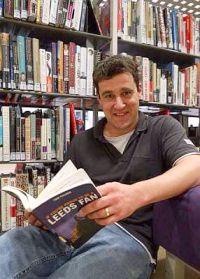
KarnaDya are targeting the youth market and, says marketing mananger Faiz Al-Shahab (left) :
... even though the culture and lifestyle in the books will be different from that of local publications, the plots and story lines will be entertaining to Malay readers. In terms of the storylines, I think Red Dress Ink offers more interesting content compared to local novels. From our experience in Malay fiction, it should be suitable for the local mindsets and tastes.
Dzireena isn't too impressed with the titles she picks up, though :
I found the language a bit stiff and writing didn’t flow very well. Some parts sounded like they were direct translations from English to Bahasa.

Sunday, April 19, 2009

Sunday Shorts

I'm willing to admit this to you, my dear reader. I am such a voracious consumer of books that I used to steal in order to satisfy my need.
Former book buyer with Kinokuniya Abby Wong starts an occasional column of things book related in Starmag and begins by telling us about her obsession. Another avid reader, Christine Jalleh tells a heartwarming story about how a stranger in a shopping mall turned Book Angel. (And, you know, we could do with a few more of those!) Elsewhere, Kuan Guat Choo hobnobs with ghosts. Deputy Prime Minister and Education Minister Tan Sri Muhyiddin Yassin reiterates the message that Malaysians don't read enough, as he launches the Kuala Lumpur International Book Fair 2009. (But there's no word about where his statistics about reading are taken from. Perhaps it is the mythical National Library Survey?) And Datuk Lat gets orchestrated.

Sunday, August 31, 2008

National Day Books

Malaysia is enjoying a long weekend for the 51st National Day, so Sunday's newspapers are, predictably, full of talk of nation building. It was a lovely surprise to see my friend and erstwhile writing group buddy Soo Choon on the pages of the Star, talking about her cross-cultural marriage.

In a very packed-with-good-stuff ReadsMonthly section the Starmag team journalists compile a list of their 51 best reads esp for Merdeka.

Daphne Lee interviews Bernice Chauly about her work (You can find the full interview on Daphne's blog.) :
Chauly’s poems are deeply personal. They may or may not be autobiographical in detail, but the stories they tell feel like they were shaped by real emotions and memories.

They are Chauly’s emotions, memories and stories, but they also speak to and for women the world over. They are familiar tales, but filtered through the voice of an individual, they defy the cliches of everyday experience and become significant, compelling and unique.
and Ahnaf reviews her collection of poetry The Book of Sins.

There's a write up by Rouwen Lin about the Read While Waiting flashmob event of last weekend.

Janet Tay review Nam Le's collection of short fiction The Boat (and there's a 25% off token!), and KayKay enjoys David Sedaris' When You Are englulfed by Flames.

Vernon Adrian Emaung crossed the causeway for Kee Thuan Chye's The Swordfish, Then the Concubine, which sounds as if it was beautifully staged :
Set in minimalist staging that featured a serambi or open platform for village gatherings, 15 Singaporean actors tackled a story that called for a cast of thousands across two generations – you couldn’t get more epic than that, right? Especially so when you have a gamelan orchestra providing for the peaks and troughs of human drama, the deafening clamour of war, and the crescendo of divine retribution. Music composer Joyce Teo and the Gamelan Asmarada group delivered proficiently on that aspect. The underlying political commentary linked current issues to these ancient myths quite commendably in the writing. Similarly, it was truly fascinating to watch the production draw stylistically from bangsawan (Malay opera), dikir barat, and silat to facilitate and vibrantly colour the storytelling.
It was quite an honour to have a Malaysian play kick off a Singaporean Theatre Festival. How sad I am I missed it. But I do hope it is staged here soon.

Sunday, April 13, 2008

New Award for Local Authors

A new award for local authors is announced in Starmag today by Malini Dias. Sponsored by Popular Bookstores and Star Publications (M) Bhd, it is to be called The Star-Popular Readers Choice Awards.

The shortlist for the award is based on titles which proved the most popular in Popular and Harris Bookshops last year. Readers will get a choice to vote for their favourites by filling in the forms which will appear in Starmag's and StarTwo's book pages over the coming weeks.

The top authors in the two categories will each receive RM1,000 and a trophy; authors of the second and third most popular book titles in both categories will each receive RM300 cash and certificates of recognition. There are also book vouchers to be won by those who send in the forms.

Here's the list. I've added links to relevant posts on this blog.

Non-fiction
  • Honk! If You’re Malaysian by Lydia Teh
  • I Am Muslim by Dina Zaman
  • The Reluctant Politician: Tun Dr Ismail and His Time by Ooi Kee Beng
  • In Good Faith: Articles, Essays, and Interviews by Zaid Ibrahim
  • As I Was Passing by Adibah Amin
  • The Unmaking of Malaysia: An Insider’s Reminiscences of Umno, Razak, and Mahathir by Ahmad Mustapha Hassan
  • Tanah Tujuh by Antares
  • From Small-Town Boy to World Class Surgeon by Mangai Balasegaram
  • Malaysian Politicians Say the Darndest Things by Amir Muhammad
  • The Sky is Crazy by Yvonne Lee
  • Fiction
  • Confessions of an Old Boy: The Dato’ Hamid Adventures by Kam Raslan
  • Mamasan by Khoo Kheng-Hor
  • The Red Cheong Sam by Ralph Modder
  • This End of the Rainbow by Adibah Amin
  • 44 Cemetery Road: The Best of Tunku Halim by Tunku Halim
  • Sweetheart from Hell by Lim May-Zhee
  • The Boy Who Talks to Ghosts by Benny & Alice Wong
  • Silverfish New Writing 6 edited by Dipika Mukherjee
  • Long Road to Merdeka by Kamarul Zaman Kamarulzaman
  • Nine Lives by Teoh Choon Ean
  • There are several books here I've read in part but not written about. Several more I've glanced at in the bookshop, but given a limited budget I haven't bought. (The canny publisher slips the litblogger a free review copy!!) I may start to fill in some of those gaps now.

    But congrats to all those nominated and I hope that this very useful initiative gives local authors and publishers a much needed boost.

    The great thing about any literary award, is of course the discussion it creates, and so it's open season in the comments to this post.

    What do you think of the books nominated? How many have you read?

    Sunday, December 30, 2007

    Celebrity Literatis!

    Andrew Leci is interviewed by Anu Nathan in Starmag's ReadsMonthly supplement about his first novel Once Removed.

    Now Andrew is a bloke I feel I know very well, even if I have never met him, because he's a sports anchor for ESPN and in our house, there's nowhere to run from the rugby matches on TV! (Let me tell you that I can hold my own in any conversation about the sport, but I actually only watch it for all the wrong reasons ... which I'm sure you can guess!)

    Once Removed though, is far removed from the sports pitch and is the story of a British expat at large in Kuala Lumpur of the 1970's.
    I am not going to be winning any Booker Prize for this one. I wanted to write something that would maybe provoke thought about the way we see expats and the way expats see us ...
    And as Anu points out he seems:
    ... blithely oblivious to the fact that, in many eyes, he’s an expat himself ...
    But actually, I must interject, this is what does happens to us long-term mat-sallehs!
    I didn’t want it to be an expat book but it sort of turned out that way. Yes, it does reinforce a stereotype. But I think the whole point is that you have to question those stereotypes.... That’s what makes it interesting.
    (Rehman Rashid's reviews the book today in the NST.)

    I must say that I find it a little strange that Marshall Cavendish (after having tumbled to the fact that coverage on local blogs were the main factor behind the initial boom in sales of Kam Raslan's book Confessions of an Old Boy) haven't made a conscious effort to harness blog-power when promoting other books!

    Send out at least a press-kit at least (and a copy of the book would be nice!). Make sure that you have a website set up to promote the book! (Raman of Silverfish and Philip Tatham of Monsoon Books are a lot more clued up!!)

    Anyway, elsewhere in ReadsMonthly there is some other much good stuff. Award-winning filmmaker Yasmin Ahmad writes about a favourite book: Rumi's Bridge to the Soul. This I think is beautifully said and delightfully disingenious:
    This year, 2007, marks Rumi’s 800th birthday. The motley entourage that gathered on the day of his funeral indicates the sort of pluralism that is now frowned upon by certain quarters. Me, I’m too ignorant to take sides here. There are mighty arguments for and against pluralism, no doubt, and the proponents of each will present a seemingly airtight case. And yet, all it takes is one tiny pin prick, does it not, for us to be able to breathe again?
    (I'm amazed and delighted to see that Yasmin has 5,000 books at home!)

    Ted reviews of Clive Barker's Mister B. Gone, and Martin Spice is kinder to John Berendt's City of Falling Angels (now in paperback) than I felt like being.

    Sunday, July 08, 2007

    Celebrating Life with a Capital L

    Also much enjoyed in Starmag today, Kee Thuan Chye's review of Adibah Amin's recently reissued collections of her 1970's New Straits Times Columns, As I Was Passing Vols. 1 and 2.

    Chye puts his finger on just what's so important about these books. They show us just how much the psyche of the Malays has shifted over time (and notice too that this is a theme which emerged in my earlier post about Kam Raslan today). I think what Chye points out is very important, so excuse the long quote:
    If there is someone Malaysians could look to as a role model, it would have to be Adibah Amin. As a writer, she is truly accomplished. And through her writing, she comes across as an open-minded, cosmopolitan, all-embracing person who sees the virtues and positives in people and things, and does not discriminate against what she is unsure of or is seemingly alien to her.

    ... From the two volumes, one can gather that she is solidly rooted in her own culture, and that being so, derives the confidence to explore and even enter into other cultures without fear of losing her identity. All those petty-minded chauvinists who constantly warn against cultural pollution would be wasting their diatribes on her.

    The first three sections of Volume 1 immediately set the cultural milieu she lives in. Her love of her own Malay culture is clearly and lovingly expressed. She describes her fascination for ghazal, Quran reading, bangsawan, dondang sayang and so on.

    On Malaysian humour, she writes:

    “... our public today must be a lot more sensitive than that of past generations. The humorous Malay folktales, told orally by the village Penglipur Lara to generations of kampong people, contain some strong satire.

    “They ridicule not only common kampong types but also traditionally revered people – kings, ministers, religious officials.”

    In 2007, about 30-odd years since the above was written, you could say Malaysians have become even more sensitive. The number of taboo subjects has certainly increased. And there are sacred cows that cannot be criticised – even the slightest bit.

    There is also reluctance by some quarters to open up and accept pluralism in our society. Remember the e-mail that went around last year telling Muslims not to greet non-Muslims on the occasion of their festivals? And yet, as early as three decades ago, Adibah was writing lines like these:

    “Deepavali has for me all the mystique of tales from the Mahabharata and the Ramayana.... It is part of a rich, ancient culture that has through the ages infinitely enriched mine. It belongs to a people who have become my people and are part of my present and future as they were part of my past.”

    I feel the warmth in my heart when I read these words and the humanism inherent in them. Adibah celebrates Hari Raya, which she writes about in the book, but she also celebrates Deepavali and Christmas and Chinese New Year.

    Recalling her childhood experience of Christmas, she writes of following her Eurasian neighbours into their house and singing Christmas songs “until the cocks began to crow”.

    “It was heaven. To this day my idea of Christmas is sitting up till dawn singing song after song and stopping only to munch tapioca crisps and sip home-made pineapple juice.”

    These days, some people might consider that culturally haram.

    She writes, too, of Yin, her close Chinese friend, and how “wonderful it is to walk into Yin’s house on Chinese New Year Day ... and be warmly welcomed by the whole family”. She feels very much at home sitting among Yin’s multi-racial visitors, munching peanuts and melon seeds and “love letters” and adding “my noise to the merry din”.

    “Perhaps you too have a Yin of your own – someone of another race with whom race becomes irrelevant, someone whose very existence makes nonsense of all race-based arguments. If you do, you will understand why I feel as I feel about many things.

    “... I smile to think how far I have travelled from those childhood days when I sat by a drain and exchanged insults with Chinese schoolboys....

    “In those days the Chinese held for me the fascination of an alien people. Their ways, I gathered, were very different from those of my people and were therefore necessarily wrong....

    “I wonder what eventually shook my own conviction of my people’s monopoly to rightness? Was it reading, or thinking, or mixing? Or perhaps it was all three.

    “But I know what shook my notion of my people’s monopoly to goodness. It was getting close to people from another race, culminating in Yin.”

    I’ve let Adibah’s own words do the talking extensively here because she and her writing are so relevant to the present, so essential in these times when we find ourselves confronted with issues and sentiments in the public sphere that threaten to rend the fabric that holds our multi-racial, multi-religious society together.

    What Malaysia needs now is not another bridge, another towering building, Malaysia needs more people like Adibah Amin.

    ... You should get hold of both volumes and experience for yourself how Adibah celebrates Life, with a capital “L”, in its various shades and colours and totally without prejudice. That is undoubtedly a ray of sunshine in this cloudy climate of life-negating taboos.

    Sunday, June 24, 2007

    Discounted Reads!

    Elsewhere in this Sunday's Starmag's Readsmonthly supplement, the "Celebrity Guest Reviewer"(!) is Gift of Rain author Tan Twan Eng who looks at another historical novel. He doesn't much enjoy Anchee Min's The Last Empress. "Rushed and disjointed", "oversimplified" and "weak and diluted" are some of the adjectives he slings in its direction.

    Twan, who is now back in South Africa, also goes along to the Cape Town Book Fair, now in its second year. The event is a collaboration between Germany's Frankfurt Book Fair and the Publisher's Association of South Africa. It sounds an enormous affair with a deliciously varied range of events.

    The cover story is an interview by Hah Foong Lian with a Malaysian author who has slipped beneath this blogger's literary radar ... yes, I know that Khoo Kang-Hor was nominated for the IMPAC by the National Library staff (who always choose to support a local writer rather than vote for the international novel they consider best overall) but apart from that I don't remember Khoo's first novel Taikor (which means "big brother") really being promoted at the time. I heard about it by word of mouth from friends and saw it only in the ghettoised shelves of books by local writers in the bookshops.

    Maybe I should have picked it up. Maybe now I will. Hizamnuddin Awang reviews the book and judges it:
    ...one of the very rare, well-written works of fiction by a local author.
    (Though this sweeping generalisation begs the question, how rare actually is "very rare"??)

    But Khoo's latest novel sounds more interesting. Writes Hah:
    Mamasan is set in 1970s and 1980s Kuala Lumpur and Singapore, in the colourful world of cabarets and nightclubs. Khoo created a host of vividly drawn characters, such as dance hostesses, mamasans (madams), bouncers and the customers who patronise these nightclubs. He steers adroitly clear of stereotyping and addresses hypocrisy and how an external veneer and charm can hide flaws.
    Nightwing reviews the book favourably on the next page.

    Khoo Keng-Hor lives in Cameron Highlands was a journalist before joining the corporate world and has produced 26 non-fiction books based on Sun Tzu's The Art of War. He is currently working on another historical novel. (The author's website is here.)

    Bridget Rozario writes about Malaysian-born Russell Daniel Ng who's written and illustrated his first book. (Keep going, kid!)

    And then there are appetite whetting reviews of books I want to read including William Boyd's Restless, Emma Darwin's The Mathematics of Love and John Updike's Terrorist. And there are lots of discount coupons from various bookshops for the books featured in the supplement.

    All good stuff.

    Sunday, June 17, 2007

    Let's Talk About Sex

    My review of Ian McEwan's On Chesil Beach in the Star today.
    One might think that Ian McEwan is treading on slightly dangerous ground in his new novella, On Chesil Beach, having chosen for himself a scenario which, for British readers (at least), will bring to mind smutty seaside postcards and sniggered blue jokes: a young couple on honeymoon find themselves unable to consummate their marriage. Instead, he presents us with a heartbreaking tale of misunderstanding and lost love.

    It’s the early 1960’s, a few years before the so-called “sexual revolution” and the advent of The Pill and the accompanying shift in moral attitudes. Girls are still expected to “keep themselves” for a future husband and nice girls don’t “go all the way”. Edward and Florence are pretty typical of their time: they come to their wedding night with no sexual experience.

    Both are anticipating the now officially sanctioned act of sexual intercourse with trepidation. Edward worries about how the act might be achieved “without absurdity or disappointment” and is afraid of (as he quaintly puts it) “arriving too soon” while Florence has “a visceral dread” of sex which she sees as a physical violation.

    To make matters worse, she has been further put off by a sex manual she has read in lieu of being able to have an intimate conversation with the women in her life. Despite its “cheery tones and exclamation marks and numbered illustrations” the book is written in a formal sexual vocabulary that almost makes her gag in places. She though realises that she has signed all rights in the gloomy sacristy after the wedding ceremony and prepares resignedly to meet her fate.

    McEwan fills in the story of the couple’s path to the altar in flashbacks, and draws each as a convincing individual. Florence is a talented violinist who dreams of performing with her string quartet at the hallowed Wigmore Hall. Edward is studying history at University College and wants to write biographies. Both are idealists who actively support CND (the Campaign for Nuclear Disarmament) and, in fact, meet when he encounters her handing out leaflets in Oxford. The later tragedy is compounded by the fact that this is a couple already very much in love. They are physically and intellectually well-matched, and they have already negotiated many of the practical difficulties which might have separated them.

    But neither has yet learned how to break free of cloying convention. Neither have an appetite for the heavy roast beef dinner they are served in their room but struggle to finish it because it seems the polite thing to do. They are at liberty to kick off their shoes and run down to the beach but actually don’t because, “for now, the times held them ? a thousand unacknowledged rules still applied.” And so it is with sex.

    Marked by clumsiness, down-right ignorance and an inability to communicate with each other about their feelings, their fumbling attempts at intercourse are indeed every bit as disastrous as both feared. McEwan doesn’t flinch from detail (a single kiss is given a page and a half, for example) but the writing is never prurient. Indeed, there really isn’t a word out of place in this beautifully crafted story.

    In a moment of disgust and blind panic, Florence rushes out of the room. In their angry confrontation, injured pride stands in the way of any real communication and the conversation has life long repercussions for both.

    How ironic it is that in the larger scheme of things their lives are destroyed – not by an atom bomb (as both feared) or by the whims of a dictator (of the sort that Edward is researching) but because the society of the time did not make discussion of intimate matters possible.

    The book makes a convincing plea for effective sex education that deserves to be heard in the Malaysia of the early 21st century.

    There's also a very nice review by J.N.C. Tay (Janet trying to be a bit incognito?) of Chimamanda Ngozi Adichie's, Half A Yellow Sun.

    In the print version of the paper there are vouchers to clip that will give you a very good discount on the books. (25% off the McEwan at Kinokuniya and 20% off Adichie's book at MPH).

    (Photo stolen from the Age.)

    Sunday, June 03, 2007

    Bashing the Reviewer

    I'm probably opening up a bag of worms with this post but still ...

    The most interesting thing in the Sunday papers is the letter from Tunku Halim in the Star because I think it throws up interesting questions about how local books are reviewed and what we expect from reviewers, and I hope I'm not sticking my neck out by bringing the topic up. (Both author and reviewer are my friends, and I hope they both still are after this!)

    Michael Cheang's review of Tunku Halim's latest book 44, Cemetery Road appeared last Sunday. It is a compilation of previous stories from his previous collections with three new ones. I haven't read the book yet (drowning in books I have to read for review) although hope to do so soon, so this personal jury is out, for now, on the merits and demerits of the book. My argument then is a general one.

    The review was largely a very positive one, but a couple of the criticisms were leveled by Cheang against the writing. He also had issues with the writing style in one story:
    ... words leaped out at me like a vengeful spirit. Elaborate descriptions, overdone superlatives and textbook-style plotting abound ...
    But it was the charge that he had used “very similar plot devices” (similar to each other presumably) and some of his earlier stories were “predictable” that got up the author's nose.
    This is a serious allegation indeed against any writer and I wish to state my case. Here it is and right to the point: the stories are NOT predictable, nor are they similar in terms of plotting.

    If Cheang thinks otherwise, he should have elaborated, pointing out the offending stories and also to explain why. Such a flippant comment can easily be thrown in, particularly by a reviewer who readily admits from the start that he regards horror stories as often “cheesy”. Yet what he claims is “predictable” is extremely difficult to justify unless we do a test. After reading say 25% of the story, Cheang should then tell us what exactly is going to happen. I doubt he can. This also leads me to the question of predictability or, its opposite, the unexpected ending. It is the journey rather than the destination that matters. If you watch any Hollywood movie you more or less know the good guys are going to win. Yes, predictable. But how? The journey that gets them there is what counts. That’s what you enjoy. It’s the detail of the story, the suspense, the action, even if you know the outcome, is what makes for good entertainment. So predictability should not be an issue. Having said that, my stories are not predictable.
    As a reviewer myself, I have to say that the author is not the one to make a judgment about whether his work is predictable or not (no matter how concerned he was about avoiding predictability when he was writing it). It is a judgment entirely for the reader. And in this case for the reviewer. Now a review is a personal opinion. Reviewers differ greatly on how they perceive a book. One loves it. One shreds it. But none of them has the final word.

    Just look at how different the reviews of On Chesil Beach by Ian McEwan (I take this example since I've just finished reading it) are in the New York Times "a small sullen, unsatisfying book" and in The Washington Post
    where Jonathan Yardly enthuses that it "reaffirms (his) conviction that no one now writing in English surpasses or even matches McEwan's accomplishment".

    Who is right? Both.

    And neither.

    These are personal reactions to the novella, and the fact that readers can react so differently to a text is large part of our engagement with literature.

    Cheang should have elaborated? Could he have included more specific examples? Perhaps so. But actually he was already 167 words over the limit (according to recent guidelines for Star reviews in which the word limit was cut from 800 words to just 500).

    It's unfortunate in a sense that Cheang and Halim opened up such a bag of worms because no local publication gives space for the in-depth discussion of literature that it deserves. There is no forum for in-depth discussion or analysis of texts outside academia. And writers do need to know what they are getting right and what they aren't so that they can move forward.

    It's good that an effort is being made in the Star to review local books, and I hope to see other titles on the book pages.

    The reviewer doesn't like the genre? That there are so few competent people willing to review books is undoubtedly part of the issue here. Besides, does not liking a genre actually diminish the value of the review?

    But the reviews cannot, and should not, always be positive ones. They should be fair and authors should understand this.

    Tunku Halim to his credit says that he does, and writes some further thoughts about the review on his blog. He adds that he feels:
    ... that local reviewers have a pre-conceived idea of local writers which is “it’s local, so it can’t be much good”. The reviewer looks through blinkers, searching for negatives, not the positives. This means the local author necessarily has an uphill battle from the start. He or she has to convince the reviewer that despite being local the work is great. But take heart, this attitude will change with time.
    This is certainly something we should examine our reviewerly consciences for.

    Sunday, April 29, 2007

    Malaysia's Top Ten

    The people have spoken! These are Malaysia's Top Ten Books according to a survey carried out by ReadsMonthly in Starmag:

    1. The Lord of the Rings by J.R.R. Tolkien

    2. The Harry Potter series by J.K. Rowling

    3. To Kill a Mockingbird by Harper Lee

    4. Pride and Prejudice by Jane Austen

    5. The Da Vinci Code by Dan Brown

    6. The Chronicles of Narnia by C.S. Lewis

    7. Anne of Green Gables by L.M. Montgomery

    8. Jane Eyre by Charlotte Bronte

    9. Little Women by Louisa May Alcott

    9. The Catcher in the Rye – J.D. Salinger

    218 readers contributed lists, most of them, not surprisingly from the Klang valley, although there also appear to be enthusiastic readers in Kuching, Sarawak.

    As Daphne Lee says in her article, fantasy is clearly a favourite genre. What also strikes me is that so many of the books are the kinds of classics typically read by young readers, four of them are children's books (Harry Potter, Little Women, Anne of Green Gables, The Chronicles of Narnia). (I use the term children's books advisedly, before legions of Potter fans accost me, because I know that older readers enjoy them too!)

    The Catcher in the Rye and The Lord of the Rings trilogy typically find their most enthusiastic readership among teenagers, while To Kill a Mockingbird is a typical college choice. (I've taught it to matric students.)

    Now this could represent the demographic of the survey (most readers were under 35, but I wonder how many were under 20?) ... or it could represent the fact that older readers hold on to their childhood friends ... for comfort or nostalgia or simply because a busy life has meant that they haven't had time to read since. Or, more worryingly, (and here my neck is stuck right out!) it could mean that a Malaysian readership is not really maturing? Mind you, there are some interesting similarities with the list produced by British readers, where To Kill a Mockingbird, Pride and Prejudice, Lord of the Rings and the Harry Potter books also hold sway.

    Of course, plenty of other books were nominated - most receiving just a single vote.

    My own list of favourites looks a bit stuffy and dead-white-male-ish though:

    1. Crime and Punishment- Fyodor Dostoevsky
    2. A Hero of our Time – Lermentov
    3. Les Miserables – Victor Hugo
    4. Captain Corelli’s Mandolin – Louis de Bernieres
    5. The Shipping News – Annie Proulx
    6. 1984 - George Orwell
    7. A Suitable Boy – Vikram Seth
    8. The Malayan Trilogy – Anthony Burgess
    9. Jude the Obscure – Thomas Hardy
    10. True History of the Kelly Gang – Peter Carey

    My criteria? These are books that constantly live in my head, and I keep needing to reread, whole and in part. (I'm not a reader who rereads very much, so these books have to be special.)

    Only one woman on it (and a woman who writes like a man, at that!). But I got conniptions of the heart yesterday when I realised that I hadn't included Jean Rhys' Wide Sargasso Sea which I've read three times.

    And should I have had An Equal Music instead of A Suitable Boy? I truly love both.

    And shouldn't Atwood have been there?

    Dilemmas!

    Besides the result of this survey, ReadsMonthly has some very good reviews, including a couple by guest reviewers. Lim Chee Seng reviews Raise the Red Lantern by Su Tong (and there's a 25% off voucher from Kinokuniya) and Gerry Liston (Acting British Council Regional Director) writes about The Malay Archipelago by Alfred Russel Wallace. There are also another couple of reviews I plan to link to later ...

    What We Need

    The StarMag team have done an excellent job with the ReadsMonthly supplement again. Tunku Halim (dubbed Malaysia's Stephen King) is on the front page, interviewed by Daphne Lee. His new book 44 Cemetery Road is a compilation of 21 dark tales previously published in other collections, and three new ones.

    It's nice to have a prince as a pal who comes round to tea (!), and Halim is the youngest son of Tunku Abdullah of the Negri Sembilan royal family. He told me that it is his grandfather's portrait (did I get that right?) on the front of all the ringgit notes. He now lives with his wife and children in Tasmania, but we've been lucky enough to see him back in KL a couple of times this year. He's yet another Malaysian lawyer turned author, writes full-time now, but also deals in real estate.

    What
    Halim says this about the needs of our local writing community really strikes a chord with me:

    "There is a vibrant writing culture where I live. ... There is a writing centre that organises talks for budding writers on how to write and to get published. There is a lot of sharing and encouragement. The community spirit is strong, which is important as writing can be a lonely activity, and yet the fruits of writing depend on others’ notice to thrive."

    He feels that Malaysian writers could benefit from a stronger writing community to support them. He suggests the formation of a “writers society”. “Through such a society, ideas and skills can be exchanged. It will be supportive of local writers and their writings. The society can, once established, also offer writing courses to members.”

    Halim feels that a variety of writing courses should be offered. “Not just a standard creative writing course. How about offering courses for the short story, the novel, non-fiction, poetry, popular fiction, plays?”

    He laments the fact that in Malaysia, budding writers don’t really have much to aspire to. “Their work gets scant publicity,” he says. “Unlike fine art and theatre, local writers and their books seem to be hidden in the background. When was the last time a local writer gave a talk at a school near you?”

    Halim remembers entering a writing competition organised by the New Straits Times and Shell. “I didn’t win but it was exactly the spur I needed to get writing. Young writers need incentives like that.” (The competition ran for several years but is now defunct.)

    As for already published authors, Halim suggests a “best book of the year award, from a recognised body, even if it’s only at a municipal level, for example, the local library.”

    He also believes in mentorship. “It would be good for experienced writers to work with those who are just starting out,” he says, adding that local publishers may be able to act as “networking vehicles for all writers”, putting published and experienced writers in touch with those who are still aspiring to the craft.

    He is willing to help other authors in any way he can and has set up a blog, Write lah! expressly to share writing and publishing tips with younger, less experienced writers – specifically Malaysian writers, as the blog’s subtitle is “Writing for Malaysians”.

    I talked in a blog entry way back about how I would love to see a writers' centre set up here, half wistful thinking, half manifesto. A while back, my friend Jean sent me a poster showing all the activities for writers in Perth ... courses, workshops, meet-ups, talks ... and I felt sick with jealousy! We so badly need this here.

    Update

    One can never predict which way the discussion in the comments should go, but I think those in the book trade (publishers, booksellers and distributors) should take a look at the conversation that resulted from this post. Your feedback to the comments very much welcomed, because there are some serious issues to address! (And c'mon lah, I KNOW you read me!)

    Sunday, April 22, 2007

    Little Books with a Big Mission

    My article about World Book Day and how we get to celebrate it twice in Malaysia is in StarMag today. I have to tell you that it was written in record time (for me, anyway! Had to pretend to myself I was writing a blog entry between first and second cups of tea!)

    Anyway, the article allowed me to do a little bit of tub-thumping over a couple of issues close to my heart - reading campaigns and books for marginal readers.

    The Quick Reads series I mention in the article is I think a very exciting innovation - short, exciting reads by top writers, which are accessible to those who might find a longer book a bit of a struggle. They are not in any sense simplified readers and there is nothing dumbed down about them. This I think is a very important point.

    New titles have just been released in conjunction with World Book Day 2007 including Lily by Adele Geras, Twenty Tales from the War Zone by John Simpson, Dr Who: Made of Steel by Terrance Dicks, The Sun Book of Short Stories and the delightfully titled Reading: My Arse! a novel by Ricky Thomlinson. The series is also supported by extensive resource material.

    I have seen the books in Times in Bangsar Shopping Complex, but they were just mixed in with everything else. Other bookstores seem to sadly have missed the boat. (I have, though, ordered the whole set for the British Council Library and feel they will be ideal for the language learners who use the resources there.)

    I reckon that if Britain has almost a fifth of the population who are sub-literate, Malaysia is likely to have a much higher proportion. You can't simply issue a government directive and tell people that they should read books. Many people can't read books!

    But perhaps they can be lead to reading books if the stepping stones are put in place for them.

    The simple equation is this: if a marginal reader picks up a little book that they can finish without too much of a struggle, and has a very enjoyable reading experience, they will be looking to repeat the experience.

    Anyway, it's World Book Day tomorrow, so why not buy a book for a close friend as a gift and present it with a red rose?

    Sunday, April 08, 2007

    KLILF Round-up

    The write-ups on the KL Litfest (KLILF) continue in StarMag. Jamie Khoo writes a very good overview piece which includes this great Raman quote:
    There’s a huge gap in English and Malay writing here. If we take away K.S. Maniam ... who else do we have? Where are the writers?
    Kadek Kris interviews Dina Zaman about her sessions and reactions to her book I Am Muslim. I liked Dina's message to her readers:
    If you care enough about these stories, then you write them. Don’t wait for me.
    Daphne Lee interviews Australian author Randa Abdel-Fattah about her teen novel Does My Head Look Big in This? which focuses on an Australian-Palestinian Muslim girl who decides to wear the hijab. As the article points out, Randa feels it’s vital that writers who belong to ethnic minority groups write about their experiences as part of these communities.
    Who knows us better than we do? We have stories that we can tell about experiences and feelings that no one else has as much knowledge of. There’s nothing like having lived through something to give weight to your description or narrative.
    The Sunday Times, meanwhile, have their story on the festival slated for next Sunday in Learning Curve.

    Sunday, February 25, 2007

    Twan's Debut!

    The Gift of Rain is in every sense a “big” book, not only substantial in size, but also in theme, and in the amount of incident that is crammed into it. It’s hard to know just how to pigeonhole this book. Literary fiction? Thriller? Historical novel? Big screen kung-fu movie with Hollywood glitz and glamour translated to the page? The novel combines elements of all of these, yet succeeds very much on its own terms ...

    My interview with Tan Twan Eng gets a whole page in the first of StarMag's brand new Readsmonthly supplements. In it he talks about how his debut novel was conceived, written and researched, why he unashamedly embraces the exotic ... and a sneak preview of what he's working on next. And you can read my review of The Gift of Rain here.

    So much had to be squashed into such a teensy word limit alas: I had a whole lot more I wanted to say about the book, and fascinating chunks of interview I had to cut out. (All to be used elsewhere and elsetime, have patience!)

    Also in the supplement is a very interesting piece by filmmaker Ho Yuhang on the dark world of Japanese crime novelist Natsuo Kirino - I'm tempted to take advantage of the 25% off discount voucher ...

    It's good to see the bookshops on board, supporting this supplement ... and all I ask for is MORE PLEASE. Not a monthly, but a weekly. Not four pages, but a whole thick pullout. But then I'm just greedy!

    Sunday, February 04, 2007

    Kongrats Kaykay!

    Was so happy to spot Kaykay's first ever published book review in StarMag today, giving his take on John Connolly's Lost Things. I poked, prodded and provoked him into sending in a review because he writes so well and I love to hear what he says about books in our Book Club meetings ... particularly when he doesn't like 'em. You really should hear him on Kiran Desai!

    You want to write reviews too? Just get to it! The more of you the better.

    Related Posts:

    Reviewing the Reviewers (19/12/06)

    Sunday, December 17, 2006

    Author Blogger

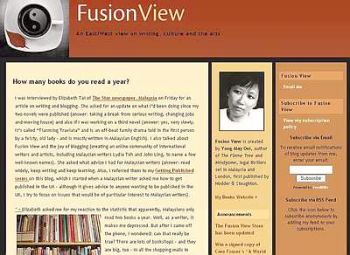
    How lovely to see Malaysian author Yang-May Ooi's blog, Fusion View featured inStarmag today in a piece by Elizabeth Tai.

    Yang-May is a fairly recent blogger (she began in April) but her space online is a great place to go for useful insights into the writing life and the low-down on getting published.

    And for a good read about all things Malaysian written by an expat in London.

    I can echo her sentiments about blogging being a great way to connect with people from across the world (how many good friends has it sent my way?) and I find it particularly interesting that she says that blogging has helped her to write in a more relaxed manner.

    Yang-May plans to put up extracts from the new novel she is writing, Tianming Triavata "a quirky family drama" set in small-town Malaysia, as well as podcasts of them.

    I gotta podcast soon or burst!

    Related Posts:
    Getting Published: Advice from Yang-May (28/5/06)
    The Real David K.T. Wong (5/6/06)

    Reading Ain't Just Books!

    Daphne Lee interviews reading development expert Tom Palmer in Starmag today, and talk about how his mum got him into reading by giving him football magazines! Now he builds on a love of the game in his own workshops to encourage kids to read.

    On getting kids to read:
    Often, all it takes is to allow children to make their own reading choices. It’s logical, really. Why would a child or anyone read a book that they find boring? It makes all the difference to identify a subject of interest and use it to lead to reading. Reading is not really perceived as a cool activity, apart from when it’s something like the Harry Potter books – whenever one comes out, it’s carried around like a fashion accessory. So it’s a bad idea to force a child to do something that’s already seen as boring. ... I know boys who say they don’t read and dislike reading, but when you talk to them you realise they spend an hour every day reading blogs, websites, magazines. They do these things unconsciously and because the reading doesn’t involve a book, they don’t see it as reading.
    Related Posts:
    Football, Reading and Tom Palmer (3/12/06)

    Wednesday, October 18, 2006

    Feedback @ Starmag

    I was in the Star offices yesterday, the tables neatly turned on me because I was being interviewed by Elizabeth Tai about my prolifigate book buying habits for a feature coming out this Sunday*. I wandered off after that to have a chat with my Starmag friends and editors Gim Ean and Malini. (Along with a pat on the back for Daphne Lee for her library roof story and the weekly reviews of kids' books.)

    I think they've been doing a great job recently, putting out more pages on book news than any other local newspaper, usually 3 pages on a Sunday, and articles in Star Two on Tuesday and Friday.

    But theirs is a lonely battle. They say they get no feedback from newspaper readers to tell them how they're doing or what is going down well. That makes it harder to fight for their space.

    If you appreciate their efforts or have comments about what you like/don't like in that section of the newspaper, why not let them know at:
    starmag@thestar.com.my
    Your feedback can be used to lobby the management.

    Me, I put in my request for an eight-page literary supplement and space for the reviews of local books! Star management, please take note.

    Anyway, I have enough problems to worry about this morning. I have a photographer coming round to take a photo for the feature and I'm having a really awful awful bad hair day!

    *My mistake. Star Two sometime soon.