Showing posts with label independent bookshops. Show all posts

Sunday, June 13, 2010

The End of Charing Cross?


You could take the Charing Cross Road once from Centre Point and walk south and stop for tea at the coffee shop in the National Portrait Gallery with the satisfaction that you had had the good fortune to be able to examine a facsimile edition of Tomé Pires's Summa Oriental, feasted on a second hand copy of the Haji's Book of Nursery Rhymes along the way, and you'd have probably met many remarkable men and Gurdjieff, too, and waded through murders most foul in the book-shelves of Murder Inc and probably managed to persuade a doubting bibliopolist that you had the means to buy a 1st edition copy of 1984 that you managed to persuade him to pull out from his locked showcase.

There were three chain bookshops in Charing Cross, but now there's only two, but the crux of the Charing Cross Road is not the big giants but the small shops, the second hand trade and antiquarian books and shops that look after the niche market ranging from esoterica to car manuals and books about maps and art, and first editions galore. It is this side of the street that is now under threat from money-grabbing landlords, and inhospitable planning policy and the Internet too and big bookshops and supermarkets who are able to buy in bulk and sell as loss leaders at three for the price of two.
Wan A. Hulaimi writes in today's New Sunday Times about the imminent demise of London's famous street of books. His early post on the street is linked here, and here's another link to a post on the same topic.

(And happy I am to hear that our Awang Goneng has a second book about Terengganu coming out later this year.  Now I want the big glossy coffee table version that only exists in my dreams!)

Sunday, April 04, 2010

The Death of Independent Bookshops

The death of independent bookshops is just one symptom of a much wider crisis in publishing. Discounted books, online bookselling and the advent of ebooks are destroying old patterns of reading and book buying. We are living through a revolution as enormous as the one created by Gutenberg’s printing press – and authors and publishers are terrified they will become as outdated as the monks who copied out manuscripts. How this happened is down to ambitious editors, greedy agents, demanding writers and big businesses with an eye for easy profit. Combine that with devilishly fast technological innovation and you have a story as astonishing as the credit crunch – and potentially as destructive.
Sameer Rahim in The Telegraph mourns the loss of yet another independent London bookshop, and wonders whether the writing on the wall for literature in a piece aptly called Apoca-Lit:
We are living through a moment when all the balls have been thrown in the air and no one is sure where they will land. In the digital age, will publishers and agents survive in their current form? Derek Johns argues that “authors need agents as first readers and financial advisers” and someone will have to collate and distribute books whether in bound or ebook form. But will they? How long can it be before Tesco (which already has a 10 per cent share of the book market) stops dealing with fussy publishers and brands its own books? The ebook is also changing things dramatically. The iPad arrives in this country next month and looks set to put the Sony Reader out of commission. Perhaps more significantly, ebooks will allow writers to bypass agents, publishers and bookshops by launching their work on the web or exchanging it quickly among themselves. The extra costs involved in manufacturing books will inevitably come to make them seem a luxury and make the bound book as obsolete as vinyl. ... Without some form of institutional support, there is a risk that only the trashy and the brilliant will thrive. That might sound like a bracingly efficient way of doing things, but the wonder of books is that no one can ever be sure how important they might be – or who might start slowly and then turn, eventually, into a genius. The careers of many authors show that the mercurial and the eccentric often take a long time to be appreciated. Abolishing the gatekeepers – however excessive or peculiar they may be – will not help reveal all those hidden talents to public view. Instead, the danger is our bookshelves will come to resemble a long line of branded baked beans.
In case you think this is an alarmist view look at what Simon-Peter Trimarco, manager, of the Kilburn Bookshops says about the business shutting down:
I'm trying to put down my thoughts about where I see the industry going, and realize that I think the whole industry is going to fail in the next couple of years. Dillons, Ottakar's, Hammicks have all gone; Borders went bankrupt in December; Waterstone's has obviously been struggling for ages; most independents have closed, or will do soon; and those stalwarts and new shops which (we are told) are "thriving" are situated in out-of-the-way places and in very affluent neighbourhoods with no competition for the mass market.

Soon there won't be enough shops for publishers to get a new title stocked and sold - then they'll start failing too. We’ve had to suffer the online folk like Amazon and the big chains and supermarkets demanding huge discounts in order to discount themselves to oblivion. 
And he foresees that :
... once almost all the bookshops have closed, Amazon, or some similar mega-company, will start opening little Browsing Bookshops. It'll be like TescoMetro or Starbucks: first put all the other shops and suppliers out of business, then go in there yourself and tell everyone what a great job you do, a great service to the "consumer", that we‘ve never had it so good.

Previous posts about Independent bookshops here.

Saturday, October 10, 2009

Mantelpieces

There's another excellent interview with Man Booker Prize winner Hilary Mantel, this time in The Independent with Boyd Tonkin. And on the same page there is a video of her reading from Wolf Hall which was filmed in my favourite bookshop - Daunt Books in London - so do have an oggle.

And the author has contributed an exclusive short story - The Heart Fails Without Warning - to The Guardian.

Postscript :

Robert McCrum sees similarities between Mantel and this week's Nobel prize winner, and salutes their hard work and dedication in the face of considerable adversity :

Müller suffered horribly under Ceaucescu, and her work has been shaped by political repression. Mantel's early adult life was blighted by a debilitating, undiagnosed illness. Müller committed herself to her writing in great privation and obscurity. Mantel laboured for years on a book (A Place of Greater Safety) that was repeatedly rejected, and finally shoved into a drawer before its belated publication in 1992. Now, after years of quiet dedication, both women have been fully recognised. This underlines a fundamental truism I have always believed about the book world: it's the work, not the life, that matters.

Sunday, March 01, 2009

Literary Dreamscape

Bookshops are important places for us word merchants. The good bookshop will contain an air of intrigue. It will smell musty, it will lure you into its interior and, with warm armchairs and a glowing fire perhaps, it will embrace you and invite you to discover the thousands of stories hidden there. The good bookshop will enhance the delicious experience of browsing, touching covers, pulling volumes from the shelves and even buying a book.
Diane Dempsey in The Age describes her search for the "dream bookshop" on an overseas trip. her search takes her to the London Review Bookshop in Bloomsbury, London, and The Winding Stair in Dublin (which novelist John Banville apparently apparently uses as his personal post office). But its only in Shakespeare & Company on the Left Bank in Paris that she finds her bookish nirvana :
All the ingredients were there — mystery and chaos, and eccentric and lovely people whose passion has created the most fabulous bookshop in the world.
And if you want more, here's the shop YouTubed! Postscript : Jeanette Winterson revisits Shakespeare & Co. and paints a loving portrait of its owners.

Friday, February 20, 2009

Clearance Sale at Skoob

Many thanks to Trailshoppers for letting me know about a clearance sale at Skoob which goes on till 25 February. Every book is priced at RM10 or less! The address is : Skoob Books Lot 122&133 Level 1 Menara Mutiara Majestic 15 Jalan Othman PJ (Old Town) (Map) If you haven't ever found your way to this wonderful Aladdin's cave of books, this would be a very good time!

Tuesday, February 03, 2009

Raman's Dire Prognostications

In his Silverfish newsletter Raman makes some predictions about coming shake-outs in the book trade in the light of the current economic situation, particularly with regards to the situation locally. It would be very interesting to get some feedback to this piece from others in book retail ...

Virtual Tour of Charing Cross Road

One of my favourite haunts when I go back to London is Charing Cross Road with specialist bookshops the length of the street, the biggest and most famous of course being Foyles. Now crime, romance, sci-fi bookshop, Murder One, the only one of its kind in the UK, is to close its doors and the street may never be the same again.

Mark McCormick in The Guardian puts together an interactive guide to the area complete with map so you can take a virtual tour with photos and video.

I'm homesick!

Saturday, September 20, 2008

Bookselling in the Big Apple

Opening an independent bookshop doesn't seem like the kind of activity that will get you noticed by the New York Times. But when you realise 75 independent bookstores have closed down since 2000, you begin to appreciate the extraordinary leap of faith Jessica Stockton Bagnulo is making.
All I had was my ambition and my passion
she says. Now she has experience gained from working in the trade, a business partner and a whole lot of supporters. I really wish her luck and will be dropping by her blog from time to time to see how its going.

Oh, and hands up, how many of you also harbour a dream of opening a bookshop? I do.

(The pic above from the New York Times shows the opening party.)

Friday, September 19, 2008

Bibliotherarapy

Can literature sort out your life problems? A group of authors including Alain de Botton have set up a "cultural apothecary" to dispenses bibliotherapy to those who need it :

On offer at the School of Life: books; artwork; holidays; courses; food; sermons; and – most popular of all – "bibliotherapy". Split over ground floor and basement, the building offers a sanctuary where visitors can read, relax and think for themselves.
The bookshop also offers intriguing weekend trips :
De Botton, who six years ago published The Art of Travel, will take customers to Heathrow, where they can expect a guided tour of the new terminal, meet baggage staff and chat to plane spotters – all for £250. Another holiday will feature a tour of the "great tarmac institution" of the M1, promising meetings with "architects and historians, artists and truckers".
More on the shop's website and on the School of Life blog.

Friday, August 22, 2008

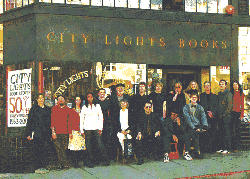
City Lights: 50 Years On

City Lights is a flagship local bookshop for a flotilla of self-sufficient booksellers and publishers around the world who are committed to independent thought and who refuse to succumb to a mass-marketed literary canon. We may not like some of the books but, if we care about their right to be read, City Lights is an indie institution whose actions still speak louder than words. The beat goes on.
The Times' Megan Walsh visits the famous City Lights in San Fransisco which was established more than 50 years ago and looks forward to a bright future. The bookstore's website is here.

Monday, January 14, 2008

Beauty Pageant of Bookshops


Want a dose of biblioporn?

The Guardian lists the most beautiful bookshops in the world, including (clockwise from left) Livrario Lello in Porto, Hatchards in London, El Ateneo in Buenos Aires.

I still reckon Daunts takes some beating.

Thursday, October 11, 2007

The End of the Independents?

Is the end of the independent bookshop in sight? Will the book, in its physical paper manifestation, be around much longer?

In the Guardian, Michelle Pauli reports from the Frankfurt Book Fair that according to a poll of 1,324 top industry professionals the book will still be around in 50 years time, the independent bookseller may not be:
Almost a quarter of the industry professionals who took part in the survey predicted that the high street bookseller would no longer exist in 2057, while only 11% thought that the printed book would be obsolete. However, nearly as many - 10.5% - also thought that the electronic reader would be superseded. The respondents, of whom nearly half were at senior director level or above, were not asked to look into their crystal balls to predict what might replace the book and e-reader, but 44% identified the use of e-books as a key area of growth for the industry. In an increasingly globalised world, 27% saw books in translation as a growth area, and nearly a third saw China as the future dominating market in the publishing industry.
Pauli notes that the biggest area of growth at the fair is in digital products, and that there are a number of sessions aimed at helping publishers learn how to tackle the developments in e-publishing. She quotes Frankfurt Book Fair director Juergen Boos as saying that the fair is now a "contents fair" and the book is just one transmitter of content.

Sunday, August 05, 2007

Balram Dass and the Great Indian Book Bazaar

I loved Stephen McClarene's piece in the Times about Delhi's huge weekly book market and a certain gentleman called Balram Dass who has had his pavement stall for 40 years. Then there were only 3 other dealers. Now there are 160!:
They make up the Great Indian Book Bazaar, often described as the world’s biggest weekly book market. Every Sunday, from 9am to 8pm, Daryaganj, a hectically busy commercial street in the shadow of the Red Fort, is lined by literally a mile of books, mostly secondhand and in English.

If you want a copy of Chaucer’s Wife of Bath’s Tale (slightly scuffed) for about 20p, or Increase Your Height – Well Tried Methods for Wonderful Results (80p), or a clutch of Danielle Steels at 65p each, this is the place to come. There are tales of first editions of A Passage to India changing hands for 60p.

Mr Dass, aged 67, delves into a pile of Mills and Boons and “hot-cakes” (bestsellers) and pulls out the Woman’s Journal Home Cookery manual. With its colonial recipes for stuffed sheep’s heart, sardine sandwiches and Nell Gwynne pudding, it’s the sort of book left behind by British memsahibs when they went home to Pinner or Oxted. “Very good copy,” Mr Dass says. “150 rupees only.” That’s less than £2.

He and his son Manish have a pitch halfway along Daryaganj, the street where all the wonders of the Orient are sold, plus air-conditioning systems.

These shops open during the week, but on Sundays the shutters are pulled down and the bookstalls set up in front of them. The dealers sit crosslegged behind their stock, wads of rupee notes stuffed in their shirt pockets, cannily observing the passing crowds. If it’s raining, they shelter under plastic sheets.

For Mr Dass, the bazaar, which lures customers and dealers from all over India, is his only source of income. Like three quarters of his colleagues, he has no shop, and spends the week scouring Delhi for stock.

Some books come from private libraries; others are left on trains and buses and auctioned by the transport authorities; others still are bought from radhi-wallahs, who cycle around middle-class enclaves collecting wastepaper for recycling.

On a good Sunday, with successful haggling, Mr Dass may take £35; on a bad Sunday, perhaps as little as £10. “It is hard to predict,” he says. “Nothing has a fixed price. People are looking for value, not price.” So what has his best sale been? “ Encyclopaedia of Ports and Cities, 1928 edition,” he intones reverently. “Sold for 1,200 rupees.” At about £14, we are not talking mega-books.
The article also mentions some more upmarket bookshops, those of:
Khan Market and Jor Bagh Market (twin haunts of expats), the glitzy new western-style Oxford Bookstore at Connaught Place, the city’s commercial hub, and the air-conditioned showrooms of upmarket South Delhi dealers.
and here's a list of New Delhi bookshops!

I am always envious of Malaysian friends who head to India to do their book-buying, especially as they always gloat about the choice and the price. (But isn't Mumbai more the centre of the bookselling world?)

If you have had a chance to check out Indian's bookshops please leave a note as to which you recommend. And maybe one day I'll pop over with an empty shopping bag.

Saturday, July 21, 2007

Harry Potter and The Evil Price War

Big drama. Front page news in the Star.

Because of Tesco and Carrefour undercutting the price of HP7 (both selling at RM69.90 instead of the recommended price of Rm109.90) the four major bookshop chains, MPH, Times, Popular and Harris, have decided not to sell the book! Good for the retailers sticking together. Sad sad sad for all those who were planning to launch the book in a fun way this morning, and for the fans. (Those who pre-booked will still be able to collect their copies.)

Says MPH's chief operating officer, Patricia Chen:
It's not fair to allow hypermarkets to sell such a popular book when they are not in the book business.
I wholeheartedly agree with her. Stick to your baked beans and chicken portions and ikan bilis, hypermarkets, and if my credit card doesn't go through your till for a good long while you'll know it's my small way of making a protest. (Actually you probably won't notice, as the only thing I go out of my way to buy at Tesco is ground coffee, which is really rather good ... but I can live without that!)

On a happier note, there are some very nice pictures of last night's Sorceror's ball at MPH 1 Utama in the print version of the paper but sadly not online.

Update:

Raman of Silverfish (who said he couldn't afford to sell the book anyway) is laughing long and hard at all this and seems to feel it serves the chain bookshops right. Under the charming heading:
In Malaysia, the Harry Potter Shit Hits the fan
he writes:
Guess it was bound to happen. Major bookshop chains in the city have decided to boycott the latest Harry Potter book in the series Harry Potter and the Deathly Hallows due to 'unfair' pricing by Tesco and Carrefour hypermarkets. Isn't that simply delicious? Unfair pricing? Well, well, well. Who's talking now? Now, isn't that exactly what major chains have been doing to independent bookshops all these years? When they sold the latest release of a best-selling author below cost at their four-times-a-year 'warehouse' sales to attract customers, what did they think they were doing? Now they are protesting? Is that rich or what? Does anyone remember how JRR Tolkein's latest book Children of Hurin was sold below cost at a recent warehouse sale even before it was even released to the public.

Well, talk about poetic justice. Oh poor thing ... boo, hoo, hoo ...

I think what has happened with Harry Potter is the best thing that has happened to the industry. Time to put the house in order, right?
Meanwhile, some other bloggers have posted on the issue including The Malaysian, Georgette Tan, Eyeris, and Eric Forbes.

Yinny the Yinn works at Borders (which was selling the book) and tells how she almost got crushed in the rush.

This is the biggest local bookshop crisis ever, I think, and brings to a head issues that have been bubbling under for a long time.

(Photo of newspaper ad scanned in by Raman and nicked from his website.)

Wednesday, July 18, 2007

One Disaffected Bookseller

As promised. You can listen here to a BBC World Service special on the launch of Harry Potter 7, and a certain "disaffected" bookseller from Bangsar telling it as it is!

Rowling apparently has a great deal of gratitude for independent booksellers. What a pity the marketing behemoth now excludes the very people who stood by her books in the early days.

Saturday, June 02, 2007

Oh to be in Hay Now that Summer's Here

I am reading the Guardian's coverage of the Hay Literary Festival with a great deal of envy, not only because they have a formidable line-up of authors (including no less than four Nobel prize winners) but because ... well, if there is one spot on earth where the mystical ley lines of bibliomagic converge, it is in this tiny town on the border between England and Wales which has ... wait for it ... thirty-nine second hand bookshops! (The population is 80,000 so that makes it one bookshop for every 37 residents.)

Bookseller Richard Booth, whose empire quickly spread across all the empty shops in the town, as well as the former firestation and 17th Century Jacobean mansion, declared independence from both England and Wales in a bloodless coup on 1st April, 1977. No-one actually took him seriously, but it certainly put Hay on the map.

Our family once visited the town back in the early 1970's when were on holiday on a Herefordshire farm (yes, British people do such strange things!) and I remember spending a whole afternoon in just one section of one shop, utterly mesmerized by the choice of antiquarian books. I had glimpsed paradise, and one day, I have promised myself, I will return.

But has the festival, now in its 20th year (with150,000 ticket sales for 435 events) got too big, too impersonal and too concerned with commericialisation and celebrity glitz? Some critics think so, writes Andrew Johnson in the Guardian.

Another much smaller UK festival I read about with much envy is the Way With Words festival in Dartington, Devon.
A well-run literary festival should be something like a convivial garden fête - lots of strangers milling around in the sunshine and striking up conversations over a coffee, at the bar, waiting in the queue for the next event.
says author Penelope Lively in the Telegraph, who reckons that she's found bookish heaven in Dartington.

I know the venue well from my days living just down the road in Plymouth or visiting my friend Helen in Totnes and have happy memories of chamber concerts in this beautiful old hall, scones and clotted cream in the tea shop, and long walks in the beautiful gardens.

The trouble is perhaps that when I think of England I always see it on a perfect Summer's day and am just swallowed up by waves of nostalgia ...

*Sigh*
(Top picture from Guardian blog, bottom picture form the Telegraph)

Wednesday, May 30, 2007

Manuscripts Do Burn!

Now why would a bookseller burn his own books?

Thanks Patrick Lee sending me this link, which then lead me to Tom Wayne's website for his independent second-hand bookshop Prospero's Books in Kansas City. (I've actually bought from there via abebooks.com)

I lift this very apt quote from his site:
There are worse crimes than burning books, one is not reading them. ~ Joseph Brodskey

Monday, March 26, 2007

KL's Little Bookshops

Thanks Marisa for pointing the way to this article in the New Straits Times yesterday about KL's independent bookshops. It's nice to see the publicity for these little shops which are till able to hold their own despite competition from the big boys.

Not sure though Raman who caters for "the discerning reader" would care to be lumped together with the book rental places!

Above is a pic of Skoob proprietor Thor Kah Hoong. Time to make a vist if I could only get past these warehouse sales.

Monday, October 09, 2006

The Lure of the Independents

Johan Jaafar described every literary buff''s bookshop fantasy (well certainly mine!) in the New Straits Times on Saturday:
Back in 1988, I visited a small bookshop in New Delhi. I was browsing through a remarkable collection of Indian classics when a gentleman appeared. Since we were confined to a small space we had no choice but to acknowledge each other’s presence.

We talked about a book I was holding, the Bhagavad Gita — probably one of the best known war treatises in the history of mankind. I told him of my interest in the Mahabharata and how it went through a magnificent "local colouring" in my country.

Before he left he took out a book and gave it to me, The Golden Gate, which he signed. "My last copy, not in pristine condition I’m afraid, but since you can’t get it here, I’ll let you have it," he said.
It was of course Vikram Seth.

The Golden Gate is an incredible work (imagine this a whole novel written in sonnets!) I didn't know though that:
It was inspired in part by Aleksandr Pushkin’s Eugene Onegin. Legend has it that he found the copy at a second-hand bookstore in Stanford. That discovery changed his life forever. He chose to be a writer rather than an academic. See what a bookshop can do to a person?
This leads him to reminisce about other bookshop encounters both abroad:
... I was in Paris in 1997 when I came across the Shakespeare and Company bookshop (left) across the Seine from the Notre Dame Cathedral. It was not the original bookshop of the same name started by Sylvia Beach in 1919. That shop became famous for it was the meeting place for English- speaking expatriates and lovers of English books, not to mention the place where Ernest Hemingway, Ezra Pound and John F. Fitzgerald spent hours. In the world of Francophiles, Shakespeare and Company was the symbol of all things English. Beach died in 1962 but the name was retained by another bookshop.

It is cramped, cold, even stuffy, with books spilling into narrow corridors and whatever spaces available, but it was where the "real books" were. Unlike modern book stores that are well-lighted and better arranged, this place reminds you of penniless authors and unpretentious scholars lingering with only one purpose in mind — to immerse themselves in the world of books.

And then there is the City Lights of San Francisco. It was co-founded by poet Lawrence Ferlinghetti in 1953 and became the first in the United States to concentrate on paperbacks. The best thing about the bookshop is its unusual triangular structure.
... and nearer home:
I grew up in a village in Johor, 35km from the nearest town, Muar. There was no bookshop in the village. Whenever my father went to Muar I accompanied him. He would spend his time having teh tarik at his favourite mamak shop facing the Muar River. I was left to hang around at Kedai Buku Manap. What an experience it was. I was surrounded by books of all shapes and sizes. In my kampung, I read The Thirty Nine Steps and King Solomon’s Mines over and over again, for those were the only English books I had. At Kedai Buku Manap, there were few English books, none that I could afford anyway, but there were books published by Sinaran Brothers of Penang and Dewan Bahasa dan Pustaka. The best my father could do was to buy me a comic book.
He singles out those two little independent bookshops for praise:
I am more of the "Silverfish kind" – I am referring to the little bookshop in Bangsar the size of a convenience store, next to a famous eatery. Silverfish is unpretentious, it is a booklovers haven, and more importantly it offers the feel of familiarity that has eluded the bigger chains. ... Silverfish, which belongs to Raman Krishnan, is also a respectable publisher. Or I would prefer my friend’s little hideout — Thor Kah Hoong’s Skoob Books. Hideout, I say? It is hidden somewhere in the bowels of the tallest building in Old Petaling Jaya. Sadly, you will find a lobby with unoccupied shoplots, a hair salon and a snooker parlour before you come across this gem of a bookshop. Thor, the former journalist, is also an actor and playwright. His books are old and new, expensive and cheap, but like any small independent bookshop, it has the smell of genuineness.
I would so love to visit Shakespeare and Co. especially since reading Books, Baguettes and Bedbugs (which I've not told you about yet, have I?) and City Lights of course.

Independent bookshops are idiosyncratic and fun ... you never know what you'll find, who you'll bump into and just how grouchy or chatty the owner might be.

One of the delights of travelling is to seek them out independent bookshops in whichever country you find yourself. (There is such a phonomena as "bookshop tourism" you know!) Trouble is that the "personal touch" usually leads to more recommendations ... leads to more book buying ... leads to more penury!

Related Posts:

Skoob is Books Drawkcab (17/1/06)
A Home for Bookworms (20/2/06)

Monday, February 20, 2006

A Home for Bookworms

Continuing the bibliobibuli guide to local bookshops:

I write so often about Silverfish because Raman is the superhero of the book-centric world: the universe knows no peer! Truly.

The shop was in Sri Hartamas in 1999, moved to more upmarket Bangsar a few months later, and occupies the first floor of a shop-lot on Jalan Telawi Tiga, just a roti canai's twirl from Devi's Corner.

Raman moved into publishing in 2000. Revitalised the Malaysian short story in English, long neglected, with his New Writing series. Gave the wannabe-published something to live for. (Which reminds me, the deadline for the next anthology is end March and even those of you who read this blog from the otherside of Pluto can send in stories.) Published books by other local writers. Is perhaps the best person to send a manuscript too if you need a second opinion, though he won't mince words if he thinks it's rubbish. (I do respect his opinions even if I don't always agree with them.) Runs an editing service.

Hosts events for writers - some very famous names have turned up to read and socialise and eat crisps including Bharati Mukherjee, Shashi Tharoor, Tash Aw and Romesh Gunasekera.

Raman also started up the KL International Literary Festival, something that was badly needed in this corner of the globe. (The next festival is glinting in Mr. Raman's eye even as I type this. I seriously better run and hide.) Now he has started up a literary mag. Is there no end?

As a bookshop, it must be admitted, Silverfish is a little run-down, extremely eccentric. (Like it's owner?)

It might be my bad luck but the shoe-mender from the street below always seems to be changing his clothes on the stairs. (He uses the switch-box as his personal locker.) I've stopped apologising for invading his privacy.

Books there are. A very good section of books by local writers. Some good finds of the more literary kind on the shelves, a mix of new and second-hand copies, though stocks seem low at the moment. When Raman goes on a book-buying spree to India there are some great bargains to be had. And there are always too many temptations on the front counter: I'm so often caught by the "Hey have your read this?" which has heralded not only my happy introduction to Bulgakov, Saramago and Bukowski, but also my gradual fiscal undoing. Phek Chin, Raman's assistant is very clued up about books and whatever they don't have in can usually be ordered very quickly.

Raman's recently partioned off the back room, and now has a space for readings, classes, meetings. He's custodian of a large private library of antiquarian books about this part of the world, and you can sit and read them as long as you like.

The best thing about the shop is that it operates as a meeting place for all kinds of interesting people.Peter Carey and VS Naipaul have browsed the shelves. You might bump into an ambassador or a BBC correspondent or a famous poet or a publishing rep or just another booklover or fictionating scribbler like yourself. Hang out here. Make yourself a cup of tea. Relax.

A woman recently wrote to Raman all the way from Australia to express her concern about the name of the shop. Did Mr. Raman know that Silverfish ate books?


(The one and only silverfish that turned up in Mr. Raman's office one day was treated with the great reverence that befits a mascot.)