Showing posts with label johan jaafar. Show all posts

Saturday, August 08, 2009

Johan Jaafar on Censorship

Censorship comes in many forms. Some of the books mentioned were not banned wholesale by governments, but there are Little Napoleons out there trying to show their power. It took someone with an axe to grind to initiate such an intellectual calamity. ... Books are supposed to represent the best of the nation's intellectual tradition. But, sadly, books are banned and burnt for challenging prevailing assumptions or deemed detrimental to the ruling elite. Worse, they are suppressed for being politically or religiously incorrect. Or for being different. Books are supposed to nourish the mind. Books help to inculcate good values in society, encourage healthy debate and enlarge the realm of learning. Banning books is not an acceptable method to suppress freedom of expression.
Johan Jaafar dedicates his column in today's New Straits Times to the topic of banned books - a timely topic - though one wishes he had had gone a stage further and point a finger at Malaysia's Little Napoleans.

Something I didn't know and am frankly quite shocked by (especially as I've been unhappy about Pak Pram's work being banned in his home country) :
Closer to home, the late Pramoedya Ananta Toer, one of the best writers Indonesia has ever produced, was involved in the Lembaga Kebudayaan Rakyat, better known as Lekra. It was controlled by Partai Komunis Indonesia and denounced works that were anti-rakyat or "irrelevant to the struggle". ... Writers were labelled, condemned and their books became bonfires. Sadly, Pramoedya's chequered past in his involvement with Lekra caught up with him. Prominent Indonesian writers protested when he was conferred the Magsaysay Award for Literature. Their argument: he stifled creativity and suppressed literary works.
Anyone know any more about this?

Saturday, July 28, 2007

Life Post-Harry

There's an extremely good piece in the New Straits Times today by Johan Jaafar about life in the aftermath of the latest Harry Potter launch. He's spot on when he talks about book selling in Malaysia in general and last weekend's kerfuffle:
... we are dealing with an industry which has too many misses and very few hits. One business magazine calls it "the twisted economics of Harry Potter": The wizard brings both profit and pain to the industry.

Imagine life for the bookstores after the Harry Potter mania subsides.

They will have to be content with very few reasonably successful titles.

Bestsellers are hard to come by. Stores are stacked with titles whose shelf life is the stuff of legend.

The talk among booksellers these days is about inventories, if anything at all. Unsold stocks are devouring booksellers’ profits. What you see in posh, well-lit and well-stocked stores is deceiving.

The cost of operating is prohibitive, the buyers are shying away and foreign books are flooding the market.

Publishers, too, are not getting their money as fast as the books are being churned out of the printing presses. For every successful title, there are hundreds of sluggish ones.

The book industry is as perilous as Harry’s attempt to fight the Dark Lord Voldemort.

It is a thankless industry. In this country, only textbook publishers are smiling all the way to the banks.

Publishers of general titles are struggling to survive in an industry worth a mere RM1.5 billion.

Even the broiler chicken industry is bigger than the book industry.

Little wonder there are very few quality book publishers in the country.

There is not even one specialising in children’s books. Perhaps the book industry is searching for the missing Horcruxes, the secret magical objects that need to be destroyed by Harry Potter in order to kill Voldemort.

There are far too many "dark forces" bedevilling the industry in order for it to rise to the next level.

A supermarket chain in Britain offered the book at about RM35.

Online retailer Amazon.com is offering half the price offered by bookstores.

Understandably, booksellers in US and Britain cried foul but in Malaysia they did something about it.

As much as the Potter brand is seductive, slashing the price the way of the hypermarkets will spell trouble for the book industry.

Yes, I will support anything that will benefit consumers. But an unnecessary price war is detrimental to the industry as a whole.

The industry simply can’t survive on a one-off phenomenon.

This is not even about survival of the fittest. The truth is there is no pot of gold even in such a precious commodity like Harry Potter.

In the wake of the Harry Potter mania lie realities very few outside the industry will ever understand.*

For my daughters it is time to bid farewell to a long-trusted friend.

For the industry, at least in Malaysia, it is a time of reckoning. And to move on.
* My emphasis.

Monday, October 09, 2006

The Lure of the Independents

Johan Jaafar described every literary buff''s bookshop fantasy (well certainly mine!) in the New Straits Times on Saturday:
Back in 1988, I visited a small bookshop in New Delhi. I was browsing through a remarkable collection of Indian classics when a gentleman appeared. Since we were confined to a small space we had no choice but to acknowledge each other’s presence.

We talked about a book I was holding, the Bhagavad Gita — probably one of the best known war treatises in the history of mankind. I told him of my interest in the Mahabharata and how it went through a magnificent "local colouring" in my country.

Before he left he took out a book and gave it to me, The Golden Gate, which he signed. "My last copy, not in pristine condition I’m afraid, but since you can’t get it here, I’ll let you have it," he said.
It was of course Vikram Seth.

The Golden Gate is an incredible work (imagine this a whole novel written in sonnets!) I didn't know though that:
It was inspired in part by Aleksandr Pushkin’s Eugene Onegin. Legend has it that he found the copy at a second-hand bookstore in Stanford. That discovery changed his life forever. He chose to be a writer rather than an academic. See what a bookshop can do to a person?
This leads him to reminisce about other bookshop encounters both abroad:
... I was in Paris in 1997 when I came across the Shakespeare and Company bookshop (left) across the Seine from the Notre Dame Cathedral. It was not the original bookshop of the same name started by Sylvia Beach in 1919. That shop became famous for it was the meeting place for English- speaking expatriates and lovers of English books, not to mention the place where Ernest Hemingway, Ezra Pound and John F. Fitzgerald spent hours. In the world of Francophiles, Shakespeare and Company was the symbol of all things English. Beach died in 1962 but the name was retained by another bookshop.

It is cramped, cold, even stuffy, with books spilling into narrow corridors and whatever spaces available, but it was where the "real books" were. Unlike modern book stores that are well-lighted and better arranged, this place reminds you of penniless authors and unpretentious scholars lingering with only one purpose in mind — to immerse themselves in the world of books.

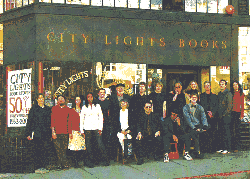
And then there is the City Lights of San Francisco. It was co-founded by poet Lawrence Ferlinghetti in 1953 and became the first in the United States to concentrate on paperbacks. The best thing about the bookshop is its unusual triangular structure.
... and nearer home:
I grew up in a village in Johor, 35km from the nearest town, Muar. There was no bookshop in the village. Whenever my father went to Muar I accompanied him. He would spend his time having teh tarik at his favourite mamak shop facing the Muar River. I was left to hang around at Kedai Buku Manap. What an experience it was. I was surrounded by books of all shapes and sizes. In my kampung, I read The Thirty Nine Steps and King Solomon’s Mines over and over again, for those were the only English books I had. At Kedai Buku Manap, there were few English books, none that I could afford anyway, but there were books published by Sinaran Brothers of Penang and Dewan Bahasa dan Pustaka. The best my father could do was to buy me a comic book.
He singles out those two little independent bookshops for praise:
I am more of the "Silverfish kind" – I am referring to the little bookshop in Bangsar the size of a convenience store, next to a famous eatery. Silverfish is unpretentious, it is a booklovers haven, and more importantly it offers the feel of familiarity that has eluded the bigger chains. ... Silverfish, which belongs to Raman Krishnan, is also a respectable publisher. Or I would prefer my friend’s little hideout — Thor Kah Hoong’s Skoob Books. Hideout, I say? It is hidden somewhere in the bowels of the tallest building in Old Petaling Jaya. Sadly, you will find a lobby with unoccupied shoplots, a hair salon and a snooker parlour before you come across this gem of a bookshop. Thor, the former journalist, is also an actor and playwright. His books are old and new, expensive and cheap, but like any small independent bookshop, it has the smell of genuineness.
I would so love to visit Shakespeare and Co. especially since reading Books, Baguettes and Bedbugs (which I've not told you about yet, have I?) and City Lights of course.

Independent bookshops are idiosyncratic and fun ... you never know what you'll find, who you'll bump into and just how grouchy or chatty the owner might be.

One of the delights of travelling is to seek them out independent bookshops in whichever country you find yourself. (There is such a phonomena as "bookshop tourism" you know!) Trouble is that the "personal touch" usually leads to more recommendations ... leads to more book buying ... leads to more penury!

Related Posts:

Skoob is Books Drawkcab (17/1/06)
A Home for Bookworms (20/2/06)

Saturday, September 23, 2006

Off the Edge Celebrates

If sometimes I paint a pessimistic picture of the lack of intellectual discussion (particularly literary) in a country where the regular print media has been dumbed down (ostensibly to appeal to a 'younger generation' of thickos)*, one publication here warms the cockles of my heart.

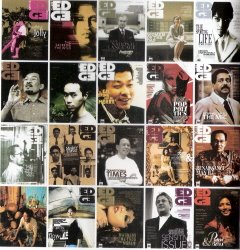
This month Off the Edge is celebrating it's first anniversary as a separate entity from the financial newspaper which spawned it. Congrats to Jason Tan and team for producing a glossy mag which is both intelligent and visually delicious, which talks art and literature and politics, which isn't shy to be appropriately subversive at times, which isn't afraid to feature the occasional piece of locally written fiction, and which is prepared to explore issues in depth. Happy birthday!

My only wish (and a selfish one at that) is that more of the features were available online so that I could pick them up and run with them on this blog, and that they were archived. (Some articles from previous issues can be found here.)

Anyway ... in the current issue there is a (very!) lengthy interview with Datuk Johan Jaafar who in Deputy was former Editor-in -Chief of Utusan Malaysia and is now deputy chairman of the Malay literary board Dewan Bahasa dan Pustaka. The whole thing is worth a read, but I give you this snippet because it is most quoteworthy:
Are we producing good works of literature now? Ask yourself, what was the last good malay novel you read? If you ask me I would say Hujan Pagi (by A. Samad Said) published more than 26 years ago. Where are the tomes, the canons, the masterpieces? Sadly, today's literature has little time for the poor, the downtrodden, the rakyat or even the successful. We are still nostalgic for Shahnon Ahmad and Samad Said's works becasue we're not producing good contemporary novels.

The most-read Malay novels are the popular ones - picisan, they call it. At least 20,000 copies of any one of these titles are printed. one such novel, retailing at RM49 is selling more than 50,000 copies, and it will take at least five years to finish the stock. People don't read serious stuff anymore. Period.
Picisan? A Malayisation of "fiction"? Nice!

(It occurs to me to ask though ... where are these classic Malay novels? I never see them in the bookshops and I would like to buy them. Raman tells me it is very hard to get copies and even he doesn't have them on sale! Don't DBP need to get their finger out and actually promote their books???)

Other good stuff in this issue includes an article on Goenawan Mohammad, Indonesian poet and man of letters (also by Eddin), Rahel Joseph's review of Suketu Mehta's Maximum City: Bombay Lost and Found, and an interview with Leow Puay Tin about her curatorship of texts for Second Link. And much much more.

So thanks Off The Edge for keeping this litbuff happy. Each issue is a keeper. But please, celebrate your birthday with a decent website!

* If you find insulting the assumption made by local newspapers that being young and cool equates having nothing between your ears, it's time you started making your voice heard, I think. I certainly don't believe it to be true.

Related Post:

Stumped by Salina (26/1/06)