Showing posts with label authors. Show all posts

Monday, January 12, 2009

Twenty Years of the Satanic Verses

The Satanic Verses remains a book about the struggles of migration and the frictions of cultural exchange. It pokes fun at all manner of targets, not least America and Britain. Above all, perhaps, it dramatises the conviction that there is nothing more sacred than the freedom to question what is sacred. Twenty years on, it's a principle that urgently needs to be remembered.
In an excellent piece in the Observer Andrew Anthony describes how the book, first published twenty years ago, ignited a cultural war across the globe - the repercussions of which are still being felt, especially in terms of greatly increased censorship in Britain :
Who would dare to write a book like The Satanic Verses nowadays? And if some brave or reckless author did dare, who would publish it? The signs in both cases are that no such writer or publisher is likely to appear, and for two reasons. The first and most obvious is fear. The Satanic Verses is a rich and complex literary novel, by turns ironic, fantastical and satirical. Despite what is often said, mostly by those who haven't read it, the book does not take direct aim at Islam or its prophet. Those sections that have caused the greatest controversy are contained within the dreams or nightmares of a character who is in the grip of psychosis. Which is to say that, even buried in the fevered subconscious of a disturbed character inside a work of fiction - a work of magical realism fiction! - there is no escape from literalist tyranny. Any sentence might turn out to be a death sentence. And few if any of even the boldest and most iconoclastic artists wish to run that risk.

Postscript :

Literary Saloon pointed me in the direction of another article worth reading on the same issue : Twenty Year's On : Internalising the Fatwa by Kenan Malik. Particularly interesting :
The lesson of the Rushdie Affair that has never been learnt is that liberals have made their own monsters. It is the liberal fear of giving offence that has helped create a culture in which people take offence so easily.
Another Postscript :

Screech left this link to Christopher Hitchens Vanity Fair essay on the same theme in the comments. Very well worth a read.

Monday, March 05, 2007

Why She Writes

I don't think you should ever try to make things up. We all lead such strange lives that there is no need to. Use your own experiences and then twist it a bit.

BerylBainbridge talks about why she writes in the Guardian.

Saturday, February 17, 2007

Arse-Scratching Amis A Non-Acerbic Tutor?

Martin Amis, long dubbed 'the bad boy of British fiction' is to take up a post teaching creative writing at Manchester University reports Alexandar Topping in the Guardian. He promises not to be unkind to his students:
I may be acerbic in how I write but I'm not how I live. And I would find it very difficult to say cruel things to people in such a vulnerable position. I imagine I'll be surprisingly sweet and gentle with them. One of the things I've learned about fiction - you really do lay yourself open in a way that no other so-called creative artist does. Most other art you're just exhibiting a particular talent, even poetry up to a point, but by writing fiction you expose not only your talent but your whole being, your social, sexual and psychological being and you're never more vulnerable than when you do that, and I'm well aware of that fact and will take it into account.
And he has this to say about the so-called glamour of being a writer:
Well, it is a sort of sedentary, carpet slippers, self-inspecting, nose-picking, arse-scratching kind of job, just you in your study and there is absolutely no way round that.
Update

More Martin Amis in the Sunday Times and you can listen to him talk about his latest book The House of Meetings on WYNC.

Pic nicked from the Guardian.

Sunday, February 11, 2007

Whose Desk?

Whose writing room? Find out and view even more famous authors' scribbling spaces on the Guardian website. Must say, though, that this is the one I like best. (And the author is one of my favourite people!)

And if you have an interesting space for your literary endeavours, send me a pic or a link and I'll feature it.

Friday, February 09, 2007

Did Burgess Get it Right?

Rob Spence asked a very good question in the comments a couple of days back. Referring to The Malayan Trilogy by Anthony Burgess, he asks:
What does the average Malaysian make of Burgess's portrayal of the place?
meaning of course, Malaysia.

Rob is a UK academic, and Burgess his area of special interest, so the question is a particuarly pertinent one (and you never know, might end up in a research paper!).

All I can say is that the local readers I know (including the members for my book club) have very much enjoyed it, and were not offended by its portrayal of the different racial groups. There are those in academia apparently (or so Faridah informs me) who consider the book a nasty bit of orientalism especially as it propagates "the myth of the lazy native", and have had a nice bit of post-colonial revenge on the text. (I want to follow this up.)

But I'd like to throw the question open to those of you who have read it.

BTW I've just finished writing an article for Kakiseni about the book and the banning thereof and it will be up as soon as the site is revamped.

And if we can get the status of the book sorted out, I suggest that we have a KL readathon of the book and a public debate later in the year. Who's up for it??

Tuesday, February 06, 2007

Ooh ... Flashy Tashy!

Taking up once again the theme of internet presence and the necessity thereof for writers, Malaysian novelist Tash Aw now has a really whizzy author-website which requires a flash down-load to view. Very impressive!

You can of course see Tash at the end of March at the KL Literary Festival where he will be running two workshops for writers. Am looking forward to catching up with him again.

Monday, February 05, 2007

Dina Gets YouTubed!

Was so sad that I missed Dina Zaman's appearance on Al-jazeera. But here she is on Youtube!

Here she is interviewed on the Everywoman programme:


And here with Sir David Frost talking about the bloggers vs. NST.


Think I'd die of terror in front of TV cameras, but Dina looks remarkably composed ...

Sunday, February 04, 2007

Website Wonderings

After my little rant about author websites the other day, it's nice to see that novelist Tan Twan Eng now has a very nice site up for The Gift of Rain (due out in the UK March 8th).

Do come and meet him, and cheer on his first public appearance (outside law courts, I suppose!) on Wednesday night at Central Market Annex. And cheer on our other Malaysian authors too Kam (no website yet) Raslan and Dina Zaman . (These guys should have no stage fright left after all those readings at Seksan's.) 'Tis as good a time to shout Malaysia Boleh! as any.

But while on the subject of web presence and the lack thereof, would love to ask why local publisher Maya Press does not have a website? There is a website for another company with the same name, ironically.

I picked up a collection of Shirley Lim's poems from Silverfish the other day. Listening the the Singer. The book is beautifully produced - nice layout, good paper, gorgeous cover. The poems I know I'm going to enjoy and I have it by my bedside to dip into.

But when I wanted a pic of the cover so I could enter it into LibraryThing (geeky me!) couldn't find anything about it online. Couldn't, as I say, find anything about the publisher, even.

The picture you see here is only on the internet because I scanned it in.

Now Maya Press have some excellent local books in their range - do check them out when you drop by Raman's place. But it makes me wonder why the company is so slow to promote its efforts? And is this fair on the writers it represents?

Shirley Lim doesn't have a website either, though she is mentioned on plenty of others (including this). When we heard her speak at Silverfish some months back, she talked about how hard it was to sell copies of her novels. A decent author's website might help her reach a wider audience.

Talking about Dina as I was, she was on Al-Jazeera yesterday. She called me to tell me but I was so blur that I went and forgot and now feel very guilty. Her book is going to attract a lot of international attention, I think.

*Pic nicked from author's website. Since he's a lawyer specialising in intellectual property by day, I have to pray that that he doesn't mind too much!

Friday, February 02, 2007

A Whopping White Lie

Author David Malouf in the Age, tells how some of Australia's leading publishers and agents:
... received a chapter of a novel in progress from a new and as yet unpublished writer, Wraith Picket. Some of them simply rejected the manuscript with the usual apologies. Others recognised a certain flair for language but found it confused, overwritten and in need of the sort of editing that no publisher these days could afford.
But poor, rejected Wraith, alas, was already long deceased.

And yes, you clever folks have guessed it, his name is an anagram. The "unpublishable" manuscript was Chapter Three of Patrick White's The Eye of the Storm. And the whole thing a hoax. (It isn't the first time such a trick has been played on the publishing world, and Grumpy Old Bookman, justifiably, isn't too impressed with the deception.)
White, if you didn't know, was a Nobel prize-winner and is regarded as perhaps Australia's finest author. Though sadly, he has fallen out of fashion these days. (Which does happen.)

I first met his work when I was an undergrad - he was one of the authors I had to study on a foundation course. I didn't find The Tree of Man an easy read, but I can still, more than 30 years later, remember whole scenes of this story about a couple's battle to eek out a living from the land vividly.

Later, I read Riders in the Chariot. This time I don't remember the story so much as the strong sense of spiritual upliftment I got from it. Voss I began but just could not get into.

Anyway, White played a hoax of his own, when he claimed to have burned all his papers in a pit in his backyard. ("Don't bother looking...", he said.)

Those same papers reapppeared last year and were acquired "for an undisclosed sum" by the National Library of Australia. The collection includes drafts of letters, plays and filmscripts and 10 notebooks (1930-1970) containing the germs of his novels. And "Realia" about which Malouf says:
I can hear the hoot he would have given, then the long-drawn-out diphthongs of his mock Australian accent, ree-ah-leeah, at the translation of these ordinary objects of his poor existence into the realm of the iconic, the extraordinary - the glasses he needed for his milky marble old eyes, the beret, the woollen beanie Manoly knitted - exhibited not as objects but (as in "Australiana") as the left-over oddities of a lost and now mythological continent. He would have been amused by that.
Said White's biographer, David Marr, about the cache:
It's rough on a biographer to be finding these things far too late. I sat there with the boxes around me cursing and laughing. But it was so like the man to leave a few more bombs to be lobbed years after his death.

Thursday, February 01, 2007

Sheldon Shuffles Off This Mortal Coil

In the comments to the last post seems that everyone wanted to talk about Sidney Sheldon's passing on. (Hey, should readers dictate the contents of a blog? ... Oh, all right then.)

Sheldon died on Tuesday from complications from pneumonia. His best known novels included Rage of Angels, The Other Side of Midnight, and If Tomorrow Comes. Several of his novels became TV miniseries.

Sheldon called writing novels:
... the most fun I've ever had ...
and said in a 1982 interview:
I try to write my books so the reader can't put them down. ... I try to construct them so when the reader gets to the end of a chapter, he or she has to read just one more chapter. It's the technique of the old Saturday afternoon serial: Leave the guy hanging on the edge of the cliff at the end of the chapter.
He said of his strong female characters:
I like to write about women who are talented and capable, but most important, retain their femininity. ... Women have tremendous power - their femininity, because men can't do without it.
(Right!)

And I hadn't realised that Sheldon didn't start writing novels until he was 50!

(Still time for me then.)

I was too much of a booksnob in those days to read Sheldon's novels, (though I'm sure I must have watched the miniseries). And I probably missed out because of that.

Tuesday, January 23, 2007

Walk-On Part

I was just sitting there, not stirring, not even breathing, like the pub's pet reptile, when who should sit down opposite me but Martin Amis, the writer. He had a glass of wine, and a cigarette - also a book, a paperback. It looked quite serious. So did he, in a way. small, compact, wears his rug fairly long ...

I was feeling friendly, as I say, so I yawned, sipped my drink and whispered 'Sold a million yet?'
He looked up at me with a flash of paranoia, unusual in its candour, its bluntness. I don't blame him really, in this pub. It's full of turks, nutters, martians. The foreigners around here. I know they don't speak English - okay, but do they even speak Earthling? They speak stereo, radio crackle, interference. They speak sonar, bat-chirrup, pterodactylese, fish-purr.
'Sorry,' he said.
'Sold a million yet?"
He relaxed. His off-centre smile refused to own up to something.
'Be serious,' he said.
'What you sell then?'
'Oh, a reasonable amount.'
I burped and shrugged. I burped again. 'Fuck,' I said 'Pardon me.' I yawned, I stared around the pub. He returned to his book.
'Hey,' I said 'Every day, do you ...Do you sort of do it every day, writing? Do you set yourself a time and stuff?'
'No.'
'I wish I could stop fucking burping,' I said. He started reading again.
'Hey,' I said 'When you, do you sort of make it up, or is it just, you know, like what happens?'
'Neither.'
'Autobigraphical,' I said. 'I haven't read any of your books. There's, I don't really get that much time for reading.'
'Fancy,' he said. He started reading again.
'Hey,' I said, 'Your dad's a writer too, isn't he? Bet that made it easier.'
'Oh sure. it's just like taking over the family pub.'
'Uh?'
I love the way Martin Amis gives himself a cameo role in Money, and uses it to such comical effect. (His dad, of course was Kingsley Amis). Auster is another author who walks into his own novels. Can you think of any others? I must have a go at fictionalising myself ... a nice writing exercise.

I have been meaning to read Money (also sometimes subtitled A Suicide Note) for years and finally bought a copy a few months ago.

In case you're wondering how this highly acclaimed and best-selling novel slipped past me ... well in 1984 when the book was published, I was living in a small town in Malaysia and didn't hear the buzz about it. The bookshops in KL (Berita, Times, Guardian Pharmacy) carried such a limited range of best-sellers. I missed so much good stuff and now have to go back and fill in the gaps. (The TBR Challenge is very useful!)

But progress is slow. Because a) It's the sort of book where you want to read each sentence carefully to enjoy the style - I love the voice, the energy and the poetry of the writing, and b) it is my "bag book" i.e. I am not allowed to read it at home ... just in cafes, on the LRT and during moments when "real life" is Dullsville. (Yesterday I was at Immigration getting my yearly stamp, and read a fair whack.)

At home, I have to get on and read the stuff I need to read ... for reviews, interviews, blurbing, editing and proofreading. And these are also the copies I musn't spill stuff on and can't let get scrunched up and dog-eared in the chaos of my big bag.

(How ironic the other day that I remembered my novel, but not my purse. I had Money, but no money, haha.)

Among my other reads - The Gift of Rain by Tan Twan Eng, which I am very much enjoying and am nearly two-thirds through. (It's a substantial read!). But since this is presently sub-judice, I can't say any more about it for now. Also Dina Zaman's I Am Muslim which I'm proofreading, and which is informing and delighting me even as I scribble corrections on it.

More about all of these reads in the fullness of time.

But more importantly, what are YOU reading?

Thursday, January 18, 2007

McEwan's Long Lost Brother

Personal drama does rather seems to adhere to novelist Ian McEwan without him needing to hunt it down in fiction.

Back in 1999, the police were called in when his 13-year old son was kidnapped by McEwan's ex-wife.

And now it seems he has a long-lost brother. According to the Independent:
Dave Sharp, 64, a bricklayer, tracked down McEwan, unaware that his brother was a renowned novelist. It was not until he was in his sixties that Mr Sharp discovered he was born as a result of a wartime affair, and was given away at a railway station to a family who answered an ad in a personal column.

The ad simply read: "Wanted, home for baby boy, age one month: complete surrender."

His mother, Rose Wort, was desperate to get rid of the child she had named Stuart before her husband returned from the war. She handed over her baby at Reading station.
The author describes the reunion with his brother five years ago as "a surprise and a pleasure" and the McEwans welcomed Sharpe and his family into theirs. It turns out that both families had been living within a few miles of each other.

Sharpe says that he did not know that his brother was famous until he found their conversations kept being interrupted by autograph hunters.

Now it seems that sharpe has a book about his life on the boil, a memoir (co-written with a ghost-writer) called Complete Surrender.

Why didn't Ian McEwan use the plot himself, asks the Oxford Times?:
"I did suggest it," Dave laughed, "but he said it was my story and that therefore I should tell it."

Thanks, Swifty, for the heads up on this story.

(Pic lifted from the Oxford Times)

Related Posts:

On Ian McEwan

His Saturday, My Sunday (4/9/05)
Hello, Would You like a Free Book? (20/9/05)
A Little Literary Lifting (2/12/06)
Pynchon on Pinchin' (10/12/06)

Thursday, December 21, 2006

You're a Writer, Nathan

"You're wrong, Nathan. After years in the dark you've finally found your true calling. Now that you don't have to write for money anymore, you're doing the work you were set out to do all along."

"Ridiculous. No one becomes a writer at sixty."

The former graduate student and literary scholar cleared his throat and begged to differ with me. There were no rules when it came to writing, he said. Take a close up look at the lives of poets and novelists, and what you wound up with was unalloyed chaos, and infinite jumble of exceptions. That was because writing was a disease, Tom continued, what you might call an infection or an inflamation of the spirit, and therefore it could strike anyone at any time. The young and the old, the strong and the weak, the drunk and the sober, the sane and the insane. Scan the roster of the giants and semi-giants, and you would find writers who embraced every sexual proclivity, every political bent, and every human attribute - from the loftiest idealism to the most insiduous corruption. They were criminals and lawyers, spies and doctors, soldiers and spinsters, travelers and shut-ins. If no-one could be excluded, what prevented an almost sixty year-old ex-life insurance agent from joining their ranks? What law declared that nathan Glass had not been infected with the disease?

I shrugged.

"Joyce wrote three novels," Tom said. "Balzac wrote ninety. Does it make any difference to us now?"

"Not to me," I said.

"Kafka wrote his first story in one night. Stendhal wrote The Charterhouse of Parma in forty-nine days. Melville wrote Moby Dick in sixteen months. Flaubert spent five years on Madam Bovary. Musil worked for eighteen years on The Man Without Qualities and died before he could finish it. Do we care about any of that now?"
From The Brooklyn Follies, Paul Auster

Monday, October 23, 2006

Mother's Milk

Mother's Milk by Edward St. Aubyn picks up characters from his earlier trilogy collectively titled Some Hope, something I didn't realise until after I'd finished it and began reading some of the reviews.

Mother's Milk
stands alone perfectly well, but there did seem to be too heavy a burden of backstory (all that history of the loss of family fortunes!) for such a slim volume. Ahah, now I know why.

The pleasure of the book lies in its sharp depictions of family life as seen through the eyes of the members of the Melrose family, Patrick, his wife Mary and young sons Robert over four successive August holidays.

The first three holidays are spent in Provence, in the house where Patrick, grew up. But the house is soon to be transfered to a flaky new age charity and a charlatan of a shaman called Seamus Dourke, while Patrick is effectively disinherited. His mother, Eleanor, meanwhile, is on her last legs and in a nursing home. But inheritance is about more than property - it's also about venemous anger and sense of betrayal passed on from one generation to the next, and both parents realise that they must break the chain with their own children.

I wasn't interested so much in the midlife angst of London lawyer Patrick, which has him seeking solace in the bottle and in an affair with an old girlfriend. But I had more sympathy for Mary, so absorbed into motherhood and its demands that she has nothing of herself to give anyone else.

I loved the parts of the book narrated from the viewpoint of the boys. St. Aubyn writes childhood wonderfully, and the opening pages, where the precocious and terrifying observant Robert describes his birth is for me one of the best parts of the novel. (And you can read it here.)

The writing is wonderfully witty and sharply observed. There are some wonderfully grotesque small part characters from an utterly incomptent Nanny to rich cousin Henry who turns out to have more extreme views on foreign policy than Rumsfeld and Bush.

Another joy is the many memorably acerbic one-liners. (The blurb on the back has a quote from the Sunday Telegraph describing St. Aubyn's "mocking aphoristic style", which says it nicely.) He writes, for example, about obese passengers on the flight, who had:
... the apprehensive fat of people who had decided to become their own airbag systems in a dangerous world.
St. Aubyn is a writer with an intriguing past (upper class upbringing, raped by his father, became a heroin addict) which has fed into his fiction. Rachel Cooke's interview with him in the Observer is well worth a read.

You might also like to check out Michael Ardetti's fine review on the Independent website.

Would I recommend Mother's Milk? Yes. Literary fiction lovers will enjoy and appreciate it. But I think that many of the local readers of this blog would find more accessible Kiran Desai's or Hisham Matar's novels from the Booker shortlist.

Tuesday, October 17, 2006

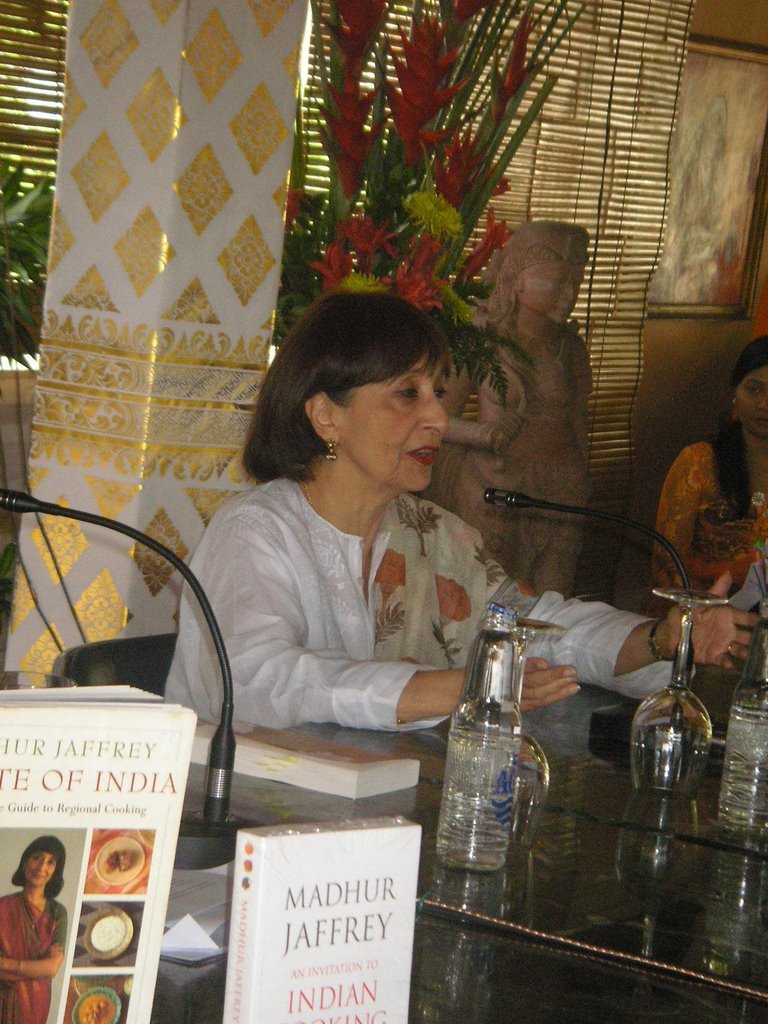
Mad for Madhur

I've loved Madhur Jaffrey for years, with that special affection engendered for those who teach us to cook and transform our kitchen lives.

I thought about taking my cookbooks along to Bali for Madhur to sign, but quite aside from AirAsia's measly baggage allowance, wouldn't she have been insulted to see her books curry splattered, the pages stuck together with splashes of my own attempts, and my comments and adaptations scribbled on them? (I have the fantasy of presenting her with a stained page and saying "Here, Madhur, sniff this. Did I get the proportions right?")

Madhur says that she learned to cook after she moved to London from Delhi to take up a course at the Royal Academy of Dramatic Arts (RADA) and discovered just how dreadful British food was "apart from the fish and chips". She encountered "beef grey in colour and cabbage boiled for days" in the canteen. She longed for the spicy food of home.

Learning to cook, then was a matter of survival. She asked her mother for recipes, and the air letter arrived with fairly vague instructions ("add a little bit of this, a little bit of that") so that she had to rely on her memory of taste to get the proportions right.

When she came to write recipes for others she said that she "thinks like a dummy" to make sure that the instructions are as foolproof as possible.

Althought there were numerous Indian restaurants in Britain at that time, they did not reflect the authentic cuisine of the subcontinent, and tended to behave for example, as if India did not have fish.
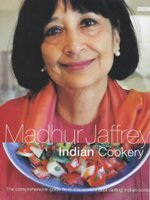
After graduation, Madhur became a successful film actress, appearing in Shakespeare Wallah, Heat and Dust, and numerous others, as well as in TV and radio productions. She moved married actor Saaed Jaffrey and moved to New York. (She later divorced, and married Sanford Allen.)

But being an actress is a precarious business and she realised that if she wanted to be able to aford to send her children to good schools and colleges, she needed to supplement her income. She decided to write about the arts for newspapers and magazines, then got "somehow hijacked" into food writing and started writing for magazines like Gourmet.
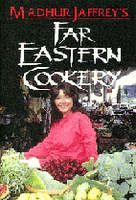
She says she picked pieces according to countries she wanted to go to and then set out with her "begging bowl" to ask ordinary folk for their recipes. She would enlist "the farmer's wife, the fisherman's wife" and then go to their houses to watch exactly how the recipe was cooked. She enjoys exploring the cultural connections along with the food.

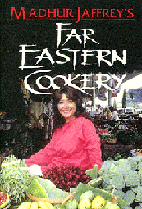
I can personally attest for the authenticity and user-friendliness of the recipes in Far Eastern Cooking, one of my favourite cookbooks of all time. (I have the videos too.) Everything works. Everything tastes right.

Madhur has always been a "one woman band, with no assistance", she says. When she tests a recipe, she does all her own shopping, chopping, preparation and cooking, and records her notes onto the computer. "Any mistakes in the recipes are all mine," she says. She says that when writing a cookbook, she typically puts on 8lbs as she tests recipes and ends up with all the left overs in the fridge!

Her first book was published in 1973, though the early publications didn't do well. Then in the early 80's the BBC decided that they would like to do an educational programme about Indian food and asked Madhur to audition.
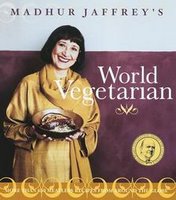
The print run of 30,000 copies of Indian Cooking sold out first week the programme aired! Her audience "were hungry for recipes that didn't come out of flock papered restaurants" and Indians wrote to tell her that they were proud of her. The restaurants began to change, and she says she feels responsible in a sense for that change.

Several more very successful books followed it including World Vegetarian. My favourite (and she says it's hers too!) though is a book which did not sell well - Food for Family and Friends a fusion cookbook she says "was ahead of its time". (I got my copy at a bargain basement price at MPH years ago.)
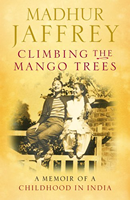
At the festival she read an extract from her latest book - not a cookbook this time, but a memoir, Climbing the Mango Trees: A Memoir of a Childhood in India. She says that in writing it she had to wrestle with issues such as how truthful should you be? Who do you hurt? Who do you not hurt? And she notes that "when you start writing one thing a whole host of other things come back to you: writing awakens what seems to be sleeping and dormant".

At 73, (I couldn't believe it until I did the maths just now) Madhur Jaffrey shows no sign of slowing down and still relishes the idea of travelling the world to collect recipes. Indeed, one of the things she enjoyed doing in Ubud was going on the market walk Janet de Neefe organises weekly, along with a cookery demonstration.

No doubt there will be some Balinese dishes in her next collection!

Sunday, September 17, 2006

Perfectly Bowled

My article about Romesh Gunasekera in Starmag today. It's a blend of interview and review. But it definitely suffers from the word limit which is unavoidable with so little space for reviews, but extremely frustrating when the book is as complex and multi-layered as The Match, and you are bursting to say so much more about characters and themes and the writing. Difficult too just to cut out chunks of a conversation with a fascinating writer and reduce them to soundbites.

“Identity is never a one dimensional thing,” says author Romesh Gunasekera, neatly sidestepping my question about whether he sees himself as a British or a Sri Lankan writer. His novels and short stories are set in both places and he clearly relishes the ability to move between worlds without being pigeonholed himself.

His first novel Reef, a lyrical story about memory and imagination, put Gunasekera firmly on the international literary map. The novel was nominated for the 1994 Booker prize, and whilst he says it was wonderful to be shortlisted, he claims that it was “kind of ideal not to have won it because the one or two first time writers who did win it with the first book tended not to have written after that.”

At under 200 pages, Reef is an unusually short novel in an age where fiction writers seem obliged to turn out complex and lengthy tomes. Says Gunasekera with characteristic humility “I didn’t think I had the right to demand someone read a long novel by a writer they didn’t know.”

It is impossible of course to write about Sri Lanka without reference to the atrocities which have been part of its recent troubled history. I ask him whether he felt he had a duty as a writer to make sense of the violence.

“I’m not writing to an agenda, but writing stories that interest me,” he says. “But I also have to write to understand the world I live in and the fact that the world is getting more violent.”

In his earlier works that violence tends to occur outside of the frame of the story, but with its effect and reverberations being felt by the characters in the foreground. It’s his third novel Heaven’s Edge, set in a dystopian fictional country, which deals with the subject more directly. It “explores the whole idea of violence, how it comes into our lives and how man has to come to terms with it.”

Gunasekera says he always has ideas for the next novel are germinating even as he writes current one. “I already know the books I intend to write if I live long enough”, he says. But he finds it hard to talk about the process that he goes through when writing fiction because it’s been different for each book.

“One thing I’ve learned is I don’t know how to do it. I do know roughly how long it’ll take me which is longer than I think. I have a rough idea of how much of my life will go into it. Otherwise when you start any book you are always a novice.

“If you write the kind of books I tend to write which don’t conform to a genre, you start with nothing and you have to invent the way to do it each time. People always talk about giving birth to novels, and I think that there is a similarity. Afterwards you tend to forget what’s involved, how difficult, frustrating and painful it is.”


It’s vitally important for him that the book feels alive for his readers and totally engages them. The key to making this happen is a great deal of revision.

“Unless you are making a Jackson Pollock which is fine in terms of self-expression, creating different worlds does involve rewriting. I’d happily continue rewriting for many more years except that some time it must come to an end.”

Gunasekera’s first book Monkfish Moon established his credentials as a writer of short fiction at a time when it was relatively rare for writers to bring out a collection as a first book, and although he says that he would love to bring out another, it not be commercially viable.

Indeed, the short story has been declared so seriously endangered in Britain that a campaign to save it from extinction has been instigated. But Gunasekera sees the tide beginning to turn with the awarding of an annual short story prize, and with the growth of e-zines and the increasing popularity of the short-short story. He firmly believes the short story is still the best form for the beginning writer to tackle.

I tell him that I read that he’d once warned that fiction can be dangerous because it “opens up things that probably shouldn’t be opened up” and ask him what he meant by that. It’s a theme he warms to.

“Literature should be subversive. When you read a book, you become the story. You can imagine it exactly how you like and no-one can tell you you’re right or wrong. External authority has no place - and this is why in a repressive regime fiction is banned and fiction writers are persecuted.”

And probably the most powerful argument for our need to read good books!
What I'd have added if the word-limit was unlimited and my editor had put up with self-indulgent meanderings:

Romesh (in my blog we're on first name terms!) writes about a character who lives between countries and between cultures, and who adopts a home for himself and puts down roots.

I can identify with the sense of dislocation that Sunny experiences, since I'm someone who has moved from one part of the globe to another (UK to here, and a couple of years in Africa in between.) You don't quite belong, either in the place you came from originally - although it represents your roots, and you don't quite belong in your adopted country. You constantly struggle to define who you are.

I know many Malaysians who feel like this. Their roots are in India, China, Indonesia, Pakistan. Their work or student days have taken them overseas, often to Western countries. Some of them emigrate to other countries for a spell or for good, looking for better lives for themselves.

These children of a wider world some unkindly call "bananas" (yellow outside, white inside) when they come home. But skin colour has nothing to do with the colour of the inner self. (If they are bananas, I'm a cheese-sandwich.)

We also absorb cultures through the books we read, the films we watch, the places we travel in our heads. And we decide to deliberately adopt cultures ... and one way of doing this is our choice of sports teams (which neatly brings us back to one of the main themes of the book!)

As Romesh said to me in the earlier interview: "I don't understand what people mean by culture." The more you think about it, the more slippery the concept gets, and the more meaningless terms like "nationality" and "patriotism" become.

I like this slipperiness. I like moving between cultures. But sometimes it can feel lonely too. (What say you?) Romesh captures this feeling so well in the book.

Romesh refuses to call himself a British or a Sri Lankan writer. The first time I interviewed him I was a bit miffed that he was being so unpindownable. After reading The Match, I fully understand.

What else? One thing that struck me reading the book is that Sunny is just so bloody ... ordinary! Heck, my life is more interesting than Sunny's (and that's not saying a lot)! There are times when I want to shake him up and shout in his ear to get a grip on his life, especially when his marriage begins to go down the tubes and he starts to slide into alchoholism. But how well I understand the sense of not being able to communicate what you want to say to someone you love because words are inadedequate. Sunny is so real! A cross-cultural everyman.

Romesh doesn't budge an inch from his viewpoint throught the novel, which gives the novel an intimacy ... and a great honesty. And the writing is of course, beautiful, with the kind of polish that can only come from painstaking revision.

Could wax on and on. But most of you have gone to sleep by now, so I'll stop here.

Would I recommend The Match? Definitely for those who love literary fiction, are fascinated by excellent craftsmanship. Definitely not for those requiring a thrill-a-minute, pacy read!

Saturday, September 09, 2006

Romesh the Wizard!

Don't miss this account on Zafar's blog of Romesh Gunasekera's reading at the Asian Civilizations Museum’s auditorium last month, it's so beautifully written.

I'm always stumped for how to describe writers physical appearance and it seems presumptuous (for me) even to try, but I think Zafar captures Romesh beautifully:
He has a Harry Potter like intelligent bespectacled face, but his unruly mop of salt and pepper makes him look like a monkish boy wizard who has grown a tad older in his troubled fantasyland ...
Well, Romesh does weave magic too!

I loved what Romesh said about belonging :
When I was very very young, reading all sorts of books that I used to come across, I was never where I was reading, I was where I was fantasizing.
All readers will surely identify with that!

Tuesday, September 05, 2006

Meeting My Match

Wouldn't it be nice if after finishing a good novel you could somehow hook up with the author and ask all those questions that are burning inside you?

Well, I have the bookholic's dream job. I just finished The Match last night and later this morning will be chatting to author Romesh Gunasekara about it in a phone interview for Starmag. The last time I spoke to him, the book was yet to be launched.

So if you'll excuse me for a while - I have to skip off and prepare my list of questions.

You might in the meantime like to check out Alefiya Akbarally's beautiful pictures of Romesh at Lord's cricket ground here and here.

Related Posts:

Have Pen, Will Subvert 27/11/05
B-Reef Reading 28/11/05
Romesh Revising 25/3/06
String Hoppers 16/5/06

Saturday, August 12, 2006

Throwing Bricks in Brick Lane

I enjoyed Monica Ali's Booker shortlisted Brick Lane very much, and so did the members of my reading group who found themselves sympathetic to this story about Nazneen, a young Bangladeshi woman who comes to London's East End as a result of an arranged marriage.

Now a film is being made of the book, but protests by the Bangladeshi community mean that Brick Lane, cannot be used for the actual filming. The street has been the home of successive waves of immigrant communities, and now is famous for its Bangladeshi restaurants. It was the backdrop for some of the scenes in the novel, but Ruby Films production company, concerned for safety of cast and crew, has taken the advice of the police and decided to shoot exterior scenes elsewhere in the city.

Local business leader, Abdus Salique, is leading the protest, and has threatened to publicly burn copies of the book, declaring that it degrades his community. Not all quarters of the Brick Lane Bangladeshi community stand with him though and Independent columnist Johann Hari declared the campaign was part of:
a cascade of protest by ultra-conservatives within Europe’s immigrant communities trying to silence women from their own neighborhoods calling for change.
The fun and games and name-calling really began in earnest, though, when so-called feminist writer, Germain Greer, waded into the fray, to support the protests against the book and screamed hysterically in the Guardian:
Writers are treacherous; they will sneak up on you and write about you in terms that you don't recognise. They will take your reality, pull strands from it and weave them with their own impressions into a tissue that is more real than your reality because it is text. ... Every individual, every community ever to be written about suffers the same shock of non-recognition, and feels the same sense of invasion and betrayal.
Salman Rushdie in turn declared Greer 'a sanctimonious philistine' and pointed out that she is the most treacherous writer of all, raking up the embers of an earlier bitter feud. (In an article on recent celebrity spats, Emile Saner said Rushdie's attack on Greer made 'surviving a fatwa look like having a long bath with a good book'!)

Other writers, including Hari Kunzru, weighed in, with English PEN issuing a statement:
It would be best if we could show that this is not the Free Speech absolutists vs an embattled minority (which is the way the story now looks, though that doesn't reflect the reality on the ground); but rather a small group of authoritarians who don't understand the nature of fiction vs a much larger us that includes many progressive Bangladeshis and others in the Brick Lane area.

PEN goes on to warn:

Without strong political leadership, Britain will become an increasingly hostile climate for writers, with far-reaching and damaging impact on our creative industries, and receding hopes of building a genuinely pluralist society.

And of course wider questions are being asked, as Alan Cowell writes in the New York Times:
In some ways, the debate has revived a much wider discussion in Europe about whether free speech may be limited by the sensitivities of people who feel affronted by it. Should old Western societies, in other words, rewrite their definitions of liberty to accommodate the sensitivities of others?
Most definitely not.

Or let's just bury fiction alive, why don't we?

I am very interested to hear the opinions of the Bangladeshi community, but there are ways and there are ways of getting your point across and burning books just makes you look like an yobbish ignoramus.

Salique calls Brick Lane, 'an icon of Britain as it is now'. I remember it in the '70's as a place where you could get the best curry in town. Now you can't even walk down the road without being constantly harrassed by Bangladeshi restaurant workers waving menus under your nose promising gastronomic wonders the cooking sadly fails to fulfil.

Thursday, July 27, 2006

Summer Stories

The internet serves the short story well! Listen to new stories by Hari Kunzru and others, recorded at the Port Eliot Litfest. (For sure the most fun and unstuffy festival of them all, with authors being encouraged to do something other than read from their work. Last year, Hari made cocktails. This year he's "performing".)

The Guardian also recently featured a Summer Reading Special with great short stories from Colm Toibin, William Trevor and William Boyd among others.

I also came across a fabulous collection of short stories read by their authors at Comma Press who aim to create a growing archive of spoken word downloads.

All good stuff and free.

This technophobe is tempted to get an MP3 player or something. (Am I the only person without one?)