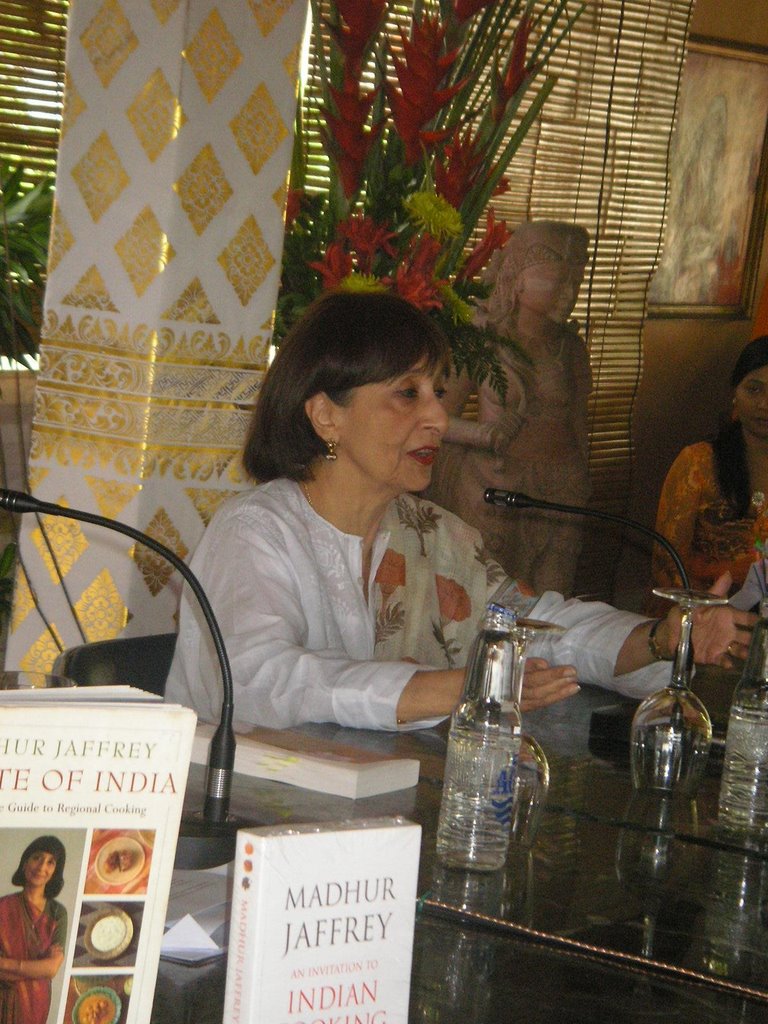
 I've loved Madhur Jaffrey for years, with that special affection engendered for those who teach us to cook and transform our kitchen lives.
I thought about taking my cookbooks along to Bali for Madhur to sign, but quite aside from AirAsia's measly baggage allowance, wouldn't she have been insulted to see her books curry splattered, the pages stuck together with splashes of my own attempts, and my comments and adaptations scribbled on them? (I have the fantasy of presenting her with a stained page and saying "Here, Madhur, sniff this. Did I get the proportions right?")
Madhur says that she learned to cook after she moved to London from Delhi to take up a course at the Royal Academy of Dramatic Arts (RADA) and discovered just how dreadful British food was "apart from the fish and chips". She encountered "beef grey in colour and cabbage boiled for days" in the canteen. She longed for the spicy food of home.
Learning to cook, then was a matter of survival. She asked her mother for recipes, and the air letter arrived with fairly vague instructions ("add a little bit of this, a little bit of that") so that she had to rely on her memory of taste to get the proportions right.
When she came to write recipes for others she said that she "thinks like a dummy" to make sure that the instructions are as foolproof as possible.
Althought there were numerous Indian restaurants in Britain at that time, they did not reflect the authentic cuisine of the subcontinent, and tended to behave for example, as if India did not have fish.
 After graduation, Madhur became a successful film actress, appearing in Shakespeare Wallah, Heat and Dust, and numerous others, as well as in TV and radio productions. She moved married actor Saaed Jaffrey and moved to New York. (She later divorced, and married Sanford Allen.)
But being an actress is a precarious business and she realised that if she wanted to be able to aford to send her children to good schools and colleges, she needed to supplement her income. She decided to write about the arts for newspapers and magazines, then got "somehow hijacked" into food writing and started writing for magazines like Gourmet.
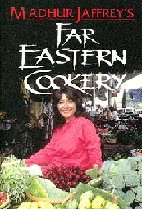 She says she picked pieces according to countries she wanted to go to and then set out with her "begging bowl" to ask ordinary folk for their recipes. She would enlist "the farmer's wife, the fisherman's wife" and then go to their houses to watch exactly how the recipe was cooked. She enjoys exploring the cultural connections along with the food.
I can personally attest for the authenticity and user-friendliness of the recipes in Far Eastern Cooking, one of my favourite cookbooks of all time. (I have the videos too.) Everything works. Everything tastes right.
Madhur has always been a "one woman band, with no assistance", she says. When she tests a recipe, she does all her own shopping, chopping, preparation and cooking, and records her notes onto the computer. "Any mistakes in the recipes are all mine," she says. She says that when writing a cookbook, she typically puts on 8lbs as she tests recipes and ends up with all the left overs in the fridge!
Her first book was published in 1973, though the early publications didn't do well. Then in the early 80's the BBC decided that they would like to do an educational programme about Indian food and asked Madhur to audition.
 The print run of 30,000 copies of Indian Cooking sold out first week the programme aired! Her audience "were hungry for recipes that didn't come out of flock papered restaurants" and Indians wrote to tell her that they were proud of her. The restaurants began to change, and she says she feels responsible in a sense for that change.
Several more very successful books followed it including World Vegetarian. My favourite (and she says it's hers too!) though is a book which did not sell well - Food for Family and Friends a fusion cookbook she says "was ahead of its time". (I got my copy at a bargain basement price at MPH years ago.)
 At the festival she read an extract from her latest book - not a cookbook this time, but a memoir, Climbing the Mango Trees: A Memoir of a Childhood in India. She says that in writing it she had to wrestle with issues such as how truthful should you be? Who do you hurt? Who do you not hurt? And she notes that "when you start writing one thing a whole host of other things come back to you: writing awakens what seems to be sleeping and dormant".
At 73, (I couldn't believe it until I did the maths just now) Madhur Jaffrey shows no sign of slowing down and still relishes the idea of travelling the world to collect recipes. Indeed, one of the things she enjoyed doing in Ubud was going on the market walk Janet de Neefe organises weekly, along with a cookery demonstration.
No doubt there will be some Balinese dishes in her next collection!

