Showing posts with label reading. Show all posts

Friday, January 26, 2007

Liar! Liar! Books on Fire!

Cast your eyes down this list and tell me, how many of the books on it have you read?
1. The Lord of the Rings – J.R.R Tolkien
2. War and Peace – Leo Tolstoy
3. Wuthering Heights – Emily Bronte
4. Men are from Mars, Women are from Venus – John Gray
5. 1984 – George Orwell
6. Harry Potter and the Philosophers Stone – J.K Rowling
7. Great Expectations – Charles Dickens
8. Jane Eyre – Charlotte Bronte
9. The Da Vinci Code – Dan Brown
10. Diary of Anne Frank – Anne Frank
Honestly?

Or were you just bluffing to impress me?

According to a poll of over 4000 bookworms conducted by the Museums, Libraries and Archive Council (MLA), a third of British adults have lied about reading a book to appear more intelligent according to a new survey.

The poll revealed that:
40 per cent of people said they lied about reading certain books just so they could join in with conversation. ... Most people expand on their literary repertoire to impress a new date, 15 per cent have lied about the books they have read to a new colleague and five per cent have told porkies about their reading habits to their employer.
As Head of Library Policy, John Dolan, says:
It’s fascinating to see that so many people are trying to impress others with the books they haven’t actually read.
And the top ten above lists the books the Brits most often lie about.

Malaysians of course don't lie about reading books they haven't read ... even if it would be professionally expedient for them to do so!

Or do they?

Wednesday, January 24, 2007

Reading for Empathy

Print this off and keep in case you have to persuade anyone else about the value of literature. Ann-Marie Priest (of the university of Queensland) writes in the Australian about teaches us important lessons about life:
It's true that we can't expect - and most of us, surely, have no desire - to find neat moral lessons wrapped up in our favourite books. Good books are not didactic. Nevertheless, reading can have a profound, and profoundly humanising, effect on our lives. Literature has its own ways of teaching us about life and living.

The central experience in reading is of immersion, of entering so completely into the world of the story that everything else fades away. When this happens, we are opening ourselves up to a very different way of knowing. Not just our minds and our consciousness but our whole self is brought into play.

We register impressions at all levels of being, conscious and unconscious, visceral and cerebral, instinctual and aesthetic. Our deepest prejudices and ideals are engaged, along with the detritus of language and culture that contributes to who we are.

All of this is a kind of learning. When we identify with a character in a novel, or with the voice of a poem, we not only experience a sense of connectedness, we also begin to reflect on our own self. Consciously or unconsciously, we start to sort through what we want or don't want for ourselves, what we like or don't like, what kind of person we want to be or don't want to be, and how that fits with the other kinds of people we have encountered in life and literature.

Through reading (and through the study of literature), we rehearse the great dilemmas of life, both personal and social. We find ourselves asking the big philosophical questions: How should I live? What is the good life? What is love? What is justice? And what does it all add up to? Literature is not philosophy, it's not psychology and it's certainly not religion or theology. But it is a form of knowledge that tells us about who we are, about ourselves, our society and our culture. Milan Kundera calls it a "parallel history". Through the novel, he argues, we encounter all the dimensions of existence, from "the nature of adventure" to "the secret life of the feelings" to "the role of myths from the remote past", and on. Reading enables us to reflect on elements of existence we don't encounter anywhere else, and to do it in a unique way. It enables us, in the words of Virginia Woolf, "to learn through feeling".

The effect on individuals is, of course, unpredictable. There are no tidy moral lessons. This is the beauty and the challenge of novelistic knowing. As Kundera says, to take "the world as ambiguity, to be obliged to face not a single absolute truth but a welter of contradictory truths ... to have as one's only certainty the wisdom of uncertainty" requires courage. Literature does not give us a set of rules for living but it gives us a wider frame of reference, and it does enable us to reflect more broadly and engage more deeply.

Does this make readers morally better people? Of course not. Yet there can be no doubt that reading has the potential to enrich our lives and make us more humane. In bringing us into contact with the inner lives of others - fictional characters as well as writers - reading makes it difficult to withhold our empathy in the real world.
Someone please pass this article on to educational planners!

Related Posts:

It's Official - Fiction Readers are Better People (25/10/06)

Tuesday, January 23, 2007

Walk-On Part

I was just sitting there, not stirring, not even breathing, like the pub's pet reptile, when who should sit down opposite me but Martin Amis, the writer. He had a glass of wine, and a cigarette - also a book, a paperback. It looked quite serious. So did he, in a way. small, compact, wears his rug fairly long ...

I was feeling friendly, as I say, so I yawned, sipped my drink and whispered 'Sold a million yet?'
He looked up at me with a flash of paranoia, unusual in its candour, its bluntness. I don't blame him really, in this pub. It's full of turks, nutters, martians. The foreigners around here. I know they don't speak English - okay, but do they even speak Earthling? They speak stereo, radio crackle, interference. They speak sonar, bat-chirrup, pterodactylese, fish-purr.
'Sorry,' he said.
'Sold a million yet?"
He relaxed. His off-centre smile refused to own up to something.
'Be serious,' he said.
'What you sell then?'
'Oh, a reasonable amount.'
I burped and shrugged. I burped again. 'Fuck,' I said 'Pardon me.' I yawned, I stared around the pub. He returned to his book.
'Hey,' I said 'Every day, do you ...Do you sort of do it every day, writing? Do you set yourself a time and stuff?'
'No.'
'I wish I could stop fucking burping,' I said. He started reading again.
'Hey,' I said 'When you, do you sort of make it up, or is it just, you know, like what happens?'
'Neither.'
'Autobigraphical,' I said. 'I haven't read any of your books. There's, I don't really get that much time for reading.'
'Fancy,' he said. He started reading again.
'Hey,' I said, 'Your dad's a writer too, isn't he? Bet that made it easier.'
'Oh sure. it's just like taking over the family pub.'
'Uh?'
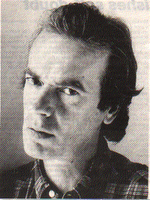
I love the way Martin Amis gives himself a cameo role in Money, and uses it to such comical effect. (His dad, of course was Kingsley Amis). Auster is another author who walks into his own novels. Can you think of any others? I must have a go at fictionalising myself ... a nice writing exercise.

I have been meaning to read Money (also sometimes subtitled A Suicide Note) for years and finally bought a copy a few months ago.

In case you're wondering how this highly acclaimed and best-selling novel slipped past me ... well in 1984 when the book was published, I was living in a small town in Malaysia and didn't hear the buzz about it. The bookshops in KL (Berita, Times, Guardian Pharmacy) carried such a limited range of best-sellers. I missed so much good stuff and now have to go back and fill in the gaps. (The TBR Challenge is very useful!)

But progress is slow. Because a) It's the sort of book where you want to read each sentence carefully to enjoy the style - I love the voice, the energy and the poetry of the writing, and b) it is my "bag book" i.e. I am not allowed to read it at home ... just in cafes, on the LRT and during moments when "real life" is Dullsville. (Yesterday I was at Immigration getting my yearly stamp, and read a fair whack.)

At home, I have to get on and read the stuff I need to read ... for reviews, interviews, blurbing, editing and proofreading. And these are also the copies I musn't spill stuff on and can't let get scrunched up and dog-eared in the chaos of my big bag.

(How ironic the other day that I remembered my novel, but not my purse. I had Money, but no money, haha.)

Among my other reads - The Gift of Rain by Tan Twan Eng, which I am very much enjoying and am nearly two-thirds through. (It's a substantial read!). But since this is presently sub-judice, I can't say any more about it for now. Also Dina Zaman's I Am Muslim which I'm proofreading, and which is informing and delighting me even as I scribble corrections on it.

More about all of these reads in the fullness of time.

But more importantly, what are YOU reading?
Saturday, March 19, 2005

When Do You Read?

Love to get up very early and read in my favourite chair on the verandah while the sun comes up - drink copious amounts of tea and eat breakfast slowly page by page with smudges of yoghurt or jam between the lines.

Promiscuous reader. Love to read in cafes ... especially after the gym when I feel I've deserved it.

Favourite reading spots - Elly's Table at Centerpoint (excellent coffee); Coffee Bean at BSC (though I hate drinking from those silly glasses); Starbucks at Bangsar Village; Chinos on the Park; Delicious (most comfortable with all those lovely cushions!) and Basque Lane in 1 Utama. Need sunlight and the open air, good coffee, decent food.

All of these are also favourite writing haunts too - depends on how the mood takes me. I seem to read a lot when i'm not writing and write a lot when I'm not reading. I'm fickle. Go through phases.

Always read when I eat. (As a forensic examination of any of my books would show.)

Always read in the loo. Usually magazines or poetry or books with very short chapters. Need to fix up library shelves in there.

Have given up reading in the bath. (It is possible to get special bathbooks with waterproof pages though ...)

Have books in different rooms of the house and can't seem to pass them by without at least a little read. Coffee table books usually on some local theme in the lounge. Cookbooks in the kitchen. Inspirational stuff about self-actualisation, poetry, psychology by my bed. Naughty books stuffed into the back of a cupboard where the in-laws won't find them and get shocked that I have such an X-rated imagination. Writing books in my office (the back bedroom) dipped into as I prepare course materials. Books floor to ceiling in the room where we watch TV.

And always a book in my bag. Handbags chosen for bookholding capacity.

Read at odd moments. Check-out queues. On public transport. At immigration.

Can't understand how most people can tolerate the boredom of life without a dialogue with a book! Compare the voracious readers on the London Tube with the staring-into-spacers of the LRT, for example.

Don't read at night. Can't. Fastest acting soporific drug.