Showing posts with label critiquing. Show all posts

Thursday, July 02, 2009

Twitter Revenge

Your book got a lousy review? Twitter seems to be the tool of choice for hitting back at the reviewer.

Alice Hoffman called Boston Globe critic Roberta Silman a moron for this review (which actually contains plenty that isn't negative!) and demanded to know :
How do some people get to review books? Now any idiot can be a critic.
She then tweeted (is there such a verb, or should that be twote?) Silman's phone number and email address to the world asking her followers to :
... tell her what u think of snarky critics ...
This bordered on harrassment writes Kate Ward at Entertainment Weekly who adds a rather amusing aside :
Thanks to a tipster, we stumbled upon an interview with author Richard Ford, in which he admits to putting a gunshot hole through a book written by a writer who panned one of his books. The reviewer? Alice Hoffman.
UCL's professor of English, John Mullan in The Guardian reckons we can expect more authors sounding off on Twitter because it is a safety valve, but reckons that the best response to a less than good review is a dignified silence. This blogger agrees.

Postscript :

Philip Hensher writes in The Telegraph :
The danger of the internet ... is not so much that anyone can express their opinion – if that is true, everyone is also free to ignore that opinion – but the way it sets a casual statement in stone, and propagates it freely. An author's response to a bad review may be immediate, but the heartfelt expression of your emotional pain is there for as long as anyone chooses to preserve it. ... A comment in conversation, a bad-tempered grunt over breakfast, disappears into thin air; five foul-tempered sentences responding to a blog stay there indefinitely. In former times, what preserved your writing was what came out in hard covers.

Monday, July 21, 2008

Book Critiques and Freelance Editors

A week or two back, I discovered that one of the people who had joined in the discussion on a post here was freelance book editor, Rob Redman. Never one to miss an opportunity, I persuaded him to write a post for us about what a freelance editor (sometimes, especially in the US called "a book doctor") actually does, and what you need to bear in mind when you choose one.

I reckon that this is very useful for those of you who write to know about, as good editors who can give you proper advice that will help you to develop your manuscript are few and far between in Malaysia.

Here's Rob's piece :
This is how the story goes. Freelance fiction editing began to bloom a couple of decades back, when downsizing publishers sacked many of their in-house editors. Publishers were now more reluctant to take on manuscripts that were in need of development, and there were dozens of experienced fiction editors in need of work. It was only a matter of time before those editors began to advertise their services directly to hopeful writers. In an increasingly competitive marketplace, where more prospective authors than ever before compete for the attentions of fewer publishing houses, hiring an editor is seen as one way to increase the chances of success.

I think this has led to a slight misconception regarding the role of freelance editors, and it's one that the less scrupulous editors are all too ready to exploit. You see, editors aren't really there to help you sell your book, but rather to help you improve it, to develop your abilities as a writer, and progress towards that point where you can sell your book for yourself. Personally, I'd say that 90% of the critiques I do are about helping writers in the early stages of their development, rather than polishing almost-perfect manuscripts before they're submitted to agents.

It's best to think of an editor is as a writing coach, and the process of the critique as a focussed writing course, based around your novel.

HOW TO CHOOSE A GOOD EDITOR

You'll find plenty of opinions online about what makes a good editor. All good editors should have worked in a publishing house, or have an MFA in creative writing, or have published novels themselves, or... Ultimately, that's all rubbish. Any one of those might be a good founding for an editor, or it might not. What you should look for in an editor are: an understanding of the way fiction works; genuine enthusiasm for your manuscript, whatever its level; a willingness to exchange ideas, an ability to communicate clearly; and a working knowledge of your genre, both in terms of the classics, and what's happening in the market now.

The best way to find out how an editor matches these criteria is to request a sample edit. Many editors offer these for free, others charge a token sum (say £10-£20, or US$20-40) for editing the first few pages of your manuscript. I don't think there's any harm in charging a token fee for this, as it does help to weed out time wasters, but be wary of anybody who charges anything more substantial, or doesn't offer a sample edit at all. (If you end up hiring the editor, you can often get the fee deducted from the price of the critique.)

Critiques themselves can vary hugely in terms of both price and style, so look closely before making your choice (and don't be afraid to ask questions). To give you an idea of the sort of differences involved, both of these are real critiques, from real editors: For a critique of a 70,000 word manuscript, Editor A charges £175, while Editor B charges between £525 and £700. Both critiques come with a report, of about 6-10 pages, which examine the manuscript according to a checklist of factors: character, plot, opening, language, etc. At first, it looks like Editor A is the one to go with, and editor B is some kind of shark.

However, Editor A actually farms its manuscripts out to subcontractors, to whom it pays about half its fee. These guys skim through the manuscript and then fill in the form in the space of an afternoon. Meanwhile, Editor B spends a week or two with each manuscript, annotating it throughout. After the critique, Editor B is available to discuss their comments, while Editor A is not. The services are entirely incomparable, but both have the same name. In fact, Editor B is the professional, and Editor A, well, I wouldn't hire them. This is one of the reasons why it pays to shop around, and to check the small print. The critiquing business is entirely unregulated, and the only way to know what you're getting is to ask, every time.

Here are some things to consider when shopping around for an editor:

Do they offer a sample edit? (either free or for a token payment)
Do you get just a report, or a report and annotations to the manuscript?
Is the editor available to discuss their suggestions with you after the critique?
What's the editor's experience?
Does the editor work in your genre?

(Regarding this last question, my website's called "The Fiction Desk", but I still get a surprising number of requests to edit non fiction. I've even had a request to edit a hip hop video!)

Don't ever hire an agent or a publisher for any kind of critique or reading. The same goes for self-publishing outfits, who have an interest in making you think your book is publishable when it may not be.

Draw up a shortlist of two or three editors who look like they meet your requirements. Send them an email asking for the sample edit, and don't be afraid to ask any other questions you might have. (Requesting more than two or three sample edits at a time isn't really fair, because these do eat into editors' workdays, but if your first round doesn't turn up anybody you'd like to work with, you can always try again with more editors.)

When the editors reply, they'll probably have some questions of their own, about your story, who you're writing for, that sort of thing. It really is worth trying to answer these, because they'll help the editor to do a better job for you. It's also worth getting into the habit of writing professional, responsive emails about your work, because you'll need to do this when you're looking for an agent or a publisher. Sometimes an editor will turn down the sample edit request, simply because it's not their genre. That's okay.

Once you've got your sample edits back, compare both the edits and the emails you've received, and decide whose working style suits you best. If none does, start looking for another couple of editors. (If you decide not to hire an editor, it's nice to send them a quick email to let them know, and to thank them for the sample anyway.)

If you find an editor you like, ask again to confirm the details of the edit, what you'll get and when, then sign up!
Rob Redman offers editing services and advice through his website, The Fiction Desk.

He has promised to drop by and answer any questions you may have about freelance editors, so please go right ahead and ask. And some of you might have experiences of your own to tell us about.

Tuesday, June 17, 2008

Silverfish Writers' Forums

Good for Raman for taking the initiative with this. (It's very badly needed.) :
After repeated requests, Silverfish Books is organising a writers' forum. The intention is for it to become a monthly meeting for aspiring creative writers in English to read their works, request feedback, network, form their own splinter writers' groups, and to share their stories with others having similar interests. We have been pondering this for a while. The original intention was to make it exclusive to Silverfish Writing Programme participants. But after discussing this with others we have decided to open it to all (including writers from Singapore if any want to make the trip). No fee will be charged.

It is proposed that this free forum be held on the first Saturday of each month ( as long as interest lasts) and the first event will be on
Date: Saturday, 5th July 2008
Time: 2.30 to 4.30pm
Venue: Silverfish Books, 58-1, Jalan Telawi, Bangsar Baru

This session is ideal for you if:

1. You write short fiction, biography or travelogues
2. You have unpublished short stories, biographies or travelogues of around 2000-3000 words to share
3. You crave constructive criticism on your writing to help you improve
4. You want to continue writing till you die
5. You are willing to work hard to improve your writing
6. You are passionate about writing
7. You intend to write enough stories for a whole book (not a one-story-in-ten-years writer)
8. You are thick-skinned and resilient and not afraid of criticism

This session may be a waste of time for you if:

1. You want to write mainly to make money
2. You only want to be a writer but you are not interested in the hard work (or you merely want to be famous for being famous)
3. You are not open to criticism of your writing
4. You are not willing to share your stories.
5. You are not interested in reading various genres and authors
6. You think writing is all about glamour
7. You think your writing is already perfect
8. You have a weak heart
9. You like to dominate events by not allowing anyone else to speak (or present their stuff)
10. It's all about you, you and you.
Great list too!

Wednesday, May 14, 2008

Complete Authonomy


Jean Hannah Edelstein on the Guardian blog reports on an initiative by HarperCollins to help new writers avoid the slush-pile.

Instead of posting an unsolicited manuscript which may just be filed in the bin, writers can now post up to 10,000 words on the Authonomy website ("social network for writers and book-lovers alike") which will be judged by readers. The extracts that attract most interest will be considered for publication. (The Authonomy blog is here.)

Edelstein seems cautiously optimistic about what the site might achieve for writers, but worries that it :
... may end up being a nice polite way for the publishers to say that they're not accepting unsolicited submissions anymore. If the launch goes well, I'd wager that anyone asking about submissions will be directed to hit the site, keeping editors' (and editorial assistants') desks clear for them to get on with the books agents have sent them, the ones they are genuinely interested in.
I must add here that when I interviewed publisher David Davidar a few months ago, he said that he was very positive about such initiatives since he felt that they really would help the best writers get noticed.

As Edelstein points out, this isn't the first time a social network for writers has been launched. Other are YouWriteOn (funded by the Arts Council) and The Frontlist.

But getting discovered isn't the only benefit of such sites. My friend Saras, now writing really good fiction and getting it published, says that the feedback she received from other subscribers to YouWriteOn has made an enormous difference to her writing. Hopefully she'll swing by this blog in a while and tell us more about her experiences.

Postscript :

Another site, Booksie, comes very highly recommended by Phil in the comments to this post and looks well worth checking out.

Saturday, August 11, 2007

It Jist Comes Oot ...

James Kelman looks back on his earliest struggles as a writer in the Guardian.(This article is required reading for anyone who argues that they don't have time or space for writing ... )

He also talks about his determination to use authentic voice to depict his working class characters in his short stories and later in his Booker Prize winning novel (extract here) and the prejudice he encountered as a result.
"Nice to be Nice" was my earliest attempt at the literary or phonetic transcription of a speaking voice. It so happens that the voice belongs to a working-class man from Glasgow. The story is told in the "I-voice", a first-person narrative. It was difficult to do. I spent ages working on it but learned much from the process.

It was one of the stories I later sent to Mary Gray Hughes. She commented on my early stories, and it was important to me, even if I disagreed with some of it. She advised caution in my use of "dialect", and warned me of the risk of alienating the reader. Mary Gray Hughes recommended I look at the work of Flannery O'Connor and Emily Brontë's use of dialect in Wuthering Heights. Of course I had my own opinions about "dialect" and I sent her "Nice to be Nice". She replied, "Forget all I said about dialect . . . you obviously know what you are doing better than anyone." I never bothered about alienating readers, neither then nor now. The priority was to write the story properly. The readers could take care of themselves.

My original intention in "Nice to be Nice" was to use the phonetic transcription only for the narrative. I thought to apply Standard English form for the dialogue. It was an attempt to turn the traditional elitist assumption on its head. I was irritated by so-called working-class writers who wrote third-party narratives in Standard English then applied conventional ideas of phonetics whenever a working-class character was called upon to say a few words. When a middle-class character entered the dialogue all attempts at "phonetics" disappeared; his or her lines were transcribed in standard form, leading to the extraordinary presumption that Standard English Literary Form is a literal transcription of Upper-Class Orature.

In "Nice to be Nice" the story is narrated in the first person by the central character. I was concerned about other characters. In what sense could the "I-voice" be defined as the central character? Only because he is telling the story. Each of the four characters would see it differently, each of the four characters had their own story, a different story. I started writing them, each as a first-person narrative. The shift in the language of each person was the most interesting factor. That subtlety, the sophistication of how human beings use language, is not possible for the elitist or racist for whom working-class existence may be an amorphous experiential mass, but if you hear one you hear them all, see one you see them all. During the Booker Prize controversy of 1994 much of the hostility directed at How Late It Was, How Late derived from the astounding proposition that the life of one working-class Glaswegian male is a subject worthy of art. I was used to the prejudice but the gleeful abandon with which some attacked my work took me by surprise. It never occurred to the literary mainstream that working-class males from Glasgow might be watching the programme or reading the newspaper.
On one occasion a member of an adjudicating panel asked him if he ever revised his stories "or did it just come out?":
It jist comes oot, ah says, it's the natchril rithm o the workin klass, ah jist opens ma mooth and oot it comes. Similar to the American dancer in reply to a related question, ah jes closes ma eyes an ma feets git to movin.
Kelman of course says he "sweated blood" getting them right.

His earliest collections of short fiction An Old Pub Near the Angel, A Chancer, Not Not While the Giro and The Busconductor Hines will be reissued by Polygon on August 30.

Saturday, May 20, 2006

The Gentle Cycle

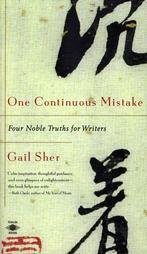
I liked this extract from Gail Sher’s book One Continuous Mistake: Four Nobel Truths for Writers so much I copied it for my writing class:
Unfortunately, the desire to write is more fragile than the desire by family, friends, and well-intentioned others to prematurely extinguish it. All too often a young writer’s dreams have been quashed by a single inept remark.

When it comes to feedback, why not treat yourself as you would a new piece of fine lingerie? At first you might wash it by hand or else on a machine’s gentlest cycle with the mildest detergent. You might simply let your garment soak, not agitate it at all. Later, when you’ve experimented a few times and you know exactly what it can handle, you might try tumbling it around. Eventually you might throw it in with the rest of your wash. But not before you are sure the seams are strong, its dye won’t fade and that the fabric can “take” rough treatment. Well, you (vis-à-vis your own writing deserve at least the same consideration.

Being emotionally and psychologically ready to receive feedback presupposes an ability to use the feedback constructively. “Constructively” means that you have achieved enough distance from your writing to understand, for instance, that “not quite” describes the paragraph, not you.
Sher points out that for feedback to be effective, there are 3 requirements:

First, the writer must be emotionally ready to receive it. Secondly, the person giving feedback must be knowledgeable about type of writing and how to give feedback (this is a learned skill) and he/she must care about this particular person’s writing. And thirdly, no matter how good the feedback, if it is ill-timed, it will be worthless, possibly even harmful.

I know that when I first plucked up courage to show a poem I'd written to a colleague at work, my heart was in my mouth. She knew a great deal about literature and had strong opinions. I knew she could be a tough critic and had she rubbished my attempt, I think I would have been crushed. Luckily, she was so supportive she became my sounding board for all my pieces. She probably helped me more than any writing course I did.

Other new writers aren't so lucky and get their early attempts rubbished (often, ironically, by the people closest to them) never to find the courage to write again ...

Giving constructive feedback is tough though ... and these days I tend to err very much on the side of caution having seen how easily new writers bruise. I have no wish to add to the critic's voice yaddering away in their heads. Stress the positives, gently suggest what could be improved. Push them to continue to write ... Hand wash them in soapy suds.

But how refreshing it is to sit down with a writer who has built up confidence in their work over time, and to be able to talk honestly about what works and what doesn't without them taking it personally. Bundled in with the rest of the laundry, this writer is colour fast, won't shrink or tear at the seams. They will listen, ask questions, sometimes fight back and explain why they wanted to do certain things in a certain way ... Hot cycle, tumble dry.

But it's taken them a while to get to this stage, gradually developing a thicker skin against the hard knocks that come with the territory.

My prayer is ... if I have offended anyone along the way with a surfeit of honesty, please forgive me ... for not being able to judge what level of feedback you were ready for. (If only you came with a care label ...)

Okay, writers -what have your experiences been with feedback and what kind of care label would you stick on yourself?

Sunday, July 03, 2005

Bookaholic Shopaholic

Bookaholic turned shopaholic for just one brief spell this morning. Went to 1 Utama to buy some cakes for an extended session with the Quacking Ducks this p.m. But just happened to pass through Parkson Grand and see THE bag. When you see THE bag, you know it instantly, and I fell in love. Soft leather. Capacious. It passed the ultimate bag test - how many books can it fit? The answer is a whole mini-library, a writer's notebook and a clutch of pens. The essentials of life. Had to have it. No money? What's the credit card for, then?

Then I fell in love with a Mambo t-shirt with a writerly slogan I loved I parted with RM72. It was half-price in the sale, would you believe! What a ridiculous markup on their clothes. Still I might just outdo Nizam Zakaria at the next round of Bernice's readings. (Oh ... talking of which, do go check out the great photos of last week's redings at 67 Jalan Tempinis 1 on Nizam's blog. He captures the whole atmosphere so well.)

The critiquing was fun. As much a chewing over of life as a digestion of texts.

A couple of very short shorts from one quacking duck.

A second quacking duck was jinxed by a car breakdown, but we looked at her story anyway and took a vote on what she wanted to know - which viewpoint worked best. We let her have the verdict on the phone.

We talked about a couple of scientific articles written by a third duck who was concerned not to dumb the science down but to make it accessible to a lay audience. (One of her pieces has already been accepted for publication, which she's thrilled about.)

And then we took on and tossed around some poems from a fourth quacking duck and from the quaking duck.

Altogether a most satisfying day.

Saturday, January 29, 2005

That Tightrope

We got together to discuss a couple of stories. One by Chet who joined us for the first time and was brave enough to trust us with her story. The second by Norasiah. Both with powerful endings, although needing to build a more solid bridge to those endings. Both about sisters and the rivalry between them. Both about separation and loss. Both with a great deal still to be discovered by the writer ... Stories with much promise nevertheless.

We walk the fine line, the tightrope between telling truth and necessary kindness for a writer willing to take this risk of exposure. I pray we got the balance right. And that we continue to get the balance right. It's a way for writers to grow, as valuable for those giving the feedback as for those who courageously allow scrutiny of their fiction. I know that I learned a great deal from listening to other viewpoints.

Nicest quote for the evening (as we brainsormed possible alternative endings to Norasiah's story): "Who wants to be subtle when you can be sick?" The story could go either way ... it's up to its author to choose - or better still, to play with alternatives and see which one fits best.

Wonder why it is thought that local writers feel the need to so often have the shock-horror twist in the end? (Or as in the case of another published local writer friend - a humourous punchline!) Where has this expectation come from?

I posted an article a month or two back by William Boyd in which he argues that what he called the "event-plot story" with it's surprise ending is somewhat ... passe.
The stereotype of the event-plot story is the "twist-in-the-tail" famously developed by O Henry but also used widely in genre stories - ghost stories (WW Jacobs, for example) and the detective story (Conan Doyle). I would say that today its contrivances make it look very dated, though Roald Dahl made something of a mark with a macabre variation on the theme, and it is also a staple of yarn-spinners such as Jeffrey Archer.
Anyhow ... I found it an enjoyable and exhilarating evening. Chet and Norasiah were sporting. Leah thought she was being a grouch but I think her genuine honesty and well-formulated comments made her a real treasure. (As I say, I'm learning.) And we laughed a great deal too, of course.

Monday, December 20, 2004

Critiquing

Friday had my writing buddies round. Once a month we meet for a critiquing session where a couple of us submit a piece of writing for fine-tooth comb scrutiny. A scarey process, but necessary for growth. This is the third time Asiah has joined us - she has had I think three stories published - lovely ironic slices of life and a real sense of mischief. Leah joined us for critiquing for the first time. She has been in critiquing groups for years and has more experience in that sense than the rest of us put together (we're so new to it, feeling the way.) We looked at a couple of stories of Mercy's - one of them an excellent short short - almost there but the language in need of tightening to make it a little more pacey. Then we looked at some short pieces of memoir/essays I had written and was not sure what to do with ... and ended up with some pretty good suggestions (This one should be used for a poem. ... This one feels just like raw material from your notebook maybe you could use it as part of a story but you need to add more to it.... This one is good, I wanted to know more ... ). It's so helpful to know how what you've written strikes other people - and you're always surprised by responses.

Leah was so positive about our little group - said we were communicative, articulate and honest without being hurtful - and the groups she's been in before haven't always been like this. (Feel dead chuffed that we're suceeding!)

We also had a good laugh together - wicked women's laughter over spaghetti puttanesca (which translates as "lady of the night" spaghetti!)and beaujolais noveau. Delicious.