Showing posts with label john updike. Show all posts

Sunday, February 01, 2009

Books as Ballast

Some more very good reasons (because we need these touchstones from time to time) - this time from John Updike why physical books will not become obsolete. He looks at the book as furniture, as sensual pleasure, as souvenir ... and as ballast (one category I hadn't thought of) :
As movers and the moved both know, books are heavy freight, the weight of refrigerators and sofas broken up into cardboard boxes. They make us think twice about changing addresses. How many ageing couples have decided to stay put because they can't imagine what to do with the books? How many divorces have been forestalled by love of the same jointly acquired library? Books hold our beams down; they act as counterweight to our fickle and flighty natures. In comparison, any electronic text-delivery device lacks substance. Further, speaking of obsolescence, it would be outdated in a year and within 15 as inoperable as my formerly cutting-edge Wang word-processor from the mid-Eighties. Electronic equals (e-quals, if you will) immaterial, Ariel to our earthy Caliban. Without books, we might melt into the airwaves, and be just another set of blips.
The essay appears in his collction Due Considerations: Essays and Criticism.

Talking about Updike, the BBC is repeating a Hard Talk interview with him today recorded in 2004. I caught half of it earlier (thanks to messages from friends) and hope to catch a repeat later.

Wednesday, January 28, 2009

Giving the Mundane its Beautiful Due

The writer must face the fact that ordinary lives are what most people live most of the time, and that the novel as a narration of the fantastic and the adventurous is usually an escapist plot, that aesthetically the ordinary, the banal, is what you must deal with. So I tried to make interesting narratives out of ordinary life by obscure and average Americans.
One of America's greatest authors has passed away yesterday, aged 76, after battling lung cancer. John Updike was that rare animal - a best-selling author who enjoyed literary acclaim winning the Pulitzer twice. His novels include the four novels in the Rabbit series, featuring onetime basketball star Harry "Rabbit" Angstrom who becomes a car dealer in a small town. Perhaps though his most widely known novel was The Witches of Eastwick which was turned into a film. His most recent novel is a sequel : The Widows of Eastwick, which came out last year. A collection of short fiction My Father's Tears and Other Stories is due out in June. The BBC has a list of Updike quotations (from which I took the one above), and here's another lovely one about being a writer:
There's a kind of confessional impulse that not every literate, intelligent person has. A crazy belief that you have some exciting news about being alive, and I guess that more than talent is what separates those who do it from those who think they'd like to do it. That your witness to the universe can't be duplicated, that only you can provide it, and that it's worth providing.
Meanwhile, the tributes flow in. Mitchiko Kakutani in The New York Times calls him :
... arguably this country’s one true all-around man of letters. He moved fluently from fiction to criticism, from light verse to short stories to the long-distance form of the novel ... a literary decathlete in our age of electronic distraction and willful specialization, Victorian in his industriousness and almost blogger-like in his determination to turn every scrap of knowledge and experience into words.... (But) It is as a novelist who opened a big picture window on the American middle class in the second half of the 20th century, however, that he will be best remembered. In his most resonant work, Mr. Updike gave “the mundane its beautiful due,” as he once put it, memorializing the everyday mysteries of love and faith and domesticity with extraordinary nuance and precision. In Kodachrome-sharp snapshots, he gave us the 50’s and early 60’s of suburban adultery, big cars and wide lawns, radios and hi-fi sets, and he charted the changing landscape of the 70’s and 80’s, as malls and subdivisions swallowed up small towns and sexual and social mores underwent a bewildering metamorphosis.
I'll put in links to other interesting pieces as I find them. Postscript : The Guardian has Updike's life in pictures and a whole list of authors including Richard Ford and Toni Morisson pay tribute. I like what Zadie Smith says :
Updike's example seemed the model of a real writer's life, in that this was an existence spent not in talking about writing, promising to write, boasting of having written or telling other people how they should write, but simply in the act of writing, every day, for decades.
There's another piece here by Martin Amis - and I impressed to learn that Updike had four studies in his house, each for a different type of writing! John Mulland and John Sutherland suggest the best titles to begin with, if you're embarking on your own voyage of Updike discovery. The Telegraph has an interview with the author from last year.

Monday, May 15, 2006

Seeking The Great American Novel

When the editor of the New York Times Book Review:
... sent out a short letter to a couple of hundred prominent writers, critics, editors and other literary sages, asking them to please identify "the single best work of American fiction published in the last 25 years" -
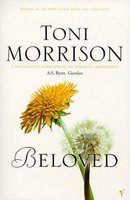
- Toni Morrison's Beloved emerged as winner. The runner's up were Underworld by Don de Lillo, Blood Meridian by Cormac Mc Carthy, John Updike's Rabit Angstrom: The Four Novels and Philip Roth's An American Pastoral.

The complete list is here with links to the original NYT reviews of the books. (Also well worth reading is A. O. Scott's essay about the search for the Great American Novel.)

I'm dreadfully badly read in American fiction. I've read other novels by Toni Morrison (most recently Jazz) but not Beloved. I have read no Philip Roth (though I accidently watched the film of The Human Stain on TV and thought it had a great cast but was clumsily handled).

I have had Cormac McCarthy's All the Pretty Horses (which also apparently received multiple votes) sitting on my to-be-read shelf for a couple of years.

I read the first two books in the Rabbit tetralogy when I was in my teens (more than three decades ago - ouch!) and far too young to appreciate them.
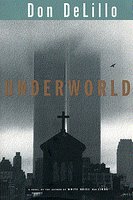
It's interesting looking at the reader reviews on Amazon - great literature is not always the most popular reading. Underworld is particularly controversial. Readers love it or hate it totally. Give it one star or five.

I thought this story of ordinary lives lives in the shadow of the cold war one of the most satisfying books I've ever read.

Like the film The Red Violin or Annie Proulx's Accordian Crimes, much of the plot comes from the passing from hand to hand of a physical object - in this case a baseball. But otherwise there is no real plot: scenes and incidents fit together like a chinese puzzle and the reader is left to discover all the interconnections.

But I've never come across a book that was harder to get into. (The opening section describes a baseball game and you just have to imagine that you are the eye of the camera panning around the auditorium.)

You know, I've never met anyone here in Malaysia who has managed to read Underworld, so if you have, let me know. And if you are a determined reader who loves a challenge, go for it!

Meanwhile, I have to go hunt out Philip Roth ...

Postscript:

The Elegant Variation argues that "The absence of literary bloggers from the list of consultees has much to do with the staid nature of the results."

Related Posts:

The 100 Greatest Novels (23/10/05)
1001 Books You Must Read (19/4/06)