Showing posts with label philip roth. Show all posts

Saturday, November 21, 2009

Another Year of Bad Sex

Maybe Neil Gaiman got it succinctly right on Twitter a few hours ago :
Just read the Guardian Bad Sex Award contenders ... I may never write a sex scene ever again. O Roth. O Banville. Argh.
Yes, it's that time of year again when literary lust becomes fodder for fun. The Guardian has extracts from all the 2009 nominees for The Literary Review's annual Bad Sex Award which you can read at your peril. But those of you of a somewhat tenderer disposition may want to ignore the link. (I started down the list earlier but had had a surfeit of fictional bonking before I made it through all the contenders, so will resume later in the interest of - ahem - research. ) My question to you is, do you really think these are examples of bad writing about sex? The Roth extract, green dildo aside (!) i though pretty intriguing and I'm off to buy the book. I didn't snigger pruriently at Banville's :
... tang of fish-slime and sawdust ... .
Theroux's : '
Yoni puja – pray, pray at my portal.
is a rather sweet line I can hear being taken up as a reprise by his female readers and Richard Milward's, yes, IS funny - but that is his intention surely? The usual refrain on posts of this nature on my blog - sex is very difficult to write well anyway. Postscript : And that is the point made very well in Sarah Duncan's response on The Guardian blog :
Writing about sex can be like a complicated game of Twister. You sit in front of your laptop, trying to work out where everything's going. It's worse than following the instructions for assembling flatpack furniture.

Sunday, August 10, 2008

Cover Stories

Most authors don't have any say in the cover design for their books, but some of the big names do. This essay from the New York Times features three authors, Philip Roth, Haruki Murakami and Chuck Palaniuk,who have chosen to stick with particular designers.

I have to say that I really love John Gall's retro covers for Murakami ... but the other two do rather leave me cold.

Tuesday, May 16, 2006

The Vampire and the Alimony Whore

Breaking-up is hard enough at the best of times. But how much more painful must it be when one partner is a writer and draws on the pain of a relationship to provide fuel for fiction?

Peter Carey's ex-wife, theatre director, Alison Summers found herself in the unenviable position of having to explain to sons Sam and Charley why they were all suddenly being beseiged by journalists around the world:'
Your dad has written a book and apparently the main character resembles him and the ex-wife resembles me in the way he has been talking about me the last three years.'
Carey's latest novel Theft: A Love Story has just gone on sale in the US. It's a story of an art theft but features an acrimonious divorce between an Australian artist and a nameless woman he refers to as 'the Plaintiff' and 'the alimony whore'. The author denies any autobiographical reference, but Summers sees the novel as a thinly veiled attack and calls Carey 'a vampire' because, she says, he has consumed everything in her life.

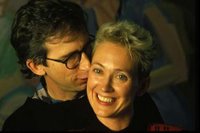
(The whole story here and here in the Sydney Morning Herald and thanks Iolanda for the link. The picture above also from the SMH shows the couple in happier times - obviously.)

Of course, other authors have drawn on painful divorces and today's Independent has a list of them:

In 1984, the columnist Julie Burchill walked out on novelist Tony Parsons leaving him to raise their son Bobby single-handedly. He later published Man and Boy, a tear-jerking story of a single father and his son. Burchill says:
I've always been sceptical about how much the characters in Man and Boy resembled us - the runaway wife and mother is decent, slender and dull, while the saintly husband and father is attractive, good in bed and has all his own hair. Which, quite frankly, rules us both out.
Touché!

Philip Roth's ex-wife, actress Claire Bloom, described him as "cruel, erratic and emotionally manipulative" in her autobiography. He exacted his revenge with I Married a Communist, in which the character of Eve Frame is based on Bloom.

Hanif Kureishi said of his novel Intimacy that it was about the demise of a relationship and he wanted to be "intentionally horrible - I wanted to write about an event as it happened".

Kureishi's former partner Tracey Scoffield, called the book was an unfictionalised account of the end of their relationship. She said his attempt to call the work a novel was "total hypocrisy - you might as well call it a fish. No one seriously believes that the book is only fiction. It all shows how little responsibility he feels towards his children."

Anyway, the moral of the story is just think twice before you marry a novelist!

Related Posts:

Kidnapping Peter Carey (25/5/06)

Monday, May 15, 2006

Seeking The Great American Novel

When the editor of the New York Times Book Review:
... sent out a short letter to a couple of hundred prominent writers, critics, editors and other literary sages, asking them to please identify "the single best work of American fiction published in the last 25 years" -
- Toni Morrison's Beloved emerged as winner. The runner's up were Underworld by Don de Lillo, Blood Meridian by Cormac Mc Carthy, John Updike's Rabit Angstrom: The Four Novels and Philip Roth's An American Pastoral.

The complete list is here with links to the original NYT reviews of the books. (Also well worth reading is A. O. Scott's essay about the search for the Great American Novel.)

I'm dreadfully badly read in American fiction. I've read other novels by Toni Morrison (most recently Jazz) but not Beloved. I have read no Philip Roth (though I accidently watched the film of The Human Stain on TV and thought it had a great cast but was clumsily handled).

I have had Cormac McCarthy's All the Pretty Horses (which also apparently received multiple votes) sitting on my to-be-read shelf for a couple of years.

I read the first two books in the Rabbit tetralogy when I was in my teens (more than three decades ago - ouch!) and far too young to appreciate them.

It's interesting looking at the reader reviews on Amazon - great literature is not always the most popular reading. Underworld is particularly controversial. Readers love it or hate it totally. Give it one star or five.

I thought this story of ordinary lives lives in the shadow of the cold war one of the most satisfying books I've ever read.

Like the film The Red Violin or Annie Proulx's Accordian Crimes, much of the plot comes from the passing from hand to hand of a physical object - in this case a baseball. But otherwise there is no real plot: scenes and incidents fit together like a chinese puzzle and the reader is left to discover all the interconnections.

But I've never come across a book that was harder to get into. (The opening section describes a baseball game and you just have to imagine that you are the eye of the camera panning around the auditorium.)

You know, I've never met anyone here in Malaysia who has managed to read Underworld, so if you have, let me know. And if you are a determined reader who loves a challenge, go for it!

Meanwhile, I have to go hunt out Philip Roth ...

Postscript:

The Elegant Variation argues that "The absence of literary bloggers from the list of consultees has much to do with the staid nature of the results."

Related Posts:

The 100 Greatest Novels (23/10/05)
1001 Books You Must Read (19/4/06)

Thursday, December 15, 2005

More Problems with the L-Word

I would be wonderful with a 100-year moratorium on literature talk, if you shut down all literature departments, close the book reviews, ban the critics. The readers should be alone with the books, and if anyone dared to say anything about them, they would be shot or imprisoned right on the spot. Yes, shot. A 100-year moratorium on insufferable literary talk. You should let people fight with the books on their own and rediscover what they are and what they are not. Anything other than this talk. Fairytale talk. As soon as you generalise, you are in a completely different universe than that of literature, and there's no bridge between the two.
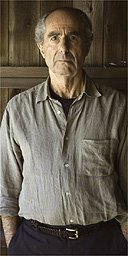
The great (and unsmiling!) American author Philip Roth in an interview in today's Guardian. Amen!