You have to treat this as the single most important part of your life. You do not need anything as fancy as inspiration, just this steady habit of writing regularly even when you're sick or sad or dull. Nothing must stop you, not even your beloved children. If you have kids you do what Toni Morrison did—write in the hours before they wake. If you wish to be a like the champion who swims for four hours every day of the year, you will need extraordinary will. You either have this or you don't, but you won't know unless you try.
Biggest congratulations to all those who finished this year's Nanowrimo with 50K words under their belt. Even if those novels never see light of day, they are preparation for the one that will.
Those who signed up for the biggest of all writing competitions have been receiving regular pep talks from famous authors. The final one was this one from Peter Carey which arrived in everyone's inboxes last night. If you want to be a published author, all the advice you need to suceed is here.
Now imagine this. (Highly hypothetical situation for all my blog readers I think!) You are a critically acclaimed author with several successful books under your belt. Your work is just going from strength to strength. The trouble is that when you look back at your earliest published work, it now seems ... somehow lacking. You've learned so much along the way. You've grown as a person, and as a writer, and looking back now you can see the flaws in your earlier work.
Do you get tempted to go back and revise?
A couple of recent articles in The Age raise this very question. First of all, Jane Sullivan wrote that Peter Carey set the cat among the pigeons by saying on a TV bookshow that he intends to go back and line edit his early stories. His fellow authors on the show, Paul Auster and Ian McEwan were apparently shocked :
It was almost as if Carey had uttered a heresy. Yet, what he was proposing didn't seem so awful. He explained that the idea had come to him when he was preparing a reading in New York a few years ago. He was going to read the story he was most proud of, American Dreams. But when he began to look at the sentences, he thought they were "really appalling". He could not bear to read them aloud in the company of other writers such as Joyce Carol Oates*, so he sat down and line-edited the story.
And presumably just didn't want to stop at just that one!
Now it seems that this year's Miles Franklin winner Steven Carroll is revisiting his earlier fiction starting with his 1994 novel, Momoko, which was republished last year as The Lovers' Room. Later this month Twilight in Venice is due to be launched - this is a rewriting of his 1998 novel, The Lovesong of Lucy McBride.
Carroll explains :
With Momoko I underwrote the book and I knew I did. I rushed it ... With Lucy McBride I was determined not to underwrite the book and I overwrote it. I knocked out about 50,000 words, I threw out about five or six characters and it all concentrates on three characters and Twilight is a much shorter book. It's only about 55,000 words. I wrote a lot of new material too. ... If you can, if you've still got enthusiasm, what's the harm with going back and making something work a little bit better than it did initially. ... the earlier ones were apprenticeship books, I was still learning my trade.
I was a colonised person when I wrote those books. It’s been a whole process of personal decolonisation that I’ve had to go through to do this. Part of that decolonisation is to get out of my family. Trying to create for myself a sense of independence; a sense of political independence and a sense of sovereignty that allows me to see with my own eyes and with my own judgment the sorts of things my grandmothers were trying to tell me. ‘What you see is not what it’s all about.’ ... I was born brown with a white soul. Over the years I’ve had to find that brown soul again. And thank God, I’ve done it.
Comparing the before and after versions of the revised works of course will, as Sullivan points out, give PhD students a great deal of fun!
So are such revisions, understandable and even desirable? Or do you agree with Joyce Carol Oates :
... that is folly for the vindictive elder to try to set right the product of youth with the doubtful wisdom of experience.
In Peter Carey's new novel His Illegal Self, the child, a seven year old called Che (named for revolutionary Che Guevara) is not only a willing party to the abduction, he's actually been waiting for it.
They will come for you, man. they'll break you out of here
his neighbour predicts, referring to the boy's parents, famous student radicals on the run from the FBI.
When Dial arrives one day at the apartment Che shares with his WASP grandmother in New Yorks Upper East Side, he recognises her immediately, and soon the pair are on the run from the law and with financial and, with tactical help from the activists, eventually skip the country and find themselves on the run in Australia. Is the young woman with honey-colored skin, tangled hair in 15 shades, hindu necklaces and little silver bells around her ankles his real mother though?
Now I must confess that I found myself frequently scratching my head in the first part of this book, struggling to find out exactly what was happening. I felt as if I were watching a film through frosted class - I couldn't quite get the picture into focus and I felt distanced. Most of the pieces do fall into place later in the novel, but still there is still a need to suspend a fair old bit of disbelief, and I am still not convinced about Dial's motives for taking Che in the first place.
For me the book really began to pull together once the pair move into a hut in the inhospitable Queensland wilds, and find themselves part of an equally inhospitable hippy community (based on a commune Carey had once been part of) guaranteed to knock any residual nostalgia for the good old '60's and 70's firmly on the head.
(I must add a note here while I remember that I am thinking of founding a society for the prevention of cruelty to fictional animals, because the incident with the cat was totally uncalled for, I thought.)
The great strength of the book is in Carey's ability to create characters we can fully believe in and want to root for. His portrait of the watchful, needy Che is pitch perfect. We sympathise deeply with Dial, torn between regret for opportunities lost (she was due to start a new career as a college when she found herself drawn into her friend's mess) and her fierce love for Che whom she took care of for a time when he was a baby. The narrative is told at times from her perspective, at times from his, and I very much like the way that sometimes the same event (most notably the actual abduction) is viewed through both sets of eyes to show the differences in the child's and the adult's perception.
There's also Trevor, their neighbour in the commune is just the kind of wily rascal that Carey excels at creating, who gradually assumes the role of a father figure to Che and lover to Dial.
It's a sort of modern adage that there are two kinds of families, those we are born into, and those we struggle to create. In his novels, Carey frequently draws characters who are in some sense orphaned as these three are. The love that grows gradually between them is earthy and real. So real in fact that I wanted to spin the last few chapters of the book out for as long as possible, though when I got there, the life-affirming ending had me cheering.
So in the end, yes, I was a satisfied reader, although I didn't feel as strongly for the book as I have done for most of Carey's other novels, notably True History of the Kelly Gang and Theft.
Will the novel get Bookered? I bet.
If you want to know more about the book, here are some leads you might follow :
Carey is my darling*and I'm so scared of even the teensiest spoiler in Jackie McGlone's piece that my eyes skip over (for the moment at least) all mention of the novel, but fasten onto all the little snippets about Carey the man and Carey the writer.
Some insights into his creative process:
... What really fascinates me ... is the power of the imagination. I believe that writers should write about what they don't know, not about what they do know. Some of my students become trapped in their own lives, churning over the crimes of parents and siblings, which stops them discovering the incredible joys of invention.
... Perhaps it was writing The True History of the Ned Kelly Gang that really freed me up – maybe it was being brave enough to abandon all punctuation in that book that did it. Getting rid of punctuation means you have to get rid of all sorts of sloppiness in your writing, you have to be really, really exact. And it allowed me to be playful with language, which is what I'd admired in serious literature when I first started to read it when I was about 18.
... Writing's a mysterious process. It doesn't do to analyse it too much. This will sound romantic coming from me, but I do feel it's often like I've been through a fit of madness. When I'm a little anxious or insecure, I'll take down one of my earlier books to try and cheer myself up. It never works. I either think, 'God, this is crap!' or 'This is good, I couldn't do that again!' Sometimes, though, it's like someone else wrote a particular book."
McGlone adds some previously quoted Carey nuggets:
On creating characters:
I do not speak to them outside working hours, although the pleasures of creating proper characters is enormous, especially since novelists are prone to magical thinking anyway. You write something; then you meet someone who's exactly like the person you invented. My novel Illywhacker has some of that argument about it – the storyteller, Badgery, tells lies which later become truths."
On writing novels:
It's a privileged way to spend your mornings. When you have made some nice sentences, how thrilling is that? And then you get to go to lunch – I'm enthusiastic about lunch.
On the unexamined life:
For a writer it's the only one worth living. As a human I'm better off knowing why I do things, but as a writer I don't want to know. Everything that happens to me goes down like sediment to the bottom of the river. I do draw on that swampy stuff, but it's better not to know where it came from; also it's a good excuse not to improve my character.
Here's the trailer for the new novel:
*Reminder to self, try to be more cool and detached as a literary blogger ...
The shortlist for other the Orange Broadband Prize, that for new writers has been announced, and it is a very short shortlist with just three titles on it this time:
I first came across her work when I happened upon (in Guardian Pharmacy, in the days when it was the only place that sold books in Bangsar Baru!) Touch the Dragon, a collection of pieces which began life as journal entries and letters written when she spent a year living in Thailand when she was 17. I was blown away by the beauty of the images she captured and her power of observation, and when I lent the book to a "friend" who didn't return it, I had to hunt for another copy at abebooks! If you want an excellent example of a writer's journal, do try to get hold of a copy.
The 2007 shortlist for Australia's premier prize for fiction, The Miles Franklin Literary Award has also been announced and is also nicely short.
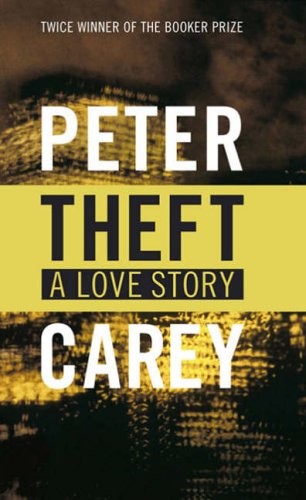
Deborah Robertson- Careless Alexis Wright- Carpentaria Gail Jones - Dreams Of Speaking Peter Carey - Theft : A Love Story
Am rooting for Carey of course, though that hardly seems fair when I haven't read the others on the list yet! Anyway, links to further information about all theses titles can be found in the official website.
Postscript
The other titles nominated for the miles franklin award do sound very interesting - do take a look at these articles in the Age and the Australian.
Finished Peter Carey's Theft: A Love Story a few days ago and enjoyed it so much that I haven't been able to pick up another book for days. I'm sort of moping about in the wake of it, hoping to get my appetite back.
The story is told in alternating chapters by two brothers - renown artist Michael Boone (aka 'Butcher Bones') and his idiot-savante brother, Hugh ('Slow Bones').
Recently released from prison where he was sent for trying to steal his own paintings from his ex-wife (and here is where the alimony whore comes in) he is installed in a country house by his 'sponsor' and begins to make some of the best art of his life. Across huge canvasses he splashes fire and brimstone texts remembered from his violent and abusive childhood, the full scale of which only gradually becomes apparent.
And then one stormy night there walks into his life (in her Manolo Blahniks - important detail) a beautiful young woman who claims to have lost her way. Marlene is the wife of Oliver Leibovitz, son of one of the greatest artists of the century. She's also an accomplished art thief and con-woman. Both brothers fall in love with her ... which fits into her plans just nicely. And thus begins a rollicking tale of art theft and deception which moves from Australia to New York via Tokyo.
Love-story, thriller, comedy ... the novel is all of these. But the greatest strength of the novel is the depiction of the complicated love-hate relationship between the brothers. The interplay of voices is excellent, and the way the two accounts give sometimes contradictory views of events, the "truth" of things falling somewhere between them. Hugh may not be the full shilling, but he is certainly astute and in many ways sees the world more clearly than his brother. I love the way his talk is peppered with phrases picked up from everyone else and is full of malapropisms.
The research for the book seems authoratitive - I knew little beforehand about how the art world works, or how artists feel about their work becoming an item of commerce, or how painting might be forged ... and certainly now I feel interested to learn more.
I love the energy and drive of the writing. One reviewer described the prose as "muscular" and I like that. But the language has a rugged poetry too, particularly during when describing the artist working. We can see the finished canvases and know why they are so brilliant, through the words.
Theft reminds me of a couple of other novels I've enjoyed: Steinbeck's Of Mice and Men (the episode of the dead puppy, Hugh's capacity for sudden violence and the murder at the end - I'm certain this is a reference Carey means us to pick up!), andHeadlong by Michael Frayn (also about shady dealings in the art world and very funny). And then of course Carey's there are echoes earlier novels, particularly My Life as a Fake which also tackled the theme of forgery, and True History of the Kelly Gang in the way that Carey recreates the voice of Ned Kelly so brilliantly. And there's Carey's siding all the way with the rascal, the fraudster, the thief, and making us love him too.
I bumped into my friend Mercy in Bangsar Village, Friday, and she'd just finished reading it too, and we were sitting there over coffee at Bakerzine laughing out loud at the cleverness of the book and saying I loved the part where ... and Did you notice ...? and laughing all over again.
Love it! I blow Carey a kiss!
You can read the first chapter here to see if the novel is one you'd enjoy. If it raises a smile, go out and buy a copy.
Breaking-up is hard enough at the best of times. But how much more painful must it be when one partner is a writer and draws on the pain of a relationship to provide fuel for fiction?
Peter Carey's ex-wife, theatre director, Alison Summers found herself in the unenviable position of having to explain to sons Sam and Charley why they were all suddenly being beseiged by journalists around the world:'
Your dad has written a book and apparently the main character resembles him and the ex-wife resembles me in the way he has been talking about me the last three years.'
Carey's latest novel Theft: A Love Story has just gone on sale in the US. It's a story of an art theft but features an acrimonious divorce between an Australian artist and a nameless woman he refers to as 'the Plaintiff' and 'the alimony whore'. The author denies any autobiographical reference, but Summers sees the novel as a thinly veiled attack and calls Carey 'a vampire' because, she says, he has consumed everything in her life.
(The whole story here and here in the Sydney Morning Herald and thanks Iolanda for the link. The picture above also from the SMH shows the couple in happier times - obviously.)
Of course, other authors have drawn on painful divorces and today's Independenthas a list of them: In 1984, the columnist Julie Burchill walked out on novelist Tony Parsons leaving him to raise their son Bobby single-handedly. He later published Man and Boy, a tear-jerking story of a single father and his son. Burchill says:
I've always been sceptical about how much the characters in Man and Boy resembled us - the runaway wife and mother is decent, slender and dull, while the saintly husband and father is attractive, good in bed and has all his own hair. Which, quite frankly, rules us both out.
Touché!
Philip Roth's ex-wife, actress Claire Bloom, described him as "cruel, erratic and emotionally manipulative" in her autobiography. He exacted his revenge with I Married a Communist, in which the character of Eve Frame is based on Bloom.
Hanif Kureishi said of his novel Intimacy that it was about the demise of a relationship and he wanted to be "intentionally horrible - I wanted to write about an event as it happened".
Kureishi's former partner Tracey Scoffield, called the book was an unfictionalised account of the end of their relationship. She said his attempt to call the work a novel was "total hypocrisy - you might as well call it a fish. No one seriously believes that the book is only fiction. It all shows how little responsibility he feels towards his children."
Anyway, the moral of the story is just think twice before you marry a novelist!
So in the latest round of KL bookshop snakes and ladders, who's on the way up and who's coming down?
MPH for sure climbs up a fireman's ladder for arranging events for Tash Aw this weekend - a dialogue at the Writer's Circle, two booksignings and a private gathering tomorrow. (Am dying to tell you all about it - have sheaves and sheaves of notes - but have to get my article out first. And yes, I am still alive and totally totally charmed by young Tash.)
Silverfish also climbs a ladder. Although Tash's reading there was hastily arranged, a good crowd came and crammed into the tiny bookshop, and many of them had read the book so asked thoughtful questions. The Chilean wine was good, and there was a wonderful relaxed atmosphere.
MPH slips down a few rungs for not bringing in hardback copies of the book. Honestly! Why didn't they realise that we'd be flocking to get our books signed for posterity?
Borders (which slid right down the biggest blackest snake the other day telling me that it would take 6-8 weeks to get Edward Carey's books which the other bookshops could obtain in half the time) now redeems itself by having anticipated the desire for hardback copies of The Harmony Silk Factory.
Silverfish goes up another ladder because it can get me Edward Carey's books within a fortnight. They have a good relationship with the local supplier, apparently. Responsive, personal service wins the day.
MPH goes up a rung for having a counter selling delicious chocolates and sweets which you can munch as you browse. I laid waste to a bag of sugared almonds while browsing the shelves. (Laid waist to my waistline?)
But I'll make them descend a rung (spiteful, aren't I?) for shelving a novel by Will Self in the psychology section. I guess someone just saw "Self" on the spine and decided it belonged with Freud.
Incidentally, the funniest misshelving of books occurred in Times, Bangsar Shopping Complex a couple of years ago. I found a whole pile of Peter Carey's The True History of the Kelly Gang in the non-fiction section. I went up to the counter to point out that the book was fiction and should be shelved with the novels. The staff there argued that it must be non-fiction because the title said "True History" and refused to move the copies.
I felt so sad for Peter Carey because his books couldn't be selling. When the staff had their backs turned, I picked up the books and transferred them to their rightful place among the fiction.
The next time I went into the store, the books were back in non-fiction. And once again I moved them.
In the end they left the books where I had placed them. Maybe the staff thought there were ghosts around?
Do you remember the Steven King book (or the film of it) Misery? Well, I have this fantasy that when I finally do get to meet Peter Carey, I will be forced to kidnap him and keep him locked up in a little room (though I wouldn't go as far as smashing up his feet with a sledge-hammer) until he writes a sequel to The True History of the Kelly Gang and brings Ned Kelly back to life.
It was my favourite book of 2001 and the one I tipped for the Booker even before I knew it had made the longlist! (Can I pick 'em or what?) I loved the voice of the character and so totally believed in him that I often forgot that Peter Carey was the one actually pulling the strings.
So a story about Peter Carey which is worth retelling, dated as it is:
One day Kee Thuan Chye walked into Silverfish with a friend. They spent some time looking through the shelves which contain the books by local writers. Chye then introduced his companion to Raman:
"Raman, I'd like you to meet ... Peter Carey."
"You mean THE Peter Carey?" stammered Raman, not quite able to believe it. ("Of all the bookshops in all the towns you had to walk into mine.")
"Well ..." said the writer modestly "A Peter Carey."
Raman was so truly gobsmacked that he even forgot to ask Carey (only the second writer to have won the Booker twice) to autograph the copies of his books on the shelves.
Tamil who was working behind the counter that day didn't hear this exchange, didn't quite latch on to what was happening, and struck up a conversation with the writer as he wrapped up his purchases:
"So where are you from?"
"Australia," said Carey.
"Here on holiday?" said Tamil.
"Well not exactly. I'm doing some research here." (He was researching background for My Life as a Fake.)
"So what do you do?"
"I'm a writer."
"That's nice. ... Have you had anything published?"
Did he wish the ground had swallowed him up or what, when Raman explained who the visitor was to him later?
I'm glad I wasn't there. I probably wouldn't have gone to the extent of kidnapping Mr. Carey, but I probably would have ended up on the floor licking his shoes.
I'm a total groupie for those whose words and music furnish my brain. But I never know what to say to them. I always sound so inane ...
I once had tea with Rostropovitch (another name dropped - kaboom!) and all I could do was grin at him! He must have thought that I was a mental defective. Well ...