Here's the amazing Margaret Atwood as we've never seen her before, singing in a musical about ... ice hockey! She plays herself in a cameo role in Score : A Hockey Movie, and you can see some pictures on her blog.
She also appeared on a popular Canadian TV show giving tips about how to keep goal in the game.
It's nice, isn't it, when you favourite authors have talents and passions you never dreamed of!
Showing posts with label canadian authors. Show all posts
Showing posts with label canadian authors. Show all posts
Tuesday, March 16, 2010

Saturday, August 22, 2009
Another Glimpse into a Dystopian Future
 ... people kept asking me what happened two minutes after Oryx and Crake ended. I returned to this world because ... I didn’t know. So in order to find out what happened, then I had to go back and write another book.
The novel I'm most looking forward to reading this year is undoubtedly Margaret Atwood's The Year of the Flood which is a sister volume to the distopian Oryx and Crake with some overlapping characters. Sinclair McKay interviews the author in The Telegraph and gives us a peep into the concerns of the new book :
Here, through the eyes of two female characters, Toby and Ren, we learn of the days that lead up to a horrible pandemic that ravages humanity – forget coughs and sneezes, here people melt. There is enviro-religion, overweening science, hideous sex clubs, nightmare food, grotesque cosmetic surgery. And there are also bees. ... Behind the novel is fierce environmental concern, as well as a subtler inquiry into what it is that makes us human; central to the story is a sect called God’s Gardeners who read the Bible as a profoundly green text (for instance, convincingly reinterpreting what Genesis says about man’s relationship with the animal kingdom).Atwood's portrayal of the near future in the earlier book, was for me, extremely chilling and thoughts go back to it all the time. I think I shall have to pre-order this, so I get it the moment it hits the shops.
Atwood will be doing staged readings around the world to promote the book and raise money for environmental charities. (But, *sigh*, she isn't coming here.) And she's started a blog to keep us up to date.
Wednesday, October 22, 2008
Bali Photos (2)
 Remember Camilla Gibb who was in KL last year for the literary festival? Well her novel Sweetness in the Belly which many of you have enjoyed has now been translated into Bahasa Indonesia with the title Lilly : Pencarian Cinta Seorang Gadis Eropa di Etiopia. Wouldn't it be nice to have a Bahasa Malaysia version for the local market??
 Pakistani author Moni Mohsin now lives in London, and her debut novel The End of Innocence was published in 2006. Really enjoyed talking to her at the dinner at Karim Razlan's house.
 The last session on the last day was defintely one of the best. Deepika Shetty was in conversation with Mexican master of magical realism Alberto Ruy Sanchez. It is impossible to listen to him and not fall in love.
Guess what? Bernice discovered that he will be stopping over in KL next week and plans to get him to do a reading. (More news about this later when it's fixed up.)
 And here's our Bernice between sessions.
Saturday, October 11, 2008
Opening Creative Space in Canada

The shortlist for Canada's Scotiabank Giller Prize has been announced, and the finalists are :
(Read more about all the authors on the website.)
Margaret Atwood who is one of the judges spoke about the power of the Giller to :
The winner will be announced on November 11th.
Joseph Boyden - Through Black Spruce (novel)
Anthony De Sa - Barnacle Love (short stories)
Marina Endicott - Good to a Fault (novel)
Rawi Hage for his novel - Cockroach (novel)
Mary Swan - The Boys in the Trees (novel)
(Read more about all the authors on the website.)
Margaret Atwood who is one of the judges spoke about the power of the Giller to :
... put people into the spotlight who might never have been there. It's astonishing how much talent there is out there. You open up a cultural space like that and I guess I've always said — and have been saying recently — Canada is full of creativity. You make a space for that, for that creativity to be and to flourish, and there it is.Most of those shortlisted have just one or two novels under their belts.
The winner will be announced on November 11th.
Thursday, June 12, 2008
Rawi Hage Wins IMPAC
 And this year's Impac Dublin Literary Award goes to ... Canadian author Rawi Hage for his debut novel De Niro's Game.
In the judges citation, the novel is described as :
... a powerful, stark yet lyrical and compassionate book (in which) luck is a central element. The title refers to the game of chance - to the death-defying game of Russian Roulette played by DeNiro in the film The Deer Hunter. Hage’s characters find themselves in a very different yet equally extreme situation - caught in the civil war raging in Beirut in the 1980’s. Hage’s writing allows the reader a shocking intimacy with the personal impact of such conflicts. Through the fate of his anti-heroes, George and Bassam, he shows how war can envelope lives – how one doesn’t have a choice in such situations. Concepts of guilt and innocence are left to flounder in the hail of bombs and the struggle for survival. Life itself becomes a game with no real winners, only scarred survivors whose estrangement is deeper than any bullet wound, and whose future seems darker than their blacked out city.
 Hage was born in Beirut in 1964, and grew up in Lebanon and Cyprus. He studied photography in New York, and in 1991 moved to Montreal. His novel was shortlisted for the 2006 Scotiabank Giller Prize and the 2006 Governor General's Award for English fiction and won several smaller prizes. Not bad for an author writing in his third language!
He's also a successful photographer and his work has been acquired by the Canadian Museum of Civilization and the Musée de la Civilisation de Québec.
More at The Toronto Star and The Guardian.
Tuesday, May 20, 2008
Stories of Neglected History
The overall winner of this year's Commonwealth Writer's Prize is African-Canadian novelist Lawrence Hill for The Book of Negroes while the first novel award went to Tahmima Anam for A Golden Age.
Hill (which is, incidentally called Someone Knows My Name in the US for political correctness!*) said of his novel :
Tahmima Anam is the first ever Bangladeshi author to win the prize. She says she wrote A Golden Age, because she wanted the story of the Bangladesh war to reach an international audience :
More about the prize and winners from Lyndsay Irvine in The Guardian.
(* Of which we had another fine example the other day, of course.)
Hill (which is, incidentally called Someone Knows My Name in the US for political correctness!*) said of his novel :
The Book of Negroes dramatises the all but forgotten story of 18th Century Africans forced into slavery in the Americas, liberated after many years and miraculously returned to the mother continent in the same lifetime. It was both intimidating and exhilarating to write the novel in the voice of an 18th Century African woman, Aminata. I thought of her as my own daughter and gave her the name of my eldest child, in order to love her sufficiently to lift her off the page.You can listen to chapter 1 of the novel here.
Tahmima Anam is the first ever Bangladeshi author to win the prize. She says she wrote A Golden Age, because she wanted the story of the Bangladesh war to reach an international audience :
It is a story of great tragedy, but also represents a moment of hope and possibility for my sometimes troubled country.her book is described by the judges as :
...the first major fictional account in English of the creation of Bangladesh. ... Housewife, widow, and mother, Rehana Haque, exemplifies the power of the individual to resist and ultimately prevail against the ravages of war. The assured and lyrical prose evokes the tumultuous birthing of a new nation in an intensely personal family narrative.You can read an excerpt here.
More about the prize and winners from Lyndsay Irvine in The Guardian.
(* Of which we had another fine example the other day, of course.)
Thursday, October 18, 2007
Meanwhile, Across the Atlantic ...
 Right, now we've got the Booker excitement out of the way, it's time to shimmy across the Atlantic to see what's happening with a couple of other very important literary awards. (And as always thanks Eric for jogging my memory).
 The shortlists for the National Book Awards in the US were announced. The fiction list interests me most, so here it is.
Mischa Berlinski - Fieldwork (A thriller set in northern Thailand with anthropologists and missionaries competing with each other for influence over the hill tribes.)You can see all the shortlists of books in all categories on the NBA website, and then click through to read more about the selected titles and authors.
Lydia Davis - Varieties of Disturbance (A collection of "spare and always surprising" short fiction. )Joshua Ferris - Then We Came to the End (A comedy set in the world of advertising.)
Denis Johnson - Tree of Smoke ("An epic novel of bungled espionage and small mercies in the Vietnam era.")
Jim Shepard - Like You’d Understand ("Eleven first-person stories that offer an eclectic overview of the human experience.")

The finalists will be announced on 14th November.
The other award is Canada's Scotiabank Giller prize, which provides us with another tasty list of novels:
More information about the prize and the individual titles here. The winner will be announced November 6th.Elizabeth Hay - Late Nights on Air (The lady is compared to Annie Proulx and Isabel Allende - that's enough for me!)
Michael Ondaatje - Divisadero (I'm still wondering how one of my favourite authors could have missed the Booker boat completely, so I'm glad to see it here. I have this one lined up to read.)
Daniel Poliquin - A Secret Between Us ("An epic tale of a wartorn society in the midst of astonishing transformation.")
M.G. Vassanji - The Assassin’s Song (Vassanji has won the Giller Prize twice before, and I have a copy of his earlier The In-Between World of Vikram Lall - acquired at a times warehouse sale! - waiting to be read.* This novel is described as a "memorable, melancholy family saga.")
Alissa York - Effigy ("A stunning novel of loss, memory, despair and deliverance by one of Canada’s best young fiction writers, set on a Mormon ranch in nineteenth-century Utah.")


*One of the judges for the Giller is our friend, Camilla Gibb, who recommended Vassanji's novel to me when I asked her advice about the best Canadian fiction to read.

Sunday, October 14, 2007
Atwood on Aspiring Authors
 Thanks to the friend who sent me this piece by Ben Hoyle from the Times.
Margaret Atwood who recently spoke at the Cheltenham Literary festival about the challenges faced by aspiring writers.
Nobody should become a novelist who is not a gambler or obsessed with words ...- because, she says, it is now much harder for aspiring writers to break through and establish themselves than it was when she began her career in the 1960s.
She also talked about how very hard it was for her as an aspiring poet:
“
At that time few Canadian writers were published, even in Canada.But now the challenges have changed:
If you wrote a novel you were told that there weren'’t enough readers in Canada so you have to get a British or American publisher.”
Then, after years of being told that there was nothing unique about Canada, “you were told that your novel was too Canadian for Britain or the US”.
At the same time “the immediate postwar years were probably the most male-dominated decade in the history of literature in the past 150 years”.
...there’'s so many people writing there’'s a great struggle to find an agent and a publisher.... “Sometimes [new authors] are flavour of the month when their book comes out but if it doesn'’t then sell a trillion copies they struggle again.And she talked about the advantage that age confers to writers:
If you are young you can imagine what it’s like to be old but you haven’t lived it. If you are older you have not only experienced what it’s like to be older but you can remember every stage in between.”Now that is about the only advantage of growing older as far as I can see!
Thursday, October 04, 2007
Searching the Past
 The hand of destiny brought together two authors from opposite sides of the world who found they had a great deal in common in a panel discussion called Searching the Past, at the Ubud Writers' and Readers' Festival. It was an extremely interesting discussion in which the two authors discovered that they had a lot of common ground.
Tan Twan Eng is of course Malaysian of Chinese descent, while Madeleine Thien has Malaysian-Chinese parents but lives in Vancouver.
Twan's novel is set in Penang, Thien's latest novel Certainty is set in Sandakan where her father grew up. Both set their novels during World War II and the Japanese invasion figures large. (She told us how her grandfather had worked for the Japanese and was taken away to be killed when her father was only 5 years old.) Her novel explores the theme of displacement.
Both books, as moderator Joanna Saville pointed out, are about human choices and about fate and destiny and how much we can control.
And both novels have won critical acclaim and have been serious contenders for prestigious literary prizes. Twan of course was Booker longlisted for The Gift of Rain, while Thien was shortlisted for the Kiriyama Prize for novels from the Pacific Rim for Certainty.
(You might also like to check out her previous books Simple Recipes (a collection of stories) and The Chinese Violin (a children's book).)

How difficult was it for them to carry out the research for their books?
Thien found it hard to obtain first hand information from her family, as they didn't want to talk about that period, so she came to Malaysia for two months in 1999.
Sandakan had been "bombed to bits in the war", she says, and so she found herself writing about a place that had essentially been lost.
But she didn't feel so strange going back - she still has family there, and her father had drawn a map for her from memory which enabled her to find her way around, and so she says there was a sense of entering the world of the novel. She found people in Sandakan willing to talk to her about that period of history: most hadn't been asked about their wartime experiences for so many years.
However, because she does not speak Hakka and Malay, so she always felt that she was at one remove from the people she interviewed. (This proved to be another area of similarity between the two authors, as Twan does not speak Mandarin or a Chinese dialect either.)
Twan said said that he did not need to do any specific research before starting the novel as he has always read a great deal about the period although the literature on the 2nd World War was written by the British rather than by the local inhabitants. And he said that that it was only in the older generation of Malaysians has he heard rancour against the Japanese for atrocities committed during the war.
He described Penang as a main character in the book, and said that he felt a need to record a part of the world that is so quickly changing.
Twan also explained how he had begun writing The Gift of Rain. He'd always felt that he wanted to write but finally had some time on his hands when he was doing his Masters in Shipping Law with the University of Cape Town. He originally set out to write what he says was
a 100 page short story about three minor characters whom he wanted to include in a much larger novel, but their story grew and grew until it became the present novel!
The novel was actually written on the edge of the desert in Kimberley, and his longing for rain in this arid landscape seeps into the opening pages so much you can almost smell the scent of it ...

Saturday, June 09, 2007
Reading List for Politicians
Think a certain politician is ignorant? Want to make a protest? Provide a reading list or better still send them a book or two!
Kam Raslan told me in an e-mail that he was much tickled reading about how Republican presidential candidate Ron Paul gave front-runner Rudy Giuliani a reading assignment, suggesting a list of foreign-policy books to back up his contention that attacks by Islamic militants are fueled by the U.S. presence in the Middle East.
Kam goes on to say:
All this of course begs the question, which books would you like to send to which politician? (Home-grown or international?)
Kam Raslan told me in an e-mail that he was much tickled reading about how Republican presidential candidate Ron Paul gave front-runner Rudy Giuliani a reading assignment, suggesting a list of foreign-policy books to back up his contention that attacks by Islamic militants are fueled by the U.S. presence in the Middle East.
Kam goes on to say:
And I thought, what about reading lists for people who want to do something or other? There's a great book called A Savage War of Peace by Alistair Horne about the Algerian war of independence from the French in the 1950s. The author sent a copy to Rumsfeld and was politely told to sod off. Bush apparently read the book and then drew completely the wrong conclusions. Oh well.The book protest story I like best though is this one I came across on Nury Vittachi's blog:
Our old friend Yann Martel has started the world's smallest book club - one member. He's sending a book he likes to the Prime Minister of Canada every two weeks, to encourage more funding of the arts.Booker prize winner Martel vows to send Stephen Harper an inscribed book every two weeks accompanied by a letter. So far there have been four books and four letters which you can read here. There is as yet no response from Harper saying how he has enjoyed Martel's choices, which range from Tolstoy to Agatha Christie.
All this of course begs the question, which books would you like to send to which politician? (Home-grown or international?)
Thursday, June 07, 2007
Orange-Flavoured Fiction
 The 2007 Orange Broadband Prize goes to .... (drumroll, please, while I open the envelope) Half of a Yellow Sun by Chimamanda Ngozi Adichie (left, at the Guardian Hay festival).
And the Orange Broadband Award for First Writers goes to ... (another drumroll) Karen Connelly for The Lizard Cage.
Am longing to read both ... the first I have, and it's shouting at me from my TBR shelf. The other I haven't seen in the bookshops here yet.
Do check out the author websites. Chimamanda has set up a site especially for the book which includes a board for readers to post their memories of the Biafran war. Karen Connelly's includes her journal.
Friday, June 01, 2007
Uncommon Commonwealth Winners
 The overall winners of the Commonwealth Writers Prize have been announced.
The award for best overall book has been won by New Zealander Lloyd Jones for Mister Pip. The Sydney Morning Herald reports that Jones, is the first Kiwi to take the award since 1989, when Janet Frame won with her novel, The Carpathians.
Mister Pip tells the story of a teacher who educates a small village's children by reading them Charles Dickens' Great Expectations. ... After the book is destroyed in rebel fighting, he encourages them to retell the story from remembered fragments.The Hon Justice Nicholas Hasluck speaking on behalf of the Pan-Commonwealth judging panel at the award ceremony in Jamaica commented that:
This mesmerising story shows how books can change lives in utterly surprising ways.The winner for the best first book went to Canadian writer D Y Béchard for Vandal Love:
... an epic family tale, poetic and gritty, magical and yet believable, replete with misfits and boxers, giants and runts.
 The novel, which took Bechard eight years to write, traces generations of a French-Canadian family through the 20th century as they move across North America in search of a place to belong.
The French-Canadian family background is fascinating. (And don't we always love the gossipy bits, whether or not they have anything to do with the writing!) His father was a bank robber with more than 50 heists to his credit, while his American mother was into the occult and conducted seances.
Not surprisingly, a memoir is also in the works!
Thursday, May 31, 2007
From Fragment to Novel
I am so excited to hear about Michael Ondaatje's new novel since it's been quite a while since the moving and beautiful Anil's Ghost.
In an interview in the Sydney Morning Herald he talks about how writing a novel is a process of evolution for him. He reveals that he began his new novel, Divisadero with a fragment of story someone told him in passing:
In an interview in the Sydney Morning Herald he talks about how writing a novel is a process of evolution for him. He reveals that he began his new novel, Divisadero with a fragment of story someone told him in passing:
It was something about a horse that got loose in a barn and knocked down its owner. He wrote it down: a stormy night, an animal losing its mind, the girl in a heap on the floor. Gradually, the beginnings of a novel collected around those two pages; one girl turned into two, followed by a young man.So if you need a starting point for a story carry a notebook around with you and jot down those interesting snippets that you overhear, the stories that people tell you. You might just find the starting point you're looking for.
"It was a keyhole that allowed me to discover the rest of the book," he says now. "It was the opening." A landscape rose up to meet the horses, humming with insects and shimmering with grasses and, over five years' writing, the three people in the barn gradually revealed themselves to him. "I wasn't quite sure what any of them was like; they were all mysteries to me," he says. He didn't yet know that they had grown up together, that one limped, that one became a gambler.
"Some writers know exactly what their books are about when they begin," he says. "That seems incredibly boring to me. I am much more interested in how the writer evolves in the writing, so that the novel evolves as well." It was the same, he says, when he wrote his most famous novel, The English Patient. "I didn't know who the patient was: he was just the patient. He was a mystery to me. But then, as a book progresses, there is a kind of archaeology the writer performs on the characters; you work backwards.
Friday, April 27, 2007
Another Shortlist or Two
 The shortlist for other the Orange Broadband Prize, that for new writers has been announced, and it is a very short shortlist with just three titles on it this time:
Clare Allan- Poppy ShakespeareYou can find out more about the titles and read an extract here.
Karen Connelly- The Lizard Cage
Roopa Farooki - Bitter Sweets
I am cheering though at seeing Canadian author Karen Connelly's name on the list! In a sense she isn't a new "writer" as she has had poetry and non-fiction published previously, although The Lizard Cage is her first novel.
 I first came across her work when I happened upon (in Guardian Pharmacy, in the days when it was the only place that sold books in Bangsar Baru!) Touch the Dragon, a collection of pieces which began life as journal entries and letters written when she spent a year living in Thailand when she was 17. I was blown away by the beauty of the images she captured and her power of observation, and when I lent the book to a "friend" who didn't return it, I had to hunt for another copy at abebooks! If you want an excellent example of a writer's journal, do try to get hold of a copy.
 The 2007 shortlist for Australia's premier prize for fiction, The Miles Franklin Literary Award has also been announced and is also nicely short.
Deborah Robertson- Careless
Alexis Wright- Carpentaria
Gail Jones - Dreams Of Speaking
Peter Carey - Theft : A Love Story
Am rooting for Carey of course, though that hardly seems fair when I haven't read the others on the list yet! Anyway, links to further information about all theses titles can be found in the official website.
Postscript
The other titles nominated for the miles franklin award do sound very interesting - do take a look at these articles in the Age and the Australian.
Thursday, April 05, 2007
Sweetness in the Writing
 Trying to catch up with notes on books recently read and still falling behind!
I finished (of course, since I was interviewing her!) Camilla Gibb's third and most recent novel Sweetness in the Belly, and liked it best of all of them.
Sweetness is a story of Lilly, a white Muslim woman, who is forced to rebuild her life as a nurse in Thatcher's Britain after fleeing from Ethiopia, in the process becoming separated from her lover.
Concerned to help the Ethiopian refugee community, she spends her weekends as a volunteer for an organization which seeks to bring exiled families together, and hopes to find news of Aziz.
Alternate chapters tell the story of Lilly's years in Ethiopia, a decade earlier. She is the child of hippy parents who are every bit as irresponsible as the parents in Gibbs' earlier novels. They travel in Morocco and Lilly is left at the shrine of a Sufi saint with an imam called the Great Abdul, while they return to the city and are murdered - probably selling heroin in a back alley. Lilly finds peace in her soul through prayer and learning to recite the Qu'ran.
She makes a pilgrimage to the walled city of Harar in Ethiopia with Hussein (another adoptee of the imam) when unrest breaks out. Lilly goes to live with an impoverished Ethiopian family and gradually learns the ways of the people she has come to live amongst. She falls in love with an idealistic young doctor, Aziz whom she is forced to leave behind when political upheavals make it dangerous for her to stay in the country.
This brief summary doesn't do this carefully researched and beautifully written novel justice. I knew so little about Ethiopia, hadn't even heard of Harar, and now I feel that I've spent some time there - the setting is so beautifully invoked and sensuous. There's a real compassion and respect in Gibbs depiction of the Ethiopian people and their way of life, and the plight of refugees in London.
Would I recommend it? Very strongly.
Wednesday, March 07, 2007
The Fallout of Sexual Abuse
 Going through my Camilla Gibb phase in anticipation of the lady coming for the Litfest and my interview with her. I found her first two novels in the British Council Library, and then later bought copies (20% off!) at Kinokuniya.
Mouthing the Words is a powerfully engaging and highly readable novel about growing up in a dysfuctional family.
Thelma is five when the story opens. The family live in a village called Little Slaughter where they are ostracized as outsiders by the neighbours. Thelma's mother, Corinna, a former model, wants little to do with her daughter and relegates her "to the realm of the rather inconvenient", preferring to shower affection on her younger brother, the result of an affair with an Edinburgh solicitor.
Thelma is sexually abused by her alcholic father, Douglas, and made to play games of naughty secretaries and bosses. Unable to communicate this terrible secret to anyone outside the family, Thelma invents three invisible friends each representing an aspect of herself, who help her to cope. She longs, in vain, for another adult to adopt her.
The family move to Canada where things worsen, her parents eventually separating. There is a friendship with the hippyish family next door, and an all too brief period of happiness when her mother takes a Punjabi student as a lover, the first adult who really reaches out to the love-starved Thelma.
Thelma is institutionalised with anorexia - starvation is the only way she can physically prevent herself from becoming an adult woman, but recovers to win a scholarship to Oxford to study law. Although she proves to be a brilliant student, she rapidly descends into serious mental illness and self-mutilation.
Gibb is able to portray a descent into madness better than almost any other author I've come across (with perhaps the exception of Bessie Head in Maru) and her depiction of the psychological effects of abuse is extremely convincing. And we're right there to cheer on Thelma's slow journey to reclaim herself, and to be able to own her own words.
Sounds like a misery read? Far from it. The material is dark, but Gibbs has a lightness of touch and a humour (some parts are extremely funny!) that pulls the book back from being heartbreakingly sad.
Would I recommend this book? You betcha! And if you miss the author at the Litfest, she will also be signing copies oh her books in Kinokuniya 30th March at 7.30 p.m..
Now on to her second novel ...
Friday, November 10, 2006
Emergency Doctor Wins Giller
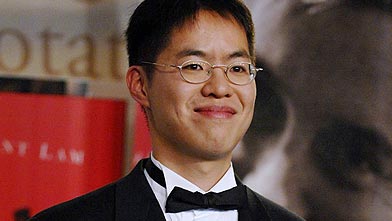 Jordan was kind enough to send me this link to a CBC interview with this year's Giller prize winner.
Canada's major literary award this year went to Toronto doctor and writer, Vincent Lam for his collection of short fiction Bloodletting & Miraculous Cures which follows the lives of four medical students. Lam beat four other authors in a field of relative unknowns.
Lam whose family migrated from Vietnam has apparently been mentored by Margaret Atwood, who helped him to find a publisher. And he is at work on his first novel, which is due out next year. His print debut, incidentally, was with a co-authored medical book: The Flu Pandemic and You.
Lam has a very demanding job as an emergency physician, yet finds no conflict between the day job and writing:
I find that I can be exhausted as a writer after having worked a fair bit and still have the energy to go to the hospital. In fact, I’m relieved by the concreteness of medicine. And I can be mentally exhausted as a doctor and I’ve still got writer energy. They’re very different processes. Writing is something that starts from the page and off you go, whereas with medicine, you’re confronted with a situation and then have to deal with it.And I liked his answer in the interview about whether his patients ever recognise him from the fiction:
Very occasionally. Thankfully, a couple of things work against that happening. One is that I do emergency medicine, so people come to me when they have emergencies, so they are primarily concerned with their health problems. Two, I’m a man of average build and figure. I haven’t got movie-star looks, so I can blend into the crowd. But I must say that one of the things that sets me apart from other doctors is that if a patient has a book with them, I’m always curious about what they’re reading.Postscript
Lotus Reads has a couple of interesting posts about the shortlist and Lam's win.
Thursday, October 12, 2006
Word Weavers
 One of the sessions I enjoyed most in the Ubud Reader's and Writers' Festival was was Weaving Words featuring Shauna Singh Baldwin and Gail Jones, moderated (extremely well) by Irina Dunn (executive direcor of the NSW Writers' Centre).
Canadian writer Shauna is best know as the author of What the Body Remembers a story of two women in a polygamous marriage in occupied India, has written a second novel The Tiger Claw, collections of short fiction and Foreign Visitor's Survival Guide to America. Reviews, interviews and information about her books can be found on her website.

Australian novelist Gail Jones is the author of Sixty Lights, which was longlisted for the 2004 Booker prize.
The session gave intriguing insights into what started these authors writing, their work processes and their attitude to revision. Both also read from their work.
Here are some notes on their responses:
 Gail Jones said that she came from a working class background in rural Australia and was interested in the narrative she met in cinema (a particular favourite was Dr. Zhivago) - which was "melodramatic, hyperbolic, and full of vivid technicolour imagery".
It wasn't until her teens that she read her first novel: Tess of the D'Ubervilles in her teens. She developed a love for Russian literature, particularly for Chekov's short stories, and for Dostoesvsky's novels for their "sense of risk and vulnerability to the larger forces of history". She was also influenced by Australian novelist Patrick White and she says that it distresses her that he's not so well regarded now.
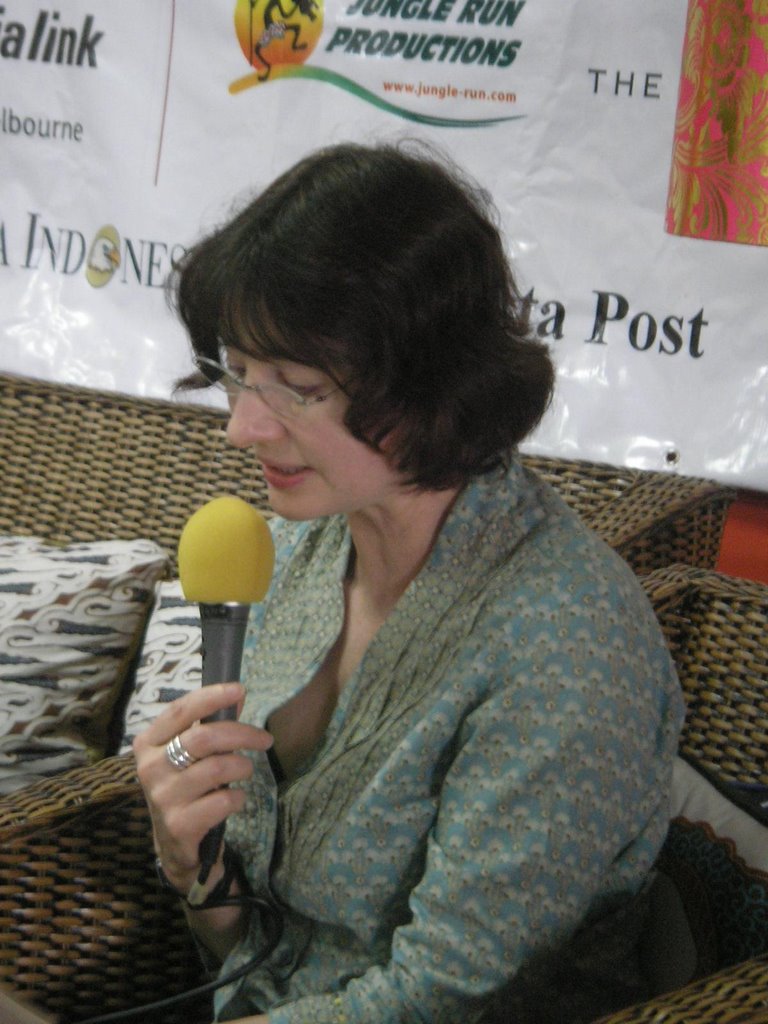 She had, she says, no faith in herself as a writer to begin with and believes that it takes women longer to believe that they might have a public voice.
She writes longhand because she believes that the body needs to be engaged in writing - it's almost metaphysical. She says the keyboard has a a fracturing effect on her and finds reading on screen "very counter intuitive". She also says that she travels a lot and loves to be able to pull out her (paper) notebook at any time.
She tries to write even the first draft as well as she can, which saves time writing revisions later and feels rhythm is important as it pushes one sentence to another. She describes her work as "highly wrought" and says she adore metaphor, the power of an image and the poetics of a text.
Plot is less important to her, in fact, she began Sixty Lights with no plot in mind. She liked the sound of the title and decided to bring together sixty illuminated moments which give the novel its structure. Writing is for her a linear process and she says she doesn't often show anyone her work.
 Shauna Singh Baldwin says that she was first introduced to the oral tradition: the telling of the Ramayana and Mahabharata, and became particularly attuned to the rhythms. She did not assume that she could write, but saw so much beauty around her that she felt compelled to keep a journal, trying to capture images before the moment was lost.
Her grandfather gave her HG Wells at 10, neither he nor she giving a second-thought to the fact that is was an adult novel. She didn't read Indian novels and the first stories she remembers were about red-heads and blondes. She said that she learned later that UK writers were so widely available in India when she was growing up because their work was out of copyright (and therefore cheap) and that's British writers came to influence a generation!
She remembers being told at school that Indians could be writers, but not authors. But then she began to discover the wealth of Indian literature. Tagore was an early influence, and then Rushdie opened the door for Indian writing in English, using the language for the first time as an Indian language in fiction. (Anita Desai said exactly the same thing in another session.)
 She became a technical writer and only began writing stories when doing a radio show for new immigrants. One day when she found herself running out of material she read some of her stories on air. They were so well received that she continued to broadcast her work and the final collection was collected in English Lessons and Other Stories.
Because she was a journalist from way back and says the computer has always been part and parcel of her thinking processes. She uses systems thinking and finds that flow charting and time lines and document maps on Excel help to her plan her writing.
She is now writing historical fiction. Metre and rythm are particularly important to her when she writes and reflect the voices of those she's writing about. In the book she's working on, the rhythm of the words reflects the rhythms she finds in Koran, as she is writing about a Moslem woman. She says that her starting point for fiction is a single image or a voice. She says:
I've done a lot of work with the kind of people I write about, I feel I have a responsibility when other people's words enter the text. ... I don't think about characters as characters. I think about them as people.And she says she tries to include a social element to her work "something that might help someone else". She does not write in a linear way at all, but in a jigsaw fashion "which is horrible to edit", using the computer to cut and paste text, and throwing in different images.
She says she writes as if for "the people you don't live with on a daily basis but who you love" and keeps in mind her cousins scattered around the globe. She says that she constantly edits and rewrites and also does "beta testing" (I love the way she keeps employing techie terms - when she's such a lyrical writer!) with a group of readers scross the world who give her useful feedback on what she has written at final draft stage. She refuses to have a glossary of Indian terms in her books - and this is even written into her contract.
Her next book is a collection of short stories to be entitled The Distance Between Us 10 short stories each in a different cultural voice. And she says that she has started the research for a novel which might take a very long time as it moves back and forward between India and Canada.
Wednesday, March 08, 2006
Atwood's Great Autograph Machine
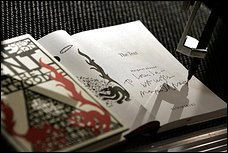 Booksignings can be bothersome for authors who really have better things to do than travel long distances just to meet fans and autograph books. (Write the next novel, for instance?) And now it seems, there is a way round the problem, thanks to Margaret Atwoods new invention: the LongPen. Now authors can talk to fans across the world via videoconferencing facilities, and scribble a personal message in real time, without leaving the comfort of their own homes.
Yes, I thought it was a joke too when I first read about the idea some months ago. But then Atwood set out to demonstrate her new toy by signing copies in a New York bookshop while she was physically at the London Book Fair.
But things didn't go according to plan, writes Oliver Burkeman in the Guardian:
Find out what went wrong!In novels such as Oryx and Crake and the Handmaid's Tale, Ms Atwood has demonstrated that she has few equals when it comes to imagining the transformative powers of technology on humanity. But turning science fiction into fact was proving tricky yesterday, thanks to the even more powerful force of sod's law.
Sunday, November 06, 2005
Living Memorial for Saro Wiwa
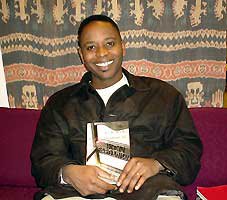 A moving memoir in today's Observer by Ken Wiwa.
Ken Wiwa was one of the "stars" of last year's KL Literary festival arriving on these shores courtesy of the Canadian High Commission. Wiwa, of course, is the son of Nigerian writer Ken Saro Wiwa, who was imprisoned, tortured and executed ten years ago for leading protests on behalf of the Ogoni people who were being screwed by oil giant Shell in the Niger delta.
I'd expected Wiwa's book In the Shadow of a Saint it to be an extended song of praise for the great man his father undoubtedly was. It turned out to be an extremely moving and honest account of a sometimes very fraught father-son relationship, and a wider exploration of the legacy of the pain and confusion a political martyr can bequeath his children. (You can listen to an interview with Wiwa about the book and his father's life here.)
Felt very sad reading the Guardian piece that this is the first I've heard about plans to celebrate the 10th anniversary of Saro Wiwa's execution with performance and readings around the world. Couldn't we also mark the anniversary here somehow?
Subscribe to:
Posts (Atom)