I'm off to the Publishing Symposium at the Singapore Writers festival and most probably away from this blog till Friday. Expect some updates after that of stuff I hope will be particularly relevant to local writers.
So while I'm gone, this is your space. What have you read recently? Any good?
Non-fiction and short stories are still my reads of choice at the moment. I finished Madness : A Bipolar Life by Marya Hornbacher very moving memoir of life with the illness - very well written, often harrowing but ultimately hopeful. A must-read if you know people who are bipolar and a book to put beside Kay Redfield Jamison's An Unquiet Mind. (I found my very cheap copy at Big Bookshop, and you can read excerpts from the book here.)
I read most of Gerrie Lim's In Lust We Trust : Adventures in Adult Cinema, at the hairdressers yesterday. Quite an eye-popping read (How does a nice Singaporean boy get mixed up in this? What actually goes on behind the scenes at the filming of porno movies - well aren't you also curious?), insightful and intelligent. (Bought by copy from Times bookstore.)
And now I'm toying with what to put in my bag to take to Singapore. Might give Neil Gaiman's The Graveyard Book a chance since it's almost halloween.
Showing posts with label mental illness. Show all posts
Showing posts with label mental illness. Show all posts
Tuesday, October 27, 2009

Sunday, April 05, 2009
That Old Depression ...

Nicholas Hughes’s mother, and mine, succumbed to the exhaustion of unrelenting depression. They self-destructed. And we grew up in the wreckage of their catastrophe. Their deaths took away from him and his sister, Frieda, and from me and my sister, Joyce, the solace of a mother’s love. And worse, all four of us, I imagine, had to live with the knowledge that our mothers had quite willfully abandoned us.Following the suicide of poet Sylvia Plath's son, Nicholas, Linda Grey Sexton shares her own experience of living with a tortured inheritance the The New York Times. Her mother, Anne Sexton (left) killed herself in 1974.
Staying, for the moment, on the depressing topic of depression (!), novelist Margaret Drabble writes very candidly in The Guardian about how she wards off her own bouts :
Drabble reads from her new autobiography The Pattern in the Carpet here.I write at least in part to investigate, to ward off, to understand these recurrent dark periods. Maybe depression fulfils a useful function, maybe it has an evolutionary benefit. In the year of Darwin, this is a question that I haven't yet seen posed. How early in pre-history, how many millennia before Hamlet, did man and woman begin to suffer in the mind as well as in the body, and what good did it do the human race?... Many other writers have prophylactic motivations similar to mine, and some admit to them, though others strongly deny any connection between writing and self-therapy, just as they tend to deny links between alcoholism and workaholism.

Tuesday, March 24, 2009
Sylvia Plath's Son Kills Himself
 It was very sad to read today that Nicholas Hughes, son of poets Sylvia Plath and Ted Hughes, has committed suicide at the age of 47.
The Guardian reports that he had carved himself out a successful scientific career, but :
... ultimately he could not escape the legacy of being the offspring of one of the most famous and tragic literary relationships of the 20th century.Sylvia Plath was famously very ill with depression and also died at her own hand. Depression often runs in families, and Sylvia had at least one other close relative who suffered from it (according to Kay Jamison's Touched with Fire). But Judith Flanders in The Guardian quite rightly has a go at those who would sensationalise these deaths, calling them a kind of curse of poetry.
The picture shows Sylvia with baby Nicholas taken from The Daily Mail which has a very good piece.
Nicholas was immortalised in his mother's poetry, including in this poem, Morning Song written just months before she died:
Love set you going like a fat gold watch.
The midwife slapped your footsoles, and your bald cry
Took its place among the elements.
Our voices echo, magnifying your arrival. New statue.
In a drafty museum, your nakedness
Shadows our safety. We stand round blankly as walls.
Friday, June 06, 2008
Hearts of Darkness
 Two works of non-fiction I've read this week were both in a sense journeys into the heart of darkness.
I picked up a copy of William Styron's Darkness Visible: A Memoir of Madness at the Big Bookshop sale. It's a very slim volume, just 84 pages long, which started life as a lecture given at a symposium sponsored by the Department of Psychiatry at the Johns Hopkins University School of Medicine. It was later developed into a piece for Vanity Fair before being published as a book.
Styron was hit by serious depression at the age of 60, and describes most evocatively his own struggle with the life-threatening illness from first symptoms, through his treatment, his brush with suicide, hospitalisation to eventual cure. Along the way he includes the stories of friends and others so afflicted - many of them also writers.
It's the honesty of the book that makes it so compelling. It was one of the first "insider" accounts of depression, and captures extremely well just what it feels like. (You have to have been there to know.) I agree with him that the word "depression" is totally inadequate, sounding more like a mild case of the blues rather than something that fills your soul with dread and despair.
The second book involved a physical journey into the part of the world that Conrad described in his novel Heart of Darkness - the Congo. Tim Butcher, a journalist for The Daily Telegraph decides to recreate H.M. Stanley's famous expedition in the 1870's. (Stanley had been also sponsored by the same newspaper!) He was also curious to see the country that his mother had visited in the 1950's as a tourist. He was told that by just about everyone he contacted that the journey was impossible, but against the odds he manages to enlist the help of aid workers (including a pygmy human rights activist and the Malaysian commander of a vessel working for the UN) and others. Each stage of the journey is uncertain, and he's constantly in danger of his life and in great discomfort. But he does manage in the end to find the transport he needs (motorcycles, dugouts, a UN barge) and the journey continues. It's impossible not to salute his courage.
 Blood River : A Journey into Africa's Broken Heart is a fascinating account, not just because it takes us into a part of the world we wouldn't normally venture into and lets us share the journey (from our comfy armchairs!), but also for the historical perspectives which are woven into the narrative.
In the space of half a century, Congo has gone completely backwards - it is not "a developing country", or an "underdeveloped country", so much as an "un-developing country", going backwards so fast that almost nothing remains of the infrastructure left under Belgian rule due to the greed and incompetence of its leaders. It's a terrifying portrait of how quickly things can unravel. You also come to realise that putting things right isn't a matter of throwing financial aid at the problems, but in establishing the rule of law.
It's impossible not to really pity the ordinary people of this failed country, but that there is such potential for economic growth (minerals, fertile land) turns this missed opportunity into a tragedy.
As you would expect, there's plenty of coverage of the book on The Telegraph website, including photos and extracts.
The book was chosen as one of the reads for the Richard and Judy bookclub and of course made the shortlist for this year's Samuel Johnson Prize.
Many thanks to Kavita of Pansing for passing me this copy.
Tuesday, June 03, 2008
When the Spirit Moves a Nobel Winner

The modern American canon would not exist without all this madness and alcohol ...says Micheal Carolan (left) in The Amhearst Bulletin. Carolan is teaching a course at the University of Massachusetts entitled Dionysus Hitting Bottom: The Alcoholic Narrative in Film and Literature.
Those who ponder the fact that Malaysian authors aren't winning Nobel Prizes might like to think about this :
... of eight native-born Americans awarded the Nobel Prize in Literature, five were alcoholics, including Sinclair Lewis and Eugene O'Neill. ... (And) Alcohol is a factor if not the central focus of the three top modern novelists - Hemingway, Faulkner and Fitzgerald. ... As novelists they were addressing how man lived in the 20th century, and the answer was, through drinking.And yet, says Carolan, authors' alcoholism has been ignored or denied in literary criticism.
This looks set to change with the growth of :
... the relatively new area of inquiry known as "addiction studies," a multidisciplinary field that combines literary criticism with sociological and historical perspectives. ... Carolan said his class also brings together fields of addiction medicine, film studies, psychology, sociology, cultural and gender studies.
(Story found via Literary Saloon.)
Thursday, April 19, 2007
Writings from the Dark Side
 Terri, from my British Council writing group, sent me this yesterday:
Sharon,
Do you ever feel like you can see directly through people when you read a few pieces of their writing? I imagine you must. It's always their inner voice speaking somewhere beneath the adverbs and the plots.
The excerpt below really made me think about the role teachers play in the lives of their students. Not just writing teachers but all teachers ...
A Virginia Tech professor told NBC News that Cho’s creative writing was so disturbing that she referred him to the school’s counseling service, but he would not go. The professor, Lucinda Roy, the English Department’s director of creative writing, would not comment at length on Cho’s writings, saying only that in general they “seemed very angry.”It's easy to be wise after the act, but weren't the clues to his later behaviour all in place?
“I kept saying, ‘Please go to counseling; I will take you to counseling,’ because he was so depressed,” Roy said. But “I was told [by counselors] that you can’t force anybody to go over ... so their hands were tied, too.” Fellow students in a playwriting class with Cho also noticed the dark and disturbing nature of his compositions.
“His writing, the plays, were really morbid and grotesque,” Stephanie Derry, a senior English major, told the campus newspaper, The Collegiate Times “I remember one of them very well. It was about a son who hated his stepfather. In the play, the boy threw a chainsaw around and hammers at him. But the play ended with the boy violently suffocating the father with a Rice Krispy treat,” Derry said.
Should I be worried when my own creative writing students harbour dark thoughts of murder?
(And to Terri, does your writing show a way into your soul? Oh yes, all writing does!)
Update:
Thanks Chet for pointing the way to other links which discuss Cho's writing. This article from CNN tells how renown poet and author, Nikki Giovanni, immediately suspected Cho when she got word of the shootings. She said that she had found Cho's poetry was intimidating, and his behavior so menacing that she had had him removed from her class.
And AOL News has acquired two of his plays from a Virginia Tech student.
Required reading at this point in time - of course, DBC Pierre's Vernon God Little which will remain just as relevant as long as history is allowed to repeat itself by courtesy of US gun laws.
Postscript:
Blake Morrison on the Guardian blog writes:
... in truth, the plays are no more violent than Shakespeare's. In fact, despite their banality, Shakespeare is arguably a key influence ... many theatres have staged bloodier dramas. And if creative writing programmes excluded students with personality disorders, they would all have to close down.Cho's literary experiments neither caused his psychosis nor purged him of it. Psychoanalysing them for clues to his behaviour is a pointless distraction from the underlying cause of the massacre: American gun law.
Wednesday, March 14, 2007
Petty Details of My Latest Read
 I'm not doing a good job of writing about what I've been reading so am hoping to slip in a few more reviews over the next few days.
Most recently finished, Camilla Gibbs second novel The Petty Details of So and So's Life.
The novel explores much of the same territory as Mouthing the Words, centering on a dysfuncional family, an abusive father, a withdrawn mother, and the ensuing psychological after-shocks in adulthood.
Twins Emma and Blue are so close that they communicate in an invented language and are almost telepathic. They huddle in the basement from the rages of their unpredictable father, who drops out of paid work to become an inventor - gradually withdrawing from the family to live a reclusive existance in the garage, until one day he disappears, taking with him the family's life savings.
Although Gibb never uses the term, the father is clearly manic-depressive - his moods swing unpredictably, he's full of grandiose schemes and ambitions to change the world (and scorn for those who lack the same vision), yet unable to complete even the simplest of tasks.
The twins react differently to their father's disappearance - Blue becoming obsessed with finding him, while Emma defects to a new family and sees academic success as her ticket out of chaos, while their mother Elaine numbs the pain with alchohol and anti-depressants and becomes increasingly withdraw.
Again, as in Mouthing the Words, Gibb handles painful material (and I must ask her how much is drawn from her own life) but the book never feels heavy, and is tempered with humour and people with characters you care about.
Highly recommended. (I like it even better than Mouthing the Words.)
The book is avalable at 20% off at Kinokuniya (and no, I don't have shares!)
Also available at 20% off is Tan Twan Eng's The Gift of Rain, here at last!
And by the way, since it seems only polite to ask, what are YOU reading?
Wednesday, March 07, 2007
The Fallout of Sexual Abuse
 Going through my Camilla Gibb phase in anticipation of the lady coming for the Litfest and my interview with her. I found her first two novels in the British Council Library, and then later bought copies (20% off!) at Kinokuniya.
Mouthing the Words is a powerfully engaging and highly readable novel about growing up in a dysfuctional family.
Thelma is five when the story opens. The family live in a village called Little Slaughter where they are ostracized as outsiders by the neighbours. Thelma's mother, Corinna, a former model, wants little to do with her daughter and relegates her "to the realm of the rather inconvenient", preferring to shower affection on her younger brother, the result of an affair with an Edinburgh solicitor.
Thelma is sexually abused by her alcholic father, Douglas, and made to play games of naughty secretaries and bosses. Unable to communicate this terrible secret to anyone outside the family, Thelma invents three invisible friends each representing an aspect of herself, who help her to cope. She longs, in vain, for another adult to adopt her.
The family move to Canada where things worsen, her parents eventually separating. There is a friendship with the hippyish family next door, and an all too brief period of happiness when her mother takes a Punjabi student as a lover, the first adult who really reaches out to the love-starved Thelma.
Thelma is institutionalised with anorexia - starvation is the only way she can physically prevent herself from becoming an adult woman, but recovers to win a scholarship to Oxford to study law. Although she proves to be a brilliant student, she rapidly descends into serious mental illness and self-mutilation.
Gibb is able to portray a descent into madness better than almost any other author I've come across (with perhaps the exception of Bessie Head in Maru) and her depiction of the psychological effects of abuse is extremely convincing. And we're right there to cheer on Thelma's slow journey to reclaim herself, and to be able to own her own words.
Sounds like a misery read? Far from it. The material is dark, but Gibbs has a lightness of touch and a humour (some parts are extremely funny!) that pulls the book back from being heartbreakingly sad.
Would I recommend this book? You betcha! And if you miss the author at the Litfest, she will also be signing copies oh her books in Kinokuniya 30th March at 7.30 p.m..
Now on to her second novel ...
Sunday, January 29, 2006
Misery is Money!
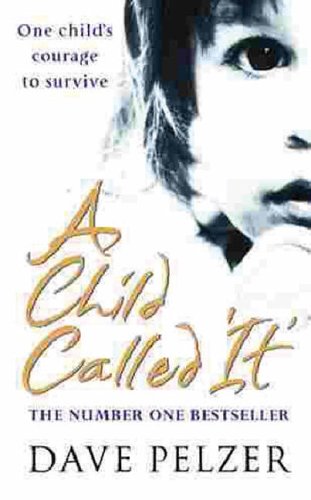 Pain sells. We love to watch the descent into hell of the mentally anguished and the chronically addicted. We just adore our voyeuristic glimpses into childhoods scarred by cruelty and abuse. And of course, we hope to be redeemed by an emerging message of spiritual survival against the odds.
At least that's what the publishers on both sides of the Atlantic appear to be banking on in 2006.
Michael Prodger in the Telegraph blames Dave Pelzer's abuse memoir A Child Called 'It' for starting the trend and notes that:
... the flood of misery he unleashed still shows no sign of abating. ... alumni of the school of Pelzer are everywhere. ... Whether your ailment is physical or psychological, there will be a memoir to suit. You're no oil painting? Try Ugly, Constance Briscoe's account of how her mother hated her looks and everything else about her (the author, incidentally, looks rather fetching in her jacket photograph). Behavioural difficulties? Joe by Michael Blastland recounts the pain (and occasional pleasures) of living with an autistic son. Eating disorder? The Invisible Girl is Peter Barham's memoir of his dead anorexic daughter. Disability? White on Black by Ruben Gallego details a Russian man with cerebral palsy. Grim home life? Dragonslippers is Rosalind Penfold's diary of a decade in which she endured physical, mental and sexual abuse as a wife. (Or, failing that, there's also A Secret Madness in which Elaine Bass recalls marriage to a man with compulsive obsessive disorder.) Drugs? Out of Time by James Fountain tells how a lemonade and LSD cocktail sent him into a psychiatric unit. That's just January's crop - and not all of it.Tim Adams in the Observer identifies the same publishing trend and believes that:
These books invariably come garnished with a carefully defined set of adjectives that can be well merited: the stories they tell are 'inspiring', 'profound', 'touching', their authors are always 'brave' and the books themselves are never less than 'remarkable'. The ordeals the authors have endured are undoubtedly harrowing in the extreme, their reasons for sharing their experiences are cathartic, possibly altruistic and totally understandable. The books world might indeed be a blander place without this grist. But where most non-fiction offers the reader a range of possible responses, these books offer, or rather demand, only one - empathy. With poignancy comes impoverishment.
Misery is set to be the new celebrity.Hmmm ... I remember when the Brits would actually be more inclined to find humour instead of pathos in such accounts. (Anyone else remember the Born in a Shoebox sketch from The Secret Policeman's Ball?)
... It is tempting - though profoundly odd, given what is on the news - to see these narratives as our war stories, vicarious triumphs over outrageous adversity, except that these wars are nearly all private ones, and the battleground rarely extends beyond the author's head. Since Pelzer sold many million copies of his books, there has inevitably been a kind of arms race of his kind of extreme confession. Some of these horrific childhoods have been imported from America - including that of Pelzer's brother Richard - but the British have been quick to embrace the mood. Strange to think now that despite several years on the top of the American bestseller list, no publisher here bought Dave Pelzer initially, thinking his mix of abasement and aggrandisement would not wash on this side of the Atlantic: how wrong they were.
But there's misery and there's misery, I suppose. What makes a book palatable in the end is surely great writing. Frank McCourt's Angela's Ashes is one of the strongest memoirs I've read and rises way above maudling self-pity.
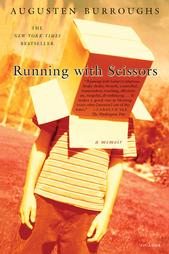
And one book about an abusive childhood I must read is Augusten Burrough's Running with Scissors: his account of a childhood with an alcholic father and manic-depressive poet mother who eventually gave him away to a deranged psychiatrist in whose household he was fed drugs and sexually abused.
Incidentally, there's an interesting little aside in Robert Chalmers interview of Burroughs which could happily be tossed into the Frey fray(!):
He (Burroughs) has never called his work autobiography, but memoir, a term whose standard definition ... doesn't explicitly demand rigorous adherence to fact.
Saturday, May 21, 2005
Obituary for Egolf
I'd never heard of the young writer Tristan Egolf till I read his obituary online today. He certainly seemed to have everything to live for. A writing career that had taken off: he had two highly acclaimed novels under his belt (his writing had been compared to Faulkner and Hemingway) and a third completed. A fiance and a baby daughter.
But Egolf shot himself, aged 33.
The story behind the publication of his first novel Lord of the Barnyard (described by Publishers Weekly as "a wild ride of a book") is almost the stuff of novels in itself. According to a report in the LA Times:
Would we ever have heard of John Kennedy Toole's The Confederacy of Dunces if the poor man hadn't gassed himself?
But what a sheer bloody waste! Who knows what even greater works these writers might have produced further down the line.
I found this essay on the subject very interesting. Earnest contends that "... we are but sadistic voyeurs who transform a writer's pain into a reader's pleasure." Perhaps true.

Some lost souls who did not handle life's difficulties well enough.
But Egolf shot himself, aged 33.
The story behind the publication of his first novel Lord of the Barnyard (described by Publishers Weekly as "a wild ride of a book") is almost the stuff of novels in itself. According to a report in the LA Times:
After 76 publishers had rejected the novel, Egolf was playing guitar for money on a bridge in Paris when a young woman noticed his cold, sockless feet and invited him for coffee. Her father happened to be a prize-winning author, Patrick Modiano, who took Egolf's book to his French publishing house, which agreed to publish it."You hate to think so, but suicide helps to sell books," Walker Percy once said, and I'm sure it's going to happen in this case too.
Would we ever have heard of John Kennedy Toole's The Confederacy of Dunces if the poor man hadn't gassed himself?
But what a sheer bloody waste! Who knows what even greater works these writers might have produced further down the line.
I found this essay on the subject very interesting. Earnest contends that "... we are but sadistic voyeurs who transform a writer's pain into a reader's pleasure." Perhaps true.
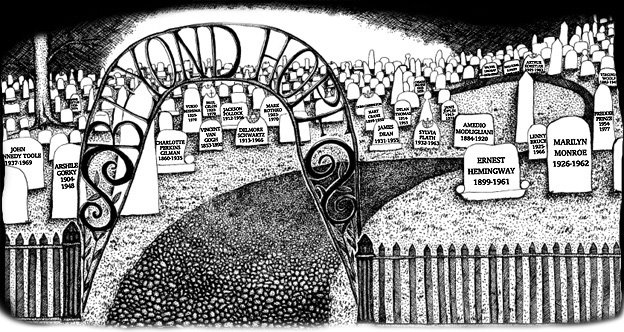
Some lost souls who did not handle life's difficulties well enough.
Subscribe to:
Posts (Atom)