Showing posts with label nobel prize. Show all posts

Friday, October 09, 2009

Herta Müller - Who?

So while the rest of us are scratching our heads and feeling uncomfortably ignorant about who the 2009 Literature Nobel Prize actually is, blogger M.A Orthofer was spot on in his predictions and had even put up a page about Herta Müller. (But then again he has become really adept at reading last minute changes in the bookies' odds!). He calls her :
A quirky, perhaps predictable choice
for the way that she seems to fit all the criteria the Nobel committee appear to be looking for :
Bicultural/ethnic minority background (German in Romania -- a pretty exotic/unusual one, at least from some foreign perspectives) -- not a literary reason, but nationality and language always seem to matter...Anti-totalitarian writing -- and how: much of her writing deals with life under Ceauşescu, in horrific detail...Writes both poetry and prose.
A summary of her life and work can be found on Nobel Prize site and she sounds a courageous woman writing important work in very difficult times. (She should surely have infiltrated our consciousness rather more, as this is not the first international literary award she has won - she won the IMPAC Dublin award for The Land of Green Plums in 1998.)

The Atlantic sums up the American reactions to the award [found via]. Particularly telling is Lev Grossman's (of Time magazine's) comment :
In the past decade, about half of the Nobel laureates in literature have been writers of whom few readers in the U.S., academics and literary journalists included, had or have any real awareness. What Americans may not realize is that Müller's selection isn't much less surprising in Germany...Almost no one considered her a figure of global literary eminence...If the past is any guide, the Nobel won't make Müller a household name in America -- it certainly hasn't done much for Elfriede Jelinek (who won in 2004) or Jean-Marie Gustave Le Clézio (2008). That may simply be because there is little in the lives of most Americans that resonates with what Müller has gone through.
But, across the world, Ulrich Baron at the Spiegal Online gives a quite different perpective of the win :
Herta Müller's is a political voice that can also sing poetic. Her writing unites the great virtues of literature. Her work pleads for justice that transgresses all borders. It was correct and important to award her the Nobel Prize.
And he links to an extract, translated into English, from her latest novel Everything I own I Carry With Me.

Her novel The Appointment is available from Macmillan. Peter Filkins wrote of it in The New York Times [found via]:
The Appointment is more a test of endurance than pleasure ... the kind of novel you might be glad you finished, but sorry that you started, no matter the bleak complexity within it.
No doubt there will be more to chuck into this debate later on, and I will append here anything else interesting I come across!

Postscript :
In awarding the 2009 Nobel prize for literature to Herta Müller, as well as rewarding an outstanding writer, the Swedish Academy is, I think, doing two things. It is once again challenging the self-satisfied Anglo-centrism of the English-language publishing business, with its rather narrow definitions of what constitutes good writing, and it is widening our ideas of Europe. And it is perhaps in its failure to engage with European literatures that the English culture, for all the advantages of the global reach of the English language, shows itself at its most provincial.
Martin Chalmers, Herta Müller's translator explains why she matters, on The Guardian blog.

Thursday, September 24, 2009

The Nobel Steeplechase

The Literary Saloon reminds us that it isn't long before the Nobel Prize in Literature is due to be announced and posts up Ladbrokes' odds for the punters:
The top ten betting favorites currently -- keeping Ladbrokes' (mis)spellings* intact -- are:

* Amos Oz 4/1
* Assia Djebar 5/1
* Luis Goytisola 6/1
* Joyce Carol Oates 7/1
* Philip Roth 7/1
* Adonis 8/1
* Antoni Tabucchi 9/1
* Claudio Magris 9/1
* Haruki Murakami 9/1
* Thomas Pynchon 9/1
(the full list of all the runners is here).

Who would your money be on?

(*Hope someone from the bookmakers reads Michael's post and acccepts a rap on the knuckles for getting so many names wrong! Suspect this won't happen though.)

Sunday, December 21, 2008

The New Anglo World Order

You may remember that back in October Horace Engdahl of the Nobel prize committee controversially declared :
... you can't get away from the fact that Europe is still the centre of the literary world ... not the United States. The US is too isolated, too insular. They don't translate enough and don't really participate in the big dialogue of literature ... That ignorance is restraining.
In the New Statesman [via] philosopher and writer Jonathan Derbyshire responds with an article discussing The Rise of the New Anglo-World Order, which you can also hear broadcast. He finds that :
The real cause of Engdahl's angst ... is that what he called the "big dialogue of literature" is today actually being conducted mostly in English - by inhabitants of Britain's former colonies, for instance, especially those in south Asia and the Caribbean; and also by non-anglophone writers who have followed Conrad and Nabokov in choosing to write in English.

Monday, December 08, 2008

The Forest of Paradoxes

... literature has become a way for the men and women in our time to express their identity, to claim their right to speak, and to be heard in all their diversity. Without their voices, their call, we would live in a world of silence. ...
Jean-Marie Gustave Le Clézio winner of this year's Nobel Prize for Literature gives his lecture, speaking of his own influences and the global importance of literature in translation.

[Found via the Literary Saloon]

Wednesday, November 19, 2008

A Vietnamese Nobel?

Some time ago it was the Malaysians who were worrying about why they couldn't produce a winner for the a Nobel Prize for Literature, now it's the Vietnamese [found via Literary Saloon].

Thuy Linh in the Thanh Nien Daily quotes award-winning poet Inrasara who says that :
Nobel Prize winners ... must do one or all of the following: capture the quintessence of contemporary life like Albert Camus and Ernest Hemingway; explore new ideas that affect the human soul like Jean-Paul Sartre; fearlessly ask the unasked questions of their peoples and countries like Orhan Pamuk; or find new ways of expression that influences their contemporaries like William Faulkner and Gabriel García Márquez. Can we name a writer in Vietnam who can do these things?
Critics ponder some of the reasons why Vietnamese literature is not flourishing.

Friday, October 10, 2008

Le Clezio Wins Nobel

This year's Nobel Prize for literature goes to French novelist Jean-Marie Gustave Le Clézio, described but Horace Engdahl, the permanent secretary of the Nobel judges (and the guy who ran down American authors a few days ago) as an :
... author of new departures, poetic adventure and sensual ecstasy, explorer of a humanity beyond and below the reigning civilisation.
According to Alison Flood in the Guardian :
Born in 1940, Le Clézio first found fame aged 23 with his debut novel Le Procès-Verbal, which was awarded the Prix Renaudot for its depiction of a young man who ends up in a mental hospital. Compared to Sartre's Nausea and Camus's The Outsider, the book introduced one of Le Clézio's major preoccupations, that of the flight from the norm to extreme states of mind. It is still regarded as one of his best pieces of writing. ... His real breakthrough as a novelist came with 1980's Désert, whose tale of a lost culture in the North African desert and a Europe seen through the eyes of immigrants won him a French Academy prize.
His recent works include Ballaciner(2007) which the academy called :
... a deeply personal essay about the history of the art of film
and he has also written several books for children.

John Litchfield in the Independent today says :
Le Clézio is regarded by many students of literature as the greatest living French writer (even though he was relatively little-read and little-discussed in France until yesterday). But he has established a worldwide reputation as a "modern Homer", a student of almost every culture on the planet, written and unwritten, and a passionate advocate for the superior wisdom of "non-rational", non-Western ways of understanding human existence. ... There are few modern writers more cosmopolitan than Le Clézio. He was born in France. His father was a Mauritian-born British doctor. He spent part of his childhood with his father in Africa and several years in the 1970s living with an Indian tribe in Panama. He now lives and teaches for most of the year in Albuquerque, New Mexico. He once said: "The French language is my only country, the only place that I call home."
There's an interesting interview with the author on France Diplomatie.

Thursday, October 02, 2008

Ignorant and Insular?


The US is too isolated, too insular. They don't translate enough and don't really participate in the big dialogue of literature. That ignorance is restraining. ...Of course there is powerful literature in all big cultures, but you can't get away from the fact that Europe still is the centre of the literary world ... not the United States ... what I said expresses a conviction resulting from more than 10 years of assiduous labour.
Permanent secretary of the Swedish Academy (which awards the Nobel prizes), Horace Engdahl, who is also a professor of Scandinavian literature and a literary critic.

The prize for literature is to be awarded within the next few weeks, and of course the bets are on :
Ladbrokes' frontrunner is currently the Italian scholar Claudio Magris, who is 3/1 favourite to take the SEK10m prize, trailed by the Syrian poet Adonis at 4/1. Joyce Carol Oates and Philip Roth are the highest placed Americans, at 7/1, while Don DeLillo is at 10/1 and Thomas Pynchon at 20/1; Ladbrokes is also offering 40/1 odds on the generally reclusive Pynchon both winning and attending the prize-giving on December 10.
Postscript :

You can't say something like this and get away with it!

John Litchfield collects some reactions from the other side of the Atlantic. Sam Leith posts an excellent rebuttal at the Telegraph. And see also this very balanced post at The Literary Saloon.

Tuesday, June 03, 2008

When the Spirit Moves a Nobel Winner

The modern American canon would not exist without all this madness and alcohol ...
says Micheal Carolan (left) in The Amhearst Bulletin. Carolan is teaching a course at the University of Massachusetts entitled Dionysus Hitting Bottom: The Alcoholic Narrative in Film and Literature.

Those who ponder the fact that Malaysian authors aren't winning Nobel Prizes might like to think about this :
... of eight native-born Americans awarded the Nobel Prize in Literature, five were alcoholics, including Sinclair Lewis and Eugene O'Neill. ... (And) Alcohol is a factor if not the central focus of the three top modern novelists - Hemingway, Faulkner and Fitzgerald. ... As novelists they were addressing how man lived in the 20th century, and the answer was, through drinking.
And yet, says Carolan, authors' alcoholism has been ignored or denied in literary criticism.

This looks set to change with the growth of :
... the relatively new area of inquiry known as "addiction studies," a multidisciplinary field that combines literary criticism with sociological and historical perspectives. ... Carolan said his class also brings together fields of addiction medicine, film studies, psychology, sociology, cultural and gender studies.

(Story found via Literary Saloon.)

Thursday, January 31, 2008

Lessing Receives Her Nobel

Doris Lessing formally received her Nobel prize in a ceremony in London on Wednesday night, since she was too frail to fly to Stockholm last year for the presentation. My love and congratulations too.

It makes me very happy to hear that her publisher HarperCollins is going to donate 10,000 fiction and non-fiction books to Zimbabwe in her name.

Thursday, January 24, 2008

Authors - Protect Your Space!

Doris Lessing speaking at the Queen Elizabeth Hall in London, told her audience that she feels “desperately sorry” for young authors, pushed into promotional tours and expected to do the rounds of literary festivals - in themselves enjoyable, but likely to take them away from the core business of putting words on paper:
We all know that writing comes out of a man or a woman sitting alone in a room with the telephone off the hook, a cup of coffee and in the good old days, a cigarette.
Ben Hoyle, writing in the Times, points out that the remarks expand on thoughts expressed in Lessing’s Nobel lecture on December 7*, which was recorded and played to the Swedish Academy hall in Stockholm because of the 88 year-old author's ill health. In this Lessing said:
Writers are often asked, How do you write? With a processor? an electric typewriter? a quill? longhand? But the essential question is, "Have you found a space, that empty space, which should surround you when you write? Into that space, which is like a form of listening, of attention, will come the words, the words your characters will speak, ideas – inspiration.

If this writer cannot find this space, then poems and stories may be stillborn.

When writers talk to each other, what they ask each other is always to do with this space, this other time. "Have you found it? Are you holding it fast?"

Let us jump to an apparently very different scene. We are in London, one of the big cities. There is a new writer. We, cynically enquire, How are her boobs? Is she good-looking? If this is a man, Charismatic? Handsome? We joke but it is not a joke.

This new find is acclaimed, possibly given a lot of money. The buzzing of paparazzi begins in their poor ears. They are feted, lauded, whisked about the world. Us old ones, who have seen it all, are sorry for this neophyte, who has no idea of what is really happening.

He, she is flattered, pleased.

But ask in a year's time what he or she is thinking: I've heard them: "This is the worst thing that could have happened to me.

Some much publicised new writers haven't written again, or haven't written what they wanted to, meant to.

And we, the old ones, want to whisper into those innocent ears. "Have you still got your space? Your sole, your own and necessary place where your own voices may speak to you, you alone, where you may dream. Oh, hold onto it, don't let it go."
(* I'm so glad that Hoyles' piece sent me off to read the whole lecture. What she says about the hunger for books and thirst for knowledge in Africa compared to western indifference among plenty, is something I can personally vouch for after living in Nigeria and teaching in a school as poorly equipped as the one she describes.)

Friday, October 12, 2007

More Lessing

There is in the New York Times today, and absolutely wonderful picture of Doris Lessing slumped on the front doorstep of her house, facing a barrage of reporters.

She says she was a bit surprised because she had forgotten about the award being announced today and she's been a likely contender for the something like 40 years:
Either they were going to give it to me sometime before I popped off or not at all.
John Mullan on the Guardian blog writes about her achievements and her most important novel The Golden Notebook:
Of course the Nobel Prize is usually a long service award - the recognition of a status first gained decades ago and then held on to. So it was with Harold Pinter a couple of years ago, and, as with Pinter, there will be the thought that the award is a mark of her political influence. She has been known as a feminist novelist, especially because of The Golden Notebook, her most important novel. This defined an era by making fiction from arguments between women about what it was to be "Free Women" (the heading for the first section of the book). For 1962 it was audacious stuff. It brought to the English novel a heady brew of new material: political debate, psychotherapy sessions, disastrous sex. It is the earliest novel I know of to include matter-of-fact mentions of pre-menstrual tension and tampons.

It was a novel in which the contradictions between a woman's different needs and desires are enacted in its very form. The Golden Notebook is made out of four notebooks (black, red, yellow, and blue), all supposedly written by Lessing's heroine, Anna: different narratives, only just held together. It has usually been the content of Lessing's fiction that has drawn attention. What is less often noticed is her restless experimentation with form and genre. She hardly seemed to worry about leaving many readers behind when she took to science fiction in the late 1970s and early 1980s. The genre was attractive to her because she wanted to write novels of ideas; she didn't worry about sales. Responding mischievously (and resentfully) to those who regretted that she had left "the real world" behind, she then wrote Diary of a Good Neighbour (1983), a bleakly realistic account of old age, which she sent to publishers under the pseudonym Jane Somers. She was delighted to note that without the label "Doris Lessing", publishers and reviewers (and maybe readers) had no idea what fictional direction she might take.
He also provides a timely reminder at the end of this piece (when he says only 6 of his class of 24 students had even heard of her) that there's a generation who haven't read her, and will enjoy discovering her books.

The Guardian has a treasure trove of archived articles, interviews and reviews. Elsewhere in the paper, Fiona Sampson looks at what makes an author "Nobelisable":
Writers are often identified as being Nobelisable for similar reasons. The Nobel prize carries an aura of the writer's life as a public one; of collective identity voiced, shaped or advocated by a visionary, perhaps even brave, individual. The writer as unacknowledged legislator, maybe, but nevertheless visibly engaged with their own society. There is something of this aura behind suggestions that the decision-making of the Nobel committee is "politicised". But maybe these suggestions have it back to front. Perhaps the Nobel prize, in so far as it honours the public effects of a writer's work, acknowledges the importance of big ideas. Perhaps it holds onto those twin notions - of the writer as thinker, rather than entertainer; of great writing as a matter of often-passionately-held ideas, rather than of style - which are so out of fashion in the Anglo-Saxon publishing world.
The bold letters are mine. Lessing was always writer-as-thinker, is that a quality we really look for in writing today?

Postscript:

Nury Vittachi has a very nice Doris Lessing story to tell.

Friday, July 13, 2007

The Malaysian Nobel

So why aren't Malay language authors winning the Nobel Prize for Literature? Utusan Malaysia asks the question and consults a couple of experts in academia.

And if I understand this correctly (and remember my Malay is baaaad), the writer seems to come away with the impression it's all about successfully promoting the product.

I'm no expert, but I suspect that there might be a little more to it than that.

I rather think that you need an author who speaks not only to the concerns of the nation, but also to the hearts and minds of international audience.

The Nobel has also a strong political element. How many Malay language authors are prepared to fight in some sense for social justice?

And did I mention, the author should also be not only a good, but a truly great writer and usually one who has produced an impressive body of work?

Anyone spring to mind who fits the bill?

The Malaysian Nobel for Literature is actually a concern that keeps resurfacing and seems to really bother the literary establishment (as does the desire to win the prize in other fields too). Is it a mere kiasu twitch?

The situation seems to be paralleled elsewhere: Julia Lovell wrote a whole book about China's preoccupation with the prize and perhaps in this country also:
... the Nobel complex reveals the pressure points in an intellectual community not entirely sure of itself.
Cecil Rajendran I think is the only Malaysian to have been nominated so far. The Utusan article doesn't even mention him. It doesn't even seem to want to even consider the fact that a Malaysian Nobel prize winner might write in a language other than Malay!

Friday, October 13, 2006

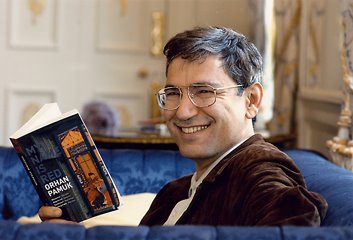
It's Pamuk!

Congratulations to Orhan Pamuk who has won the 2006 Nobel Prize for Literature. It's a choice I doubt anyone can be unhappy with: Pamuk has both the literary and political credentials.

His highly acclaimed books include Istanbul: Memories and the City part memoir , part tribute to the city, and novels Snow, My Name is Red, The New Life, The Black Book, The White Castle.

In January this year, a Turkish court dropped charges against Pamuk who had been accused of “blatantly belittling Turkishness” over an interview that he gave to a Swiss newspaper in February 2005. The statement that caused the stir:
Thirty thousand Kurds and one million Armenians were killed in Turkey. Almost no one dares to speak out on this but me.
He was referring to the killings by Ottoman Empire forces of thousands of Armenians in 1915-17, and called them "genocide", a charge that the Turkish authorities deny. Pamuk faced up to three years in jail. Now that's courage.

Opinion on Pamuk's win in Turkey is apparently very divided, the Herald Tribune reports. It also quotes EU Enlargement Commissioner Olli Rehn, who has been pressing Turkey to scrap the law that took Pamuk to trial. He recalls a conversation he had with Pamuk in Istanbul last year.
I asked him what best I could wish him. He replied: 'That I can write books again and free my mind from all this harassment. I'm a novelist.'
Rehn continues:
Today's Nobel Prize is good news for world literature, but also good news for artistic freedom and for freedom of expression in particular. It is good news for all those who want to speak, search, learn the truth, pursue dialogue, exchange thoughts and knowledge, not just in Turkey, but everywhere else in Europe and in the world.
For much more on Pamuk, visit his website.

Monday, November 14, 2005

Nice One Cecil!

I read the Sun's very entertaining interview with Cecil Rajendra (poet, writer, lawyer, crusader for human rights) on the flight back from Manila. Hadn't realised that he'd been nominated for this year's Nobel - now, that's really something.

I find the literary scene here much too incestuous and inward looking. ... it lacks what I call "testicular fortitude".
he says. Wonder what he'd make of the Saturday readings?

He's currently working on two books - both of which sound extremely interesting. The first is about the legendary stripper Rose Chan whom he came to know towards the end of her life when she was dying of cancer. The second is entitled The Secret Journal Of A Tantric which he doesn't think will be published here in a country:
... so sexually uptight that it views homosexuality as a threat to the nation. Incidentally, I have never quite figured out how a gay minister is a greater threat to the nation than a corrupt minister.
Nice one!