Showing posts with label manic depression. Show all posts

Sunday, April 05, 2009

That Old Depression ...

Nicholas Hughes’s mother, and mine, succumbed to the exhaustion of unrelenting depression. They self-destructed. And we grew up in the wreckage of their catastrophe. Their deaths took away from him and his sister, Frieda, and from me and my sister, Joyce, the solace of a mother’s love. And worse, all four of us, I imagine, had to live with the knowledge that our mothers had quite willfully abandoned us.
Following the suicide of poet Sylvia Plath's son, Nicholas, Linda Grey Sexton shares her own experience of living with a tortured inheritance the The New York Times. Her mother, Anne Sexton (left) killed herself in 1974.

Staying, for the moment, on the depressing topic of depression (!), novelist Margaret Drabble writes very candidly in The Guardian about how she wards off her own bouts :
I write at least in part to investigate, to ward off, to understand these recurrent dark periods. Maybe depression fulfils a useful function, maybe it has an evolutionary benefit. In the year of Darwin, this is a question that I haven't yet seen posed. How early in pre-history, how many millennia before Hamlet, did man and woman begin to suffer in the mind as well as in the body, and what good did it do the human race?... Many other writers have prophylactic motivations similar to mine, and some admit to them, though others strongly deny any connection between writing and self-therapy, just as they tend to deny links between alcoholism and workaholism.
Drabble reads from her new autobiography The Pattern in the Carpet here.

Wednesday, March 14, 2007

Petty Details of My Latest Read

I'm not doing a good job of writing about what I've been reading so am hoping to slip in a few more reviews over the next few days.

Most recently finished, Camilla Gibbs second novel The Petty Details of So and So's Life.

The novel explores much of the same territory as Mouthing the Words, centering on a dysfuncional family, an abusive father, a withdrawn mother, and the ensuing psychological after-shocks in adulthood.

Twins Emma and Blue are so close that they communicate in an invented language and are almost telepathic. They huddle in the basement from the rages of their unpredictable father, who drops out of paid work to become an inventor - gradually withdrawing from the family to live a reclusive existance in the garage, until one day he disappears, taking with him the family's life savings.

Although Gibb never uses the term, the father is clearly manic-depressive - his moods swing unpredictably, he's full of grandiose schemes and ambitions to change the world (and scorn for those who lack the same vision), yet unable to complete even the simplest of tasks.

The twins react differently to their father's disappearance - Blue becoming obsessed with finding him, while Emma defects to a new family and sees academic success as her ticket out of chaos, while their mother Elaine numbs the pain with alchohol and anti-depressants and becomes increasingly withdraw.

Again, as in Mouthing the Words, Gibb handles painful material (and I must ask her how much is drawn from her own life) but the book never feels heavy, and is tempered with humour and people with characters you care about.

Highly recommended. (I like it even better than Mouthing the Words.)

The book is avalable at 20% off at Kinokuniya (and no, I don't have shares!)

Also available at 20% off is Tan Twan Eng's The Gift of Rain, here at last!

And by the way, since it seems only polite to ask, what are YOU reading?

Friday, February 03, 2006

Poetry and Healing

I was intrigued by Christina Patterson's proposition in the Independent the other day that poetry might be the new prozac.

The article brought together several areas that I'm interested in. Poetry of course. Then the link between depressive illness and creativity, and the use of creative writing as therapy.

Patterson argues that whilst poetry is increasingly being heralded as a panacea for many ills including depression, it doesn't actually seem to have helped mentally-ill poets like Anne Sexton, Robert Lowell, or Sylvia Plath.

But here I think that here she's got her argument back to front: surely the desire to write poetry is often a symptom of manic-depressive illness, as sufferers tend to delight in language play (punning, rhyming, repetition, torrents of words) and have a sense of divine inspiration. (Patterson might note that Lowell was saved in the end, not by poetry, but by lithium.)

But there is no doubt that writing poetry is good for the health! Patterson cites a joint study between the Arts Council of Great Britain and the Department of Health which suggests that writing poetry boosted levels of immunoglobin A (i.e. the antibody that helps you fend off illness). Write poetry and you won't fall sick so often, is the bottom line.

I decided to google up the other studies she mentions and found much interesting stuff along the way:

Dr Robin Philipp, an occupational physician at the Bristol Royal Infirmary studied the therapeutic properties of poetry writing over several years and found that writing poetry can lift depression in nearly three-quarters of cases:
The study, found 70 per cent of sufferers felt better writing poems and eight per cent improved so much they came off anti-depressants. ... Researchers believe writing poetry forces people to confront their emotions, an essential process in overcoming mental torment. ... Poetry helped them articulate disordered thoughts.
There's plenty of other poetry-in-healthcare projects listed on the Poetry Society website if you want to read further.

The Poetry in the Waiting Room Project is an interesting initiative based on the premise that reading poetry is good for your health. Small poetry pamplets are supplied to doctors' waiting rooms and readers are encouraged to keep them. As Patterson points out, it is difficult to substantiate the health benefits from such an approach. But I think that even without the health benefits, getting poetry into the hands of the population at large is no bad thing and could lead to an addiction! (Never mind the patients, this initiative just might be good for poetry!)

I do agree with Patterson's conclusion that poetry for healing is not the same thing as poetry for art. But perhaps in rare cases the two things could overlap? ...

Related posts:

Touched with Fire
Obituary for Egolf
Creative Writing as Therapy

Friday, September 30, 2005

Being Bennett

Alan Bennett is a writer I love for his humanity, sense of voice and sheer audacity. Perhaps if my fairy godmother waved her wand at me and asked me which writer I'd most like to be, I'd choose to be Bennett for those very qualities. (Yes, even over Annie Proulx!)

I didn't manage to catch all five of hisTalking Heads monologues serialised by the BBC, but they were extremely funny and well observed. I love his long short stories The Clothes They Stood Up In and The Laying on of Hands, as well as his account of an elderly lady who parked her van in front of his house and proceeded to live there for several years.

Now Bennett has a new book out, Untold Stories, about his mother's mental illness. Reading this extract from the Telegraph struck a chord, became my mother too began to imagine that there were spies everywhere (tapping the phone, intercepting the mail, everything a plot against her or her family - even my husband losing a legal case across the world in Malaysia was her fault according to her warped logic).

Bennett's mother suffered from depression, a condition which Bennett says is largely ignored by the medical profession:
Depression, which is much the most common mental illness, doesn't even qualify as such and mustn't be so labelled, perhaps because it's routine and relatively unshowy; but maybe, too, because it's so widespread not calling depression mental illness helps to sidestep the stigma.
It makes me deeply angry that any kind of mental illness carries a stigma because it makes it so hard for suffers to seek the treatment they need. This is a corner I would love to fight myself, and I'm glad that Bennett is writing about it.

Postscript:

More on Bennett's new book from the Guardian.

Saturday, May 21, 2005

Obituary for Egolf

I'd never heard of the young writer Tristan Egolf till I read his obituary online today. He certainly seemed to have everything to live for. A writing career that had taken off: he had two highly acclaimed novels under his belt (his writing had been compared to Faulkner and Hemingway) and a third completed. A fiance and a baby daughter.

But Egolf shot himself, aged 33.

The story behind the publication of his first novel Lord of the Barnyard (described by Publishers Weekly as "a wild ride of a book") is almost the stuff of novels in itself. According to a report in the LA Times:
After 76 publishers had rejected the novel, Egolf was playing guitar for money on a bridge in Paris when a young woman noticed his cold, sockless feet and invited him for coffee. Her father happened to be a prize-winning author, Patrick Modiano, who took Egolf's book to his French publishing house, which agreed to publish it.
"You hate to think so, but suicide helps to sell books," Walker Percy once said, and I'm sure it's going to happen in this case too.

Would we ever have heard of John Kennedy Toole's The Confederacy of Dunces if the poor man hadn't gassed himself?

But what a sheer bloody waste! Who knows what even greater works these writers might have produced further down the line.

I found this essay on the subject very interesting. Earnest contends that "... we are but sadistic voyeurs who transform a writer's pain into a reader's pleasure." Perhaps true.

Some lost souls who did not handle life's difficulties well enough.

Saturday, March 26, 2005

Touched With Fire

Sometimes a book can go where our words can't and carry our message.

A friend is in pain. I'm not sure he know the cause, though its effects are all too real to him and those he loves.

He's fearlessly creative on cavas, and claims a total freedom for himself on the page, splashing words recklessly. Images emerge so fresh and surprising they make you gasp. And when he's well, he's warm and gregarious, full of talk and ideas and love for the world.

But at times he curls into himself, unable to face the world, swamped in depression. Everyone disappoints, no-one measures up. If disturbed, he hits out, throws words like rocks - knowing exactly what soft targets to hit, how to maximise the hurt.

I know it is not him talking, but the illness.

Does he know the thing that afflicts him has a name?

I don't think he does.

Does he know that there are others who suffer and have suffered in the same way? I don't think so. Yet
a roll-call of fellow sufferers
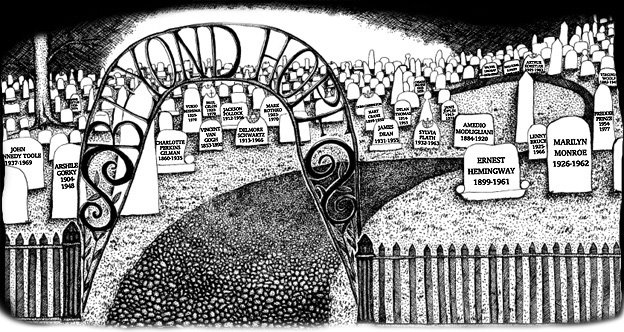
would sound like a Who's Who in the arts: Blake, Plath, Oliver Goldsmith, Coleridge, Byron, Mary Shelley, Keats, Samuel Johnson, Robert Lowell, Virginia Woolf, Rachmaninoff, Tchaikovsky, Ivan Berlin, Jackson Pollock, van Gogh to name but a few. It has been estimated that 50% of poets suffer from it, 38% of musicians, 20% of painters, and large proportions of those in other creative fields.

But to romanticise the illness is very wrong. It may be a spur to enhanced creativity (oh, and how we envy that, the pedestrian lumpen rest of us eking a little courage from our petulent muse) but unless you suffer from the illness yourself you cannot understand the darkness of the flip-side (I try but know how badly I fall short). And the risk of suicide is great. 15% of all sufferers die by their own hand, and up to 20% in untreated cases. He thinks about it too.

Made a decision yesterday that I had to tell him. Sometimes knowing the name of the demon you face helps you to begin to banish it, or at least put it in its place. I've met it before in several others and know a little of how they deal with it, their personal struggles. And I've read. There is no cure, but medication might work for him. Or at least the knowledge that he does not need to be alone with this nameless thing. I wanted to move conversation gently to this point, but it never has worked that way. I'd rather tell him tactfully, face-to-face, but I cannot find spaces between his floods of words, or else he shuns communication.

So I've send him my copy of Kay Redfield Jamison's book An Unquiet Mind: A Memoir of Moods and Madness through the post. Jamison writes a most moving account of her own journey through manic depression, and she became Professor of Pyschiatry at John Hopkins school of Medicine and one of the world's most foremost authorities on manic-depressive illness. Jamison talks of her own coming to terms with the illness, and sees it as more of a blessing than a curse in her life:
I have often asked myself whether, given the choice, I would choose to have manic-depressive illness. If lithium were not available to me, or didn't work for me, the answer would be a simple no... and it would be an answer laced with terror. But lithium does work for me, and therefore I can afford to pose the question. Strangely enough, I think I would choose to have it. It's complicated... I honestly believe that as a result of it I have felt more things, more deeply; had more experiences, more intensely; loved more, and have been more loved; laughed more often for having cried more often; appreciated more the springs, for all the winters... Depressed, I have crawled on my hands and knees in order to get across a room and have done it for month after month. But normal or manic I have run faster, thought faster, and loved faster than most I know.

Saturday, January 15, 2005

His Passport Out

He's late because he's kept in a meeting, because of the jam, because of the rain. I spend the time writing in my notebook. Writing practice in any spare space.

I haven't see him since mid-December. A lot has happened since. He's had his long-distance girlfriend to stay. They have plans. She's looking for a job for him in out there.

She's his passport to out. Out of here where no-one understands him. He's tried it before - long-distance friendships leading to a serious relationship abroad. Where people will understand him. Where he can make his art. (He's talented in so many directions - though of course it's the writer I cheer on the most - hope he finds his true centre and focus.) None of these relationships have worked out for him. And each time he's come back to Malaysia with his heart broken.

People here just aren't on the same wavelength. They don't read. They don't get what he's about. I'm not Asian, he says. Not inside, where it counts.

He talks up a storm, doesn't stop. It's not a conversation. It's a monologue. He talks books, films, his philosophies of life, acting. He psychoanalyses the characters of sitcoms (how did they get into the conversation?) quite as thoroughly as any professor of film studies. He dramatises imaginary conversations with appropriate accents. I can scarcely follow where his head goes, he moves so fast between thought and thought. There're moments when I don't quite make the connections. But then he's already moved on to the next topic. Hypomania? Perhaps. "You're special," I said once "Because you're touched with fire, like so many great artists, writers." I never told him what the euphemism meant. He never asked. I've never had the courage to take the discussion further.

It's in the moments when he stops talking and there are sudden silences that he looks so incredibly sad, so suddenly stricken. And I know that he is scared. Perhaps of the fact he's losing his job in a few days time and still has to pay the rent. Perhaps of the relationship he's committing himself to, the big leap he's about to make ... and on which he's staking so much.