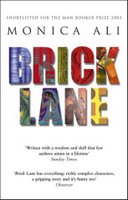
I enjoyed Monica Ali's Booker shortlisted
Brick Lane very much, and so did the members of my reading group who found themselves sympathetic to this story about Nazneen, a young Bangladeshi woman who comes to London's East End as a result of an arranged marriage.
Now a film is being made of the book, but protests by the Bangladeshi community mean that Brick Lane, cannot be used for the actual filming.
The street has been the home of successive waves of immigrant communities, and now is famous for its Bangladeshi restaurants. It was the backdrop for some of the scenes in the novel, but
Ruby Films production company, concerned for safety of cast and crew, has taken the advice of the police and decided to shoot exterior scenes elsewhere in the city.
Local business leader, Abdus Salique,
is leading the protest, and has threatened to publicly burn copies of the book, declaring that it degrades his community. Not all quarters of the Brick Lane Bangladeshi community stand with him though and
Independent columnist
Johann Hari declared the campaign was part of:
a cascade of protest by ultra-conservatives within Europe’s immigrant communities trying to silence women from their own neighborhoods calling for change.
The fun and games and name-calling really began in earnest, though, when so-called feminist writer, Germain Greer, waded into the fray, to support the protests against the book and
screamed hysterically in the Guardian:
Writers are treacherous; they will sneak up on you and write about you in terms that you don't recognise. They will take your reality, pull strands from it and weave them with their own impressions into a tissue that is more real than your reality because it is text. ... Every individual, every community ever to be written about suffers the same shock of non-recognition, and feels the same sense of invasion and betrayal.
Salman Rushdie in turn declared Greer
'a sanctimonious philistine' and pointed out that she is the most treacherous writer of all, raking up the embers of an earlier bitter feud. (In
an article on recent celebrity spats, Emile Saner said Rushdie's attack on Greer made
'surviving a fatwa look like having a long bath with a good book'!)
Other writers, including Hari Kunzru, weighed in, with English PEN
issuing a statement:
It would be best if we could show that this is not the Free Speech absolutists vs an embattled minority (which is the way the story now looks, though that doesn't reflect the reality on the ground); but rather a small group of authoritarians who don't understand the nature of fiction vs a much larger us that includes many progressive Bangladeshis and others in the Brick Lane area.
PEN goes on to warn:Without strong political leadership, Britain will become an increasingly hostile climate for writers, with far-reaching and damaging impact on our creative industries, and receding hopes of building a genuinely pluralist society.
And of course wider questions are being asked,
as Alan Cowell writes in the
New York Times:
In some ways, the debate has revived a much wider discussion in Europe about whether free speech may be limited by the sensitivities of people who feel affronted by it. Should old Western societies, in other words, rewrite their definitions of liberty to accommodate the sensitivities of others?
Most definitely not.
Or let's just bury fiction alive, why don't we?
I am very interested to hear the opinions of the Bangladeshi community, but there are ways and there are ways of getting your point across and burning books just makes you look like an yobbish ignoramus.
Salique calls Brick Lane,
'an icon of Britain as it is now'. I remember it in the '70's as a place where you could get the best curry in town. Now you can't even walk down the road without being constantly harrassed by Bangladeshi restaurant workers waving menus under your nose promising gastronomic wonders
the cooking sadly fails to fulfil.
 An Australian author and teacher, Harry Nicolaides, has been jailed for 3 years under Thailand's draconian law of lèse majesté - insulting the monarchy. (Do go watch the video footage and see the poor guy shuffling around in chains - completely shameful!)