Showing posts with label a samad said. Show all posts

Sunday, September 06, 2009

The People's Poet

As a writer, as an artist, I feel that my job is to speak the truth of what went on in each decade – be it colonisation, racial tension or poverty. ... It’s only in recent years that I have made a concentrated effort to communicate the ideas with equal force as the language used.
Venerable old man of Malaysian letters, A. Samad Said, is interviewed in today's Starmag by Priya Kulasagaran. Among other things he talks about his desire to explore other art forms and to connect with artists of a younger generation.

This, I think, is very well said :
More and more young people are acknowledging their power to go out and map their own world instead of just sitting back and letting their elders dictate their lives. ... If we allow them space to express themselves, the process can be a very constructive one for all. If you continue clamping down on them, they will just find new platforms for expression.

Friday, July 17, 2009

Outrage and Ouchy Grammar

It's been a day when our minds have been on much more serious things - tragic death (possible murder?) of political aide Teoh Beng Hock, and bombings in Jakarta.

Nevertheless, I had a little outrage left for this reader's letter in The Malay Mail today, asking why Salman Rushdie's books are sold in MPH when :
... they are banned in most Muslim countries.
(Unspecified, of course!!)

The unnamed MPH spokesman gives a very conciliatory answer and passes the buck to distributor Pansing.

If this bloke had wandered into my bookstore, I'd have told him to check in his bigotry and ignorance at the customer service counter. If I were a newspaper editor, I wouldn't have wasted column inches on him.

The fact is Rushdie's books are not banned in Malaysia with the exception of The Satanic Verses (although everyone who wants to read it can easily lay their hands on a copy). There is no earthly reason for them to be.

And the rest of us should stand up firmly against the very suggestion that books should disappear from the shelves.

I'm an extremist? You betcha. But I only read books. I don't plant bombs or throw young men out of windows. (Outrage is better saved for those people.)

As for whether Rushdie's books apart from The Satanic Verses are banned in other countries - I suspect not but I need to dig around to find the actual evidence. And certainly there is a move towards greater tolerance and away from book banning in the UAE [via].

While we're getting angry with things in The Malay Mail, let me ask you (since I feel like playing teacher today) if you can spot the grammar error in this sentence :
A leading light of the abolish English for science and maths campaign has a new book.
The article goes on to talk about how the Higher Education Ministry and the Malaysian National Institute of Translation (MNIT) will hold a road show nationwide to promote A. Samad Said's book, Bisik Warna. The Deputy Higher Education Minister calls it :
...a work of arts (sic) and words from the national laureate on life, organisations, leaders and philosophy ...
The (sic) proving that the journalist who wrote the column can spot someone else's ouchy grammar error, even if they can't see their own.

Congrats to Pak Samad anyway, and it is good to see a book getting so much official support.

Friday, July 10, 2009

Pak Samad and Friends Win the Battle

BM is a language that must be maintained. It is just a matter of getting used to learning it.
Now that the government has decided to revert to the national language for the teaching of Science and Maths, national laureate Datuk A. Samad Said must be feeling pretty pleased that the campaign he supported has been successful. The Malay Mail interviewed him yesterday.

It's a very emotional and complex issue, with much heated debate on both sides, still going on. I wrote about my feelings here, and might well be tempted to write more thoughts on the topic.

Postscript :

Author Robert Raymer wrote an article about the issue for The Borneo Post.

Sunday, March 08, 2009

Newspaper Miscellany

A hodge-podge of loosely connected things linked only by their appearance in Malaysian newspapers ...

Malaysian P.M. Datuk Seri Abdullah Ahmad Badawi launches a fantasy novel written by 13 year old Adam Umemoto who happens to be his nephew.

Of course the occasion was used to get in a political soundbite ... Resolve the Language Issue Before it Gets Out of Hand. (We learn nothing here about the young author or his book which is a pity.)

Out of hand the language issue has already got, methinks, and I agree with the Education Minister Datuk Seri Hishamuddin Hussein* : why bring up the issue 6 years after the policy was formulated? - after teachers have been trained and are working hard to make it a success, after textbooks have been written, and after the kids have proved they are coping with it?

I've seen this effort at the ground level (in teacher-training, in schools across the country) and it makes me very sad indeed that there are those intent on pulling it apart again.

National Laureate A. Samad Said was among those handing over a memorandum to the palace. (You can also watch a video at ChannelNews Asia - and there is some very good comment at Another Brick in the Wall.)

Enough.

Let me move on to things much happier.

It's International Women's Day today and in Starmag Amy de Kanter offers an eclectic list of women writers who :
write about loving, laughing and living large ...
A bilingual book of Malaysian/German fairytales, is to be launched at the KL International bookfair in August, tentatively titled Kisah Dongeng dan Cerita Rakyat Malaysia dan German. It will be the fourth collaboration between the National Translation Institute (ITNMB) and Goethe-Institut Malaysia.

Also, the National Library currently has an exhibition promoting the literary works of Finland, which features the book covers of Finnish literary works that have been translated. The photo (right) shows deputy head of mission of the Finnish Embassy in Kuala Lumpur, Henna Knuuttila, handing a copy of Kalevala, a national epic which has been translated into 60 languages to National Library director-general Raslin Abu Bakar at the launch.

Featured are literary works which feature current issues and daily life, there are children’s books, poems and fantasy stories. The literary works depict contemporary culture and recent times including the works of author Sofi Oksanen, who wrote about Estonia after World War II.

Said Knuuttila :
Finnish works have been translated to languages like French, German, Russian, Chinese and English. With this exhibition, people will get an idea of the works, get interested and look for more information. Finnish is not widely spoken so the translations are very important for us.
The exhibition will be held until March 31 at the library. Shall we organise a Bibliobibuli field-trip?

(* Oh goodness, what's happening to me? I am agreeing with government policy. Checks forehead for signs of fever.)

Postscript :

Have been caught up reading other views on the subject - Rocky links some very good posts. I also like what Ungku Aziz has to say about bilingual education.

Monday, March 02, 2009

Pak Samad on the Malay Language

How easy it is for authors to be used by factions seeking to make a political point! Somehow the word of a wordsmith carries a much heavier weight than that of a mere mortal.

According to The Sun, national laureate A. Samad Said has denied that he was being used by the opposition to push the government to revert to the use of Bahasa Malaysia for the teaching of Mathematics and Science*, from English currently (as was early reported by the press) :
He said his presence at talks organised by the opposition parties should not be misunderstood as what was important was for him to explain the matter to the public.

"It is not wrong for me to speak on the Malay language, which I have been fighting for, no matter at which political forum. My presence there is to save my language.

"I'm now 76 years old and it is time that I fight for my mother tongue before the language disappears"...
He also said he was disappointed with the limited space provided by mainstream newspapers to publish works by new writers.

I can well understand and sympathise with all those who are worried on behalf of the Malay language. But ... if you want my tuppence worth as a mat salleh ex-English teacher and teacher trainer, I would say that I strongly endorse the teaching of maths and science in English and find the argument that "Our teachers aren't good enough to teach in it," absolutely lame. (Bloody hell, you are supposed to be professionals, get with the programme!).

This is my short version of the argument and I have a vast amount to say on the subject. Anyone who wants it can buy me a coffee!

Monday, January 21, 2008

Dumbing Down the Syllabus?

Machinist tipped me off about this in the comments to another post:
Pak Samad's reaction to the KOMSAS (Malay Lit Component) issue, yesterday, at the Kata Suara event at RA Gallery.

Don't know much about it to comment beyond translating the sources, but apparently his works are to be excluded in the revised reading list for the Malay Lit Component (KOMSAS), in favour of more popular literature i.e. trash-fict (see here and here).

The governing committee, PPK defends this decision by saying that the Laureate's works are too difficult to understand and teach in school.

Pak Samad moves to disassociate himself with KOMSAS as Sasterawan Negara, saying "the national literature is actually not respected."
Here's Pak Samad telling us in his own words. (From on Firdaus' blog.)


I stand outside the argument not being a competent reader of Malay, but it seems to me that there is a shameful dumbing down of literature involved in this move. When are Malay readers going to be exposed to the best their language has to offer?

Postscript (28/1/08) :

Blogger Nik Nazmi also speaks out against the dumbing down of the syllabus:
Saya agak terkejut dengan langkah Pusat Perkembangan Kurikulum Kementerian Pelajaran untuk menyingkirkan karya-karya Sasterawan Negara dan pemenang SEA Write Award dalam pengajaran di sekolah rendah dan menengah dengan alasan pelajar tidak memahami karya-karya tersebut.

Ini merupakan langkah paling nyata bagaimana kerajaan memperbodohkan anak-anak kita di dalam usaha menghasilkan sebanyak mungkin A!

Sistem pendidikan sesebuah negara seharusnya menekankan usaha mengangkat martabat pemikiran anak bangsa. Memang karya-karya mereka tak semudah dihadam karya Ahadiat Akashah, namun ia menggalakkan kita berfikir dan menggemblengkan daya kreativiti kita untuk memahami karya tersebut. Itu sesuatu yang amat berguna bagi para pelajar. Selain itu, ia juga menggalakkan kita menghargai khazanah bangsa kita.

Monday, December 31, 2007

Readings Gets Respectable ... Well Almost

Readings@Seksan's drew its biggest ever crowd this Saturday and it was standing room only! And the audience seemed a lot more ... *cough cough* respectable than our usual boho-chic crowd. (Although KG in his shorts and orange hair, I think tried to even up the balance.) We had *gasp* a politician ... and blow me down, even our national laureate, A . Samad Said in the audience!

I'd like to think exponential increase in numbers was due to my charm and personality, but I rather think that it all had something to do with Awang Goneng bringing his fan club along.

There was definitely an east coast theme to the afternoon, with the first of our Terengganu-ites Dina Zaman kicking the afternoon off with extracts from her short stories, The King of the Sea and a new piece (I think) called Nightwatch. She's sitting on such good material (I know because I've read some of it) and I really hope that it all gets collected into a book before too long. (Nag nag, Dina!)

Patrick Teoh, actor and radio personality (and much more) read a couple of his Teohlogy columns from Off the Edge so beautifully that it's no wonder that he's been dubbed "the voice of Malaysia". The crowd just loved his-tell-it-like-it-is critiques of Malaysian society and politics. You can catch up with Patrick on his blog Niamah!!! (a useful Cantonese swear word!).

We had a very extended break (I was waiting and waiting for the call to prayers from the Bangsar mosque, as we can't read through it ... and it caught me out yet again.)

I was going to leave Awang Goneng (the crowd puller!) until nearer the end of the afternoon, but the presence of a photographer from the Star who had to leave early forced some last minute rescheduling.

Awang Goneng (Wan Ahmad Hulaimi) began by telling us how he began blogging about his childhood in Terengganu for his children who had never lived in Malaysia. He talked about how rhythm is important to his writing (something that has struck me reading Growing Up in Trengganu*) and before he read from the book, he sang some of the songs and nasyids that he remembered from his childhood days which had helped to develop that sense. (My goodness, it was so beautiful!)

The fact that so many people turned up to the launch in Kuala Terengganu, the fact that so many people turned up today, shows just how deep a chord the book has touched. The book about Hulaimi's childhood becomes a book about other childhoods as well.

It was lovely too to see Hulaimi's wife, my friend Zahara Othman who blogs as Kak Teh.

M.K. Ajay is an Indian expatriate who has been working as the director of an American company here for the past three years. He has published a collection of short stories and two books of poems, including his recent collection Sweetness of Salt, which was released last month by Plain View Press in Austin, Texas. Ajay read several poems including Shadow that Became Rains, Definitions (and I was very taken with the image of the Petronas Twin towers as a honeycomb), Dialogue and Curry Leaves.

I will be writing more about Ajay and his book soon.

The other east coast writer (from Kuantan) was our bad boy blogger (or rather ex-blogger since he's taken his posts down and is now concentrating on other projects including film making). Amir Hafizi can always be relied upon to lower the tone. I issued a health warning before he began so that anyone with delicate sensitivities or weak hearts could leave. And bless him, he was on true Malay Male form, reading a very funny piece he'd written while drunk the night before about how he wants to get paid for sex** ... but realising first he had to get into shape had gone to sign up with California Fitness, and then of course there's the signing up process to deal with and the communication gap with the girls on the front desk!

Sadly, Shinji Moriwake didn't manage to make the event (his band had a gig at Central Market and he sms-ed to say he wouldn't be free), but I do hope that he can make it another time. (I quite fancy having a hip-hop influenced Readings ...).

Anyway, after the event people partied on and Awang Goneng signed books which were snapped up incredibly quickly. (Look how many this lady is buying!).

Thanks to Seksan, as always, for the beautiful space.

(And in case you're wondering, the artist whose work provided the backdrop for this month's event is Chu Yuan, and you can read all about her in today's Metro section of the Star.)

Thanks to all who read and all who came and cheered them on.

Thanks to Shahnim for the blog poster. (Irman's turn next month since he's so picky about fonts.)

Thanks to Eugene and Leon who washed all the glasses and cleared up.

Friends who stayed back for a chat afterwards ... and Reza had the best Christmas hat (though Adrianna Noordin came a very close second).

A very Happy New Year to you all!!!!

*By the way this is an older spelling of the state now known as Terengganu.
** If there are any takers who find him via this blog, you can pay me a small commission!


Postscript:

Nice write up on Hic Sunt Dracones blog. Manal enjoys meeting the writers. Kak Teh gives us a charming behind the scenes glimpse of what it takes to be Pak Awang's manager!

Sufian has great pictures as usual, and Firdaus adds more here.

Tuesday, December 11, 2007

Singapore Stories Part 2

A second dose of stories from the Singapore Writer's Festival.

Yesterday, I talked about out blogging panel. I realised just how skimpy I'd been when I read Ivan's account and he's recorded pretty much everything everyone said! The guy is nothing if not thorough.
Sharon essentially explained that she had a compulsion to write and blogging was her outlet. She often had to tell herself to stop posting (and occasionally feed her husband, she says).
How true!

I first met Captain Elmo Jayawardena (below) at the Ubud Writer's Festival last year, and he's one of the people who most gives me warm fuzzies of the heart.

Not only an award winning novelist (Sam's Story, based on the life of one of his servants, took Sri Lanka's Graetian prize in 2001) but also a great humanitarian, raising funds for tsunami victims and the destitute through his Association for Lighting a Candle (AFLAC). He has also been a Singapore Airlines pilot, and will be in KL soon running pilot training courses for Air Asia (at which point I promise I shall nab him for one literary event or another here!)

I went along to his session with Deepika in which he talked about his books and the project he's working on at the moment (a novel with a crow's eye view of humanity! He's even threatened to have a Sharon crow in it), and his new collection of short stories Rainbows in Braille, which was launched later in the afternoon. (In typical Elmo style, all proceeds from the sale go to charity).

Zafar writes wonderfully about Elmo and the launch, and if you aren't in love with the man before you reach the end of the post, I don't know what's wrong with you!

After that, I did a quick dash over to catch the last quarter of an hour or so of Malaysian laureate A. Samad Said's poetry reading with his son Az Samad playing jazz guitar. Excellent stuff, and I was sad that I hadn't been there for the whole thing. (That's the thing about writers festivals, you have to keep making tough choices when things you want to see are scheduled against other things you want to see!)

I did though catch a full session with Pak Samad (above and below) on the Sunday. He talked (among other things) about his connection to Singapore, his early influences, and the politics of being a writer in Malaysia. (I've bought a copy of his most famous work, Salina, in Malay, so wish me luck!)

I also went along to hear Czech Jewish writer Arnost Lustig (below), who has written about his time in the concentration camps. (He survived Auschwitz, Buchenwald and Dachau.)
I learned about the nature of man. Not everything, but enough ...
he said.

And told us a couple of very moving stories, about his early life and time in concentration camps.

One about how his friend stepped in to save his life when he was about to be shot for stealing bread, and another about the necessity "to become a man" even in the shadow of the camps with the ever present threat of death.
It could always have been much worse ...
he said, adding that the main quality in life is luck, and you also need to have luck as a writer to find editors and publishers. And publishers it seems are:
...the most brutal and cruel people.
So that was my Singapore Writers' Festival. As in the famous blind men and elephant story, I only experienced a little piece of it. I am still sad that I wasn't able to be there for the whole thing, but thoroughly enjoyed the sessions I did go to. The whole thing was very well organized and the programme wonderfully varied so as to provide for all literary tastes and language groups.

There were of course the writers who got away. I spotted Jung Chang in a white suit disappearing down a corridor and almost gave chase. I wonder if that thoughtful young man standing by the staircase was Su Tong? I was too shy to ask.

Tuesday, July 17, 2007

Ask Pak Samad a Question!

The great man of Malay literature, A. Samad Said bravely places himself in the hot-seat on Kakiseni's website to answer your questions, in a new series which will feature senior figures in the arts. Please do drop by because there's only one question up so far!

I very much enjoyed Veronica Shunmugam's editorial this week, looking at the growing vibrancy of the local arts scene.

Sunday, July 01, 2007

Raja Ahmad's Home for Art

Went along to the opening of Raja Ahmad Aminullah's gallery, RA Fine Arts, yesterday. It's in a bungalow house tucked away in Jalan Aman just behind City Square, on Jalan Tun Razak. Some literary types were there among the art lovers. Had a long chat with Thor Kah Hoong and Ted Mahsun. I bumped into one of my ex-MCKK students, Latt Shariman, whom I hadn't seen for more than twenty years ... and of course in my usual blur way didn't recognise him. Also met a couple of old school friends of Abu's and we chatted about how (even if a bit belatedly) we might finally get the Burgess plaque project off the ground.

Gave poet Rahmat Harun the frangipani treatment.

Raja Ahmad with the Prince Regent of PerakRaja Nazrin Shah and Tuanku Zara Salim who were the guests of honour, and behind them (in the orange shirt) speaker for parliament Tan Sri Ramli Ngah Talib

I was introduced to the prince and had a nice chat about my days in Kuala Kangsar.

I saw the great man of Malaysian literature A. Samad Said sitting alone and plucked up courage to say hello. No sooner had I sat down next to him than he said "Are you Sharon Bakar the blogger?" and called over his wife to meet me! Really, I was laughing!

The gallery has some excellent art and is open by appointment, call 03-21617431.

Sunday, June 17, 2007

Pak Samad's Land

I am much fascinated to learn that author laureate A. Saman Said is also a talented artist and more fascinated still to learn how he uses his sketches as part of his preparation for writing.

E.N. de Silva writes in Starmag today:

For Pak Samad, as he’s widely known, the manuscripts are experimental overtures that are parallel and almost second nature to his work.

“When I write, describe a place, create a mood, drawing helps to extends the possibilities of imagination,” said the 72-year-old in a telephone interview before the launch of Daerah Samad. “I can’t do without those scribbles; they form the heartbeat to my writings.”

The images illuminate the words in compelling ways. For instance, one of his manuscripts appears to detail the thoughts of a person witnessing the marriage of his or her youngest daughter. To this raw and personal rumination, which was initially crossed out and then rewritten, Pak Samad added a swirl of jagged and cursive lines that seem to illustrate internalised and torn emotions.
The author/artist most often uses serviettes in cafes as his canvas, preferring those in Dome, Coffee Bean and Starbucks because of their better quality! He says he has a collection of over a thousand of them and has kept the ones which most informed his work:
The array of serviettes, which run through the years, deals with a variety of subjects, ranging from whimsical self-portraits and elaborately penned prose framed around calligraphic blobs and swirls to detailed sketches of those symbols of modernity, a mobile phone, a bottled drink and a wristwatch.

But one of the more compelling sketches is the signature piece of the exhibition, depicting two elegant, willow-like trees shooting out of some shrubs.

Examples of more formal sketches. The words in the sketch on the extreme left tell the thoughts of a father witnessing the marriage of his child while the jagged lines surrounding the words graphically illustrate the strong emotions present.
A discoloured stain, perhaps of coffee, lingers at the side of the red- and black-inked sketch, which, to me, somewhat emphasises how Pak Samad’s creative flights of fancy had to be made concrete on mundane, every day objects like coffee-stained serviettes.

“This particular sketch was about growth, regeneration,” says Pak Samad.

“I can’t quite remember when I did this sketch but I do remember the mood, the feeling and the intention – and that’s all that is important to me.”
The exhibition Daerah Samad: 100 Sketches by A. Samad Said runs until July 15 at Galeri Petronas.

Raja Ahmad Aminullah delivered the opening address at the opening of the exhibition and you can read it (in Malay) on the Kakiseni website.

Wednesday, April 11, 2007

Dead Crows or Inspiration?

Nurjehan's story in last week's Sunday Times about the introduction of literature into the English syllabus for Malaysian schools was interesting (well certainly for me, with my teacher-training cap on).

The literature component was first introduced in 2001 at lower secondary level. The feedback to it in the article is extremely positive. I was particularly interested to learn that one of Universiti Malaya Professor Lim Chee Seng's postgraduate students, who is doing a study on the teaching of literature in the English language syllabus for the national curriculum:
... found that about 70 per cent of students across Malaysia love the literature component that has been inserted into the English language syllabus.
70%!

That statistic interests me, and I'd love to take a look at the methodology used to arrive at that figure.

In my previous reincarnation I was preparing my students to work with those texts in the classroom. So many of the pieces chosen for the syllabus were gloomy and too far from the kids' own experience to really be accessible without a lot of help. Just to give one or two examples:

A Samad Said's The Dead Crow might be a much better poem in the Malay original, but it's very limp in its English translation. Haven't stronger poems been written on the theme of pollution?

While Macbeth's Life's Brief Candle soliloquy is great stuff, will young adolescents be able to take on board the utter despair of it, and what more when it is taken completely out of context? (Who is this bloke Macbeth anyway?)

Don't get me wrong, I do whole heartedly believe that Shakespeare should be taught in schools, but the only brush with the bard at Upper Secondary levels is Sonnet 18. I've sat at the back of innumerable classrooms watching sweating kids kids under ceiling fans struggle with the concept of finding a hot, sunny day desirable (when, of course, they long for cool overcast ones).

I've watched students struggle with a particularly gloomy choice of text Emily Dickinson's There's Been a Death in the Opposite House, not so much because the description of the funeral is so foreign to our Malaysian kids, but because it necessarily opens up some painful discussion in the classroom ("Tell me about a funeral you recently attended") which needs to be handled sensitively.

I'm not arguing that young people should not be exposed to texts that are difficult or outside their own experience - literature should stretch us all, should take us to places we've never been before. But if for most kids the component is going to be their only brush with literature - why shouldn't the texts be enjoyable and accessible and directly relevant?

As it happens the component is currently being reviewed. I was asked to go and take part in the selection of texts, but got waylaid by other things I'd promised to do. I'm very proud to see that the team includes one of my former teacher-training students, and I'm sure they will do a good job.

Methodology - how the subject is taught - is another issue, of course.

While I was goggling around I came across this piece by Amir Muhammad which originally appeared in the New Straits Times in 1999 about the literature component (and it gives a complete list of texts used at different levels at the end). Amir raises one of the most important questions - teaching literature in the classroom effectively demands a move to greater democracy in the classroom, a move away from the teacher as font of all knowledge. Personal response and personal opinion, matter far more.

But how far is this possible when students are examined on their knowledge of the texts? Most of the questions (as I remember) are multiple choice. I've also heard (from a chief examiner) that in the open questions brighter students who give imaginative answers run the risk of losing marks because they don't give the examiner what they expect! Just regurgitate what your teacher told you and you will do fine.

Having thusly ranted, I must say that I am still glad that literature is on the syllabus and I'd like to see teachers making even more use of literary texts in their classes - for fun, for enjoyment, to touch the students' hearts. Because no one (apart from parents) can build the initial love of books as teachers can.

I'd particularly love to hear from some of the younger readers of this blog who have studied the literature component in school - how did you find it? Would you consider yourself in that 70% that love it? Why? Why not?

Parents, teachers ... anyone, your views are very welcome too.

Saturday, September 23, 2006

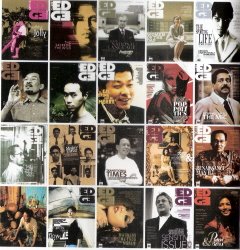
Off the Edge Celebrates

If sometimes I paint a pessimistic picture of the lack of intellectual discussion (particularly literary) in a country where the regular print media has been dumbed down (ostensibly to appeal to a 'younger generation' of thickos)*, one publication here warms the cockles of my heart.

This month Off the Edge is celebrating it's first anniversary as a separate entity from the financial newspaper which spawned it. Congrats to Jason Tan and team for producing a glossy mag which is both intelligent and visually delicious, which talks art and literature and politics, which isn't shy to be appropriately subversive at times, which isn't afraid to feature the occasional piece of locally written fiction, and which is prepared to explore issues in depth. Happy birthday!

My only wish (and a selfish one at that) is that more of the features were available online so that I could pick them up and run with them on this blog, and that they were archived. (Some articles from previous issues can be found here.)

Anyway ... in the current issue there is a (very!) lengthy interview with Datuk Johan Jaafar who in Deputy was former Editor-in -Chief of Utusan Malaysia and is now deputy chairman of the Malay literary board Dewan Bahasa dan Pustaka. The whole thing is worth a read, but I give you this snippet because it is most quoteworthy:
Are we producing good works of literature now? Ask yourself, what was the last good malay novel you read? If you ask me I would say Hujan Pagi (by A. Samad Said) published more than 26 years ago. Where are the tomes, the canons, the masterpieces? Sadly, today's literature has little time for the poor, the downtrodden, the rakyat or even the successful. We are still nostalgic for Shahnon Ahmad and Samad Said's works becasue we're not producing good contemporary novels.

The most-read Malay novels are the popular ones - picisan, they call it. At least 20,000 copies of any one of these titles are printed. one such novel, retailing at RM49 is selling more than 50,000 copies, and it will take at least five years to finish the stock. People don't read serious stuff anymore. Period.
Picisan? A Malayisation of "fiction"? Nice!

(It occurs to me to ask though ... where are these classic Malay novels? I never see them in the bookshops and I would like to buy them. Raman tells me it is very hard to get copies and even he doesn't have them on sale! Don't DBP need to get their finger out and actually promote their books???)

Other good stuff in this issue includes an article on Goenawan Mohammad, Indonesian poet and man of letters (also by Eddin), Rahel Joseph's review of Suketu Mehta's Maximum City: Bombay Lost and Found, and an interview with Leow Puay Tin about her curatorship of texts for Second Link. And much much more.

So thanks Off The Edge for keeping this litbuff happy. Each issue is a keeper. But please, celebrate your birthday with a decent website!

* If you find insulting the assumption made by local newspapers that being young and cool equates having nothing between your ears, it's time you started making your voice heard, I think. I certainly don't believe it to be true.

Related Post:

Stumped by Salina (26/1/06)

Thursday, January 26, 2006

Stumped by Salina

Kak Teh wrote a very nice piece about our national laureate, Dato A. Saman Said, the other day: do go take a look.

I see him around town, quite often - riding the LRT or browsing in Kinokuniya. With his distinctive white beard you can't miss him, and he looks every inch the eccentric writer.

Years ago, when I was learning Malay I hoped to become a fluent enough reader to tackle some of the classics written in the language, and everyone told me that Salina was the one Malay novel I must read.

Up to that point I'd been doing fine with my Malay and felt that I was ready to graduate from kid's books and newspaper articles to the fiction I longed to read in the original language.

But I managed just half a page of Salina.

You see, I got to a sentence that read: Mentari terbit, and I just couldn't imagine what a government minister was doing rising in a field. Nothing that came after that seemed to make sense.

I asked my friends at school and they just laughed at me. A minister, of course is menteri. Mentari is a literary way of saying matahari, meaning sun.

It struck me then that the serviceable, everyday Malay I'd learned wasn't up to the task of coping with the literature.

I'll read Salina in an English translation, I said, put the two editions side by side and study the Malay that way.

But I never found one in the bookshops.

And more or less my Malay got stuck at that point. Frustration point. In a sense it was a good lesson for me, because I understood what many of my students were feeling about English.

But I feel still sad about my inability to read literature in Malay and I'd love to do something even now. Especially so that I could read all those old books of poetry in the backroom of Raman's shop.

And of course, Salina.