I picked up two magazines today which both contain articles I've written on Preeta Samarasan. And both also have a plenty more great book related stuff to read.
Preeta is cover girl of MPH's Quill magazine (free to cardholders, RM8 to others, at branches of MPH) with a gorgeous portrait photo taken by top New York-based photographer Miriam Berkley who talks about her work and about what makes a great author photo inside.
The piece on Preeta here is an e-mail interview in which I ask her about the starting point of her novel, how far the family in the novel is based on her own (perish the thought!), how doing an MFA helped her and whether writing from outside the country gives her more freedom to write honestly. Do go pick up a copy to find out the answers! Preeta herself writes a very interesting piece - No More Dirty Laundry : In Defence of Fiction.
In other pieces I enjoyed, Chet writes about her "torrid affair with digital books" (!) ; Lydia gives poor, mistreated books a voice; Amir Muhammad (who seems to have the scary ability of getting everywhere these days!) reviews Adibah Amin's Glimpses; Daphne Lee writes about one of my favourite Scottish folk heroes Tam Lin; Yang May Ooi talks about her encounters with British food and Saradha Narayanan talks about hanging up her stethoscope to become an author.
The other magazine is Off the Edge and my piece about Preeta here is a review of Evening is the Whole Day. I am so happy that Jason Tan gave me the space I needed.
There are the usual thought-provoking articles about politics and the arts, and the more literary things include another episode in the life of Kam's Datuk, and the second extract from Kee Thuan Chye's The Swordfish and Then the Concubine, as well as reviews of two recent publications from The Edge Publications, Shape of a Pocket by Jacqueline Anne Surin, and Tipping Points : Viewpoints on the Reasons for and Impact of the March 8 Election Earthquake. Benjamin McKay reviews Shanon Shah's play Air Con.
Tengku Razaleigh Hamzah is the cover boy here, and the subject of a very lengthy interview with Jason. I wonder if he will still be able to mount a challenge for the presidency of UMNO and really hope so.
* (The piece is not online at the moment - but may be later.)
Showing posts with label off the edge. Show all posts
Showing posts with label off the edge. Show all posts
Monday, March 15, 2021

Wednesday, August 27, 2008
Personal is Political
 (This review of Preeta Samarasan's Evening is the Whole Day appeared in the July 2008 edition of Off The Edge.)
It’s a twenty to ten on a September morning in 1980, and the Rajasekharan family of Big House, 79, Kingfisher Lane, Ipoh family are assembled to pack their disgraced servant, Chellum, back on the bus to Gopeng. Lawyer Raju Rajasekharan (known throughout the novel simply as Appa) stands at the gate in the rain with Chellum’s wheedling, drunken father, while the two youngest children, Aasha and Suresh are kept at the breakfast table to bear witness to their mother’s scarcely contained fury as the hapless girl bumps three-wheeled, broken-strapped suitcase down the stairs.
We don’t immediately know Chellum’s crime (though Amma plants the rumour that she may be pregnant) but we are told that a year from now Chellum will be dead. This is not at all the spoiler it may at first seem, because this is a novel entirely concerned with excavating the past: the narrative seeks causes, and causes of causes, moving backwards in tiny increments of time, even while unveiling the larger story of an immigrant family’s rise from humble beginnings.
We soon learn that there’s been a death in the family. Appa’s formidable mother, Paati has died under mysterious circumstances in the bathroom, and Chellum is to be blamed for it. But just as the 1980 TV series Dallas (much loved by Malaysian audiences) invited viewers to ponder “Who killed J.R.?” so it appears as the novel unfolds that Chellum isn’t the only one complicit in her death. And as it turns out, this isn’t the only skeleton rattling round in the family cupboard. As the layers of lies and evasions are peeled away, no-one (not even Paati, not even sweet little Aasha) is entirely innocent, and convenient and face-saving fiction is invented to hide uncomfortable truths.
Since the powerless are always the most convenient scapegoats, carrying away in a metaphoric sense the sins of the rest, and so it is with Chellum and Appa’s brother (the quaintly named Uncle Ballroom). Both are unceremoniously packed off baseless pretexts when their real crime was actually to have been witness to much more.
Despite the god-like authority of the narrator, the narrative stays closest to six-year old Aasha, the latest in a long literary line of child protagonists drawn into an adult world in a way they cannot understand or really cope with. (There is, incidentally, a beautiful nod to Ian McEwan’s Atonement in the scene where the children put on a play for their parents.)
Watchful and aware, Aasha is the main witness the novel’s events and the keeper of secrets. She is even on speaking terms with the Big House’s ghosts, the most permanent of which are the daughter of the previous owner of the house, forever trapped in her last memory of being pulled into a mining pond as her abandoned mother committed suicide, and the ghost of Paati, who returns from the ashes of her funeral pyre even more grotesque and lizard-like than when she was alive.
The dispatch of Chellum is only the last in a series of events which have rocked Aasha’s world. The most painful has been the sudden change in her once doting older sister Uma before she leaves to study in America, and the child’s heartbreak is palpable.
Although on a the surface a story about a particular, dysfunction family in Ipoh, the novel must also be read on a higher level, the personal and domestic reflecting the national and political. For, just as Saleem Sinai in Rushdie’s Midnight’s Children is born at the exact moment his country gains independence, and his own fortunes are closely paralleled by those of India, so too the events taking place in the house on Kingfisher Lane echo those of the wider nation. At Independence, the house is taken over from Mr. MacDougall, a dyspeptic Scottish tin-miner, and on the stroke of midnight 31st Aug 1957, Appa’s father, Tata, switches on the light switches for the first time. Appa himself has great schemes, both personal and political, and in 1959 sets out to find a bride as “the first part of his five year plan”.
Chapter 7 is the only part of the novel where the action moves beyond the claustrophobic atmosphere of Big House, opening the novel up to light and air in much the same way as a garden courtyard serves an old Malaysian mansion. Uma and her mother make a trip to visit family in Kuala Lumpur. Amma is heavily pregnant with Suresh. Riots break out in the city, preventing their return home, and Amma is about to deliver and needs to get to hospital. The date : May 13th 1969.
May 13th has left deep scars the Malaysian psyche, yet the race riots and their causes have remained the great unwritten about in Malaysia fiction. The only other author willing to enter this territory was Lloyd Fernando with Green is the Colour, and even then the actual conflict remains largely in the background. Samarasan plunges her characters into the thick of the action and exposes the racist sentiments of the various groups in a way that Malaysian readers may indeed find unsettling.
So much remains unanswered about this dark incident in Malaysian history and so it is fitting that the author handles this part of the using personified Rumour (in a red dress) and Fact (in coat and tales) dancing a grotesque tango in the streets. “Some events and emotions are so huge that they don’t seem to be governed by the laws of realism,” Samarasan has said. Malaysian readers will of course know only too well that Rumour and Fact will continue to dance in a country where press freedoms are limited.
Samarasan is clearly critical of the insularity of her characters. Despite living in an ostensibly multi-cultural society, the Rajasekharan family have little contact with Malaysians of different races, and don’t even deign to learn the national language. It is ironic of course, that at the same time the children’s frame of reference includes so much that is imported from the west such as Wrigley’s chewing gum, Hawaii Five-O, The Wind in the Willows and Simon and Garfunkel. Malaysians of all racial backgrounds will recognise the phenomena of the cultural cocoon.
Just as we have our scapegoats in the foreground of the novel, so too they appear in the background. Appa is involved in the conduct of a murder case of one Angela Lim found stuffed sown a manhole near Tarcian convent school. Is Shamsuddin bin Yusof really the murderer, or has he been conveniently framed? Malaysian readers will of course immediately spot the anachronistic references, to more recent murder cases and tabloid scandals which have captured the national imagination.
Not only is Evening is the Whole Day an extremely intelligent novel which works on different levels, and explores a variety of themes, the writing is simply stunning. The style, while evocative of other Indian authors influenced by the exuberance Rushdie such as Arundhati Roy and Kiran Desai (against whose work comparisons are bound to be made), also draws on the darkness of the gothic, and as far as I’m aware, no other writer has managed to better use absolute misery for such comic effect since Stella Gibbon’s Cold Comfort Farm.
There’s a playfulness and a sensual love of the language which means that every sentence, every single paragraph gives an almost physical pleasure and must be fully savoured, and the imagery is fresh and frequently surprising. There is too a sharp eye for the tiniest of details and Samarasan delights in long lists with one object piled onto another which not only achieve a kind of a poetry, but also add to the cluttered and claustrophobic atmosphere of Big House.
Samarasan has moved away from the frangipani and jasmine scents of much Asian fiction, confounding perhaps a Western audience’s expectations of a certain kind of exoticism. There are to put it bluntly, and awful lot of scatological references: shit seeps into many of the scenes whether the stench from Amma’s mother improvised chamber pot doing battle with the smells of the family dinner, or Chellum’s “volcanic attack of diarrhea, all rapid fire bangs and squeaks and liquiescent bursts”, or the anonymous “sly lingering fart” on Ipoh railway station platform.
Perhaps more remarkably, in a novel published overseas and aimed at an international market, a great many local words, both Tamil and Malay are woven into dialogue in the way that Malaysian speakers actually do speak These words are not italicized, not footnoted, not explained in a glossary and not in any sense apologised for. This is as much a political decision as a literary one. As Samarasan has pointed out in an interview with Quill magazine :
“Schoolchildren studying literature in the colonies had to navigate Cockney speech patterns, imagine for themselves what toad-in-the-hole might taste like, picture moors and bogs and fens and determine the emotional significance of each of these landscapes. Now we get to tell our own stories, and this requires your dealing with my rubber estates and char kuay teow and cursing in Tamil. In the long run, this will be good for all of us. A little cultural immersion never did anyone any harm.”Samarasan is an astonishingly self-assured young author who seems to have hit the ground running at first attempt. She plays with our expectations of an Asian novel in Evening is the Whole Day, revisiting the well-worked genre of the Indian family saga with a freshness that easily transcends all the stereotypes. And for a Malaysian reading public hungry for fiction that explores political and social issues unflinchingly, and Evening is the Whole Day will be seen a fearless burst into new territory.
Perhaps we’re getting a little blasé these days, but our Malaysian authors have done enormously well on the world stage recently, winning and being nominated for major international awards. I think we can expect Samarasan to add one or two more to the national mantelpiece.
Tuesday, August 12, 2008
Pendatang Part 2
(Continued from yesterday.)
Set in late C19th China, Little Hut of Leaping Fishes tells the story of Mingzhi, the treasured first grandson in the Chai Mansion in Plum Blossom Village. His grandfather a feudal landlord who soon learns that opium is a more lucrative crop than rice, rules the household with an iron fist. Mingzhi’s future as a scholar and later a mandarin is mapped out for him, but this sensitive soul finds an escape learning from the cloying atmosphere of the household with its rivalries, adultery and addiction through books and learning.
But Little Hut is as much a story about China as about the characters. “These historical events in C19th China are woven into Mingzhi’s life. He is not just as a witness. He is part of it” says Tei.
She says that she did a lot of research for the novel to get the details right. “I found out the timeline of historical events which was very useful. I actually merged every important period in Mingzhi ’s life with important events in Chinese history. When I realised that Emperor Guangxu was enthroned in 1875, I arranged for Mingzhi to be born in that year. Then when Mingzhi’s wife dies together with the child in labour, it is on the same day that the 100 days of reform failed, when the reformers are toppled by the empress. That’s why when Mingzhi is waiting for the wife to give birth he counts to 100 and just can’t get past that number. There are many tiny details like this I don’t know if everybody will get them.”
The end of the novel has Mingzhi and his friends escaping to Malaya, along with a whole wave of Chinese immigrants fleeing poverty. Is the novel in anyway based on the lives of Tei’s own ancestors who arrived at about the same time?
Tei says that she doesn’t really know much about her great grandparents, but she does remember seeing a black and white photo of someone in a Mandarin’s costume which used to sit on the family altar, although she has no idea who he was and how he was related to her.
The novel is actually planned as the first part of a trilogy, all centered on the concept of “home”, a theme which has particular resonance for Tei, living between a Scotland where she still feels an outsider, and a Malaysia where she says feels a tourist on her return visits.
The sequel to Little Hut of Leaping Fishes will take place in the early years of the C20th and see Mingzhi having to find a home in the new land. “So he has to think, what is home to him, here or there? There is a conflict.”
The third book in the series will be set between the 1990’s and the present. “It will redefine the concept of home in modern society when everything is moving so quickly and people become so busy. People can just go from one place to another place so easily and some people even have houses in different places. So it explores how we define home and how sometimes home just equals a sense of belonging.”
Her writing is, Tei says very influenced by film, which she describes as her primary language, and she is concerned with using minimal dialogue and vivid images to tell the story.
Indeed, with its short sentences and sentence fragments, and its use of the present tense, Little Hut sometimes reads like a film script. The writing very visual, the imagery is often striking, while the relative simplicity of the language, as well as its working of themes which will be very relevant to the local audience, should win the novel a broad readership in Malaysia.Although Tei very much has her hands full with the writing projects at the moment, she says that she sees all her work as interconnected and does not rule out a return to film making. She may also return to writing in Chinese, although she says she does not know when yet.
So how does it feel being one of the growing list of Malaysian authors who are winning recognition? Tei says she was tremendously encouraged seeing Tash Aw and Tan Twan Eng longlisted for the Booker and winning recognition for their work. And it is an encouragement that she no doubt will be passing forward in turn.

Saturday, September 23, 2006
Off the Edge Celebrates
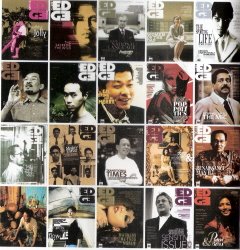 If sometimes I paint a pessimistic picture of the lack of intellectual discussion (particularly literary) in a country where the regular print media has been dumbed down (ostensibly to appeal to a 'younger generation' of thickos)*, one publication here warms the cockles of my heart.
This month Off the Edge is celebrating it's first anniversary as a separate entity from the financial newspaper which spawned it. Congrats to Jason Tan and team for producing a glossy mag which is both intelligent and visually delicious, which talks art and literature and politics, which isn't shy to be appropriately subversive at times, which isn't afraid to feature the occasional piece of locally written fiction, and which is prepared to explore issues in depth. Happy birthday!
My only wish (and a selfish one at that) is that more of the features were available online so that I could pick them up and run with them on this blog, and that they were archived. (Some articles from previous issues can be found here.)
Anyway ... in the current issue there is a (very!) lengthy interview with Datuk Johan Jaafar who in Deputy was former Editor-in -Chief of Utusan Malaysia and is now deputy chairman of the Malay literary board Dewan Bahasa dan Pustaka. The whole thing is worth a read, but I give you this snippet because it is most quoteworthy:
Are we producing good works of literature now? Ask yourself, what was the last good malay novel you read? If you ask me I would say Hujan Pagi (by A. Samad Said) published more than 26 years ago. Where are the tomes, the canons, the masterpieces? Sadly, today's literature has little time for the poor, the downtrodden, the rakyat or even the successful. We are still nostalgic for Shahnon Ahmad and Samad Said's works becasue we're not producing good contemporary novels.Picisan? A Malayisation of "fiction"? Nice!
The most-read Malay novels are the popular ones - picisan, they call it. At least 20,000 copies of any one of these titles are printed. one such novel, retailing at RM49 is selling more than 50,000 copies, and it will take at least five years to finish the stock. People don't read serious stuff anymore. Period.
(It occurs to me to ask though ... where are these classic Malay novels? I never see them in the bookshops and I would like to buy them. Raman tells me it is very hard to get copies and even he doesn't have them on sale! Don't DBP need to get their finger out and actually promote their books???)
Other good stuff in this issue includes an article on Goenawan Mohammad, Indonesian poet and man of letters (also by Eddin), Rahel Joseph's review of Suketu Mehta's Maximum City: Bombay Lost and Found, and an interview with Leow Puay Tin about her curatorship of texts for Second Link. And much much more.
So thanks Off The Edge for keeping this litbuff happy. Each issue is a keeper. But please, celebrate your birthday with a decent website!
* If you find insulting the assumption made by local newspapers that being young and cool equates having nothing between your ears, it's time you started making your voice heard, I think. I certainly don't believe it to be true.
Related Post:
Stumped by Salina (26/1/06)
Subscribe to:
Posts (Atom)