Showing posts with label found poetry. Show all posts

Monday, November 23, 2009

A Hooker Unmasks, A Diva Retires, and A Poet Appropriates

Really, my apologies for not being a very good blogger over the last week or two. I'm not sure what's happened to me, but I seem to be more easily distractible than usual. (I just spent 20 minutes getting distracted by this nice blog while looking to see if I had spelt the word right!). This being the case, I offer you some quick links to stories that have caught my eye over the last week or two and hope you enjoy them : Margaret Atwood turned 70 and on The Guardian books blog Daragh McManus celebrates the work of a writer whose versatility astounds. (I am currently reading and relishing After the Flood and reckon it needs to be the second book of a trilogy.) Zadie Smith suffers from what she calls 'novel nausea' and turns to the essay in a piece that is both erudite and refreshing. Oprah Winfrey announces that her talk show is coming to an end and Bookninja gets very emotional. Call-girl blogger Belle De Jour (one of the earliest to be successfully "blooked") reveals her real identity after years of speculation in the press - she's Bristol-based researcher named Dr. Brooke Magnanti and she turned to prostitution to finance her education. (As Rowan Pelling at The Telegraph says, the revelation is shocking because it turns on its head what we think we know about the world's oldest trade.)
I stand behind every word with pride ...
unearthed her secret way back but - bless him - gave away nothing about:
... the greatest story in the history of blogging, and probably the biggest literary puzzle in the UK this century.
British poet laureate Andrew Motion is accused of "shameless burglary” by a military historian for "extracting sexy soundbites" from his work on military psychiatry. The creation of collages of words - often called found poetry - is though a time-homoured technique. Motion's resulting poem for Armistice Day, An Equal Voice, is far better than the usually trite stuff offered up by laureates on official occasions. But still, the argument raises interesting questions about what plagiarism is and what poets can get away with. (Ellen Whyte tagged me with a link to this article on Facebook, feeling properly angry I think.) Apologies to those who have asked me to blog this and that. I am slowly sorting myself out and plan to put up some local book news very soon.

Monday, January 19, 2009

Send Your Writing Here

Need somewhere to send your work?

Chiew-Siah sent me word of the Edwin Morgan International Poetry Competition 2009, Britain's richest poetry prize (the main winner gets £5000). The closing date is June 2.

Writers Digest have announced their annual competition where prizes are awarded in 10 categories :
* Inspirational Writing (Spiritual/Religious)
* Memoirs/Personal Essay
* Magazine Feature Article
* Genre Short Story (Mystery, Romance, etc.)
* Mainstream/Literary Short Story
* Rhyming Poetry
* Non-rhyming Poetry
* Stage Play
* Television/Movie Script
* Children's/Young Adult Fiction
Both competitions are open to everyone, and there is (Yusof will be thrilled to hear!) no age limit. However, there is a fee for submission.

Saturday, September 27, 2008

Sorted Books

Jordan sent me this link to Nina Katchadourian's Sorted Books project (which he found via Boing-Boing). As the artist explains :

The Sorted Books project began in 1993 years ago and is ongoing. The project has taken place in many different places over the years, ranging form private homes to specialized public book collections. The process is the same in every case: culling through a collection of books, pulling particular titles, and eventually grouping the books into clusters so that the titles can be read in sequence, from top to bottom. The final results are shown either as photographs of the book clusters or as the actual stacks themselves, shown on the shelves of the library they were drawn from. Taken as a whole, the clusters from each sorting aim to examine that particular library's focus, idiosyncrasies, and inconsistencies — a cross-section of that library's holdings. At present, the Sorted Books project comprises more than 30 book clusters.
There's some wonderful poetry to be read from the collected book spines. The one below is entitled Women.

You might also like to check out LibraryThing which has an intriguing collection of bookpiles, contributed by readers around themes.

These pictures make me want to go and pull titles off my own shelves to make a statement with. And if you feel simularly inspired you can email me your pic (sharonbakar at yahoo dot com) and I will put it up.

Friday, March 02, 2007

Performance Poetry Workshops

I just got an email from Patriana at British Council who tells me that there are still some places for the Jacob Sam-La Rose Performance Poetry Workshops for "young (ish) and new talents". Details as follows:
Venue: Dram Projects (BG-6 Happy Mansion, Jalan 17/13, Petaling Jaya).

Fri 9 March

5pm-9pm Session 1: writing and editing poetry / performance

Sat 10 March

10am-1pm Session 2: Performing poetry

4pm -6pm Performance at Food Foundry (by participants of the workshop)

Please email arts@britishcouncil.org.my or call 2723 7988 to register.

Monday, June 05, 2006

The Poet and the Bubur Ayam

Indonesian author, Laksmi Pamuntjak, will be at Silverfish Books this Saturday to read from her poetry and short stories.

Lakshmi is an acclaimed journalist and food writer. Her book of poetry, Ellipsis, was chosen as one of the Books of the Year 2005 by The Herald, UK and her book of short fiction The Diary of RS: Musings on Art was published in April.

Sample her writing here ... and please do scroll down and read the little story about the lovers and the bubur ayam - it's a gem!

The event kicks off at 6.30p.m. at Silverfish Books, 67-1 Jalan Telawi 3, Bangsar Baru. Admission is free and all are welcome but please give Phek Chin/Vasantha a call at 03-22844837 to book a place.

Saturday, April 22, 2006

A Fib But Not A Lie

(A silence punctuated by the sound of a writer hyperventilating, and the frantic shuffling of paper)
Can't
blog
right now.
Got to fret
about my reading
at Borders. Rewriting like mad.

(Tomorrow at 3p.m. at Borders, the Curve)

Wednesday, April 19, 2006

Writing Fibs

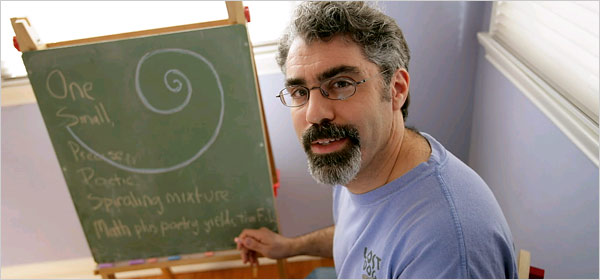
A new form of poetry has taken off the U.S. in the last couple of weeks. Gregory K. Pincus, A Los Angeles screenwriter invited blog readers to send him Fibs* - sixline poems that use a mathematical progression known as the Fibonacci sequence to dictate the number of syllables in each line. The idea spread like wildfire across the internet, and it has been estimated that more than 1,000 Fibs have been posted since the beginning of April.

The New York Times explains:

The Fibonacci progression is a mathematical formula that starts with 0 and 1 and then continues to add numbers that are equal to the sum of the previous two numbers. Thus, the first seven numbers in the sequence are: 0-1-1-2-3-5-8. ... To write a Fib, a more complicated version of the classic, highly constrained haiku, the poet composes a six-line poem that has the correct number of syllables in each line corresponding to each digit in the sequence. (The real first line of each Fib is silence.)

The sequence apparently features in the Da Vinci Code, and shows up in the nautilus shell, knitting patterns and the compositions of Bartok.

Now me, I don't understand maths at all and managed to fail every single maths exam that life ever threw at me (honestly!), but the creative part of one's soul can't resist squeezing itself into self-imposed limits. Here's my very first one.
I
don't
care that
i'm not math
matical, I just
want to write a poem in this form.
Now it's over to you. Compose one or two while the boss isn' t looking and post them up. The best Fibber buys me lunch at a fancy restaurant of their choice.

(*Hmmm. I'm just wondering if a better name for the form might not have been the Pincushion, immortalising its inventor.)

Monday, December 12, 2005

Forest Magician

Helen was my best friend at school, has remained a close friend to this day, despite distance and my laziness to write letters. We've always shared a love of words and books and nature. Helen is now a published poet and working on her PhD.

When she came to Malaysia with her family, I wanted them to see the richness and diversity of a rainforest. I knew wouldn't be equal to being a very good guide, so I enlisted birdwatcher Mike Chong to come with us to Fraser's Hill for a few days. We learned so much, saw so much. I have a long list in my notebook of all the birds and mammals and insects we spotted. We wouldn't have seen much at all if not for Mike who knew just where to find each species and how to identify them. He could even imitiate the bird calls and start a dialogue with the bird in question so that it would come out of the forest and we could see it. (Imagine talking to a hornbill!) Yes, it seemed like magic.

Helen later wrote this poem for Mike:
Forest Magician

The first night after our return, I wake to darkness
fringed with sweeping fronds, dense and
breathing with the forest’s mysteries.
I blunder in its strange dark to recover bearings,
locate the lighted exit of the room’s familiar frame.
Now this landscape is a stage removed, half-blurred by dreams,
its shades and shapes encroach on our security.

You had read its signs for us, unravelling the
tangled script, unmasked the secret rituals of animal society.
Quiet impresario, subdued in camouflage, you perched
on the broad rim of the ancient world,
panning its draped stage, twitched the curtain’s cord,
unfurled the rustling screen to lure the
shy performers from their hidden roosts,
enchant us with the patterns of their primal dance.

Master of mimicry, tuning voice and turning gesture,
measuring the pauses and the distances, you
stole the syllables of wild speech, casting voices back
like skimmed stones to dilate and spread
their rolling echoes across space, until
the youngest in our party, quick to learn,
threw the gibbon’s song into the valley’s throat
to rouse a whooping chorus in defiant dialogue,
competing for the territorial privilege.

Modest magician, with casual flamboyance, you
pulled colours from the forest’s folded sleeve to
flourish in the trained sights of the telescope,
ruffled them for our delight into sudden
bouquets of petals, plumage, by day showering
confettis of bright birds, exotic names, to
dazzle the veiled eye with visions of creation’s
blue - gold flowering, warm our dulled sense
with the molten ribbons of its first fires.

Later, challenging the evening’s gloom
with flashing wands of torchlight
you would startle eyeshine in still hunters
draped in shadow-lairs of night-time foliage.
In the ancient trees, the secret bank, we tunnelled
with your eyes, your ears into the core of
our life’s origins, woken to new wonder by the charge
of a forgotten energy

Copyright Helen Boyles

Tuesday, August 30, 2005

Cut and Paste Poetry

Oshun sent me this link to the Altered Books website a few days ago and I thought it looked such fun I'd have a go at it sometime soon. (Once I've got over the psychological trauma of actually cutting up a book!)

The instructions are these:
Cut the bindings off of books found at a used book store. Find poems in the pages by the process of obliteration. Put pages in the mail and send them all around the world. Lather, rinse, repeat.

And the results are as visually interesting as they are poetically:
Image hosted by Photobucket.com

I tried a similar exercise some time ago from the excellent In the Palm of Your Hand: A Poet's Portable Workshop by Steve Kowit. (If you want to write poetry, I think this is a must-buy!)
Image hosted by Photobucket.com

Basically, you take a text and chop out of it any words or phrases that sound interesting. Then you reassemble the cut-out bits into a poem. Simple.

To prove it, here're my own experiments! (I feel like the Blue Peter team saying "Here's One I Made Earlier" - forget the reference if you're not British of a certain generation!)

The first came from a page in New Scientist, the second from an article on an Egyptologist in the Sunday Times Magazine.


(1)

Dull middle-aged scientist
Creates
Slippery concepts.
Slips unnoticed into
The mystery of consciousness.
(How deep the mystery is!)
Brainspace
Mindspace
Impenetrable language.
“This is what I am,” she cries “inside my head
A virtual world of spaces of the mind
An ever shifting pattern in the dark …
Brainspace is also mindspace!”


(2)

A commoner
Tomb-by-tomb
recording her quest (so secret).

Every movement:
swirls of ancient dust -
tomb dust.

Every footfall
on time-worn scrap:
dynastic detritus.

In the two-pillared antechamber,
the mummy - a flame-haired royal beauty
Eloquent as a hieroglyph.

Grasping her enemy by the shortened forearm
She threw her into the darkened void beyond.
(Sex always was a problem for Egyptologists.)

Wednesday, July 13, 2005

Rejected Not Dejected

Fairy godmother was playing hard to get just now.

Poems I'd sent out ... all rejected. *sigh*

One of them interested the editor, but she said that "a greater degree of
restraint might have made it a better poem"
.

She goes on:"With a strong submission list this time round, I regret to say we're not able to offer publication."

Rewriting needed then. No problem.

Pick myself up. Dust myself down. Send out poems for the next edition.

I feel on much safe ground with fiction. Both writing it and critiquing it.

But poetry is so much harder to shape.

It's easy, I mean, to arrange words on paper and call it a poem. And call yourself a poet.

But it's so much harder to create the good stuff. For which there is honestly only one true measure of quality:

Does it give you goosebumps?

Because you feel good poetry in your body.

And then your head won't let go of it. You have to internalise it, because it says something that your recognise right there in your soul, and you haven't heard it expressed in any other way.

There are poems I carry in my head, because I need them. Because they've changed the way I see the world.

That's the kind of poetry I want to write.

Monday, July 11, 2005

McGough Mixture

Something light for Monday morning! Thought I'd post up one or two of the poems in the little Penguin book by Roger McGough. These are all about writing and made me smile:


New Poem

So far, so good


Sound Advice

Once you write a poem
you must write another

To prevent the first
from falling over.


Writer's Block

The excitement I felt
as I started the poem
Disappeared on reaching
the end of the fourth line.


Children's Writer

John in the garden
Playing goodies and baddies

Janet in the bedroom
Playing mummies and daddies

Mummies in the kitchen
Washing and wiping

Daddy in the study
Stereotyping.


This last one is my favourite. Ten years or so ago Roger Mc Gough gave a reading at the then British Council Director's house in Kuala Lumpur. I remembered all the words to this poem after just hearing it once!

No wonder Carol Ann Duffy calls Mc Gough 'the patron saint of poetry'. He makes it just so accessible.

Tuesday, December 21, 2004

Found Literature

(From my notebook. Names changed!)

Now this intrigues me. One day a couple of months ago when I was walking my usual circuit of the area where I live, I saw a piece of paper by the side of the road. Nosey cow that I am, I picked it up and read it. This is what it said:

"Kuala Lumpur Japanese teacher Mr. Nerome makes the illicit Ms. Jouji now the rise and fall.
Why it is called that this thing was understood.
Consultation from the man's wife was a start.
It was from last years September when two people are familiar.
It was worried about the compatible thing of the class of her class management and the ungoing to school student of the class of her.
When the man who had an eye there gives counsel and having a meal, it comes to make after school in the more familiar relation a back that finished becoming.
He comes to soon go in and out of her house.
Two people become related to flesh. The type of car that he is riding is SERENA.
Plate number WEL 4254.
He has come recently to the condominium (Riana Green) in which she lives everyday."


I like the rough poetry of the broken English, written I'm sure by a Japanese speaker. It tells a story than transcends cultural boundaries. But what did the writer want to achieve by throwing this by the roadside?

And today, I found the same story again, on a sodden piece of paper. And in exactly the same spot! Someone had actually retyped it too! What is happening?

(Another way to get published?)

Monday, October 18, 2004

Kristin Thomas Spam Poetry

I thought this was pretty cool. This lady writes poetry using only the subject lines of the hundreds of spam messages she received each day. And to think I just delete mine! Maybe I should recycle them in the same way that I do my old newspapers, plastic and tins ...

Kristin Thomas Spam Poetry