Showing posts with label haruki murakami. Show all posts

Friday, December 19, 2008

Haruki's Magic Diary

Talking of perfect Christmas presents for the reader or writer in your life, I think I have found the nicest one of all - The Murakami Diary 2009. I spotted some copies at Times in BSC today and wish I had gone back to buy one, even though I already have a diary for next year.

It's just a little book, visually lovely, with nice Murakami quotes that would lend themselves for use as writing prompts. As the blurb on Amazon.co.uk has it :
Cats slink across the pages; the seasons are marked by cherry blossom and Japanese maple; spaghetti strands or telephone cords separate the days; and a generous selection of quotations and extracts from Murakami's novels and stories appear on almost every page to inspire, amuse or entertain. This is a diary like no other, faithful to all that is witty, surreal, sexy and beautiful in Murakami's work. A must-have for fans of Murakami, fans of Vintage fiction and fans of unique design, this diary will appeal to everyone as a quirky companion for 2009.

By the miracle of YouTube, you can see it here :


BTW, if you are in Bangsar do go and check out the new-look Times branch as it is very squidgy, and even has a nice little cafe in the back portion. What it doesn't have (fortunately or unfortunately) is the "walk of temptation" anymore, where you had to walk past all the brand new, incredibly desirable titles as you entered the shop ...

Update (27/12):

I am gobsmacked with happiness after my friends at Times read this post and couriered a copy of the book!!! I really love it and it will be my constat companion in 2009. Thanks so much!

Sunday, August 10, 2008

Cover Stories

Most authors don't have any say in the cover design for their books, but some of the big names do. This essay from the New York Times features three authors, Philip Roth, Haruki Murakami and Chuck Palaniuk,who have chosen to stick with particular designers.

I have to say that I really love John Gall's retro covers for Murakami ... but the other two do rather leave me cold.

Monday, August 04, 2008

Murakami the Runner

A notable difference between Murakami and the other athlete-writers or writer-athletes, though, is that, for the Japanese novelist, pounding the pavement is more than something he does to fill the hours when he’s not busy pounding the keyboard. He considers it essential to his writing career, partly because it has given him the health and endurance to complete novel after novel, but in more subtle and far-reaching ways as well. Murakami fans (who number in their millions) will already be well aware of this connection between writing and running. He has written plenty of articles about it over the last two decades, and has been profiled in glossy magazines for runners, who seem to be tickled by the idea that such a celebrated author should share their world of cramps and aching knees. ... Running, Murakami explains, was a vocation that came to him not very long after his relatively late start as a writer.
Kevin Jackson in The Times looks at :
...a cult writer’s obsession with pounding the pavement when he’s not pounding the keyboard.
Murakami's new book is What I Talk About When I Talk About Running.

Tuesday, July 01, 2008

Unscary Translations

We're less afraid of tackling translated fiction these days, says Stuart Evers on The Guardian blog, and attributes this in no small part to the popularity of Japanese author, Haruki Murakami who proved that foreign fiction didn't have to be difficult and inaccessible, and so paved the way for others :
The Murakami effect has obviously benefited other Japanese writers such as Ryu Murakami (no relation), Hitomi Kanehara and Natsuo Kirino, but it's also helped people cast off negative preconceptions. Carlos Ruiz Zafon's Shadows of the Wind was a number-one bestseller, proving sales and translations are not mutually exclusive. This is especially true of crime writing, with more and more foreign novels appearing in translation. Henning Mankell, Jo Nesbo, Anne Elliot, Boris Akunin and the irresistible Fred Vargas deliver unusual and compelling novels and are valued as highly as their English-writing contemporaries.

Wednesday, September 27, 2006

Murakami the Magician

If the Japanese literary establishment is still (mysteriously) sniffy about the credentials of Murakami, the amount of recognition his works are winning abroad ought to turn the tide.

His latest novel, Kafka on the Shore was shortlisted for the Independent Foreign Fiction Award back in January. And now his collection of short fiction Blind Willow, Sleeping Woman has taken the Frank O'Connor Short Story Prize (which he shares with his translators).

According to the Guardian:
"Murakami writes with great integrity" said the judges "unafraid of dealing with tough and difficult situations between people who constantly misunderstand each other."

They praised the "terrific sense of magic" of his "truly accomplished voice", his "contemporary ability to create extended monologues of fear" and the way his stories push "deeper and deeper through layers of meaning". "Long after reading his stories, the images and situations he constructs remain unforgettable ... His writing reminds us, ultimately, that the reader comes to published work in search of magic."
Ted is understandably happy, I'm sure, and you can find his review on the Star website.

Thursday, September 07, 2006

My Friendly Guides to Japanese Literature

And talking as we were of Japanese authors ...

The other day Swifty pointed the way to a very interesting piece written by his friend Justin taking issue with Kyoko Mori's list of essential Japanese reads in Salon.com. Justin's alternative list is here.

Now I'm happy to admit areas of ignorance, and Japanese literature is a big one. I resolved to do something about that some time back, but somehow haven't yet got round to it. (More effort needed here, girl!)

Cue a story:

Just after the Litfest I had dinner at House of Sunda with my friends from the Japan Foundation and the guest writer they had brought to the festival, haiku master Kyoji Kobayashi.

The reason for the dinner? It was a hastily arranged affair (organised by Lorna Tee who was working with me) intended in some small way to make amends for Mr. Kobayashi's name being left out of the official programme booklet and the very real hurt and embarassment it had caused. Ouch ouch and ouch again.

Apology is taking responsibility. Hospitality smooths over hurts.

Paul Bailey was also taking a couple of extra days in KL (wanting to recover from jetlag acquired flying from the UK, before he had to fly back to the the UK again!) and was holed up in his room at the Renaissance beavering away on his next novel. I was scared that he was feeling lonely and invited him along as well.

Paul is a great supporter of literature in translation and a jury member for the Independent Foreign Fiction Award, and I was most impressed - and clearly so was Mr. Kobayashi, by how much he knew about Japanese literature.

Dinner at first a little formal but as the wine bottles emptied, Kobayashi who’d hitherto spoken through an interpreter (a beautiful and very gracious lady who has lived in Malaysia for many years) began to launch out into perfectly serviceable English. I asked both writers to write down a list of titles I must read, and then the conversation fairly flowed.

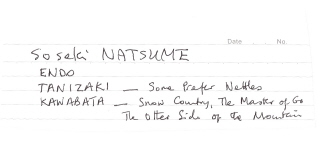
Those are the names and titles Paul finally scribbled down for me in my notebook (picture above) with Kobayashi's approval:
Soseki Natsume
Endo
Tanizaki - Some Prefer Nettles
Kawabata - Snow Country, The Master of Go, The Other Side of the Mountain
To my disappointment the list did not include Haruki Murukami. When I asked how he was regarded in Japan, there was an eloquent silence ...

Sunday, November 06, 2005

Writing That Marathon

Haruki Murakami believes he has the formula right, reports Tufts Daily: the first step toward successful writing is proper physical fitness.
'First train your body. Then, your writing style will follow. ... I realized that I needed physical strength [to focus on writing for long periods] and that strength helped to develop my writing style.
Good advice certainly for those who plan to write a marathon.

Guilt inducing words for those of us who are neither exercising or managing to pump out Nano words. (Present score 7776). Manana.

Just when I said I had no appetite for fiction picked up Chris Cleave's Incendiary and found it hard to put down. Reserving all critical comments for the review I'm writing so you'll have to wait!

Saturday, July 16, 2005

That Old Potter Magic

Bumped into Voldemort today.

He seemed a little alarmed at my scream of terror and whisked off his mask to reveal a perfectly sweet smile, a young Chinese guy on his first work assignment after graduating, which was, he told me, to spook the kids who came to buy the book. Nice work if you can get it, I say.

At a counter near the door cauldrons smoked and evil green liquid bubbled in a test tube. Giant spiders and green snakes lurked, while witchily-clad sales assistants handed out forms for the treasure hunt to locate the half-blood prince somewhere in the store.

Today of course was Harry Potter day and around the world the same joyous lunacy prevailed. MPH opened at 7a.m. for the fans. At this one branch alone there were 1,000 pre-orders for Harry Potter and the Half-Blood Prince. Just multiply that by bookshops across the city, by the bookshops of the world!


I love you, J.K. Rowling, Patron Saint of Getting Kids to Read!


How many kids will are holed up in their rooms in complete and eerie silence right now? How many will be forgetting to eat and going without sleep the whole night?

And along the way learning the best lesson of all ... with books comes pleasure and there are books you just want to devour whole.

(The cynical Mr. Raman says the problem is that kids just don't make the move from Potter to other writers. The trouble with Mr. Raman is that he is a mere muggle.)

Here I must confess I've read only Harry Potter and the Sorceror's Stone. But loved it and am saving the rest for a time when I need to feel a kid again.

For adult readers who something more substantial than Potter, let me direct you to a novel I truly love and must read again pretty soon: Haruki Murakami's Hard-boiled Wonderland and the End of the World.

It has a hero who goes through the back of a cupboard to discover a strange underground world. (Wherever did he dream up that idea?) It has horrible monsters called Inklings ... and a wood with unicorns in it, a passing nod to Harry Potter.

Rowling hasn't cornered the market in magic, thank goodness.

Postscript:

Was I over-hasty extolling the virtues of Potterdom? I laughed at this review from Kitabkhana.

Sunday, April 03, 2005

Murakami Shares His Thoughts

Came across an e-mail forwarded by a friend back in 2001. (I'm a magpie collecting all kinds of things about writers and the writing process.) It contained an article by Anita Patil of The Observer following a student dialogue with the Japanese writer Haruki Murakami at Tufts University. I decided to retype part of it for the more sceptical participants on my creative writing course who can't quite believe that your subconscious will find you all the stories you need if you just allow it to let go. It lends a little much needed authority to my cause - if a highly respected and prolific writer says this ... it might just be true that writers can and do work this way.


“I write spontaneously,” Murakami said. “I don’t think about anything when I write, I don’t know anything when I write.”

He related his writing to computer games, saying that when he writes he is like the programmer and the player at the same time; the mind is divided in half.

Murakami discussed how we are living in a world that is reality but underneath, he strongly believes there is an “underground”. In addition, there is a kind of underground within his mind. “I have things in the back of my mind that are lying beneath my conscience. Writing for me is a passive way to get these thoughts inside of me, out.”

Murakami strongly emphasized that there is no underlying meaning beneath his works, and he does not want his work interpreted.

He does not plan anything; he just writes. “If I choose to write about sheep, it is because I happened to write about sheep. There is no deep significance.”


And I loved his advice to aspiring fiction writers, which really says it all:

“Don’t think too hard.”