Showing posts with label frank o'connor short story prize. Show all posts

Sunday, July 05, 2009

Making Ripples


I approach writing much as I would approach the acquiring of any new skill. Learn the basics, check out what the pros do, practise, get some feedback, then go back through the cycle again. Learn more, read some more, write some more, and try to have some fun along the way.
Frank O'Connor shortlisted author Shih-Li Kow talks to Daphne Lee in Starmag about writing her collection Ripples, and about how she writes and gets her ideas.

And I review the book here. The last line of the review has changed, and I intended it to read :
The best pieces in the collection display Kow as an intelligent and subtle short story writer, with a firm grip on her craft. She is an excellent prose stylist, and there’s a musicality in her writing which makes it seems effortless. Ripples confirms her as one of the best writers in the form in the country, and one feels that the book can stand proudly beside its competitors on the Frank O’Connor Short Story Prize shortlist.

Tuesday, June 30, 2009

Shih-Li Makes it to Shortlist

Well blow me down! Shih-Li Kow has now been shortlisted for the Frank O'Connor Short Story Prize!

Four out of six collections nominated for this year's short stories award are by first-time writers, and bumped off the list are *gulp*some pretty big names including Kazuo Ishiguro and Ali Smith. (All the shortlisted writers are profiled here.)

Hope this opens all the doors for Shih-Li, including much deserved international publication.

My review of Ripples should be in Starmag this Sunday. (Been waitin' quite a while for it to come out ...)

Friday, May 15, 2009

Shih-Li for Frank O'Connor

Congratulations to Shih-Li Kow and to Silverfish. Ripples has been longlisted for the Frank O'Connor Short Story prize (as Wena Poons Lions in Winter was last year).

The list is 57 strong (up from 38 last year) with most entries coming from the US and UK, and there are some pretty big names on there, including Chimananda Ngozi Adichie and Kazuo Ishiguro.

As The Short Review says :
... this is a wonderful move on the part of the organisers, giving much-needed publicity to many, many books not published by mainstream publishers but by small presses without teams of publicists ... . What is also wonderful is that "big" names are alongside newer writers, showcasing that the short story is not just the province of those who have yet to "graduate" to novels!

(Thanks Steven of Horizon Books for sending me the news and the links!)

Tuesday, July 08, 2008

Lahiri Leapfrogs List

Jhumpa Lahiri has won this year's Frank o'Connor Short story prize with Unaccustomed Earth. As Lydsay Irvine in the Guardian points out, the book has been something of a publishing sensation, immediately hitting number one spot in the New York Times's fiction charts. Her first collection of short fiction Interpreter of Maladies won the Pulitzer in 2000. (Is any publisher going to spin the tired line about short fiction not selling, after this?)

So no surprises there, really.

The shocker though is that the judges, unanimous in their decision decided to go straight to the announcement, without bothering with a shortlist.

The reason :
With a unanimous winner at this early stage, we decided it would be a sham to compose a shortlist and put five other writers through unnecessary stress and suspense. Not only were the jury unanimous in their choice of Lahiri’s Unaccustomed Earth as the winner, they were unanimous in their belief that so outstanding was Lahiri’s achievement in this book that no other title was a serious contender.
Nicholas Lezard on the Guardian blog calls it :
... the unpardonable sin of failing to cater for that section of the literary public - and indeed the non-literary public - that likes a flutter.
And I have to agree. The whole point of literary awards is the exposure that they bring to new writing and often hitherto unheard of authors. Cut out the shortlist and you cut out a lot of potential publicity, not to mention a lot of fun for the reader. In other words, perlease bring on the sham!!

But looking on the bright side, Wena can now at least put a sticker on her book saying "nominated for ..." and in that sense stand proudly alongside authors like Anne Enright and Roddy Doyle.

Now to rush out to buy Unaccustomed Earth which just has to be that good!

Monday, May 19, 2008

Short Story Scoops

On Eric Forbes' blog, Eric and colleague Janet Tay scoop a couple of interviews with authors nominated (as of course Wena Poon is) for the Frank O'Connor Short Story Prize.

Nam Le is a Vietnamese-born author, raised in Australia and his whose 7-story collection The Boat has already received some very positive reviews (see his website) ; and British author Clare Wigfall who wrote The Loudest Sound and Nothing.

Wigfall has this to say about writing the short story :
One aspect I appreciate is the economy of the form; the story must create a world, a mood, a plot, wholly-real characters, an exploration of life and its complexities, and all within the space of only a few pages. There’s something almost beautifully mathematical and precise about it, and what you leave out is as important as what you leave in. For that reason, I suppose in a way your safety net is taken away, because when you write a short story you’re relying on an unknown quantity: your reader. With a novel you have the space to fill in all the gaps, with a short story you’re forced to leave these for your reader to complete—the difficulty for the author is getting the balance perfectly right, creating something that will satisfy.
This is probably what makes short stories—when they’re written well—such an intellectually demanding form of literature, and I suspect is why so many readers shun them. Those who like to stretch their minds and imaginations when they read often feel passionately about the form. A great short story may be brief, but it demands and relies upon personal investment from the reader. I believe this is why the very best short stories can haunt you long after you’ve read the concluding line, because so much of the experience is not just about the words on the page, but is individual to you and the way your own brain interprets and digests what you’ve read. There’s something magical about that.
Elsewhere, Eric also lets us in on his tips for this year's Booker!

Tuesday, September 25, 2007

FilmMaker Takes Short Story Award

Award-winning filmmaker Miranda July has just won the world's most prestigious short-story prize, writes Richard Lea in the Guardian, the 2007 Frank O'Connor for a collection described by Chair of the judges Pat Cotter as:

... a book of original genius
Her collection is called No One Belongs Here More Than You ... and I know you won't be able to stop yourself buying it if you visit the website she has set up to promote it. (Honestly, you have to go and check it out!)

The shortlist for this year's prize is here.

Wednesday, September 27, 2006

Murakami the Magician

If the Japanese literary establishment is still (mysteriously) sniffy about the credentials of Murakami, the amount of recognition his works are winning abroad ought to turn the tide.

His latest novel, Kafka on the Shore was shortlisted for the Independent Foreign Fiction Award back in January. And now his collection of short fiction Blind Willow, Sleeping Woman has taken the Frank O'Connor Short Story Prize (which he shares with his translators).

According to the Guardian:
"Murakami writes with great integrity" said the judges "unafraid of dealing with tough and difficult situations between people who constantly misunderstand each other."

They praised the "terrific sense of magic" of his "truly accomplished voice", his "contemporary ability to create extended monologues of fear" and the way his stories push "deeper and deeper through layers of meaning". "Long after reading his stories, the images and situations he constructs remain unforgettable ... His writing reminds us, ultimately, that the reader comes to published work in search of magic."
Ted is understandably happy, I'm sure, and you can find his review on the Star website.

Thursday, August 24, 2006

Good Prayers, Great Stories

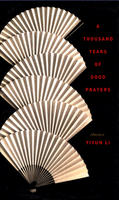
A Thousand Years of Good Prayers is Yiyun Li's highly acclaimed short story collection which won the inaugeral Frank O'Connor Short Story Award among others.

If proof were ever needed that US MFA programmes don't necessarily churn out writing clones, Li amply provides it. (She attended the famous Iowa Writer's Workshop). Her writing is fresh, lyrical - yet at times deeply disturbing. The short stories did precisely what short stories should do: illuminate small lives in telling snapshots, walk around in your head long after the few pages that contained them are read, shake you up.

It wasn't the best holiday reading - the collection made me feel weighted with melancholy for all the tangled lives Li depicts and the necessary makeshift compromises her characters are forced to make. I found it hard to snap out of the little worlds Li creates.

Most of the stories take place in a rural and small town China struggling with economic change and the move to a more free-market econonomy.

All human messiness is here. In Love in the Marketplace a schoolteacher obsessed with the film Casablanca, is the victim of a broken promise. A stranger who arrives in the market place offering to slash his arm with a knife for money is the only person who seems able to honour his word.

Extra is a hugely compassionate story about a middle-aged woman made redundant from her garment factory job. There's no way Granny Lin can survive on her dwindling savings and she reluctantly accepts a marriage of convenience to a sick old man. When he dies, she takes a job as a cleaner in a private school where she befriends a lonely little boy as much a reject as she is. Through both encounters, her eyes are opened for the first time in her life to the possibility and nature of love.

The Prince of Nebraska is the story of a complicated love triangle. Sasha, pregnant and on her way to an abortion clinic in Chicago seeks Boshen's help. Both of them are involved with the enigmatic Yang, a disgraced Chinese Opera singer. An unusual compromise is worked out between them for a love that does not fit neatly into the box of a conventional relationship.

But my favourite story - simply because I've come across a story narrated in this way before - was Persimmons. The slaying of local government officials puts a whole village under the curse of drought. The truth of what actually happened emerges gradually. Li writes the story in the first-person plural ("we") voice, as the whole doomed village speaks in one voice.

Would I recommend it?

I'd say it was a must-read, especially if you enjoy short-fiction or write it yourself. It deserved all the awards it received and is the best book I've read so far this year. (Sorry for gushing!)

If you want to read more about the author or the book, Yiyun Li has a website.