The National Library of Malaysia is planning to expand its 1Malaysia Reading Campaign by soon setting up reading corners at selected bus stations.
Its director-general, Datuk Raslin Abu Bakar, said they were in the midst of discussing the idea with the management of the selected bus stations in the Klang Valley and identifying suitable locations for the reading corners.
"The idea to set up reading corners at bus stations came up after our reading corner in Keretapi Tanah Melayu Berhad (KTMB) Intercity trains, launched on Dec 7, received overwhelming response from passengers."
Showing posts with label reading campaigns. Show all posts
Showing posts with label reading campaigns. Show all posts
Tuesday, January 12, 2010
Book Corners for Bus Stations
Some good news from The Star this morning :

Monday, November 09, 2009
Storyteller on a Train
 While I'm always moaning about reading campaigns in Malaysia never really taking off in any way that neither I nor the readers of this blog can see, I really applaud the National Library for its latest initiative.
The Star today reports that 90 children were taken on a four-hour train ride filled with story-telling, reading and singing of folk songs aboard KTM’s Sinaran Pagi as a prelude to the 1Malaysia Reading Campaign. During the journey from KL to Gemas in Negri Sembilan, the kids were entertained by singer Nurul Huda Abdul Wahab and Japanese children’s story-teller Saki Sasamori who has been resident in Malaysia for the past 15 years.
I hope this isn't a one off experiment ... it would be so nice to have to have something like this this continue.
Monday, October 05, 2009
Lydia Chai on New Zealand Writing
Lydia Chai very kindly agreed to guestblog a post for us :
October is New Zealand Book Month. Like Sharon Bakar, I have become an unlikely champion of my adopted country's literature. The only difference is that Sharon is a Brit living in Malaysia whereas I am a Malaysian living in New Zealand; and while Sharon promotes Malaysian books through her widely read blog, my sphere of influence extends to only a very small circle of friends in Auckland. A few New Zealand friends have mentioned to me that it is unusual for an immigrant like myself - Asian, no less - to have such an interest in New Zealand literature. One friend remarked that I put her to shame because it never before occurred to her to read New Zealand writers - a result of the 'tall poppy syndrome', she said. The tall poppy syndrome, for those of you who thankfully do not know it, is supposedly a social phenomenon particular to New Zealand and Australia, whereby the locals think it necessary to cut down to size their fellow men and women who succeed internationally. As a result, according to my friend, New Zealanders are more likely to pick up hipper novels by the likes of Julian Barnes or Jodi Picoult than ones by Lloyd Jones or Charlotte Grimshaw. Pity, that; as New Zealand boasts a lot of talented writers. Perhaps the fact that New Zealand Book Month exists at all is evidence that the tall poppy syndrome still persists and must be counteracted. Being a recent immigrant, I read New Zealand authors to make myself feel more at home here (another way I go about this proverbial nesting is by planting a vegetable garden to feel more connected to the land, literally letting it nourish me), since I learn more about a nation's psyche from its literature than from its history books. I learned, for instance, that New Zealand's literary identity was not always so unique and assured. Writers from earlier generations tended to borrow their voice from the English tradition. It was only relatively recently that writers had begun shedding their hang-ups about living in a country so remote from the rest of the world, and developed their own voice. The notion of 'looking back' interests me, for I am always 'looking back' to my tanahair: the distance provides a tension that is useful in my creative life. Moreover, I find it comforting that New Zealand writers have found a way to articulate the New Zealand experience without overly exoticizing their home - I'm hopeful that Malaysian writing will similarly evolve. It always thrills me to read a piece by a Malaysian author that has obviously been written with Malaysian readers in mind. Likewise with a piece of New Zealand writing. Tall poppy syndrome or no, New Zealand does heavily support its writers, as can be seen from its various annual literary festivals, heavily funded residencies and monetary awards. I do so love living in a country that highly values its writers. Here are my favourite blogs on the New Zealand literary scene: Books In The City (maintained by Auckland City Libraries' staff) Book Notes (the New Zealand Book Council's quarterly magazine) Trendy But Casual (author Paula Morris' blog) Chinglish (writer Renee Liang's blog; she organises the local poetry slams) The Elam Fine Arts Library blog Lydia Chai is a Malaysian artist residing in Auckland.
Friday, January 16, 2009
Now for the Good News!

There has been a measurable cultural change in society’s commitment to literary reading. In a cultural moment when we are hearing nothing but bad news, we have reassuring evidence that the dumbing down of our culture is not inevitable ...
says Dana Gioia, chairman of the National Endowment for the Arts, in The New York Times. A new report, Reading on the Rise: A New Chapter in American Literacy, shows that adults are now reading more literary works than they did previously.
Factors that helped reverse "the perilous decline" (recorded in the Endowment's previous study four years ago) include a programme called The Big Read :
... to encourage communities to champion the reading of particular books, like “The Great Gatsby” by F. Scott Fitzgerald and “Their Eyes Were Watching God” by Zora Neale Hurston.
(The complete list of books for The Big Read is here and would make a great guide for anyone wanting to make a start on becoming a more convinced reader - do take a look!)
 Also :
Oprah Winfrey’s book club, the huge popularity of book series like “Harry Potter” and Stephenie Meyer’s “Twilight,” as well as the individual efforts of teachers, librarians, parents and civic leaders to create “a buzz around literature that’s getting people to read more in whatever medium.”And we in Malaysia, of course, have something very important to learn from this!
Tuesday, August 05, 2008
Blokes Bribed to Books with Beer
 Luring blokes to read books with free beer * is a new one to me!
The organisers of New Zealand Book Month have announced a special evening of activities aimed at fathers and their sons to encourage blokes to pick up books .
Timed to coincide with Father's Day and entitled A Word in his Ear, the aim of the event at Auckland Town Hall is to promote reading as a "manly" activity :
in an evening of male bonding over sports, adventure and literature.Abebooks meanwhile has a very good list of Kiwi fiction.
(*Found via Literary Saloon)
(Pic shows Speight's beer which is brewed in New Zealand, but of course I have eno idea what brand of beer will be served.)
Tuesday, July 22, 2008
Turkish Readers
 Take comfort (!) in the fact that Malaysia isn't the only country with dismal reading statistics. ('Tis indeed a world wide phenomena.) Turkey Zaman reports [found via] :
Statistics shows that most Turks do not read on a regular basis. In fact, the average Turk spends only $10 a year on books. According to the United Nations 2007 Human Development Report, Turkey ranks 101st among 177 countries for its level of adult literacy. While Turks spend an average of five hours a day watching television, they devote only six hours in an entire year to reading. Furthermore, only 4.5 percent of the population reported that they are regular readers.The article talks about some initiatives aimed at getting people to read more. This I thought was great :
Some judges have also gotten into the act by ordering minor offenders to read books. Murat Şenol Demirci, who was convicted for firing shots into the air at a celebration of his friend's enlistment, was sentenced to reading four books every month for one year.Not surprisingly, the offender seemed very happy with his punishment!
Tuesday, July 15, 2008
Reading Clubs?
 The National Library has started a National Reading Club, launched July 1st, to help inculcate the reading habit among Malaysians, A. Kathirasen in the New Straits Times reports. The National Library has something to celebrate, it's membership has been rising steadily :
In 1990, it had 128,045 members, rising to 460,000 in 2001. The latest figure (as at July 5) puts it at 788,541.And the Unity, Culture, Arts and Heritage Minister Datuk Seri Shafie Apdal apparently said at the event that he would propose to the government that civil servants be given a book allowance, and he wants the private sector to do likewise.
Throughout the article it's rubbed in once again that Malaysians are failing miserably at becoming readers :
According to the national book policy target, germinated in 1984, the nation should have achieved reading society status in 2000. We are eight years overdue; and, it seems, nowhere near the target. ... The findings of a National Library survey, Shafie said, showed that only 13 per cent of 27 million Malaysians read books. ... Surely it is an indictment of our collective apathy and the failure of the hundreds of reading campaigns and book exhibitions.But as we've said before many times on this blog - What (hundreds of) reading campaigns? (As Kathirasen very tactfully puts it, there :
... has been an inability to sustain the momentum of campaigns.)None of my blog readers seem to know anything about them. The only thing I've personally seen to indicate a campaign going on is a single poster in the library of a single sekolah rendah. Surely the evidence of a reading campaign should be everywhere? This is pretty serious when you realise that a lot of taxpayers money is being spent. (We are probably more aware of the efforts of our southern neighbours than we are of our own. And look how much fun they make reading!)
Kathirasen goes on :
The government even declared 1988 The Year of the Reader. The campaign saw a flurry of activity, including the establishment of reading committees everywhere. What became of them?Who knew anything about these "reading committees"? What were they supposed to achieve? What is a reading committee anyway?
Ministers and directors-general ordered their underlings to set up reading corners in all federal, state and district government offices. There were calls to set up reading corners aboard trains and xpress buses, and in estates, factories and homes. What became of them?The people who are putting books into the hands of the public successfully are individuals who see it as a personal mission - people like Amir Muhammad with his great book giveaway at KLAB, the Malaysian Book Crossers who make reading free by "releasing books into the wild", Daphne Lee with her children's Reading Room in Section 17, our friend at Departure Lounge who has turned his cafe into a travel library, the teachers who have worked to make a difference in their own schools. We need more literary activists of this kind, small terrorist cells of book-lovers, making reading accessible, cheap and sexy.
Kathirasen gives some good suggestions for improving readership, but I do find it sad and depressing that hand-wringing articles like this appear in the newspapers at regular intervals. A lot of lip-service is paid, very little done that is effective.
I wish the National Library all the best with their National Reading Club, about which I cannot find any information on the internet beyond the fact of its launch. If there's anyone reading this who can enlighten us, please do get in touch and tell us about it.
Friday, April 25, 2008
Literary London
 Don't know about you, but when I travel I love to fit my reading to the place I'm visiting.
If you're off to London any time soon (one or two of you are there already!), you might enjoy this guide to the city in books, produced by Booktrust for the Get London Reading campaign. (The full, interactive map features 400 books set in, or about the capital, and if you find that any books have been forgotten - you can just add them!)
Of course Dickens and Conan Doyle are necessary choices, but there are plenty of suggestions for contemporary fiction including Sarah Waters The Night Watch, Zadie Smith's White Teeth, and Gautam Malkani's Londonstani.
Friday, January 11, 2008
The Brits Don't Read Neither
 It seems that readers in Britain are reading less according to figures from the Office of National Statistics. The London Evening Standard reports that a quarter of Britons say they have not read a book in the past year and this goes up to almost half of males aged between 16 and 24.
Yet, and this is deliciously ironic, nearly half of those surveyed admit to lying about their reading to appear more intelligent, while a separate survey had shown a third of Britons read "challenging literature" in order to seem well-read and so they could "join in the conversation" ... even though they could not follow what the book was about!
Meanwhile, the government is launching the National Year of Reading campaign. Among the initiatives is the encouraging bosses to set up libraries in former workplace smoking rooms. (Hoping to replace one addiction with another?)
Sian Pattenden makes some reading suggestions for the unconvinced on the Guardian blog, though I find her sniffily dismissive of contemporary British fiction. (What was Lost by Catherine O'Flynn, A Short History of Tractors in Ukrainian by Marina Lewycka, Animal's People by Indra Sinha, Gifted by Nikita Lalwani ... what's not to like?)
John Crace in the Guardian, of course, recommends his forthcoming book of digested reads. (And reckons the average reader reads 60 pages an hour - by which measure I am very slow indeed!)
Denise Winterman on the BBC website asks - do you need to read a book to be clever? Not necessarily, when so much information comes to us in other ways.
What intrigues in this piece is Professor John Sutherland's suggesting that books have lost their chic:
If you try and sell your house, estate agents will tell you to get rid of the books, they are viewed as tired and middle aged.*Gulp!*
I am feeling more and more like a dinosaur (called Bibliosaurus Text?)
Saturday, January 05, 2008
Prose, Not Prozac

Reading pushes the pain away into a place where it no longer seems important. No matter how ill you are, there's a world inside books which you can enter and explore, and where you focus on something other than your own problems. You get to talk about things that people usually skate over, like ageing or death, and that kind of conversation - with everyone chipping in, so you feel part of something - can be enormously helpful.Blake Morrison in today's Guardian writes about the therapeutic power of literature and investigates a new kind of book club, designed to heal illness both physical and mental. (The quote above is from a patient, as you probably guessed.)
Jane Davis's Get into Reading initiative runs more than 50 projects across Merseyside, Liverpool and has taken reading to:
... groups in care homes, day centres, neurological rehab units, acute psychiatric wards, cottage hospitals, sheltered accommodation and libraries; groups for people with learning disabilities, Alzheimer's, motor-neurone disease, mental health problems; groups for prisoners, excluded teenagers, looked-after children, recovering drug-addicts, nurses and carers ...with some truly remarkable results.
You can read more about the project on the organization's website and in their report here.
Sunday, April 22, 2007
Little Books with a Big Mission
 My article about World Book Day and how we get to celebrate it twice in Malaysia is in StarMag today. I have to tell you that it was written in record time (for me, anyway! Had to pretend to myself I was writing a blog entry between first and second cups of tea!)
Anyway, the article allowed me to do a little bit of tub-thumping over a couple of issues close to my heart - reading campaigns and books for marginal readers.
The Quick Reads series I mention in the article is I think a very exciting innovation - short, exciting reads by top writers, which are accessible to those who might find a longer book a bit of a struggle. They are not in any sense simplified readers and there is nothing dumbed down about them. This I think is a very important point.
New titles have just been released in conjunction with World Book Day 2007 including Lily by Adele Geras, Twenty Tales from the War Zone by John Simpson, Dr Who: Made of Steel by Terrance Dicks, The Sun Book of Short Stories and the delightfully titled Reading: My Arse! a novel by Ricky Thomlinson. The series is also supported by extensive resource material.
I have seen the books in Times in Bangsar Shopping Complex, but they were just mixed in with everything else. Other bookstores seem to sadly have missed the boat. (I have, though, ordered the whole set for the British Council Library and feel they will be ideal for the language learners who use the resources there.)
I reckon that if Britain has almost a fifth of the population who are sub-literate, Malaysia is likely to have a much higher proportion. You can't simply issue a government directive and tell people that they should read books. Many people can't read books!
But perhaps they can be lead to reading books if the stepping stones are put in place for them.
 The simple equation is this: if a marginal reader picks up a little book that they can finish without too much of a struggle, and has a very enjoyable reading experience, they will be looking to repeat the experience.
Anyway, it's World Book Day tomorrow, so why not buy a book for a close friend as a gift and present it with a red rose?
Wednesday, September 13, 2006
Happy 90th, Roald!
 If Roald Dahl were alive today, he'd be 90. Any excuse for a party!
Here's what you should do to celebrate, according to the Roald Dahl Day Challenge website:
- Wear something yellow – it was Roald's favourite colour!
- Wear one or more items of clothing backwards.
- Drop "gobblefunk" into your conversations (the unique language created by Roald and most commonly used bythe BFG).
- Swap a Roald Dahl book with a friend.
- Talk backwards.
- Tell a silly joke – Roald loved swapping these with his kids.
- Play an "unexpected" prank.
- Give someone a treat – Roald was a great believer in treats, whether it was a bar of chocolate or a lovely surprise.
- Write your own revolting rhyme.
- Make up an Oompa Loompa dance and get all your friends to join in!
(Carry a hard copy of this post in your pocket so you have an alibi if anyone wants to cart you off to the funny farm for Oompa Loompaing in the office.)
Now, me. I'm a huge Roald Dahl fan. I love his kids books (too good for children) but even more so his short stories. So clever. So nicely nasty. (If you've never read them, seek out his Tales of the Unexpected.)
Jeremy Treglown pays tribute to the master of the twisty tale in the Guardian.
Meanwhile, our Ted threatens guerilla-like readings of the good stuff in a bookshop near you. And the British Council and Times are celebrating the event in style.
Tuesday, August 08, 2006
A Lacklustre Campaign?
 Felt that this letter in the New Straits Times last week, asked some very useful questions. (Though couldn't an editor have done something about the very very wonky grammar?)
On Monday, the National Reading Month * had been on for a month. The launching of the reading campaign was done in the usual Malaysian way. A few activities were organised and the campaign was considered done. ... Dewan Bahasa dan Pustaka, which celebrated its 50th anniversary, must have been busy with its celebrations to have not joined in the lacklustre campaign.Okay, let's carry out a little poll ... what impact did National Reading Month 2006 have on your life? Did anyone who reads this blog take part in any activities?
How could we ever successfully become a knowledge society when the campaign was not followed through? Television stations did not play their role to encourage this culture. Except for the programme Resensi Buku on RTM1, there was hardly any promotion.
... It would be good to choose April as the National Reading Month as World Book Day is also in April and we can go all out to make the reading campaign a success. RW"
By the way - isn't this just the start of a five-year campaign costing RM40-50 million?
*(Sorry - I tried to find some information about the Reading Month activities online, but couldn't find a link. If anyone has more luck, please let me know.)
Sunday, July 16, 2006
A Nation That Reads ...
 Last November it was announced that the government was about to launch a huge campaign to encourage reading among the young. In today's Starmag Daphne Lee reveals that it was flagged off last week. (Did anyone hear about it?)
Culture, Arts and Heritage Minister Datuk Seri Dr Rais Yatim (left), in partnership with the Education Ministry and the National Library, has decided that this year’s reading campaign will last five years instead of the usual one month:
The campaign’s theme is Bangsa Membaca, Bangsa Berjaya (a nation that reads is a nation that succeeds).So how do you get people to read more? Dr. Rais admits that books have to be made more affordable and promises to investigate duty issues and ways of reducing local printing costs.
“A month is hardly enough time for a reading campaign to get started. It’s too short a time to see any progress and there is also no time for the public to participate in activities,” says Dr Rais.
He adds that the campaign will last throughout the Ninth Malaysia Plan (2006-2010) and that RM40mil to RM50mil has been allocated for the entire campaign, which works out to RM10mil a year.
“We will target everyone regardless of age and make the campaign a platform for public participation. Reading of all kinds of material will be encouraged – novels, non-fiction works, magazines, newspapers – in any language. It is all equally beneficial.”
He also acknowledges too the role that must be played by public libraries but laments that many are not well stocked (though I am pretty sure this is an area the government will be targetting). But there are some problems you can't throw money at: librarians need to play an active role in encouraging communities to read, but Rais suspects (most probably quite rightly) that they themselves do not read and therefore are not equipped to do a good job.
(Daphne's chat with National Library’s Director-General, Dr Haji Wan Ali Wan Mamat is ... erm ... revealing.)
Daphne highlights some very effective reading campaigns for children in other parts of the world from which we can surely draw important lessons and interviews Margaret Hamilton director of the Children's Book Council of Australia about the excellent work carried out by the organisation.
..it takes much more than book fairs, theme songs and bright ideas to get children readingsays Daphne. Now if she were spearheading this campaign ...
Friday, June 30, 2006
Read Singapore!
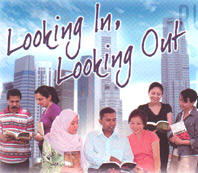 So how do you build a nation of readers?
It seems to me that Singapore is so much more proactive than Malaysia, where much lip-service is paid to the importance of reading, but little actually happens in the end after everyone has done their hand-wringing bit about the two pages a year are supposed to read. (A myth that gets perpetuated ad-nauseam.)
I was interested to read on Channelnewsasia's website about a great project, now in its second year, called READ!
... to promote a culture of reading among Singaporeans ... (and) an opportunity to rediscover the joys of reading, by creating a common topic of discussion and conversation amongst the people.The National Library Board organises a variety of activities and issues downloadable kits for folks wishing to start their own reading groups, which are apparently:
... popping up at the most unlikely places, even among hairstylists and taxi drivers.This year eight books reflecting the theme Looking In, Looking Out have been chosen for discussion. Two of the books are in English (The Kite Runner, which I'd say is an excellent choice, and Tuesdays with Morrie), two are in Malay, two in Chinese and two in Tamil - so there's something for every language group. (Not to mention the political correctness factor!) The books were selected on the basis of their appeal for readers of different races and ages, and their ability to move readers emotionally. The books also had to be affordable, easy to obtain and easy to read.
More about the project and pictures of the launch on the Rambling Librarian's blog.
Related Post:
Get KL Reading? (27/1/06)
Friday, January 27, 2006
Get KL Reading?

Now here's news of an initiative I wholeheartedly applaud:
The Get London Reading campaign, which will run annually from February 2006, aims to encourage Londoners to make more time for reading and promote London as an international centre for books. ... A challenge will be made to the book industry, cultural organisations, businesses and libraries, asking ‘what will you do to get Londoners reading?’. Responses, in the form of promotions, events, book groups in workplaces and writers in residence, will be collated in a free Get London Reading Guide Book.The event, led by independent charity, Booktrust, runs from 17th February to the 7th March 2006, and is timed to culminate in World Book Day. Other partners in the project include Arts Council London, British Council, and the London International Book Fair. Businesses and organisations across the city are encouraged to pledge their support and come up with "quirky and interesting intitiatives to engage readers and get press attention."
Some of the suggestions offered:
- A discount offered when the customer presents their Guide Book.
- Guide Book encourages Londoners to visit X bookshop on a specific date, to collect a free copy of X new title, of which 500 are available.
- Londoners could be encouraged to gather at a specific London landmark at noon on a specific date to hear Author X read from her latest work.
- Londoners could get a free coffee if they purchase three books, in association with X local coffee shop.
- Bookshops could offer a series of special breakfast or lunchtime events to encourage Londoners to take time out of their busy days.
A lot has been talked about the need to encourage reading here, and funds have been made available ... but so far nothing seems to be happening. What's happened to the proposed reading campaign announced last November?????
It is indeed very depressing to look at the activity calendar for reading events organised by the National Library. From January to December 2006 the pages tell you:
There are no activities organised for this month.Seems that really it's best for folks to organise things for themselves, and there's really no better place to start than thinking about World Book Day on March 2nd. Last year MPH and Instituto Cervantes were the only organisations in the city to celebrate it, as far as I know.
Perhaps this year your own organisation might like to mark the day in some way? If so, I'd love to hear about it ... You can check out the official website for fun ideas about how the event is being celebrated in England and Wales and get some inspiration.
Oh yes and ... hint hint ... you might just want to become a member of the British Council library before March 2nd. (More than that I can't divulge at the moment ..... shhhhhhhh!)
Sunday, November 20, 2005
Money Where the Mouth Is
 In the Star today, news that the government is to launch a huge campaign to encourage reading among the young. Culture, Arts and Heritage Minister Datuk Seri Rais Yatim announced that RM25mil has been allocated to start a campaign. Details will be announced next month, and all state and local governments, universities and schools will be involved. This is very good news, but let's just see how the money is to be spent before we applaud too loudly.
The article also outlines efforts being made by bookstores and the PJ Community library, and there's a very nice picture of my friend Renee Koh, marketing manager of MPH.
On the same page there's an article on the art of storytelling, featuring tale spinners Judy Shaik and Keats Markandu.
In the Starmag section, Daphne Lee has some excellent ideas for ways that parents can organise a reading week for their kids. Not only will parents be turning their kids into happy little book addicts, but it's all relationship enhancing stuff too, isn't it? The idea I like best, a reading-week party with costumes and suitable food.
Subscribe to:
Posts (Atom)