Philip Larkin
The poet claimed to have had a happy upbringing, but the famous opening to This Be The Verse – "They fuck you up, your mum and dad" – seems to suggest otherwise. His father Sydney Larkin, a Coventry city treasurer, was a cultured man with a love of jazz music, a passion that he passed on to his son. However, he was also fascinated with Adolf Hitler, keeping a small statue of the dictator on the mantelpiece of the family home which raised its arm in salute at the press of a button.
Sylvia Plath
The father of the American poet and novelist was a professor of apiology and German at Boston University who wrote a book about bumblebees. Otto Plath died when Plath was eight and she would later explore her non-existent relationship with him in her poem Daddy: "Daddy, daddy, you bastard, I'm through". Plath committed suicide in 1963 while her two children slept in the next room. In March this year, Nicholas, her son with Ted Hughes, hanged himself at his home in Alaska.
Eugene O'Neill
The American playwright's masterpiece, Long Day's Journey Into Night, is an autobiographical study of his own dysfunctional family. His father, James, was a successful touring actor and O'Neill was born in a hotel and spent most of his early childhood on the road. Later he blamed his father for his difficult family life which resulted in his mother's drug addiction and both parents appear as defeated characters in Long Day's Journey. O'Neill's eldest son committed suicide aged 40.
Showing posts with label writing about family. Show all posts
Showing posts with label writing about family. Show all posts
Friday, June 05, 2009
Disgraceful Dads
An old sepia portrait of Patrick Bronte, the tyrannical father of Charlotte, Emily, Anne and Branwell has come to light, and Chris Green uses the occasion to look at other famously troubled father-child relationships in literature :

Tuesday, March 10, 2009
Pain on the Page

I wrote about our son with huge trepidation. As a novelist, honesty has always been my goal: get it down as it really is, not as you would like it to be. In writing this story, I had to write and think about things I found very difficult, very intimate, sometimes shaming. I had to describe how it felt to watch your child – previously the gentlest person you could think of – kick down locked doors in fury because he’d been denied money. I also had to put myself in Mary’s mother’s place and, holding in my hands the pitiful little journal where she described burying one child after another, acknowledge that our life was not so bad. Our boy was still out there. We had hope.Julie Myerson's The Lost Child has recently attracted a great deal of controversy (e.g.), and the publisher has now brought forward the publication date to take advantage of the tide of outrage it has created. Minette Marrin in The Sunday Times said it was :
I finished the book. It took some courage to show it to my son, but I knew I had to. His response – typically generous and imaginative – is described at the end. A writer and a musician too, he understands that you write what you have to write. What he probably doesn’t understand is my impulse to share our experience with other parents. But for me that has become paramount. Not nearly enough is known or understood about skunk. There were times when we thought we were going mad. When other parents shared their (identical) experiences with us, it proved a lifelineBack to that thorny question of how far it is acceptable to use personal pain and family trauma as fuel for fiction.
... a betrayal not just of love and intimacy, but also of motherhood itself ...(And don't you just love Marrin's first line? :
A family into which a writer is born is a ruined family.)In the book Myerson (who was longlisted for the Booker in 2003) details her painful relationship with her son, Jake, and her decision to change the locks on the family home because of his use of skunk cannabis (apparently a genetically modified version and up to 30 times stronger than the usual stuff). To get an idea of just what she had to contend with, take a look at this extract from the book and this piece from The Telegraph. Another extract, which I lifted the quote above from, can be found here. (Am I the only one reminded of Lionel Shriver's We Need to Talk About Kevin?)
Jake Myerson, who now works in the music industry, sees matters in a very different light and told reporters :
What she has done has taken the very worst years of my life and cleverly blended it into a work of art, and that to me is obscene. I was only 17, I was a confused teenager, I was too young really to know who I was or what was happening. What she describes in her book are a series of incidents, it's not who I am and I find it very sad that she feels the need to tar me with the 'drug addict' brush. She's been writing about me since I was two, and, quite frankly, I'm not surprised by anything she does any more. She's a writer and like a lot of writers she is wrapped up in her own world - even if the worlds they are creating aren't quite true, they become true to them anyway, and I wasn't prepared to let her world colour mine any more.Anyway, this is all excellent publicity for the book ... just when we thought the market for misery memoirs was shrinking!
Worth reading is Charlotte Northedge's in The Guardian piece on the fallout of miserylit for the author's nearest and dearest. (Star readers will spot that the piece was reproduced in today's edition.)
Postscript :
Worth reading too is Geoffrey Myerson's account.
An interesting point from Neill Denny in The Bookseller :
The important overall point for the wider book trade is that the episode has served to underline the primacy of the book in our media hierachy. Would Myerson's revelations have counted for so much had they been expressed through any other media? A book confers a status and finality on a story that even now newspapers, television, the internet, radio—you name it—can only dream of. Remember that the next time you hear some media pundit glibly predicting the death of the book.
Sunday, November 23, 2008
Things Turn Ugly for Constance Bristow
 Readers of this blog will know that truth vs fiction in memoir writing is a topic that has come up again and again over the past year or so, as the demand for stories depicting (particularly miserable) real life experience has grown.
Now things have turned ugly (if you will forgive the pun) for Constance Briscoe who is being sued by her mother over allegations of physical and emotional abuse made in her memoir.
Mrs. Briscoe has called her daughter, who is one of Britain's first black female judges, a "wicked thief and a liar" and told the court that she had forged documents for her defence. Briscoe admits she made some mistakes with the details in her book, but stands by the substance of her allegations. The case continues.
You can watch an interview with Briscoe on Sky Television's The Book Show :
Postscript :
On the Guardian blog Alison Flood asks whether this is the end of the "misery memoir".
Another Postscript :
Briscoe breaks down as she gives evidence and tells how she attempted suicide by drinking bleach, because of her mother's cruelty.
Friday, September 05, 2008
Author as Vampire
Jason Steger looks at Fact, fiction and the writer's quest for 'a kind of truth' at The Age. I live this quote from author Helen Garner :
Artists are robbers and use the lives around them, and the ones who don't are talking bullshit.
Sunday, July 13, 2008
Complete Surrender
 Real life has the habit of being stranger than fiction, and this is nowhere more convincingly confirmed than with the story of how Ian McEwan discovered that he had a brother he had never known about.
But it was really Dave Sharpe's story to tell, and tell it he has, in a (ghost written) memoir Complete Surrender, due to be launched if a few day's time.
McEwan's foreword for the book, which can be read on the Guardian website, is a most moving essay about how his brother's illegitimate birth and handing over to strangers on a railway platform has forced a painful reevaluation of family history, and of parents who almost certainly carried the pain of the lost child (whose existence they never acknowledged) to the end of their days.
Sunday, June 15, 2008
Literary Daddies
 Happy Father's Day to those who are one. (I always know when the day is coming round from all the fancy ties and boy toys on sale in the shopping malls!) Hope your families make the day really special for you.
To mark the day, eight British authors including Will Self, Jackie Kay, Lionel Shriver, Chimamanda Ngozi Adichie, and Toby Litt describe their relationships with their fathers in The Observer.
Monday, May 26, 2008
Isabel and the Family Saga
 I was sad that I missed Isabel Allende being interviewed on the BBC's Hardtalk by Sarah Montegue the other day about her new memoir The Sum Of Our Days. It isn't possible to watch the programmes on the BBC website anymore now that they are changing to a new system (the BBC i-Player) which we can't subscribe to here (yet?). But some kind soul put a fair chunk of the interview on YouTube (Part 1, Part 2).
Allende talks about how she draws on her family for inspiration, how this is the second memoir written to Paula, her daughter who died, and also about how she writes.
What you may not know - she starts every new book on January 8th, and before that doesn't even know what the first sentence will be, let alone the plot!
Best quote from the interview :
If I had to chose between a relative and a good story, I'd chose the story.There's more about the book on the Harper Collins website.
Thursday, May 08, 2008
Houellebecq's Mummy Denounces Her Son!
 Michel Houellebecq is perhaps France's most revered contemporary author but his 83 year-old mother, Lucie Ceccaldi, has now written an autobiography, L'Innocente (The Innocent One) in which she denounces her son as :
... an untalented social climber whose ego is only matched by his dishonesty ...She goes on :
What are these novels where nothing ever happens? ... This individual, who alas! came out of my tummy, is a liar, an impostor, a parasite and especially, especially, a little upstart ready to do anything for fortune and fame?and she is apparently threatening to knock his teeth out with her walking stick if he mentions her again in one of his works.
 Adam Sage in The Times explores the origins of the long-standing feud between the two while Angelique Chrisafis in the Guardian scoops the first British interview with Lucie.
Well, this is one mum you can bet won't get a Mother's Day card this Sunday!
Saturday, March 08, 2008
Yasmin has Something to Tell You

So there is a new novel out by my brother ... . I was, of course, relieved to learn from a recent review that the central character's sister wasn't based on me, but appears to be another family member. There is quite a bevy of us now – my mother and father in The Buddha of Suburbia; Uncle Omar, portrayed as an alcoholic in a bedsit in My Beautiful Laundrette, then lauded in Hanif's memoir, My Ear at his Heart; an ex-girlfriend, Sally, who renamed his film Sammy and Rosie Get Laid as "Hanif Gets Paid, Sally gets Exploited". A semi-autobiographical novel, Intimacy (1998) centred around a man leaving his wife and kids for a younger woman. Tracey Scoffield, his ex-partner ("the wife") was not impressed. She stated that the book wasn't a novel: "You may as well call it a fish." There are probably many more...
 Yasmin Kureishi speaks out in the Independent about her brother's appropriation of family members as fiction fodder.
Hanif talks about his new novel, Something to Tell You, growing up a non-white kid in London, and family relationships in the Telegraph.
I am a huge Kureishi fan and have read just about everything he's written including screenplays, but this piece really does raise once again the great moral dilemma for writers. How much of your family life should you feel able to put in your work? Is the art in the end more important that whether feelings get hurt? (The question has of course come up on this blog several times before.) And, of course, does Kureishi go too far?
I see an awful lot of self-censorship by writers who say, I can't possibly tell the story while so-and-so is alive ... and a lot of good material that is never likely to be used.
Wednesday, October 03, 2007
Authors and the Family Secrets
After a beautiful Balinese welcome dance and Festival Director Janet De Neefe's speech on first day of festival ...
... four hectic days of non-stop book talk kicked off.
The first session I attended was a very interesting one on family, and why authors are drawn to write about them. The speakers were British novelist Patrick Gale, Australian author Jo Dutton, and Egyptian writer/translator/critic Somaya Yehia Ramadan with moderator Rosemary Sayer.
Patrick Gale said that he has spent his first 20 years as a writer thinking that he had to make it all up, and only tackled his family head-on in Rough Music finding the process very amusing:
Jo Dutton grew up in the Solomon Islands, and later moved with her family back to Australia, and described how her father wasn't really a presence in her life as parenting was seen as a feminine prerogative, and how she now finds it difficult to write fuller male characters.
Patrick Gale said that he felt that men of earlier generations were not really raised to be interesting as people - but that there was far more going on in the stories of women of that generation as they had to constantly reinvent themselves at different points in their life, and it is also often the mother who provides the official version of the family story. Younger men he feels are far more interesting than their fathers and grandfathers, as they have more to challenge them and often carry half the can when it comes to parenting.
But isn't writing about family a little dangerous in case relatives recognise themselves and never talk to you again? This is I know the fear of many novice writers, and I'm so glad the question was asked.
 Patrick Gale signs books.
... four hectic days of non-stop book talk kicked off.
The first session I attended was a very interesting one on family, and why authors are drawn to write about them. The speakers were British novelist Patrick Gale, Australian author Jo Dutton, and Egyptian writer/translator/critic Somaya Yehia Ramadan with moderator Rosemary Sayer.
Patrick Gale said that he has spent his first 20 years as a writer thinking that he had to make it all up, and only tackled his family head-on in Rough Music finding the process very amusing:
When a writer is born into a family, the family has had it!Somaya said that she grew up in a nuclear family at the time when Egypt had just started it's thrust to modernity, and she felt that she had really missed out not growing up in a large extended family.
Jo Dutton grew up in the Solomon Islands, and later moved with her family back to Australia, and described how her father wasn't really a presence in her life as parenting was seen as a feminine prerogative, and how she now finds it difficult to write fuller male characters.
Patrick Gale said that he felt that men of earlier generations were not really raised to be interesting as people - but that there was far more going on in the stories of women of that generation as they had to constantly reinvent themselves at different points in their life, and it is also often the mother who provides the official version of the family story. Younger men he feels are far more interesting than their fathers and grandfathers, as they have more to challenge them and often carry half the can when it comes to parenting.
But isn't writing about family a little dangerous in case relatives recognise themselves and never talk to you again? This is I know the fear of many novice writers, and I'm so glad the question was asked.
People are so self-deluding, they very rarely recognise themselves.said Patrick Gale said, while Jo Dutton added that:
People tend to take something that's great in a character and assign it to themselves, but when they see the negative they assume it's not them.Another writer (I think it was New Zealand poet Tusiata Avia but can't find the place in my notes at the moment) said exactly the same thing in another panel discussion a few days later, so really, there must be something in it!
 Patrick Gale signs books.
Friday, May 19, 2006
Fictionalising Family
You're writing a story which is based on your family history: how much can you change and invent? This question that came up a couple of times in my class at British Council last night, when my participants were sharing work they'd written.
The reader of course doesn't have a clue where fact ends and fiction begins, but the writer might well have a family unhappy to let those skeletons out of the cupboard to walk in the sun.
I know of one local writer who has written a pretty good autobiography but he is too afraid of what his relatives will say to put the thing before the public. (This is a great pity, becasue it's certainly the best thing he has written.) Instead he mines his material from time to time for short stories which he passes off as complete fiction.
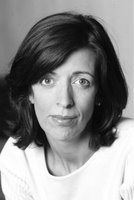 Anyway, I promised my writing group that I'd paste up a link to this article which shows how one novelist has resolved the dilemma for herself.
By the way, if Louise Doherty's name and picure look familiar, it's probably because you are following her excellent A Novel in a Year column in the Telegraph.
The reader of course doesn't have a clue where fact ends and fiction begins, but the writer might well have a family unhappy to let those skeletons out of the cupboard to walk in the sun.
I know of one local writer who has written a pretty good autobiography but he is too afraid of what his relatives will say to put the thing before the public. (This is a great pity, becasue it's certainly the best thing he has written.) Instead he mines his material from time to time for short stories which he passes off as complete fiction.
 Anyway, I promised my writing group that I'd paste up a link to this article which shows how one novelist has resolved the dilemma for herself.
As ideas go, basing a novel on one's family history has, at first sight, a pleasing simplicity: the ready-made cast of characters, the bare bones of a plot. But I soon discovered that there were other issues which make the process far more complex than I could have imagined.writes Louise Doughty in the Independent. Her novel Stone Cradle is based on the life of her romany gypsy forebears. She first of all faced the problem of naming her characters:
If you use the real names along with real events then what, precisely, makes your novel a novel? The fact that you have made up bits you couldn't find out about, or elided over anything awkward? The beauty of your prose? Many a memoirist has done as much. But a memoirist is entitled - even obliged - to say in places, this much I am only guessing at. This much I could not know. A novelist has no such excuse.She decided that she would change names, which she felt gave her greater freeedom:
... to invent where I could not discover and to explain discoveries that did not suit my invention in whatever way I saw fit.But, she cautions:
A family history is never your history alone. It is collective. It belongs to a whole set of people, many of them still alive, and however respectful you try to be of other people's opinions and feelings, there is no getting away from the fact that when a history is written down, there is a sense in which that becomes the authorised version, simply because it is a version which can be read by strangers.All's fair in love and fiction, I'd say!
By the way, if Louise Doherty's name and picure look familiar, it's probably because you are following her excellent A Novel in a Year column in the Telegraph.
Tuesday, May 16, 2006
The Vampire and the Alimony Whore
 Breaking-up is hard enough at the best of times. But how much more painful must it be when one partner is a writer and draws on the pain of a relationship to provide fuel for fiction?
Peter Carey's ex-wife, theatre director, Alison Summers found herself in the unenviable position of having to explain to sons Sam and Charley why they were all suddenly being beseiged by journalists around the world:'
Your dad has written a book and apparently the main character resembles him and the ex-wife resembles me in the way he has been talking about me the last three years.'Carey's latest novel Theft: A Love Story has just gone on sale in the US. It's a story of an art theft but features an acrimonious divorce between an Australian artist and a nameless woman he refers to as 'the Plaintiff' and 'the alimony whore'. The author denies any autobiographical reference, but Summers sees the novel as a thinly veiled attack and calls Carey 'a vampire' because, she says, he has consumed everything in her life.
(The whole story here and here in the Sydney Morning Herald and thanks Iolanda for the link. The picture above also from the SMH shows the couple in happier times - obviously.)
Of course, other authors have drawn on painful divorces and today's Independent has a list of them:
In 1984, the columnist Julie Burchill walked out on novelist Tony Parsons leaving him to raise their son Bobby single-handedly. He later published Man and Boy, a tear-jerking story of a single father and his son. Burchill says:
I've always been sceptical about how much the characters in Man and Boy resembled us - the runaway wife and mother is decent, slender and dull, while the saintly husband and father is attractive, good in bed and has all his own hair. Which, quite frankly, rules us both out.Touché!
Philip Roth's ex-wife, actress Claire Bloom, described him as "cruel, erratic and emotionally manipulative" in her autobiography. He exacted his revenge with I Married a Communist, in which the character of Eve Frame is based on Bloom.
Hanif Kureishi said of his novel Intimacy that it was about the demise of a relationship and he wanted to be "intentionally horrible - I wanted to write about an event as it happened".
Kureishi's former partner Tracey Scoffield, called the book was an unfictionalised account of the end of their relationship. She said his attempt to call the work a novel was "total hypocrisy - you might as well call it a fish. No one seriously believes that the book is only fiction. It all shows how little responsibility he feels towards his children."
Anyway, the moral of the story is just think twice before you marry a novelist!
Related Posts:
Kidnapping Peter Carey (25/5/06)
Subscribe to:
Posts (Atom)