 And talking as we were of Japanese authors ...
The other day Swifty pointed the way to a very interesting piece written by his friend Justin taking issue with Kyoko Mori's list of essential Japanese reads in Salon.com. Justin's alternative list is here.
Now I'm happy to admit areas of ignorance, and Japanese literature is a big one. I resolved to do something about that some time back, but somehow haven't yet got round to it. (More effort needed here, girl!)
Cue a story:
Just after the Litfest I had dinner at House of Sunda with my friends from the Japan Foundation and the guest writer they had brought to the festival, haiku master Kyoji Kobayashi.
The reason for the dinner? It was a hastily arranged affair (organised by Lorna Tee who was working with me) intended in some small way to make amends for Mr. Kobayashi's name being left out of the official programme booklet and the very real hurt and embarassment it had caused. Ouch ouch and ouch again.
Apology is taking responsibility. Hospitality smooths over hurts.
Paul Bailey was also taking a couple of extra days in KL (wanting to recover from jetlag acquired flying from the UK, before he had to fly back to the the UK again!) and was holed up in his room at the Renaissance beavering away on his next novel. I was scared that he was feeling lonely and invited him along as well.
Paul is a great supporter of literature in translation and a jury member for the Independent Foreign Fiction Award, and I was most impressed - and clearly so was Mr. Kobayashi, by how much he knew about Japanese literature.
Dinner at first a little formal but as the wine bottles emptied, Kobayashi who’d hitherto spoken through an interpreter (a beautiful and very gracious lady who has lived in Malaysia for many years) began to launch out into perfectly serviceable English. I asked both writers to write down a list of titles I must read, and then the conversation fairly flowed.
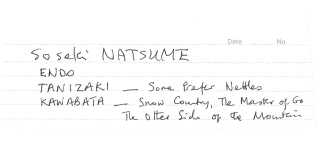
Those are the names and titles Paul finally scribbled down for me in my notebook (picture above) with Kobayashi's approval:
Soseki NatsumeTo my disappointment the list did not include Haruki Murukami. When I asked how he was regarded in Japan, there was an eloquent silence ...
Endo
Tanizaki - Some Prefer Nettles
Kawabata - Snow Country, The Master of Go, The Other Side of the Mountain

