Showing posts with label paul bailey. Show all posts

Thursday, September 07, 2006

My Friendly Guides to Japanese Literature

And talking as we were of Japanese authors ...

The other day Swifty pointed the way to a very interesting piece written by his friend Justin taking issue with Kyoko Mori's list of essential Japanese reads in Salon.com. Justin's alternative list is here.

Now I'm happy to admit areas of ignorance, and Japanese literature is a big one. I resolved to do something about that some time back, but somehow haven't yet got round to it. (More effort needed here, girl!)

Cue a story:

Just after the Litfest I had dinner at House of Sunda with my friends from the Japan Foundation and the guest writer they had brought to the festival, haiku master Kyoji Kobayashi.

The reason for the dinner? It was a hastily arranged affair (organised by Lorna Tee who was working with me) intended in some small way to make amends for Mr. Kobayashi's name being left out of the official programme booklet and the very real hurt and embarassment it had caused. Ouch ouch and ouch again.

Apology is taking responsibility. Hospitality smooths over hurts.

Paul Bailey was also taking a couple of extra days in KL (wanting to recover from jetlag acquired flying from the UK, before he had to fly back to the the UK again!) and was holed up in his room at the Renaissance beavering away on his next novel. I was scared that he was feeling lonely and invited him along as well.

Paul is a great supporter of literature in translation and a jury member for the Independent Foreign Fiction Award, and I was most impressed - and clearly so was Mr. Kobayashi, by how much he knew about Japanese literature.

Dinner at first a little formal but as the wine bottles emptied, Kobayashi who’d hitherto spoken through an interpreter (a beautiful and very gracious lady who has lived in Malaysia for many years) began to launch out into perfectly serviceable English. I asked both writers to write down a list of titles I must read, and then the conversation fairly flowed.

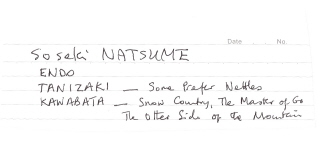
Those are the names and titles Paul finally scribbled down for me in my notebook (picture above) with Kobayashi's approval:
Soseki Natsume
Endo
Tanizaki - Some Prefer Nettles
Kawabata - Snow Country, The Master of Go, The Other Side of the Mountain
To my disappointment the list did not include Haruki Murukami. When I asked how he was regarded in Japan, there was an eloquent silence ...

Friday, April 07, 2006

Bailey in the Bar

(Glimpses from behind the lines organising the first KL Litfest, taken from my notebook. This was written August 2, 2004)

I meet British author Paul Bailey for the first time at a dinner arranged by in a local the director of British Council on the first evening of the Litfest. One day down and two more to go. I’m exhausted and in terrible need of a cold beer. A quick shower and a change of clothes. Jalan Ampang is so choked with cars that I’ll never get a taxi, and decide to walk briskly to the restaurant (which I know is in the road behind the twin towers, in an old colonial bungalow). The rain starts to fall gently and I am afraid that I will arrive both wet and late. Fortunately I am neither.

The British Council people are there already with Paul. (The first impression I have of Paul is what remarkable blue eyes he has!). Raman and wife join us – very late because they decided to drive. We sit down for a meal of local Malay dishes – very nicely cooked beef rendang, pumpkin in coconut milk, chicken curry – everything served so ethnically (on a banana leaf in a little woven tray) so that it looks more authentic than real Malay food. And the beers – everyone else drinking wine – slide down really easily, dissolving the tensions of the day.

It’s a little strange sitting down to talk for the first time with someone in whose head you have been living so intensively for the past couple of months – or is it has he been living in my in my head? (The uncanny alchemy between reader and read.) I’ve read six of his novels and enjoyed them greatly, his two books of memoir and one of his biographies. He’s been short listed twice for the Booker - that holy grail of literary success – making him one of Britain’s most significant novelists.

We’re all a little formal and polite, but Paul is amusing company, a great storyteller – we laugh at his descriptions of previous trips for the British Council, especially his account of his trips to Romania, a country he loves for it’s sheer absurdity. It’s strange though, I smile through the stories but already know what he is going to say – could even finish them for him because I’ve read his memoirs …

At the end of the evening worried that I won’t have much chance to see much more of Paul who has a very full schedule for the next few days, I pour the pile of books from my bag and ask him to sign them, which he does, graciously, taking time to put a different inscription in each. Raman and missus have agreed to give me a lift back to the hotel and just as we are walking out wife hisses at me, did you have to keep him talking so long, some of us want to get to bed. Anyway, I don’t know what you find so exciting to talk about in books, she adds. And I fix her with a very deliberate glare and say – listen, this is my reward for all the hard work I’ve put into organising the literary festival. (She didn’t think I was in it for the money, did she?)

Back a the hotel I drop by the bar. We’ve organised a songwriter’s round with four singer songwriters taking turns to play and tell the story behind the song. The music is excellent (Mia has a voice that makes the hairs raise on the back of your neck) and the bar is full of enthusiastic listeners. And just as I get there I find Paul Bailey there propping up the bar already, (goodness, he doesn’t waste much time!) and we both laugh and resume our chat over a drink feeling much more relaxed by now.

And Paul asks me and I know he’s going to (because didn’t I just read his memoirs?) – is there a gay scene in Kuala Lumpur? I laugh and say that I don’t know much about it, but I’ll introduce him to some friends who will … and I catch Pang and Jerome as they come off stage and there’s Bernice and Zedeck and Lorna and so many others to introduce to him as well. I make my excuses because I’m exhausted and need to sleep (but as it happens I have my second almost sleepless night thanks to an equal measure of excitement and anxiety.) And I know I’ve left Paul in good hands.

Apparently, after I left, Paul did a reading of an episode from his memoirs – his first gay encounter (with a London bus conductor), which went down very well. Singaporean poet Alfian Sa'at also read. Paul was so taken with Alfian’s writing (and perhaps with him???) that he said he wants to help him find a UK publisher. Hey, how’s this for networking!

Over the next few days I get to know Paul rather better. The British Council has him scheduled in for a number of things: there’s the meet the author session where he reads from his books and talks about his work, a forum on the state of literature and publishing, book signings, and a talk at the national library which I have organised. But in the evenings, he’s back there at the bar. And I have such a great time talking to him about his books and how they were written. I’m really chuffed when he tells me that my interpretation of “Sugarcane” (the novel I liked the best) is an excellent reading of the book. But there’s a strangeness in having the puppeteer tell you how he manipulates the strings. I was so fond of Gabriel in “Gabriel’s Lament” – don’t really want to know where the idea for making him a cross-dresser came from – believe in the character’s authentic separate existence and as a reader really don’t want to know more. (Though as a writer …)

Saturday night and the last night of the Litfest, I’m too exhausted to move, to even go home although all my work is finished. I have dinner with Jean in the hotel coffee shop – can barely even eat because I’m feeling so exhausted. Paul joins us, and his company is enough to make me feel much better. We meander back to the bar for a while. He’s anxious to see Pang, Jerome, Zedeck and Alfian … the lovely young men … but tonight they aren’t around. We sit and have a drink with a couple of local writers and film director Sean Walsh (the guy who directed the James Joyce film “Bloom”). I SMS MissFixIt who tells me that the whole gang is at a night club across town and asks us to join her. I’m shattered but Paul wants to go, and I’m so worried about him not being able to cope with taking a taxi and look after himself that I end up agreeing to go along with him to Frangipani.

How long is it since I went to a nightclub? Paul’s a pensioner and much more into wild nightlife than I am. We pour into a taxi. The driver tries to rip us off thinking that we are tourists but I get angry and chide him in Malay and he agrees to stick to the meter plus the after midnight charge.

Frangipani is a small, very intimate nightspot lit by candlelight. There’s a private party going on but no-one minds that we gatecrash. The party has an Indian theme; everyone is wearing bindi (the dots on the forehead) and garlands of jasmine and dancing to Indian music with a heavy beat. All our friends are there having a good time. It’s the nicest possible end to the festival. MissFixIt and I laugh about how we want to stage a coup and make a future Litfest our own – both of us loving to work with writers and be in the centre of things, but knowing that we will never work with Raman again a because of his rudeness. And we're so high this night that everything seems possible.

Mending Japanese Bridges

(Glimpses from behind the lines organising the first KL Litfest, taken from my notebook. This was written August 3, 2004)

The Japanese were hurt.

In the Litfest programme booklet there was a biodata for every invited writer – but not a word about the writer they were sponsoring – Kyoji Kobayashi. (I refused to be involved with the bookletbecause I knew I had to say no to some of the things he was piling on me).

Now I really felt bad for the Japan Foundation guys who had taken so much trouble to find a writer for us and fly him out, and who were also sponsoring a series of films based on Japanese novels. As soon as they realised what had happened, they hurried back to their office and printed off their own fliers with the biodata on.

Raman did apologise verbally for the in his opening speech, but the Japan Foundation guy – Shimadasan, asked for a letter of apology. No problem I told him and relayed the request to raman, but was too busy to follow up on it until after the Litfest had ended.

On the Monday morning, I suddenly remembered about the apology letter. I called up Raman who had decided to stay home for the day rather than open up the shop. He didn’t want to be reminded about the letter. I’ve apologised already, he said impatiently. But what about the letter we promised? Small matter, he said. Not small I argued. I said that I would write it – all he had to do was print it out on headed notepaper and sign it, and then I would come by and pick it up from him and deliver it personally to the Japan Foundation. He said I’m not going to open the shop just for that, so forget about it.

I read up a little about apologies in Japanese culture on the internet – when you apologise it means that you are accepting responsibility for something – and when you apologise in Japanese, the words for apology are exactly the same as those for thanks. So I constructed a letter which I made a letter both of apology and thanks for his sessions especially the haiku workshop from which I learned a lot. I constructed a letter head from the logo on the web page and signed the letter myself.

Before I could drive over to the city centre, Lorna Tee contacted me. She also was feeling very bad about this matter and was very indeed angry when I told her that Raman was refusing to write this letter himself. She had fixed up dinner with the Japan Foundation people as a move to mend bridges, and asked myself and Usha along. I wanted anyway to take the chance to say goodbye to new friends who would soon be leaving. I went back to the hotel and called up Paul Bailey’s room and asked him.

If he wanted to go for dinner and he seemed very pleased that someone had thought about him. (He had decided to stay on for a couple more days after the Litfest because it seemed ridiculous flying out all this way for just three days. He hadn’t spent the time sightseeing though, but had been shut in his room working on his novel.)

I was also so happy to see Ken Wiwa and say good bye to him before he left for the airport to catch his flight back to Canada.

We all met up at the excellent Indonesian restaurant at the top of the Suria shopping centre. Dinner at first a little formal but as the wine bottles emptied, the Japanese opened up a bit more and the writer, who’d always spoken through an interpreter (a beautiful and very gracious lady who has lived in Malaysia for many years) began to launch out into quite passable English. And once we began to talk about Japanese literature (about which Paul was very knowledgeable and I knew next to nothing), the conversation fairly flowed with the others contributing to a booklist of what I had to read. (A list which did not include Haruki Murukami strangely enough, whose books are not really regarded as serious literature in Japan. When I asked how he was regarded in Japan, there was an eloquent silence …)

By the end of the evening the fences were well and truly down. I had a good long chat to Shimadasan who invited me to have coffee with him when I called in to take a look at the Foundation’s library. And Kobayashi was both delightfully loquacious and flirtatious. When I left to take my train, I bowed very deeply to show him the respect he deserves (really getting into this cross-cultural thing!). And I felt very sad to kiss goodbye to Paul, who has become a friend ... Wonder if I will ever hear from him again?

Saturday, March 05, 2005

Favourite Characters

To celebrate World Book Day, the Independent asked 100 "literary luminaries" (love the term!) who their favourite characters in literature are. You can read their answers here.

Who would you choose?

I'd have to toss a coin to decide between Mr. Petulengro in George Borrow's Lavengro and The Romany Rye (very much overlooked Victorian classics - Borrow was the writer of the original "road" novel), and the eponymous Captain Corelli, created of course by Louis de Bernieres. Lost my heart to the both of them - they charmed, they made me laugh. What more do you want in a man?

Fell in love with a couple of Paul Bailey's characters when I gobbled down as many of his books as possible pre-Litfest last year. Gabriel in Gabriel's Lament and Steven the young rentboy in Sugar Cane (it's sequel).

"Don't you think Gabriel's a bit of a wimp?" Paul asked me when we were talking about his book during one of our (several) bar propping sessions "Most readers do."

I was a bit miffed that the author didn't feel like defending his protagonist. Okay, so Gabriel is a cross-dresser and can't get turned on unless he's wearing a woman's frock. But he's a survivor, coping heroically with his monster of a father and his mother's mysterious disappearance. I love his gentle, almost feminine strength and dogged determination. And the guy can cook up a storm ...

Paul then started telling me about the real-life guy he based the character of Gabriel on. And do you know - I felt terribly divided in my loyalties. The writer part of me was fascinated to see the idea for the character had come from and flattered that his creator would reveal inside information. The reader part of me was absolutely appalled - I didn't want my belief in the character to be undermined ... even by the author!

And had the oddest feeling that Gabriel existed somewhere quite independent of this author who claimed ownership ...

Saturday, December 04, 2004

According to Beryl

Amazed sometimes how fortunate I am.

Yesterday had the opportunity to talk to author Beryl Bainbridge via video link up as I was chairing the discussion for The British Council who are doing their best to promote British writers .

Second time I’ve done this. First video link-up was a few months ago with David Lodge. Then of course we had the real life (larger than life!) Paul Bailey at the Litfest. It’s a little nerve-wracking – you wonder whether you will just appear foolish with your questions. There’s always a mad rush to prepare by reading enough of the books and reading widely enough on the internet so that you don’t make a fool of yourself. I’ve learned now that the best questions are general, so that even if the audience haven’t read the author (and most of them haven’t) they won’t feel too out of their depth.

We only heard that we were linking up with Ms. Bainbridge a couple of weeks ago. The other accomplice in “we” is The Edge’s Sheila Singham who conducts an exclusive interview for an hour before the public session begins. We had our usual panic around for copies (luckily I had three of her novels on my bookshelves to lend Sheila and managed to find others in MPH) and spent half an hour or so in the little cafĂ© outside the British Council comparing notes and questions. I hadn’t read as much as I wanted to before hand – doing the Nanowrimo made it virtually impossible to have anyone else’s words in my head for that month. But I loved “According to Queeney” and had read it only a few months previously. I had also read “The Bottle Factory Outing” but so long ago I couldn’t remember it at all, and “Master Georgie” – which I wasn’t sure I liked. I had managed to read at least the first few chapters of several more at least to get a taste.

I was, of course, in awe of Bainbridge – 5 times nominated for the Booker, winner of many others including The Whitbread, made a dame. But from what I’d read … and from what Paul Bailey said about her when he was here, knew that she would be fun … and so it turned out.

Our audience this time was very small. Are there really so few booklovers in KL, so few wannabe-writers who wish to learn a little more about their craft from one of the greatest living novelists? Maybe the timing wasn’t good for working folks.

Anyway, we had Leon Wing join us. He’d heard about the session from my posting on MyWordUp and amazed me by saying that he was a terrific fan and had read everything.
Also in the audience were Joanna Thorpe of British Council, Diana Cooper, and Jagdev – a lecturer from UTM. I think the five of us asked all the questions between us.

Joanne asked first of all how we should address Ms. Bainbridge. The British are often sticky for correct protocol. David Lodge had wanted the formality of “Professor Lodge” throughout his interview. But here we were talking to just “Beryl”.

A slightly blurred image on the screen of Beryl, dressed all in black, wearing reading glasses, sitting at a table. She read for us from “According to Queeney” her novel about the relationship between Samuel Johnson and the Thrales. An amazing, luminous novel, which made me feel like a fly on the wall as history unfolded. (It helps too that I’m extremely fond of Samuel Johnson, and if I ever had a dinner party to which I could invite anyone I wanted living or dead, he definitely would be there!)

Her reading was punctuated by coughing. She was an infamously heavy smoker for most of her life, but I’d read that she’d given up for health reasons. (Later she said that she’s only coughing now because she doesn’t smoke anymore!) She also blames giving up smoking on the writer’s block which is preventing her from being able to think of the opening section of her new novel. “Smoking is a release for the soul”, she said. (I came home and quoted that at Abu who loved it.)

Of course the first question I asked was about why she had shifted from writing novels which were largely autobiographical to the historical novels of recent years. I also had the answer up my sleeve – was it, as Paul Bailey confided, that she had killed off all her family in the earlier novels and this had nothing to write about. She hooted with laughter and said that it was very largely true.

But, she said, (and I couldn’t quite believe my ears) “I’ve never seen the point of writing fiction”.

She says that for her earlier books she borrowed the plots from newspaper stories, and then populated them with people that she knew – principally her own family. She says that characters come to life in fiction, because they are people you already know. She wouldn’t dream of including people she hasn’t learned for at least 20 years. For “Harriet” her murder story, she said she stuck herself and her friends in. “The Dressmaker” was based on her aunts. And when Leon asked about whether “Sweet William” was based on anyone she knew, she said “Yes, and I had a child by him.”

For her historical novels she goes back to early sources, journals, letters and so on, but “nothing contemporary”. However, they are still populated by people that she knows.

She works on an antiquated computer (15 years old – the only other one of its type still in existence is in the Science Museum!) . She constantly prints off her work and reads all the pages she has completed out loud – a process which clearly takes much longer as the book nears completion. She has to hear the correct rhythm of words in her head. She also says that she has to get every page right before she goes on to the next, and she revises as much as 14 times until she is satisfied. She says she still feels terrific thrill from seeing her work in print.

She works around the clock starting at 6 and taking a nap in the afternoon, then working again for several hours and setting her alarm to write again at 3a.m. (And I thought I was disciplined for the Nanowrimo.)

Her favourite writing treats are 1) to have a bath because personal hygiene gets a bit neglected when you are writing like this 2) a fried egg 3) to watch “Coronation Street” the longest-running British soap opera (she acted in it in the early days). She says that she and Paul Bailey both love it, and if one of them has to go out and miss an episode, they phone the other up to find out what they missed.

Her advice to would be writers – “Write, write, write till you drop.” She also says that you must write as if no-one were going to look at your work.

All in all, she was tremendous fun and very approachable. Someone it would be great fun to sit in a pub with, and you can’t get better than that.