Showing posts with label fantasy. Show all posts

Thursday, April 16, 2009

New Fantasy Award

Here's some good news for lovers of fantasy fiction. A new award has been set up to celebrate the genre, in memory of the late David Gemell (left).

Says Prize administrator Deborah J Miller :
All of the contenders continue in the same tradition of integrity as David's own work. Fantasy at its very best like this can both entertain and uplift the spirit. The strong characterisation often resonates in people's lives; people have strong empathy and passion for characters such as Sapkowski's Geralt or Week's Kylar (Azoth) Stern. It is very gratifying to see that the fans instinctively knew what we meant by our criteria and recognised the qualities we were seeking.
And here's the (very international) shortlist :
Joe Abercrombie - Last Argument of Kings
Juliet Marillier - Heir to Sevenwaters
Brandon Sanderson - The Hero of Ages
Andrzej Sapkowski- Blood of Elves
Brent Weeks - The Way of Shadows
The David Gemmell Legend Award website is here.

Saturday, March 14, 2009

Our Lady of the Metaphors

My Facebook buddy, Maximilian Loh, tagged me on his note to share this wondrous classic of overwriting (Click to enlarge to readable size.) :
Because bad writing has to be shared. And pointed-and-laughed at. ... This has to be the worst description of a person/character that I have ever come across, in fiction or not. Hopefully, you'll have as many laughs as I did while reading this.
The original blog entry is here on vadonavan's page on Live Journal and stirred up a lot of comment ... and even some attempts to paint a portrait of the character described, including this one dubbed Our Lady of the Metaphors.

The extract is taken from is the second volume of a fantasy tetralogy Bronwyn : Silk and Steel by one Ron Miller. It managed to muster one and a half stars on Amazon.com.

Arthur C. Clarke is quoted as saying of it :
Ron Miller is unfairly talented.
Though he was probably talking about Miller's ability to cause enormous mirth.

Silk and Steel deserves to become a cult classic ... and I desperately want a copy!

Friday, January 23, 2009

Si-Fi and Fantasy Must Reads

Yes, Preeta's right, The Guardian's Sci-fi and Fantasy recommendations (part of that 1,000 books) deserves special mention. (Main page here and then look for the three part list at the side.) Oh yeah, and that bloke Burgess has two titles on it - End of the World News and A Clockwork Orange. Both I highly recommend if you haven't picked them up yet.

Tuesday, July 08, 2008

Brisingr Cometh

Shirley of MPH wrote to tell me about a treat in store for younger lovers of fantasy fiction.

Christopher Paolini who wrote the very popular Eragon and Eldest has now written a third novel, Brisingr, which will be released worldwide on 20 Sep 08. You can preorder the book at MPH, which is also giving away a limited edition magnetic bookmark + RM10 of MPH Bookstores book vouchers. (You can click up the poster to full size to read the details. But ... erm ... do I detect a whiff of Harry Potter like hype?)

Now I knew nothing about Paolini (in my astonishing ignorance!) but I've discovered that the young author has a fascinating story of his own and it's probably going to inspire other teens to write their novels and self-publish them.

Wednesday, April 16, 2008

Perfect Pitch

Author Garth Nix can now count Erna as one of his fans (after Daphne Lee introduced her to his works, via her reviews of his books in Starmag!)

Erna emailed me to pass on this little tidbit from Publishing News. Usually an author of a best-selling novel waits until Hollywood comes knocking. Not Nix, who has assembled :
.. an A-list dream team in order to bring Sabriel, the first book in his Old Kingdom trilogy, to the screen.
and plans to pitch the project directly to the studios himself. Talk about taking control! Perhaps other authors with some bestselling clout will take a leaf from his book?

Tuesday, March 11, 2008

The Author from Planet Nagy and her Cat

Author Wena Poon emailed me from Hong Kong, where she is doing her Asian tour for her short story collection Lions In Winter, with this news about her latest book :
Cryptic Tonic is the second novel comprising the Biophilia trilogy. The first book, Biophilia, was published in 2005 and also available on Amazon. The trilogy came about one hot summer day when I was lamenting that Hollywood hasn't yet come up with the summer blockbuster action adventure that I really wanted to see (you know, one with a decent plot and really cool characters and non-corny lines), so I decided to write it myself.

At that time, Bush had won for the second term and I really wanted to get off Planet Earth anyway. There appeared to be a dearth of good, new fantasy literature, which explained why adults were reduced to reading Harry Potter.

Figuring that an English major couldn't do any worse than a Hollywood hack, I decided to write a "Narnia for Adults" - a credible, kickass, action adventure story that stars thirtysomethings who normally work in an office and get sucked off to a Narnia-like space opera. Don't we all wish that would happen.

After writing two books, readers started saying it sounded like Miyazaki's anime stories, with animal sidekicks.

So there you have it, Narnia plus Anime, with a bit of Marvel Comics thrown in for good measure. "Biophilia: Guaranteed to be more entertaining than your inflight movie." Please post your reviews and feedback on Amazon, and enjoy.
Now then, if you were an author with a new novel coming out, would you let YOUR cat interview you for your blog?* Wena did, and here's what W found out.

For something a shade more serious, you can also listen to Wena speak on a radio show about Asian women writers needing to escape the Amy Tan stereotypes.

*(I certainly wouldn't ask mine : Chiki, is not the sharpest knife in the drawer, and Nisbo is a husband-stealing strumpet.)

Litfic and Sci-Fi ... A Collision of the Planets

The shortlist for the Arthur C. Clarke award for science fiction has just been announced and the finalists are:

The Red Men - Matthew de Abaitua
The H-Bomb Girl - Stephen Baxter
The Carhullan Army - Sarah Hall
The Raw Shark Texts - Steven Hall
The Execution Channel - Ken MacLeod
Black Man- Richard Morgan

Tom Hunter, administrator for the award points to the great diversity of the selection :
Featuring visions as diverse as a dystopian Cumbria and a future Hackney, time-travel adventures in 1960’s Liverpool and an alternate world British Isles in the throes of terrorist attack, through to tech-noir thrillers and a trawl through subconscious worlds where memories fall prey to metaphysical sharks, the Clarke Award has never been so close to home and relevant to the British literary scene.
The line between literary fiction and sci-fi is well and truly blurred by the inclusion of Sarah Hall's dystopian novel. You'll probably remember that it won last year's John Llewellyn Rhys prize.

In the Guardian, Hall says :
Any collapsing of imposed literary boundaries heartens me and the possibility that writers might be freer to exercise imaginative versatility is tremendously exciting.
I've heard so much about The Raw Shark Texts, described by Lindesay Irvine as :
... an exuberant fantasy about a man whose memory is being eaten by a psychic shark ...
and it's on my must read list along with Sarah Hall's. (It also appeared time and again on lists of books of the year in 2007, I recall.)

Stephen Hall says of his novel :
The book has been described as a thriller, a romance, metaphysical adventure, part of the new horror revival, slipstream, fantasy, postmodern psychological mash-up, and science fiction too ... I'm happy with all those descriptions because I've always felt that it isn't a writer's job to tell a reader how to read. If a reader decides my book is science fiction, then it is. That works for me I'm glad it worked for the judges and, who knows, it might even get me one step closer to writing that episode of Doctor Who*...
Of the other titles, Irvine says that they are more mainstream sci-fi :
Matthew de Abuitua's The Red Men follows an uneasy employee of a giant corporation manufacturing androids as part of increasingly authoritarian operations. Ken MacLeod's The Execution Channel places an IT man working undercover for the French in a Britain dominated by American power while Richard Morgan has described his novel Black Man as a "detective(ish) novel" looking at the social fallout from genetic engineering.
(* Oh I do love Doctor Who too, and am very proud that I have been a fan since the very first episode back in ... gulp ... 1963! And I can't beleive how glitzy and exciting and funny the more recent episodes are ...)

Monday, December 17, 2007

Pullman's World Building

If "fantasy", our usual name for other-world fiction, sometimes has a bad name it is for the licence this creation permits. Inventing the infrastructure of an imagined world is not as difficult as imagining the connections between such a world and ours. The Lord of the Rings fabricates wonderfully dense and elaborate history and geography, yet psychologically and morally it is utterly simplistic.

Those of you interested in reading and writing fantasy fiction will be interested in Professor John Mullan's observations in the Guardian on Phillip Pullman's skill in world-building in the His Dark Materials trilogy.

Tuesday, December 04, 2007

I'm a Raccoon!

As I was reading Philip Pullman's His Dark Materials Trilogy, I was much taken with the idea of "daemons" - creatures which are manifestations of the human soul. I wondered (as all readers surely must) what my own daemon must be. I fancied a cat because I aspire to felinity (but know that I fall way short of those exacting standards).

Anyway, I was overjoyed to find on Dove Grey Reader's blog a link to The Golden Compass movie website which let's you find out which creature your daemon is.* Mine is a raccoon.

Or at the moment it is, because depending on whether blog readers agree with my self-assessment, my form might change over the next 12 days before becoming fixed. Dove Grey Reader's began as a fox and changed into a lion.

(I'm not too unhappy with the assessment, by the way, as I do like raccoons, though the only one I've ever met was in a cage outside a petshop on Aman Suria and got his claws snagged in my skirt when I tried to pet him.)

The film looks very good and I'm fairly aching to see it.

Wired magazine has a very interesting piece on the making of the film.

Meanwhile there is of course the controversy which surrounds the film and books as Nury explains.

To which this blogger says: It's fiction. Get over it.

*(Click on Daemons link and then Meet Your Daemon.)


Sunday, September 09, 2007

L'Engle Dies

Author Madeleine L’Engle has died aged 88. She best known for her 1963 children’s classic A Wrinkle in Time which won the Newbery Medal and has sold 8 million copies. Douglas Martin writes her obituary in The New York Times.

The book has the distinction of being one of the most banned book in the United States: she was
... accused by religious conservatives of offering an inaccurate portrayal of God and nurturing in the young an unholy belief in myth and fantasy.
It also began with one of the most famous first lines in literature:
It was a dark and stormy night ...

Monday, June 25, 2007

Another Award or Two

So who's been winning what, and why?

The BBC Four Samuel Johnson Award for Non-Fiction has gone to Rajiv Chandrasekaran for Imperial Life in the Emerald City, which looks at life in Baghdad's Green Zone. Baroness Helena Kennedy, the Chair of the judges, described it as being:
... up there with the greatest reportage of the last 50 years – as fine as Hershey on Hiroshima and Capote’s In Cold Blood. The writing is cool, exact and never overstated and in many places very humorous as the jaw-dropping idiocy of the American action is revealed. Chandrasekaran stands back, detached and collected, from his subject but his reader is left gobsmacked, right in the middle of it.
You can watch a short film clip about the book here and find out about the other shortlisted titles here.

Phlip Pullman has been awarded the 'Carnegie of Carnegies' after being voted the favourite winner of the prestigious medal for children's literature in the 70 years it has been awarded. Pullman won the medal in 1985 for Northern Lights, the first part of the His Dark Materials trilogy.

These were the other great children's books competing for the prize:
  • Skellig David Almond (1998)
  • Junk Melvin Burgess (1996)
  • Storm Kevin Crossley-Holland (1985)
  • A Gathering Light Jennifer Donnelly (2003)
  • The Owl Service Alan Garner (1967)
  • The Family From One End Street Eve Garnett (1937)
  • The Borrowers Mary Norton (1952)
  • Tom's Midnight Garden Philippa Pearce (1958)
(Tom's Midnight Garden and The Owl Service are books I particularly loved as a kid and I'd recommend them strongly even to adults looking to transport themselves through time and different dimensions.)

The top Australian award, the Miles Franklin was won by Alexis Wright for Carpentaria, a portrait of life in the newly established coastal town of Desperance, North Queensland, and the novel is about:
... the strained relationship between the white folk of the fictional town of Desperance and the internal struggles of the Indigenous community, who are fighting for survival against an all-powerful mining company.
Carpentaria must be quite something to have won from such a strong shortlist where it ran against Peter Carey's Theft (my favourite book of last year), Gail Jones' Sixty Lights, and Deborah Robertson's hotly tipped Careless. Carole Ferriere in the Australian Women's Book Review goes as far as to call Carpentaria the best Australian novel for years.

And one last award I think it's interesting to mention in this pot-pourri of great reads: the Oxford-Weidenfeld Translation Prize, awarded for translations into English from any living European language. The award:
... aims to honour the craft of translation, and to recognise its cultural importance.
This year's winner was Michael Hofmann for Durs Grunbein's Ashes for Breakfast: Selected Poems (Faber). Guest judge and literary editor of The Observer Robert McCrum praised Mr Hofmann for his:
... startling, and occasionally magical, rendering of Durs Grunbein's Ashes for Breakfast, a new collection from one of Germany's contemporary masters. A vindication of the translator's alchemy, Hofmann's versions do not smell of the lamp. They look like poems that want to be poems. As translations they feel voluntary, unforced.
The collection was also shortlisted for the Griffin Poetry Prize last year.

The short-listed runners-up were:
  • Joel Agee for Friedrich Durrenmatt, Selected Writings (University of Chicago Press).
  • Anthea Bell for Eva Menasse, Vienna (Weidenfeld and Nicolson).
  • Robin Kirkpatrick for Dante, Inferno (Penguin).
  • Sverre Lyngstad for Dag Solstad, Shyness and Dignity (Harvill Secker).
  • Sandra Smith for Irene Nemirovsky, Suite Francaise (Chatto and Windus).

Tuesday, May 15, 2007

American Gods in Ampang

Last night, I courageously mastered the Middle Ringroad (for the first time!) to drive to Animah's house in Ampang near the zoo for our monthly book club meeting and brought a ratatouille as an offering. Would have arrived on time too if I hadn't somehow been sucked into the boondocks of Melawati.

Our book this month, Neil Gaiman's American Gods.

I must say, I very much liked the central conceit of the book - immigrants from all over the world came to America bringing their gods with them. Now most of these gods are fading away through lack of interest, and because America has created a new set of gods who draw their power from wired technology.

I felt that I was reading the book on behalf of a much younger self (15? 16?) who was still into superhero comics, read science fiction and fantasy and would have loved Gaiman's magic. It isn't so much that the desire for magic fades as you get older, but that as a reader you get a great deal more demanding. And while I found American Gods and enjoyable, light read to consume over lunch, I was resentful that it was taking time away from "meatier" reads that would have tickled the grey matter a bit more, and thus been more satisfying.

The central character, Shadow, is released from prison early after his wife is killed in a car crash and offered a job by the mysterious Wednesday, who as we learn later, is actually an incarnation of the Norse god Odin. There's an epic battle brewing between the old gods and the new, and Shadow and Wednesday begin a road-trip through the heart of America to rally the troops in preparation for it.

Gaiman himself says about the writing of the book:
I didn't really know what kind of book I wanted to write until, in the summer of 1998, I found myself in Reykjavik, in Iceland. And it was then that fragments of plot, an unwieldy assortment of characters, and something faintly resembling a structure, came together in my head. Either way, the book came into focus. It would be a thriller, and a murder mystery, and a romance, and a road trip. It would be about the immigrant experience, about what people believed in when they came to America. And about what happened to the things that they believed.
In our discussion last night it soon became apparent that none of us felt that the plot of the novel hangs together convincingly. You never really get a handle on the "badies" and the final battle, the climax of the book, turns out to be a damp squib rather than the anticipated firework display.

But there are some excellent episodes in the novel, and much of the talk last night was about our favourite bits. All of us enjoyed Gaiman's journey into the soul of America, and particularly the Lakeville subplot (very Twin Peaks!) where Shadow discovers the perfect small town, without crime or unemployment ... but why is it that young girls keep disappearing?

The night visits from Shadow's dead wife Laura were both chilling and darkly funny. The part where Zorya Poluchnaya (the strange sister who spends most of her life asleep) reaches into the night sky to pluck the moon and offer it as a coin to Shadow is truly moving.

I know that I won't be able to ever watch reruns of The Lucy Show without being afraid that Lucy will talk out of the TV set to me!

I loved the way that gods take human form and are forced into the seamier side of American life - the Queen of Sheeba is a prostitute, Egyptian gods Thoth and Anubis become undertakers, Bast the cat becomes a woman in Shadow's dream and seduces him (but the rough tongue is a dead giveaway!) ... and my very favourite story is that of the gay djinn taxi-driver!

The book evoked some pretty mixed reactions from the group, although most did enjoy it. (Thumb voting - 7 thumbs up, 3 thumbs down, 1 abstention.)

Would I recommend it? (Do I need to? Gaiman has an awful lot of fans, y'know!) Yes, but it will probably appeal to younger readers rather more than to cynical old fogeys like us. The style is very simple (though entirely effective) so it would be a good book to bridge the Harry Potter to more adult stuff divide for readers who haven't managed to move beyond yet.

I'm looking forward now to reading some of Gaiman's short stories.

Wednesday, April 18, 2007

Pulitzer for McCarthy

The Pulitzer Prizes were announced a few hours ago and the fiction prize this year goes to Cormac McCarthy for his highly acclaimed novel The Road. Here's the blurb from the book jacket to whet your appetite ...
A father and his son walk alone through burned America. Nothing moves in the ravaged landscape save the ash on the wind. It is cold enough to crack stones, and when the snow falls it is gray. The sky is dark. Their destination is the coast, although they don’t know what, if anything, awaits them there. They have nothing; just a pistol to defend themselves against the lawless bands that stalk the road, the clothes they are wearing, a cart of scavenged food—and each other.

The Road is the profoundly moving story of a journey. It boldly imagines a future in which no hope remains, but in which the father and his son, “each the other’s world entire,” are sustained by love. Awesome in the totality of its vision, it is an unflinching meditation on the worst and the best that we are capable of: ultimate destructiveness, desperate tenacity, and the tenderness that keeps two people alive in the face of total devastation.
You can also find an extract here.

Don't know about you, but it sounds like a must-read for me!

Ray Bradbury was given a special citation for his:
... distinguished, prolific and deeply influential career as an unmatched author of science fiction and fantasy.
This makes me very happy as Bradbury's short stories, discovered when I was fifteen or so, have given me enormous pleasure.

Anyway, what was it that we were saying about silly snobbishness and genre fiction the other day?

You can find the full list of prize winners and infomation about them here.

Tuesday, April 17, 2007

Frantic Fanarchists

It's not often that an author's fans threaten destroying a bookshop if their copies aren't signed! But this is precisely what happened to Neil Gaiman when he visited Brazil ... and since there were 1,250 people in line, Gaiman ended up signing till 2 a.m.!

Tim Martin interviews the author in the Independent.

New word gleaned from the article:= fanarchists! (But has any other author ever needed the expression?)

I liked this:

I think writing is the coolest thing you can do and I think it's a craft. I think being a writer is magical, and it's like being someone who can make a table. I don't think those two things are contradictory, but I think you do people - especially people who want to be writers - no favours if you lead them to believe that what you do is unattainable. The writing that helped me become a writer was people like Harlan Ellison, Michael Moorcock occasionally: these guys who would write about the nuts and bolts of becoming a writer, and let me understand that I could do that: all I had to do was write a really good short story.

Tuesday, April 10, 2007

Book Snobbery

Glenda writes about how genre fiction (and fantasy fiction) is looked down upon by the self-appointed guardians of literature.

She slips in a nice quote from David Langford's March edition of his sci-fi newsletter Ansible in which he talks about UK writer, Iain Banks, who writes both 'literary' works and science-fiction:
Iain Banks's new book... is variously described. An invitation to the related `The Herald Sunday Herald Book Series' event calls it `his first literary novel in almost five years' -- as distinct from illiterary novels like The Algebraist (2004)? ... Private Eye's phrasing is `Banks's first "proper" novel (as opposed to the sci-fi stuff he turns out under the name of Iain M. Banks) for five years.' ... And Radio 4's Saturday Review, after acknowledging this author's habit of alternating the `terrestrial' and the `intergalactic', went on to say: `The Steep Approach to Garbadale is his first novel for five years ...'
Glenda has her own interesting tale of prejudice closer to home:
When I first had books published in Australia, they were unavailable in Malaysia, because I couldn't interest the publisher's distributor in supplying them to book shops here - Australian books, he said, were too expensive for the Malaysian market.

But I was being well-reviewed in Malaysian newspapers, so I approached a bookshop in Bangsar. I also wanted a bookshop I could send people to when they asked where to buy copies. I offered the proprietor a win-win solution. I was willing to supply the books, and he didn't have to pay me until they were sold. He refused the offer, and told me that he didn't stock non-literary works and the kind of people who read 'those' kind of books (i.e. trashy fantasy?) didn't come into his shop anyway.

While saying goodbye to him, a customer caught sight of the sample book I had brought along, started talking to me - and bought the book from me, right there in the shop where 'people who read those kind of books' weren't supposed to shop, right under the nose of the proprietor.

The next time I was in that bookshop, I saw he had copies of Harry Potter all over the place.
I believe it was Oscar Wilde who said "There are only good books and bad books."

Go and grab a book in a genre you don't normally read, today!

Friday, September 22, 2006

Clan of the Book Lovers

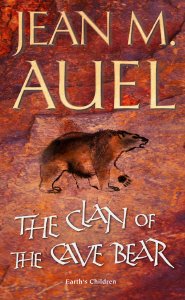
We met last night at Muntaj's house to discuss Jean Auel's The Clan of the Cave Bear and enjoy a nasi lemak supper.

It wasn't a book I'd wanted to read. Couldn't understand why I had such an adverse reaction to the title, only later realised it was probably because of the film poster of Daryl Hannah looking like Ozzy Osbourne.

The book tells the story of Ayla, a cro-magnon woman raised by a group of Neanderthals. Tall, blonde blue-eyed woman springs to the rescue of little ignorant brown people. A racist undertone, and a feminist agenda.

Most of the group enjoyed the book, Jessica (who lead the session) so much so that she's now gone tearing on to the sequels (bought in Times warehouse sale!).

There's no denying that Auel's book is a labour of love, and impressively researched. It is a bold and often fascinating attempt to reconstruct what life might have been like in prehistoric times. Most of us confessed to suffering from information overload at times, and many eyes skipped over yet another description of a herbal remedy. Some of us were bothered by not knowing where verifiable fact ended and fantasy began, and said we'd have rather read an authoritative non-fiction account of the Pleistocene period when different species of human beings co-existed. However, the book has definitely stirred the desire to know more in all of us.

New member Zen had us all laughing when she described Ayla as a Mary Sue - a term which originated in criticism of fan fiction to describe a character portrayed in an idealized way and lacking obvious flaws. Such characters project the wish fulfillment fantasies of the author.

Kumar, master of the soundbite, called the book "the world's oldest sexual harrassment case" and likened the novel to a film where thousands have been spent on special effects, but only a couple of dollars on the plot. We agreed with him that the story was predictable and terribly cliched.

I read halfway and found it a very easy breezy read. I know that a much younger self (14? 15?) would have enjoyed it very much and would have devoured the Earth 's Children series.

But Booksnob-self now kicks in and the thought of the Booker shortlisted titles sitting on my to-be-read shelf is pawing at my heart so I won't be reading on. (But I'm glad Jessica summarised the story of this book and the next for us!)

Started reading Kiran Desai's The Inheritance of Loss (for review) and am so relieved, after Auel, to be back reading beautiful writing.

Saturday, December 17, 2005

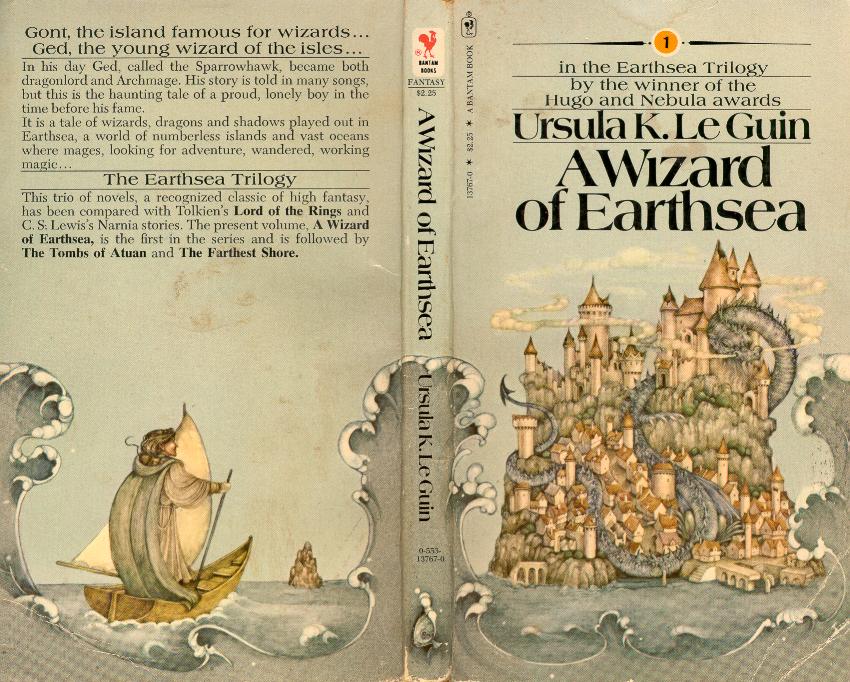
The Magician of Earthsea

Ursula Le Guin is amazed that critics find Rowling "wonderfully original" and complains that the writer "could have been more gracious about her predecessors". Her Earthsea quartet featured a school for wizards long before Potter was a twinkle in Rowling's eye.

As a fantasy writer, she learned that new worlds are not "so much invented as discovered". She says that she learned from Tolkein "... the trick of hinting at a whole background with a few names, so you'd feel situated in a real world, not a fantasy bubble."

She found C.S. Lewis less palatable: "simply Christian apologia, full of hatred and contempt for people who didn't agree."

And she lists works which she considers part of the lineage of modern fantasy writing: Shelley's Frankenstein and Phillip K. Dick, and also some more unlikely literary writers Jorge Luis Borges, Italo Calvino, Jose Saramago and Marquez. She says she was also influenced by Dickens and Tolstoy. "You have to shoot as high as you can shoot," she says. (Good advice this, for wanne-be fantasy writers nearer home!)

Read more about Le Guin's life and writing in today's Guardian. Her 20th novel, Gifts, now out kicks off a new fantasy series for young adults.

Tuesday, December 06, 2005

The Subtexts of Narnia

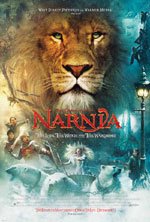
The film version of The Lion the Witch and the Wardrobe hits the big screen soon. Do I want to see it? Watched the trailer on TV and thought it had been very Lord-of-the-Ringsified. The version in my head is much gentler, painted in softer colours. And as I've said before, watching the film of the book often destroys my own vision of it.

C.S. Lewis was vehemently opposed to his books being filmed, particularly as he felt that "Anthropomorphic animals, when taken out of narrative into actual visibility, always turn into buffoonery or nightmare ...". Does Aslan keep his Christ-like dignity in the Disney version? We'll see.

When I read the books (at 11 or 12) I was unaware of the Christian subtext - they were just excellent stories. But Lewis was a committed Christian and did intend the tales to be allegorical.

Polly Toynbee in the Guardian points out that in the US the born-agains are using the film for their own ends, and suggests that this approach will backfire in more secular (atheistic) Britain.

Wednesday, September 28, 2005

Pulling In Pullman

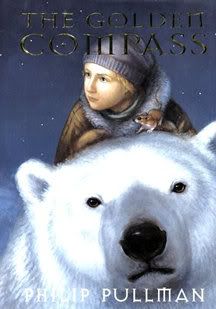
Fans of Philip Pullman's His Dark Materials trilogy will no doubt be thrilled to learn that Pullman will be a special guest of BBC World on 17th November. Pullman will be talking about the first novel in the series Northern Lights (called The Golden Compass in the US).

Your participation in the show is invited. If you'd like the BBC to record you asking your question, send an e-mail to worldbookclub@bbc.co.uk, remembering to include your telephone number.

Am I a fan? I read the trilogy with mixed feelings. Loved the parallel universe idea, Lyra's familiar yet strange Oxford, the animal companions who reflect the state of your soul (now what did he call them? - anyway I want one!), and wept buckets at the end of the final book. But talking polar bears, sorry, disbelief refused to be suspended quite that far.

Saturday, December 11, 2004

A Touch of Fantasy

Last night was invited to a reading at a private art gallery. (Wonderful art - wish i had money and walls enough!) I'd known Glenda for a number of years (as a birdwatcher and environmentalist.) Only learned that she wrote some months ago when I was on the phone to her about quite a different matter. I was sad I hadn't known, as I could have invited her to the Litfest. "I didn't think you were interested in fantasy writers," she said. Actually I'd have loved to welcome in writers from a whole range of genres ...

About Glenda

Turns out that she's published several titles (including The Tainted, Gilfeather and The Aware) in Australia, Britain (even making the best sellers list!) and now also in the US. And she's being translated into other languages.

She read from her trilogy - well-turned prose, and I'm curious to read more - and then talked about her experiences of being published (painful) and her life as a writer (3,000 words a day!). Realise that fantasy is a genre I've more or less neglected (last one I read was Philip Pullman's His Dark Materials trilogy).

Also interesting is the idea, and this is why I have to read them, that although she is writing about a fantasy world, there is a great deal in them about the state of things in Malaysia. Things that you wouldn't be able to say out loud in a more direct way.

Met some of my friends there. Keep hearing from folks who were involved in the Litfest last year "When's the next one going to be? We want to take part ... ." For which I have no easy answer. I want to help organise it, but ... let's politely say I'd like things to be managed differently.

Also met members of a book group I hadn't known previously existed. "We keep ourselves very quiet. We have eight members and we want to keep it that." So how long have they been going? "Oh ... about 35 years ...".

Felt a little ... jealous .. can't help it ... to see Glenda's husband Ramli taking photos, being so proud and supportive of her ...