Showing posts with label chinese authors. Show all posts

Wednesday, October 22, 2008

Bali Photos (1)

Here are some of my photos from Ubud. More to come. Sorry they are not great.

Am also trying to snaffle a few from friends who took pics on my behalf when my camera went walkies for two days.

Egyptian novelist, and one of the most respected writers in the Arab world, Bahaa Taher, was one of the big names at the festival. Bahaa won the Booker Prize for Arabic fiction earlier this year. (Do read Maya Jaggi's article about him in the Guardian.)

Chinese author Lijia Zhang worked for 10 years in a factory producing intercontinental ballistic missiles is Nanjing before becoming a journalist and writer. Her first book carries the ironic title Socialism is Great! (Read an extract on the New York Times website.) I have great hopes to coax this lady to KL!

Our Preeta paying gazillions of rupiah for a book.

Chiew-Siah with Chris Hanley (one of the founders of the Byron Bay Festival in Australia) who moderated the session called A Long Way From Home.

Shamini Flint launched her latest novel for children, The Seeds of Time about two children's quest to save the planet. All I remember of the event was the extremely potent cocktail made from local hooch. (If the picture is wobbly, you know the reason!).

Sunday, December 16, 2007

A Good Woman of China ... in Bali

In case you fancy a little literature with a Bali break in January! (Air Asia flights under RM200 one way at the moment.)

Here's more about Xinran.

Sunday, November 11, 2007

Novel of Mongolian Grasslands Wins Man Asian

Congrats to Jiang Rong, winner of the inaugural Man Asian Literary Prize.

Adrienne Clarkson, Chair of the judges described his Wolf Totem as :
A panoramic novel of life on the Mongolian grasslands during the Cultural Revolution, this masterly work is also a passionate argument about the complex interrelationship between nomads and settlers, animals and human beings, nature and culture. The slowly developing narrative is rendered in vivid detail and has a powerful cumulative effect. A book like no other. Memorable.
The novel is semi-autobiographical and written under a pseudonym: the author's true identity is not publicly known.

This about him from the Man Asian website:
Jiang Rong was born in Jiangsu, southern China, in 1946, and graduated from the middle school attached to China Art College in 1966. In 1967, Jiang joined the first wave of intellectuals who moved to the countryside as volunteers, living with nomadic communities on the Chinese border of Inner and Outer Mongolia for 11 years. Following his return to Beijing in 1978, Jiang embarked on postgraduate studies in political science at the renowned Chinese Academy of Social Sciences, and assumed an academic position at a Beijing university. Now retired, he lives in Beijing, with his wife.
He wins US$10,000, while his translator wins US3,000.

Update:

The Guardian has a very good piece on the book and names the author as Lu Jiamin. The book has already been a publishing sensation in China where:
...it has sold two million legal copies, along with an estimated 10 times that number of pirated books. It has been the subject of literary debates, management motivation courses and military training lectures.
Postscript:

Here's an interview with Jiang Rong from the Guardian.

Saturday, July 21, 2007

A Thrilling Challenge

Helen Brown in The Telegraph looks at the explosion of interest in the West in literature from China and lists some good reads.

However, literary agent Toby Eady sees the linguistic problem as the most serious barrier to Chinese fiction reaching the West :
How do we cross into Chinese as a language and as a way of thinking? There is but one way and that is literacy, an understanding of China through its history rather than a Western view of China's history. Good translation takes a long time, and cooperation between the author and translator. Few publishers have that time.

Thursday, December 07, 2006

Yiyun's Story

I'm cheering because Yiyun Li has won the Guardian First Book Award for A Thousand Years of Good Prayers. The prize is only the latest in a long list of awards the book has received - and deservedly so in my opinion. (Here's an extract from the first story in the book.)

Aida Edemariam interviews the writer in the Guardian - and her story is quite amazing: five years ago she struggling to learn to write in English in a US adult education class!

And I like the point she makes about not wanting to create an "exotic Asia" in her stories.
I think that happens, and I'm aware of it. But I don't buy it. I don't write for that reason. I'm not going to satisfy people's curiosity about exotic China, or exotic Asians. If I write a story, I write a story. I have to make sure it's a good story, and that I don't take any short cuts because it's about China. I feel I have a lot of Chinese stories I need to tell.
And I for one am looking forward to reading them.

Sarah Crown on the Guardian blog is rejoicing too:
For most of the second half of the 20th-century, short stories languished in literary no man's land - not long enough to qualify as "proper" novels, too long to pack poetry's punch. In recent years, however, they have enjoyed a much documented renaissance. It seems to me, when I look back over books that have come out over the last couple of years, that those which linger in my mind and that I've recommended again and again to friends have almost all been short story collections.

Monday, September 25, 2006

Looking for Local Voices!

"The world is hungry for books about the Asian experience,” says Toby Eady, but he stresses that authors need to tell stories set in the modern world. ... "Please, do not write another book about the second world war or Khartoum ... We don’t need to dwell in the past. Readers are ready for more. They are open to reading about the real Asia, the Asia that is in the present."
Daphne Lee interviews the literary agent with a particular interest in Asian writers, and Daniel Watts managing director of Pan Macmillan Asia which is employing Eady (right) to scout the new talent. Says Watts:
“We are looking for Asian voices – writers of contemporary novels. Toby is on board to help us source for Asian works of quality and we hope to build Picador Asia as a brand that is associated with Asian writing of a high literary standard.”
And adds:
The imprint will acquire and translate established works from China and other East Asian countries, but also hopes to discover new authors, Asian or otherwise, who can offer fresh insights and perspectives on Asian life.
Not so long ago the only choice was self-publish or find a small press locally and risk having no exposure for your fiction overseas, or compete in the overcrowded British or American market. Now it seems that a third path is opening up.

One of the writer's Eady has signed up is Fan Wu (left), author of February Flowers. Daphne interviews the author about her book. Eady and Watts were in Singapore for the launch of the novel.

Channel News Asia's Deepika Shetty blogs an account of the launch and of Wu's first TV interview. She's thrilled (as we all should be) at the news of PanMacmillan setting up Picador Asia. And in the interest of research, she also has dinner with Eady who tells her:
"I would love to see a book based in Malaysia - a love story."
Do I hear the sound of frantic scribbling?

(BTW You might also be interested in reading this earlier CNN interview with Eady.)

Thursday, August 24, 2006

Good Prayers, Great Stories

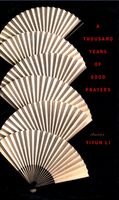
A Thousand Years of Good Prayers is Yiyun Li's highly acclaimed short story collection which won the inaugeral Frank O'Connor Short Story Award among others.

If proof were ever needed that US MFA programmes don't necessarily churn out writing clones, Li amply provides it. (She attended the famous Iowa Writer's Workshop). Her writing is fresh, lyrical - yet at times deeply disturbing. The short stories did precisely what short stories should do: illuminate small lives in telling snapshots, walk around in your head long after the few pages that contained them are read, shake you up.

It wasn't the best holiday reading - the collection made me feel weighted with melancholy for all the tangled lives Li depicts and the necessary makeshift compromises her characters are forced to make. I found it hard to snap out of the little worlds Li creates.

Most of the stories take place in a rural and small town China struggling with economic change and the move to a more free-market econonomy.

All human messiness is here. In Love in the Marketplace a schoolteacher obsessed with the film Casablanca, is the victim of a broken promise. A stranger who arrives in the market place offering to slash his arm with a knife for money is the only person who seems able to honour his word.

Extra is a hugely compassionate story about a middle-aged woman made redundant from her garment factory job. There's no way Granny Lin can survive on her dwindling savings and she reluctantly accepts a marriage of convenience to a sick old man. When he dies, she takes a job as a cleaner in a private school where she befriends a lonely little boy as much a reject as she is. Through both encounters, her eyes are opened for the first time in her life to the possibility and nature of love.

The Prince of Nebraska is the story of a complicated love triangle. Sasha, pregnant and on her way to an abortion clinic in Chicago seeks Boshen's help. Both of them are involved with the enigmatic Yang, a disgraced Chinese Opera singer. An unusual compromise is worked out between them for a love that does not fit neatly into the box of a conventional relationship.

But my favourite story - simply because I've come across a story narrated in this way before - was Persimmons. The slaying of local government officials puts a whole village under the curse of drought. The truth of what actually happened emerges gradually. Li writes the story in the first-person plural ("we") voice, as the whole doomed village speaks in one voice.

Would I recommend it?

I'd say it was a must-read, especially if you enjoy short-fiction or write it yourself. It deserved all the awards it received and is the best book I've read so far this year. (Sorry for gushing!)

If you want to read more about the author or the book, Yiyun Li has a website.

Wednesday, June 14, 2006

Smuggling Swans

I think China would be a healthier and stronger place if the truth were open to scrutiny. The Chinese have a right to know what happened to their country and I believe that Chinese society is ready to take this on because facing the truth can’t be as hard as living under him (Mao) ...
Jon Halliday, the historian husband of Jung Chang said to me when I interviewed the couple last year.

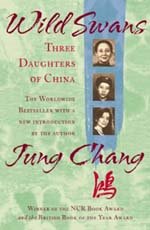
Now Chang's best selling biography Wild Swans: Three Daughters of China which tells the story of three generations of women (her grandmother, her mother, and herself) under Mao's regime has finally been translated into Chinese. Chang hopes that, despite the book being banned, copies will find their way into mainland China. Full story in the Guardian.

Sunday, August 07, 2005

The Untold Story

My telephone interview with Jung Chang and Jon Halliday in The Star today, alongside a review of their new books Mao: The Unknown Story by Phar Kim Beng.

Jung Chang’s new book (co-written with historian husband, Jon Halliday) grew from her own unanswered questions about the man who had so profoundly influenced her own life. “I didn’t know what he did exactly or how he came to power and I wanted to find out,” she says in a telephone interview. The couple found out a great deal more than they bargained for and Mao: The Unknown Story is the result of more than ten years of painstaking research.
.
“I didn’t know that there was this much new material,” says Chang “One piece of research just lead to another.” Chang carried out the research in China while Halliday, did the non-Chinese research. They delved into foreign archives and interviewed more than 100 people who had known Mao personally including members of his family, former colleagues and staff, heads of state and leading political figures. It was a process that was exhausting and both suffered from serious health problems along the way.

Their research turned up many surprises along the way. “The biggest shock,” says Chang “was about the great famine. We calculated that thirty-eight million people died. We thought initially that the economy was mismanaged, and that’s what I said in Wild Swans.” They were amazed to learn instead that “Mao had calculated the number of deaths as part of the plan to buy nuclear arms. Few in the world know that Mao’s single-minded pursuit of the weapons. He was ruthless and would not let the death of millions stand in his way.”

Halliday estimates that around 95% of the “really important stuff” they uncovered was from Russia, and he visited the country four times while they were researching the book “One file alone was a quarter of a million pages. There were tens of thousands of pages detailing for example, Mao’s first big purge and how his colleagues tried to leave him behind on the Long March. There were cables between Stalin and Mao towards the end of the civil war. And I got wonderful interviews with people who’d dealt with Mao during the 1950’s including Khrushchev’s interpreter ”

The most difficult archive to access was that of the Russian Foreign Ministry. Halliday says he was surprised at how much closer the relationship was with Russia than had been pretended, “By 1929 Stalin had identified Mao as the guy who was going to win and decided to back him. We were able to document that up to the hilt.”

I tell Halliday that the book has provoked some strong reactions in some of the online forums I’ve been reading. Some have accused Jung and Halliday of having “an obvious bias”. Someone else described the book as “unremittingly negative.’

Halliday seems quite upset by such accusations. “I dislike people saying we acted with ulterior motives. We did not set out with any agenda, just to write a well done comprehensive biography. We did a lot of hard work to get the details right and fair. We set out to answer questions, for example, what were Mao’s political decisions throughout his life? We did uncover a lot of new material and we found that his policy decisions were entirely consistent. We looked hard at everything he said in public and to his inner circle and in her research in China, Jung captured the real Mao.”

“In fact,” he goes on “We would welcome an open debate on the facts. But no-one so far has come up with any evidence to refute what we’ve said.”

Both agree that the success of Chang’s Wild Swans, opened doors for them which would otherwise have remained closed. “People in China were very keen to talk to Jung because she had written Wild Swans. It was thought that the book made people sympathetic to the Chinese. World statesmen were interested and agreed to see us including former presidents and I don’t think any of that would have happened without Wild Swans,” says Halliday.

I tell Chang that for all it’s meticulous research and careful scholarship, this is a surprisingly readable book.

“We tried very hard not to make the book dry,” says Chang adding that it was important to her to add a strong human interest angle. Particularly revealing, she says, is the way that Mao treated his wives with great callousness and indifference. It’s hard not to feel pity for Kai-Hui, Mao’s second wife, who was executed by nationalists in 1930. Chang was able to use a cache of letters that Kai-Hui had hidden behind a roof-beam before she was imprisoned. “She was abandoned with three children and he didn’t lift a hand to save her. He was completely indifferent. He didn’t care about her, the people or the party.”

With their new book poised to blow the myth of Mao apart, do they think that Chinese society is ready to take on a changed view of Mao?

Halliday thinks it unlikely though that the biography be available in China where Mao is still acknowledged as being “30% wrong but 70% right” in official parlance. “But I think China would be a healthier and stronger place if the truth were open to scrutiny. The Chinese have a right to know what happened to their country and I believe that Chinese society is ready to take this on because facing the truth can’t be as hard as living under him.”

“Mao was simply the most anti-Chinese person there’s ever been,” Halliday adds. The book makes a convincing case for that.

I was greatly impressed by the meticulous research that went into the book. Chang and Halliday had access to archives in Mainland China, Russia, Taiwan, Albania, USA, Great Britain, India and Germany. They interviewed over 100 people who knew Mao personally, as well as an impressive list of world leaders (including presidents Bush Snr. and Ford), and major political figues. This is scholarly work ... not the work of a couple who set out merely to grind an axe as some have implied. And it is extremely readable with plenty of human interest on the pages.

If the book is a catalyst for debate reassessment of China's history, then it will have done its job very well indeed.