Saturday, August 06, 2005

Those Who Can, Write; Those Who Can't, Edit

An article that makes important points about the role of the fiction editor.
Author Blake Morrison makes the point that:
A culture that doesn't care about editing is a culture that doesn't care about writing. And that has to be bad.

He argues that editors are an endangered species in the UK publishing industry. The intense collaborative process between author and editor that used to be a feature of the publishing industry no longer exists in Britain and "everyone from JK Rowling to David Eggers suffers from the lack of scissors that might have been to their benefit".

I must say I have to agree because I find myself yelling at many of the authors I read for various annoyances, length coming near the top of the list. (Not that yelling does much good now that the printed book is in my hand and I have spent the equivalent of ten good bowls of my favourite fishball noodle soup on it!)

Morrison says that because of the pressures they're under, modern-day editors simply don't have the time to edit and in some instances authors are encouraged to pay for the services of a freelance editor!

It's a truism, he says:
All writers need editors. So why isn't the matter more discussed?

Partly, as he says, because the contribution of editors:
...goes largely unacknowledged - a nod in the preface or a thank-you from the author at the launch party and that's it. They're the ghosts in the machine, the secret sharers, the anonymous power behind the throne.

And partly also because writers have done little to clarify the role of editors in their work ... unless the whole process has gone badly wrong for them.
Those who can, write; those who can't, edit - that seems to be the line. I prefer TS Eliot. Asked if editors were no more than failed writers, he replied: "Perhaps - but so are most writers."

There is too, he says the romantic image of the writer "as a solitary creative genius" and the editor as a "meddling middlebrow".

Morrison goes on to give examples of writer-editor partnerships which ensured the quality of some of the most important C20th classics - Sons and Lovers, The Waste Land and The Great Gatsby.

This lack of editorial assistance, he concludes, is probably what is fuelling the growth of creative writing programmes in Britain in recent years. Where else are writers going to get the help they need to improve their manuscripts?

And where, I wonder, are our Malaysian writers going to find the editorial help they need, because it seems to me that this is one of the most pressing issues for the local writing scene.

Books in Custody

The competition of find Britain's best reading group was recently won by a inmates of a prison. The Penguin/Orange Prize was awarded to the "book loving fools" of High Down Prison reading group, Surrey.
Image hosted by Photobucket.com

Loved the reaction from the one-male member of our group Fiction&Friends when I forwarded an article about the finalists:
"Am laughing out loud at the fact that the only all-male book club consists of a bunch of convicts. So that's how you get men to read. Take them out of the general population and lock them up!"

Why is it that women love to meet and talk books but men not?

Postscript:

Read about Nick Hornby's prison visit.

Friday, August 05, 2005

The Exotic Moon

And talking (as we do from time to time) of the exotic, of sterotypes, of conforming to expectations imposed from outside ... Loved this piece The Visitor posted today on his blog.

Write a Novel in a Month

This month's Writer's Circle meeting at MPH will be a little different. This from the MPH website:
The Writer's Circle: Write A Novel in A Month
A meeting for anyone interested in the idea of writing a novel in a month. (Yes, it is possible!) Also an invitation to take part in the largest creative writing competition on earth - the annual Nanowrimo. Last year 40 Malaysians took part with ten winners. This year we hope to encourage many more.
The fictionators are beginning to infiltrate and hopefully will take over the earth!

Chet and I have roped in other friends to talk about the Nanowrimo and their experience of doing the competition in previous years.

Last year was the first time I'd attempted it. But I had a lot of fun, made friends, learned a lot about myself as a writer, and ended up with some good material for the novel I'm writing. (Here's the entry I wrote just after I'd completed the Nano last year.)

I know an event is not for everyone. Someone on an e-group I belong to asked why we needed this and why can't we organise an event like this on our own? Good point and I hope that we will have more locally organised writing events. I have some ideas and I'm sure the readers of this blog have too. But this event is a great starting point to pull together folks who are interested in writing and first-time dabblers ... and maybe from this local involvement, the impetus for other local events will emerge. And besides, the infrastructure for the event is already set up - there's a website and bulletin boards and home pages and advice at the Nanowrimo website.

It would be very nice to get some schools and colleges participating too this time ... get 'em hooked and writing while they're young!

There may be folks who don't want to join the Nanowrimo but who are interested in the whole idea of writing a novel in a month, so the MPH meeting will be geared to that too.

Dunno if I will be able to write as much this time round. Last November was pretty free but this year I will be away at a conference in Manilla and then there's everything else I've taken on. But yes, even if I can't reach the 50,000 word target, shall be writing alongside everyone else to see how many words I can produce.

Anyway, if you're interested in joining us, then please register by calling MPH Customer Service at 03-7726 9003 or e-mail csoneutama@mph.com.my. There are limited seats.

And here's a book you might want to buy:

I saw autographed copies of it in MPH Midvalley yesterday!

Thursday, August 04, 2005

Gems in the Slush Pile

Zafar has linked to a very interesting article about how UK publishers are finding new talent in unexpected places. Go read.

Writing Rhythm

This was one of the mornings when I told myself I shouldn't come here at all. Too much to do. Two angry editors chasing me for stories that are well overdue. One of them reads this blog! All I can do is grin weakly and offer up these immortal words of Douglas Adams:

"I love deadlines. I love the whooshing sound they make as they go by."

What is it about deadlines that freezes the brain? I can come here without a single idea in my head about what I might write, and a topic pops up as soon as I touch the keys. I can chuck words out onto my blog pages at the speed of thought, and they sounds reasonable coherent when I read them back to myself. (Might be wrong there, but.)

I guess you have to find your own working rhythm. I have discovered that I write much more fluently first thing in the morning even before I'm fully awake. A half-dreaming mind has no problem finding the words it needs. These days I'm at the computer before 7, stealing a start on the day. I wish it wasn't true because I'd much rather wake up gently, drinking tea on the veranda and watching the antics of the wild life and cats and reading a novel. I write very happily too in the afternoon after a nap. Sleep seems to do the unlocking trick for me.

Wednesday, August 03, 2005

Blogging For A Cause

There was a nice article in the Youth section of the Star today about a young lady called Yvonne Foong, who drops by this blog to add comments from time to time because she's interested in all things writing. Yvonne suffers from a rare and incurable condition called neurofibromatosis which means that benign tumours keep growing in different parts of her body.

But rather than sit back and feel sorry for herself, Yvonne has turned writer and her book I'm Not sick, Just A Bit Unwell is due out at the end of November.


And she's blogging for charity on Saturday August 6th along with 14 Bullets author John Ling. You can read more about their joint venture in this article from Think Magazine Online.

Here's news of bloggers doing their part for charity by taking part in an international blogathon. Yvonne will be blogging with 14 Bullets author John Ling to raise money for Eden Handicap Service Centre.

I dropped by this morning to make my pledge at the Blogathon site, maybe you'd like to support them too.

Please contact Yvonne at her website if you'd like more information.

On Not Conforming to a Stereotype

Sometimes I wish my life had been more tragic ...
... writes Nigerian writer Doreen Baingana in this article from yesterday's Guardian.
This is because my audience expects me, as an African writer, to regale them with tales of hunger, war and catastrophe. ... felt as if I had been invited under false pretences. I should have been born in a poverty-stricken village, brutally circumcised with a blunt, unsanitised knife with other five-year-old girls, then, a few years later, kidnapped by child soldiers, becoming a sex slave of a rebel commander before escaping dramatically and trekking through the dry bush for miles and months until I was rescued by foreign aid workers, "rehabilitated" and adopted by a gracious American family. I would end up triumphant and grateful in the US and living to tell my story; which is, of course, a story worth telling.
Writers from the "developing world" are too often expected to support myopic western views of what their part of the world and their literature is supposed to be like: Africa is impoverished; Asia is "exotic"; all Latin-Americans write magical realism.

Baigana says that African writers should counterbalance the view of the continent given in media portrayals:
As an African writer, I pluck what I know and throw it into a pot with what I don't and what I conjure out of nothing and dreams. I shake in all sorts of spices, grains, water, salt and lies, African or not, and try to create a new stew with new flavours every time. I ask my audience to demand this much of me and other African writers. To expect so much more than yesterday's leftovers: the newspapers' diarrhoeic stream of problems and problematic stories. Let's imagine together all the possible and impossible ways individuals try to make sense of themselves and their worlds, African or otherwise.
I'm glad that she also questions that tired old label "postcolonial", so beloved of literature departments and used to describe literatures from all those parts of the globe that were once coloured pink.
Even here in cosmopolitan London last July, at events for the Caine Prize for African Writing, students and others posed questions within the same framework, using the word "postcolonial" like it was going out of style. I wish. Is there any other way we can view and talk about the multiplicities of the African experience? We need to, desperately.

Tuesday, August 02, 2005

International Young Publisher of the Year Award

We're looking for a Malaysian candidate for this award. (Yes, I'm wearing my British Council hat now!) Are you eligible? Or do you know someone who might be?
In 2006 the British Council will award the International Young Publisher of the Year (IYPY) award for the third time – to champion and celebrate the importance of creative entrepreneurs working in the international publishing sector – showcasing individual achievement and potential. The award will be promoted through the British Council’s international network of offices, focussing on transitional and developing economies.

IYPY is awarded in partnership with London Book Fair ), the largest publishing networking event in Europe in the spring.

For the purpose of the IYPY award participants can be from any of the following sectors:
• Publishing (including e-tailing and e-publishing)
• Agents
• Literary festivals
• Retailing

A participant should be:
• Aged between 25 and 35
• Already working within the publishing industry (as broadly defined above)
• Through their character, drive and abilities demonstrate their potential to be a future leader of the sector in their country
• Be entrepreneurial and have shown their ability to promote publishing in their country
• Have English language skills to IELTS 6 - ‘competent user’ or above.

A participant should not primarily be an academic, writer, author or poet.

The finalists will fly to the UK for a fourteen day visit; a tour of the national publishing industry which will culminate in attending the London Book Fair (5-7 march 2006). They will also have a chance to make a book 'pitch' to present a title from their country which they feel deserves to reach a wider international market.

There's a lot more information on the flyer I received, but by now you will have said to yourself "That sounds like me/my friend," or you will have sighed deeply because you'd love the opportunity, but don't fit the bill. (I wish I could enter!!!!!!)

If you fall into the first category, e-mail me at sbakar@streamyx.com and I will forward the information to you.

Representing Thailand on the Page

Interesting interview with Thai-American writer Rattawut Lapcharoensap in The Star today.

The article describes him as "a rare South-East Asian talent writing in English"
and I mentioned a day or two ago that he is one of the writers who will be at the Singapore Writers Festival. I picked up a copy of his collection of stories Sightseeing in Kinokuniya the other day.

A couple of soundbites from the interview regarding cultural identity and "exoticism":

I didn’t want to represent Thailand as hyper-exotic. As a teenager growing up in Bangkok, I couldn’t quite figure out what was so strange about Thailand and why people were travelling all this way to come to a place where I simply walked around malls every weekend. I wanted readers to see Thailand as a real place, with a kind of ordinariness about it.

There’s been some concern in the Thai-American community about the way Thais are represented in my book. Many feel that Thailand’s been (stereotyped as being rife with) sex, drugs and police corruption. The government’s strategy has been to portray this other Thailand: This land of smiles, a kind of sanitised Thailand, which doesn’t agree with my sense of how things are there either.

Read the rest of the interview here.

At Swim, One Ambassador

Last night there was a farewell for Dan (HE Mr Daniel Mulhall to give him full respectful title!), the Irish Ambassador and his wife, Greta at Silverfish before they head back to Dublin.

Dan has been a wonderful ambassador not only for the country, but also for literature in general and Irish literature in particular and James Joyce's Ulysses in particularest of all. I thank him sincerely for all the help and support he gave us for the Litfest.

A farewell for a word lover has to be a bookish one, so there were readings of poetry and prose from several.

But the piece I loved most was this poem that Dan read out right at the beginning of the gathering. This charming poem, translated from the Celtic by Robin Flowers, was written more than a thousand years ago by an unknown Irish Monk, in the margins of a copy of St Paul's Epistles. The poet sees himself as a student pursuing knowledge in much the same way that his cat Pangur Ban (which means White Cat), pursued mice.

Pangur Ban

I and Pangur Bán, my cat
'Tis a like task we are at;
Hunting mice is his delight
Hunting words I sit all night.

Better far than praise of men
'Tis to sit with book and pen;
Pangur bears me no ill will,
He too plies his simple skill.

'Tis a merry thing to see
At our tasks how glad are we,
When at home we sit and find
Entertainment to our mind.

Oftentimes a mouse will stray
In the hero Pangur's way:
Oftentimes my keen thought set
Takes a meaning in its net.

'Gainst the wall he sets his eye
Full and fierce and sharp and sly;
'Gainst the wall of knowledge I
All my little wisdom try.

When a mouse darts from its den,
O how glad is Pangur then!
O what gladness do I prove
When I solve the doubts I love!

So in peace our tasks we ply,
Pangur Bán, my cat, and I;
In our arts we find our bliss,
I have mine and he has his.

Practice every day has made
Pangur perfect in his trade;
I get wisdom day and night
Turning darkness into light.

I chose an extract from At Swim Two Boys by Jamie O'Neill, a gay love story set in Ireland shortly before the Easter uprisings. I knew that Dan hasn't got round to reading it yet, and that when he does, he will be blown away by the prose style. O'Neill takes the language of Joyce and just runs with it. Who couldn't love a writer who can craft a sentence like "A carillon of coins chinkled in his pocket."?

If you want a taste of the book, you can read the first chapter of the book here.

I think O'Neill is very much a "writer's writer" - just look at how he plays tricks with "point of view", moving inside the main character's head, and then out again, in alternating paragraphs.

Monday, August 01, 2005

Captured!

Image hosted by Photobucket.com

Image hosted by Photobucket.com


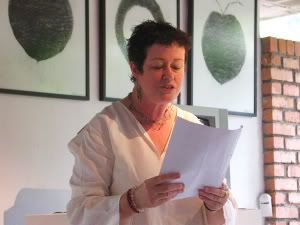
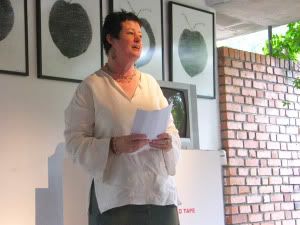
Thanks so much Nizam for taking the photos. I usually hate photos of me, but these are not too bad. There's another one on Nizam's fotoblog that's really scary so I haven't stolen that one. Do go and read some of Nizam's writing too ...

Sunday, July 31, 2005

Winning Wimmin!

Great to see so many friends turn up to support the readings at 67, Jalan Tempinis 1 yesterday. Seksen's place looked a little different with some very interesting installation art including a mobile of glass bottles stuffed with various colourful objects.

It was an afternoon of "wimmin" writers, readdressing the gender balance after the past few months when male writers tended to feature rather more. (Too many Kutus!)

In the end there were five of us reading. Sharanya Manivannan went first reading a beautiful poem about her relationship with her mother tongue, and a longer excerpt from "a novel in progress". Her writing is so sensual and languid and I'm glad that she's chosen for herself the larger framework of the novel. Have to pinch myself to remind myself how young she still is. (Yesterday was her 20th birthday!).

I read next. In the end I chose a piece I'd begun as a short story but plan to work into my own "novel-in-progress". Reading it aloud was an extremely useful experience - could hear how the audience collectively reacted to the words. And I was so pleased that they laughed in the parts where I had laughed when writing it.

Bernice then read a piece about a woman being physically assaulted by her lover. She used repetition and short sentences to skilfully control the emotional impact. Hope it grows into a longer piece.

It was Eileen Lui's first reading. (Bar of course for the launch of my anthology Collateral Damage.) As I've said before, I think she is a very good short story writer. Her two published stories are set in Vietnam, where she was working for some time. At The Gates, the story she read out, has a local setting and features two very elderly Chinese men reflecting on their pasts and worrying about their children. As with her earlier stories, characters emerge sharply from the dialogue, and background detail is worked in very carefully.

The final reader of the afternoon was Jac SM Kee who has recently completed Beth Yahp's creative writing course. She read several short pieces and an extract from a very quirky children's story Sammy and Me.

The only think that might have made me a little happier yesterday was some ice to put in my coca-cola ... it was a really hot afternoon with some serious sweating going on!

Comic Relief in War Time

My review in today's Star of Chong Seck Chim's Once Upon a Time in Malaya, an entertainment set mainly in KL's Chinatown around the time of the Japanese occupation.


The book provides many fine comic moments, has an excellent cast of minor characters and records an important part of Malaysia's social history and I did overall enjoy it. But I found it frustrating too ... if only Chong had gone that bit further and developed his main characters rather more, the book could have been excellent.

I met Chong at his booksigning at MPH Midvalley on the same afternoon as Tash Aw appeared there. I wonder if he is the oldest first-time author ever to be published - anywhere? He is 81, a retired diplomat and a reviewer for the New Straits Times. And I found him totally charming as I chatted to him while he signed my book. He says that this is the only novel he will ever write: he's now going to learn to cook and spend time in meditation.

Postscript (8/11/06):

Since the original is now behind subscription I'm posting it here:

The action in Chong Seck Chin’s Once Upon a Time in Malaya takes place around the time of the Japanese occupation, a time of great turbulence and change in the Malay Peninsula. Surprisingly then, the novel sets out to be “a tale of light relief ” (as Chong explains in an epigram): a comedy rather than a war story.

The story follows the fortunes of a young lad called Ah Kiew and those around him, during the war years. He lodges with his brother, Ah Sing, and his father (a traditional Chinese physician specializing in the treatment of piles) in the house of the twice-widowed Madam Tuck and her daughter Mei Li, in Kuala Lumpur’s Chinatown. Ah Kiew is about to sit for his Senior Cambridge and faces tough choices both about his future career path (he wonders whether to become a pastor or a clerk) and his love life. (Should he choose the more accommodating Mei Li or hold out for the haughty Shirley Howe of the ‘Scarlet O’Hara’ ringlets?).

But the Japanese invade, and decisions are very much taken out of his hands. After a brief spell hiding out in the tin mines of Ampang (during which time Ah Sing throws in his lot with the communists), Ah Kiew goes to work for Captain Tanaka in a Japanese army depot and begins to discover latent entrepreneurial skills which will determine his subsequent direction in life.

Chong writes very well and the novel cracks along at a fair old pace. He has an excellent vocabulary which borders on the bombastic at times, but his delightfully wry sense of humour tempers his excesses. Indeed, his turn of phrase often delights: Howe’s wife “bristled like a disturbed mimosa”. And when the cunning Mei Lin invites Ah Kiew to give her some help with her algebra (a request that does not fool him for a moment), Chong writes “Algebra had become abracadabra – or as a classic Chinese hack would have put it, prudishly, ‘A conjuncture of turbulent cloud and rain ensued.’”

The author is clearly most at home with those characters he can get greatest comic mileage from and pokes gentle fun at human vanity. Some of the funniest moments in the novel are between the avaricious Madam Tuck and the naïve sinseh Lim whom she sets about manipulating to her own ends both as a marriage and business partner.

Some of the minor characters are drawn with a deftness and economy that many more established writers would envy. Particularly amusing are Howe senior, an anglophile clerk of Baba extraction, with a love of “orotund legal phrases” and bowties; and Terry White, a spinster of Eurasian extraction, “one of those women whom looked better from the behind than from the front, and not many of her rearview admirers had survived the frontal deception”. The chapter in which Terry tries to ensnare her cousin Freddie with a love potion is hilarious and could stand by itself as a satisfying piece of short fiction!

Sadly, Ah Kiew emerges as a rather insipid character by comparison with these larger-than-life figures, and even the author seems to tire of him, allowing him less and less time on the page as the book goes on. And whereas we expect a stirring love story to develop when Ah Kiew and Shirley when they are thrown together during the war, (particularly as he spends so much time mooning over for her in the early chapters) the romance, such as it is, simply peters out without causing the reader to care very much either way.

While Chong writes comedy very well, he finds it much harder to create moments of real drama. The darker side of the Japanese invasion is almost completely ignored. Indeed, the reader is left with the impression that the war was a minor inconvenience to the inhabitants of Chinatown, who quickly learn to capitalize on the commercial opportunities it brought.

It also seems strange that while Chong can spend time lovingly sketching in background detail of, for example, the pharmacist’s shop or a group of Nonya ladies playing chiki, he fails to capitalize on some of the novel’s pivotal scenes. Ah Sing takes upon himself the task of murdering collaborator Ivan Ho, but in the chapter where his assassination attempt on is thwarted, Chong gives barely a paragraph to the shooting which leaves the lad seriously wounded. Similarly, much more suspense could have been worked into the scenes where Shirley and Ah Kiew decide to increase their fortunes in the gambling dens.

In the end, the novel largely succeeds at what it sets out to do: it does entertain and is a valuable social document, giving an intriguing insight into this particular period of history. However, it could have been so much more satisfying if both plot and main characters had been more fully developed. The reader comes away from the book feeling that the author ran out of steam before he ran out of things to say.

Saturday, July 30, 2005

The Book Project

It's great to hear about anyone providing encouragment for new writers locally. But isn't the whole point about publication that it performs a "gatekeeping" function, preventing the market being flooded by mediocre fiction?

Iolanda forwarded this article to me which she found in today's Sun newspaper about a woman who believes it is everyone's right to write and be published.

Image hosted by Photobucket.com

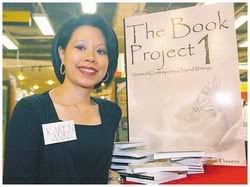
IT SEEMED - at least on the face of it - an impossible task. An unassuming former flight stewardess-turned-restauranteur, with no background in publishing, decides to source, edit and publish a collection of short stories, with the promise never to reject a single manuscript that comes her way.

A woolly fantasy? Tell that to Karen Ann Theseira, who has put her time and energy in getting her idea to bear fruit with the publication of her maiden effort, called The Book Project 1.

The idea for the project came to her two years ago, when Karen Ann, a self-confessed book lover who firmly believes everyone has a story to tell, wanted to find a way to encourage ordinary people to write.

The result is The Book Project 1 (published by Various Channel Marketing Sdn Bhd) which offers 23 original short stories from 21 writers in one collection.

Karen Ann herself contributed two short stories, Women (under the pen name Ira) and Dating Game in this compilation. The lanky lady, who is married to an engineer and currently resides in Johor Baru, has began working on the second volume, The Book Project 2.

Here's a link to the rest of the article by Bissme S. and his interview with Karen.

Friday, July 29, 2005

Toyols Steal the Reading Public

Interesting article in yesterdays New Straits Times about Malay reading habits. (Thanks again, Dina, for forwarding the link!)

Apparently Datuk Seri Abdullah Ahmad Badawi said during his adjournment speech at the Umno general assembly last week that the Malays are religious but tend to resign themselves to fate and can be very superstitious.

Syed Nadzri takes up the theme and relates it to the kinds of books and magazines favoured by the Malay Community:

... it is quite disconcerting to note that the cerita hantu or cerita toyol (creepy gothic stories) are among the most popular among Malay readers.

That is why some tabloids and magazines are cashing in on this craze by sensationalising with headlines such items as Kubur berasap (Smoke on the grave) or Mayat bertukar menjadi babi (Dead turns into pig).

They are certainly worse than the News of the World-type of stories about UFO sightings, Elvis alive and women giving birth to crocodiles.

Among the best-selling Malay storybooks not too long ago was the Bercakap Dengan Jin series (conversations with the spirits) by an author called Tamar Jalis.

His books were all about grisly tales and they were told in a not-so-tasteful language.

The books also have garish covers. Yet these were so popular that most were sold out the moment they hit the shelves.

I know an avid reader of the series. He would spend nights on end reading the books to the point that he always overslept and was often late for work.

One of the books he read was about a snake god and the snake man.

He must have liked this book because he read it over and over until one day when he came to me with a horrified look.

I asked him what was wrong and he said: "Please help me, please, please. I am going to turn into a snake tonight. I can feel it in my skin. And they are calling me."

When I asked who "they" were, he said: "My snake family."

To my horror, he was indeed writhing and squirming on the floor when night came, although he looked as human as ever. Things were never the same for the poor chap ever since.

This could be dismissed as a remote case of a good mind gone wrong.

Some magazines and tabloids even stretch the reader’s imagination by suggesting a twist to sicknesses suffered by somebody — as in "Artis dijangkiti penyakit misteri" (Singer down with mysterious illness) when there must be a medical explanation for the ailment.

It is no surprise, therefore, that the best-selling Malay reading materials are those featuring either these kinds of bizarre fare or those with sexy and gossipy elements.

All well and good. Everyone to his or her own taste. But what is really worrying is what Syed Nazri says at the end of the article:

Journals on current affairs, literary magazines or special interest periodicals in Bahasa Malaysia hardly sell. Massa, a political and current affairs news magazine, had to cease publication not too long ago, while Dewan Bahasa’s Dewan Masyarakat and Dewan Sastera are struggling.

Would be interested to hear your views.

Thursday, July 28, 2005

Readings from an Author in Progress

Bernice called me up the other day and asked me if I'd like to do a reading this Saturday p.m. at 67, Jalan Tempinis 1. Of course lah, quoth I. Didn't broadcast the news because I was waiting for her "official" e-mail before I blogged it.

I can now pass it on:-

this month we present an afternoon of wimmin writers

eileen lui
sharon bakar
sharanya manivannan
bernice chauly
jac sm kee
and more

place: 67 tempinis satu, lucky garden, bangsar
time: 3.30 pm
date: 30 july

come one and come all

readings is organized by bernice chauly and is proudly
supported by la bodega and 67tempinis satu.

see you there!!

Wimmin!

Well, I shall read some little snippets from my "novel-in-progress" which also feature "wimmin": Orchid stalking her rival in the gym; Iris hopelessly lost on the roads of Kay Hell; and Peramjit facing her class last lesson on a Friday afternoon.

Glad Eileen Lui is going to read. Her stories are very powerful, and her Chewing Gum Boy was in the anthology I edited. Sharanya's too. And hope "others" includes Muslin Abd. Hamid ...

If you're free, do drop in and join us.

Biar Papa Asal Bergaya

Talking as we were yesterday (thanks Animah!) about the outrageous price of books here in Malaysia, I thought this little quote from RuhayatX's article Well Stuff That which appears in the current edition of Rentakini was particularly appropriate.

Ruhayat applauds the Indonesian democratic spirit, and recounts a conversation with an Indonesian journalist in which:
She remarked on how food and books are dirt cheap in Indonesia but shopping is not, whereas here it's the other way around: food and books are expensive while shopping is cheap.

I thought that was good to know. At the very least, it means even our poor will still look stylish as they lie starving and ignorant in their huts.

South of the Border, West of the Lit World

How strange it is that Malaysia and Singapore are neighbours, share so much in common culturally and yet we often don't know what is going on down there. Thanks, Dina for passing on information about the Singapore Writers Festival 2005 which runs from 26th August-4th September 2005. Here's the blurb about it from the website:
The Singapore Writers Festival celebrates the power of the written word! Aimed at inspiring great writing and nurturing a greater understanding and appreciation of the literary arts, the Festival is set to carve out a bold new trail on the literary stage with its exciting programme line-up. In the spirit of great literature, the Festival offers over 80 events by 63 writers. The events range from talks, readings, panel discussions, workshops, master classes, performances, film screenings to book launches and author signings. Broadening its scope this year to include popular genres such as Crime, Science Fiction and Fantasy as well as Graphic Novels, the Festival has something for everyone to enjoy. Singapore Writers Festival 2005 has attracted a galaxy of writing stars. Some of our stellar names from the literary world include Manju Kapur from India, Peter Goldsworthy and Doris Pilkington from Australia, Nuri Vittachi from Hong Kong, Goenawan Mohamed from Indonesia, Yu Hua from China. Our award-winning authors from the genre of Science Fiction and Fantasy include Bruce Sterling, Robert J. Sawyer, Norman Spinrad, Cory Doctorow, Juliet Marillier, Jennifer Fallon. The Festival also presents rising stars from the Asia-Pacific literary scene such as Ouyang Yu and Kathryn Fox from Australia, Wei Hui from China, Ayu Utami from Indonesia, Tarun Tejpal from India, Rattawut Lapcharoensap from Thailand, Cyril Wong, Tan Hwee Hwee and Gerrie Lim from Singapore and Amir Muhamad from Malaysia. Interesting line up. A couple of names jump out at me. Wei Hui is the infamous author of Shanghai Babyand Thai/American writer Rattawut Lapcharoensap's collection of short stories Sightseeing has won a great deal of critical acclaim.
And it's nice to see Ayu Utami in the line up. She was one of the most interesting speakers at our own Litfest last year. I also like the way that the festival doesn't only cater just for the lovers of literary fiction: there are science fiction and fantasy writers, as well as sessions about writing cookbooks, graphic novels and blogging. The programme is not up yet but I will be checking back frequently. And yes, I think I'm going to be going down to catch as much of it as I can.

Wednesday, July 27, 2005

Harry Potter and Quickbuck Pirates

I told you we'd soon be seeing pirated Potters. This from today's Malay Mail. It will be interesting to see if Bloomsbury take action against the pirates. Or is there someone much bigger behind this scam?
Pirated copies of Harry Potter and the Half-Blood Prince, have found their way here and are selling like magic at a fraction of the original cost.

The genuine hardcover books retail for RM99.90 each while the bootleg paperback versions are sold at RM48; slightly less than half the price of the original.

The pirated versions, at a glance, appear similar to the originals except that they are paperback versions. The originals are only available in hardcover.

The laminated cover features the same illustrations as the original.

Following a tip-off, The Malay Mail visited a bookstore on the ground floor of Tesco hypermarket in Puchong yesterday, and purchased a copy.

The store, selling mostly Chinese magazines and books, had a bookcase near the entrance, where several pirated copies were displayed.

The lone cashier claimed ignorance when asked why the books were in paperback and sold at half the price of the originals.

She declined to reveal where the books were obtained from and the number sold so far.

The shop has been in operation for more than a year.

Meanwhile, an industry source said the pirates are reaping a huge profit.

According to the source, the average cost of printing a 607- page paperback of that size would cost around S$5 (RM11.25) at the most.

Meanwhile, a spokesman for Pansing Distributors, the sole distributor of Harry Potter books in Malaysia and Singapore, said they were unable to comment on the matter as they were awaiting approval from Bloomsbury, the publisher.

In the first 24 hours of its release on July 16, Harry Potter and the Half-Blood Prince sold 6.9 million copies in the US and more than two million in Britain, smashing all previous sales records of Harry Potter books.

The book has already become a victim of piracy in India, where pirated copies flooded the streets of Mumbai two days after the book’s launch.

A race has also begun in China, where the People’s Literature Publishing House is frantically attempting to release the Chinese version of the book before the pirates do.